maintenance GMC ACADIA 2009 User Guide
[x] Cancel search | Manufacturer: GMC, Model Year: 2009, Model line: ACADIA, Model: GMC ACADIA 2009Pages: 420, PDF Size: 2.23 MB
Page 274 of 420
Parking on Hills
{CAUTION
Parking the vehicle on a hill with
the trailer attached can be
dangerous. If something goes
wrong, the rig could start to move.
People can be injured, and both
the vehicle and the trailer can be
damaged. When possible, always
park the rig on a at surface.
If parking the rig on a hill:
1. Press the brake pedal, but do
not shift into P (Park) yet.
Turn the wheels into the curb if
facing downhill or into traffic
if facing uphill.
2. Have someone place chocks
under the trailer wheels.
3. When the wheel chocks are in
place, release the brake pedal
until the chocks absorb the load.4. Reapply the brake pedal. Then
apply the parking brake and
shift the transmission into
P (Park).
5. Release the brake pedal.
Leaving After Parking
on a Hill
1. Apply and hold the brake pedal
while you:
start the engine,
shift into a gear, and
release the parking brake.
2. Let up on the brake pedal.
3. Drive slowly until the trailer is
clear of the chocks.
4. Stop and have someone pick up
and store the chocks.
Maintenance When Trailer
Towing
The vehicle needs service more
often when pulling a trailer.
SeeScheduled Maintenance on
page 6-3for more information.
Things that are especially important
in trailer operation are automatic
transmission uid, engine oil,
axle lubricant, belts, cooling system
and brake system. It is a good
idea to inspect these before and
during the trip.
Check periodically to see that all
hitch nuts and bolts are tight.
Trailer Wiring Harness
The vehicle is equipped with the
following wiring harness for towing
a trailer.
4-32 Driving Your Vehicle
Page 278 of 420
When It Is Time for
New Tires.......................5-48
Buying New Tires.............5-49
Different Size Tires and
Wheels............................5-50
Uniform Tire Quality
Grading...........................5-51
Wheel Alignment and
Tire Balance....................5-53
Wheel Replacement..........5-53
Tire Chains.......................5-54
If a Tire Goes Flat............5-55
Tire Sealant and
Compressor Kit...............5-56
Tire Sealant and
Compressor Kit Storage. . .5-68
Changing a Flat Tire.........5-69
Removing the Spare Tire
and Tools........................5-69
Removing the Flat Tire
and Installing the
Spare Tire
.......................5-72
Secondary Latch System. . .5-76
Storing a Flat or Spare
Tire and Tools.................5-78
Compact Spare Tire..........5-81
Appearance Care
Interior Cleaning................5-81
Fabric/Carpet....................5-83
Leather.............................5-83
Instrument Panel, Vinyl,
and Other Plastic
Surfaces
..........................5-84
Care of Safety Belts.........5-84
Weatherstrips....................5-84
Washing Your Vehicle.......5-84
Cleaning Exterior
Lamps/Lenses.................5-85
Finish Care.......................5-85
Windshield, Backglass,
and Wiper Blades............5-86
Aluminum or
Chrome-Plated
Wheels and Trim
.............5-86
Tires.................................5-87
Sheet Metal Damage........5-87
Finish Damage..................5-88
Underbody Maintenance. . . .5-88
Chemical Paint Spotting. . . .5-88
Vehicle Identication
Vehicle Identication
Number (VIN)..................5-88
Service Parts
Identication Label...........5-89
Electrical System
High Voltage Devices
and Wiring......................5-89
Add-On Electrical
Equipment.......................5-89
Windshield Wiper Fuses. . . .5-90
Power Windows and
Other Power Options.......5-90
Fuses and Circuit
Breakers.........................5-90
Instrument Panel Fuse
Block...............................5-90
Underhood Fuse Block......5-92
Capacities and
Specications
Capacities and
Specications..................5-96
5-2 Service and Appearance Care
Page 280 of 420
Doing Your Own
Service Work
{CAUTION
You can be injured and the
vehicle could be damaged if you
try to do service work on a vehicle
without knowing enough about it.
Be sure you have sufficient
knowledge, experience, the
proper replacement parts, and
tools before attempting any
vehicle maintenance task.
Be sure to use the proper
nuts, bolts, and other
fasteners. English and metric
fasteners can be easily
confused. If the wrong
fasteners are used, parts
can later break or fall off.
You could be hurt.If doing some of your own service
work, use the proper service
manual. It tells you much more
about how to service the vehicle
than this manual can. To order
the proper service manual,
seeService Publications Ordering
Information on page 7-15.
This vehicle has an airbag system.
Before attempting to do your
own service work, seeServicing
Your Airbag-Equipped Vehicle
on page 1-59.
Keep a record with all parts receipts
and list the mileage and the date
of any service work performed. See
Maintenance Record on page 6-16.
Adding Equipment to the
Outside of the Vehicle
Things added to the outside of the
vehicle can affect the airow
around it. This can cause wind
noise and can affect fuel economy
and windshield washer performance.
Check with your dealer/retailer
before adding equipment to
the outside of the vehicle.
5-4 Service and Appearance Care
Page 281 of 420
Fuel
Use of the recommended fuel
is an important part of the proper
maintenance of this vehicle. To help
keep the engine clean and maintain
optimum vehicle performance, we
recommend the use of gasoline
advertised as TOP TIER Detergent
Gasoline.
Gasoline Octane
Use regular unleaded gasoline with
a posted octane rating of 87 or
higher. If the octane rating is less
than 87, you might notice an audible
knocking noise when you drive,
commonly referred to as spark
knock. If this occurs, use a gasoline
rated at 87 octane or higher as
soon as possible. If you are using
gasoline rated at 87 octane or higher
and you hear heavy knocking, the
engine needs service.
Gasoline Specications
At a minimum, gasoline
should meet ASTM specication
D 4814 in the United States or
CAN/CGSB-3.5 or 3.511 in Canada.
Some gasolines contain an
octane-enhancing additive called
methylcyclopentadienyl manganese
tricarbonyl (MMT). We recommend
against the use of gasolines
containing MMT. SeeAdditives on
page 5-5for additional information.
California Fuel
If the vehicle is certied to meet
California Emissions Standards,
it is designed to operate on fuels
that meet California specications.
See the underhood emission control
label. If this fuel is not available in
states adopting California emissions
standards, the vehicle will operate
satisfactorily on fuels meeting federal
specications, but emission controlsystem performance might be
affected. The malfunction indicator
lamp could turn on and the vehicle
might fail a smog-check test. See
Malfunction Indicator Lamp on
page 3-41. If this occurs, return to
your authorized dealer/retailer for
diagnosis. If it is determined that the
condition is caused by the type of
fuel used, repairs might not be
covered by the vehicle warranty.
Additives
To provide cleaner air, all gasolines
in the United States are now required
to contain additives that help prevent
engine and fuel system deposits
from forming, allowing the emission
control system to work properly.
In most cases, you should not have
to add anything to the fuel. However,
some gasolines contain only the
minimum amount of additive required
to meet U.S. Environmental
Protection Agency regulations.
Service and Appearance Care 5-5
Page 291 of 420
Engine Air Cleaner/Filter
When to Inspect the Engine
Air Cleaner/Filter
Inspect the air cleaner/lter at the
MaintenanceIIintervals and replace
it at the rst oil change after each
50,000 mile (80 000 km) interval.
SeeScheduled Maintenance on
page 6-3for more information. If you
are driving in dusty/dirty conditions,
inspect the lter at each engine oil
change.
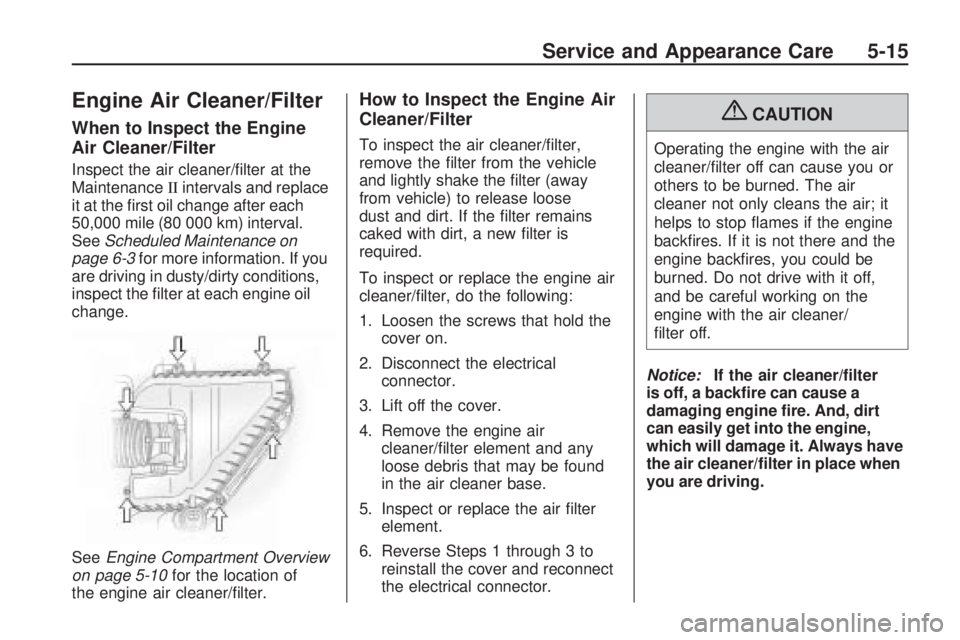
SeeEngine Compartment Overview
on page 5-10for the location of
the engine air cleaner/lter.
How to Inspect the Engine Air
Cleaner/Filter
To inspect the air cleaner/lter,
remove the lter from the vehicle
and lightly shake the lter (away
from vehicle) to release loose
dust and dirt. If the lter remains
caked with dirt, a new lter is
required.
To inspect or replace the engine air
cleaner/lter, do the following:
1. Loosen the screws that hold the
cover on.
2. Disconnect the electrical
connector.
3. Lift off the cover.
4. Remove the engine air
cleaner/lter element and any
loose debris that may be found
in the air cleaner base.
5. Inspect or replace the air lter
element.
6. Reverse Steps 1 through 3 to
reinstall the cover and reconnect
the electrical connector.
{CAUTION
Operating the engine with the air
cleaner/lter off can cause you or
others to be burned. The air
cleaner not only cleans the air; it
helps to stop ames if the engine
backres. If it is not there and the
engine backres, you could be
burned. Do not drive with it off,
and be careful working on the
engine with the air cleaner/
lter off.
Notice:If the air cleaner/lter
is off, a backre can cause a
damaging engine re. And, dirt
can easily get into the engine,
which will damage it. Always have
the air cleaner/lter in place when
you are driving.
Service and Appearance Care 5-15
Page 304 of 420
Battery
This vehicle has a maintenance free
battery. When it is time for a new
battery, see your dealer/retailer
for one that has the replacement
number shown on the original
battery’s label.
For battery replacement, see your
dealer/retailer or the service manual.
To purchase a service manual,
seeService Publications Ordering
Information on page 7-15.
Warning:Battery posts, terminals,
and related accessories contain
lead and lead compounds,
chemicals known to the State of
California to cause cancer and
reproductive harm. Wash hands
after handling.
Vehicle Storage
{CAUTION
Batteries have acid that can burn
you and gas that can explode.
You can be badly hurt if you are
not careful. SeeJump Starting
on page 5-28for tips on working
around a battery without
getting hurt.
Infrequent Usage: If the vehicle is
driven infrequently, remove the
black, negative (−) cable from the
battery. This helps keep the battery
from running down.
Extended Storage: For extended
storage of the vehicle, remove
the black, negative (−) cable from
the battery or use a battery
trickle charger. This helps maintain
the charge of the battery over
an extended period of time.
Jump Starting
If the vehicle’s battery has run
down, you may want to use another
vehicle and some jumper cables
to start your vehicle. Be sure to use
the following steps to do it safely.
{CAUTION
Batteries can hurt you. They can
be dangerous because:
They contain acid that can
burn you.
They contain gas that can
explode or ignite.
They contain enough
electricity to burn you.
If you do not follow these steps
exactly, some or all of these
things can hurt you.
5-28 Service and Appearance Care
Page 309 of 420
All-Wheel Drive
It is recommended that the all-wheel
drive lubricants be checked and
lled by the dealer/retailer.
When to Check Lubricant
Refer to the Maintenance Schedule
to determine how often to check
the lubricant. SeeScheduled
Maintenance on page 6-3.
Headlamp Aiming
Headlamp aim has been preset at
the factory and should need no
further adjustment.
However, if your vehicle is damaged
in a crash, the headlamp aim may
be affected. Aim adjustment to
the low-beam headlamps may be
necessary if oncoming drivers ash
their high-beam headlamps at
you (for vertical aim).
If the headlamps need to be
re-aimed, it is recommended that
you take the vehicle to your
dealer/retailer for service.
Bulb Replacement
For the proper type of replacement
bulbs, seeReplacement Bulbs
on page 5-34.
For any bulb changing procedure
not listed in this section, contact
your dealer/retailer.
Halogen Bulbs
{CAUTION
Halogen bulbs have pressurized
gas inside and can burst if you
drop or scratch the bulb. You or
others could be injured. Be sure
to read and follow the instructions
on the bulb package.
Service and Appearance Care 5-33
Page 310 of 420
License Plate Lamp
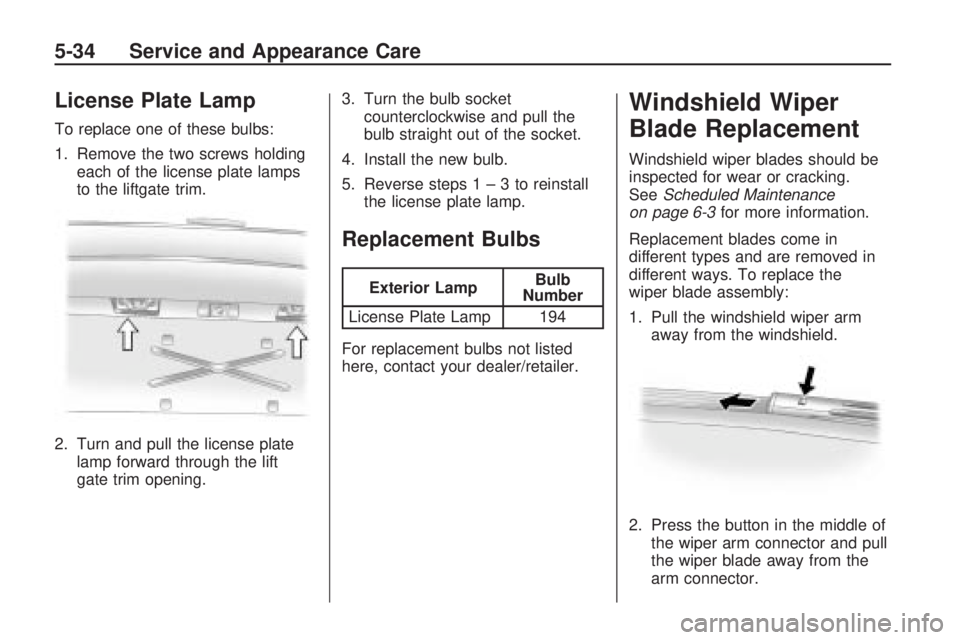
To replace one of these bulbs:
1. Remove the two screws holding
each of the license plate lamps
to the liftgate trim.
2. Turn and pull the license plate
lamp forward through the lift
gate trim opening.3. Turn the bulb socket
counterclockwise and pull the
bulb straight out of the socket.
4. Install the new bulb.
5. Reverse steps1–3toreinstall
the license plate lamp.
Replacement Bulbs
Exterior LampBulb
Number
License Plate Lamp 194
For replacement bulbs not listed
here, contact your dealer/retailer.
Windshield Wiper
Blade Replacement
Windshield wiper blades should be
inspected for wear or cracking.
SeeScheduled Maintenance
on page 6-3for more information.
Replacement blades come in
different types and are removed in
different ways. To replace the
wiper blade assembly:
1. Pull the windshield wiper arm
away from the windshield.
2. Press the button in the middle of
the wiper arm connector and pull
the wiper blade away from the
arm connector.
5-34 Service and Appearance Care
Page 311 of 420
3. Install the new wiper blade and
make sure the wiper blade
locks into place.
For the proper size and type see
Maintenance Replacement Parts on
page 6-14.
Backglass Wiper Blade
To replace the backglass wiper
blade:
1. Pull the wiper blade assembly
away from the backglass.
The backglass wiper blade will
not lock in a vertical position
so care should be used when
pulling it away from the vehicle.
2. Rotate the wiper blade assembly,
hold the wiper arm in position,
and push the blade away
from the wiper arm.
3. Replace the wiper blade.
4. Return the wiper arm and blade
assembly to the rest position on
the glass.
Tires
Your new vehicle comes with
high-quality tires made by a
leading tire manufacturer.
If you ever have questions about
your tire warranty and where to
obtain service, see your vehicle
Warranty booklet for details.
For additional information refer
to the tire manufacturer.
{CAUTION
Poorly maintained and
improperly used tires are
dangerous.
Overloading your
vehicle’s tires can cause
overheating as a result
of too much exing. You
could have an air-out and
a serious accident. See
Loading the Vehicle on
page 4-16.
(Continued)
CAUTION (Continued)
Underinated tires pose
the same danger as
overloaded tires. The
resulting accident could
cause serious injury.
Check all tires frequently to
maintain the recommended
pressure. Tire pressure
should be checked when
your vehicle’s tires are
cold. SeeInflation - Tire
Pressure on page 5-41.
Overinated tires are more
likely to be cut, punctured,
or broken by a sudden
impact — such as when
you hit a pothole. Keep
tires at the recommended
pressure.
Worn, old tires can cause
accidents. If the tire’s tread
is badly worn, or if your
vehicle’s tires have been
damaged, replace them.
Service and Appearance Care 5-35
Page 319 of 420
Accordingly, when the low tire
pressure telltale illuminates, you
should stop and check your tires as
soon as possible, and inate them to
the proper pressure. Driving on a
signicantly under-inated tire
causes the tire to overheat and can
lead to tire failure. Under-ination
also reduces fuel efficiency and
tire tread life, and may affect the
vehicle’s handling and stopping
ability.
Please note that the TPMS is
not a substitute for proper tire
maintenance, and it is the driver’s
responsibility to maintain correct tire
pressure, even if under-ination
has not reached the level to trigger
illumination of the TPMS low tire
pressure telltale.
Your vehicle has also been
equipped with a TPMS malfunction
indicator to indicate when the system
is not operating properly. The TPMS
malfunction indicator is combined
with the low tire pressure telltale.When the system detects a
malfunction, the telltale will ash for
approximately one minute and then
remain continuously illuminated.
This sequence will continue upon
subsequent vehicle start-ups as
long as the malfunction exists.
When the malfunction indicator is
illuminated, the system may not be
able to detect or signal low tire
pressure as intended. TPMS
malfunctions may occur for a variety
of reasons, including the installation
of replacement or alternate tires or
wheels on the vehicle that prevent
the TPMS from functioning properly.
Always check the TPMS malfunction
telltale after replacing one or more
tires or wheels on your vehicle to
ensure that the replacement or
alternate tires and wheels allow
the TPMS to continue to function
properly.
SeeTire Pressure Monitor Operation
on page 5-44for additional
information.Federal Communications
Commission (FCC) and
Industry and Science Canada
The Tire Pressure Monitor
System (TPMS) operates on a
radio frequency and complies
with Part 15 of the FCC Rules.
Operation is subject to the following
two conditions:
1. This device may not cause
harmful interference.
2. This device must accept any
interference received, including
interference that may cause
undesired operation.
The TPMS operates on a radio
frequency and complies with
RSS-210 of Industry and Science
Canada. Operation is subject to
the following two conditions:
1. This device may not cause
interference.
2. This device must accept any
interference received, including
interference that may cause
undesired operation of the device.
Service and Appearance Care 5-43