oil GMC ACADIA 2009 User Guide
[x] Cancel search | Manufacturer: GMC, Model Year: 2009, Model line: ACADIA, Model: GMC ACADIA 2009Pages: 420, PDF Size: 2.23 MB
Page 177 of 420
Turn off all unnecessary accessories
to allow the battery to recharge.
The normal battery voltage range is
11.5 to 15.5 volts.
CHANGE ENGINE OIL SOON
This message displays when
the engine oil needs to be changed.
When you change the engine oil,
be sure to reset the CHANGE
ENGINE OIL SOON message.
SeeEngine Oil Life System
on page 5-13for information on how
to reset the message. SeeEngine
Oil on page 5-11andScheduled
Maintenance on page 6-3for more
information.
CHECK TIRE PRESSURE
On vehicles with the Tire Pressure
Monitor System (TPMS), this
message displays when the
pressure in one or more of the
vehicle’s tires needs to be checked.
This message also displays LEFT
FRONT, RIGHT FRONT, LEFT
REAR, or RIGHT REAR to indicate
which tire needs to be checked.You can receive more than one tire
pressure message at a time.
To read the other messages that
may have been sent at the
same time, press the set/reset
button or the trip odometer reset
stem. If a tire pressure message
appears on the DIC, stop as soon as
you can. Have the tire pressures
checked and set to those shown on
the Tire Loading Information
label. SeeTires on page 5-35,
Loading the Vehicle on page 4-16,
andInflation - Tire Pressure on
page 5-41. The DIC also shows the
tire pressure values. See “DIC
Operation and Displays (With DIC
Buttons)” earlier in this section. If the
tire pressure is low, the low tire
pressure warning light comes
on. SeeTire Pressure Light on
page 3-41.
CRUISE SET TO XXX
This message displays whenever
the cruise control is set. SeeCruise
Control on page 3-9for more
information.
DRIVER DOOR OPEN
This message displays and a chime
sounds if the driver door is not
fully closed and the vehicle is shifted
out of P (Park). Stop and turn off
the vehicle, check the door for
obstructions, and close the door
again. Check to see if the message
still appears on the DIC.
ENGINE HOT A/C (Air
Conditioning) OFF
This message displays when the
engine coolant becomes hotter than
the normal operating temperature.
SeeEngine Coolant Temperature
Gage on page 3-40. To avoid added
strain on a hot engine, the air
conditioning compressor
automatically turns off. When the
coolant temperature returns to
normal, the air conditioning
compressor turns back on. You can
continue to drive your vehicle.
Instrument Panel 3-57
Page 180 of 420
OIL PRESSURE LOW STOP
ENGINE
Notice:If you drive your vehicle
while the engine oil pressure
is low, severe engine damage
may occur. If a low oil pressure
warning appears on the Driver
Information Center (DIC), stop the
vehicle as soon as possible.
Do not drive the vehicle until the
cause of the low oil pressure
is corrected. SeeEngine Oil on
page 5-11for more information.
This message displays if low
oil pressure levels occur. Stop the
vehicle as soon as safely possible
and do not operate it until the cause
of the low oil pressure has been
corrected. Check the oil as soon as
possible and have your vehicle
serviced by your dealer/retailer.
SeeEngine Oil on page 5-11.
PARK ASSIST OFF
If your vehicle has the Ultrasonic
Rear Parking Assist (URPA) system,
after the vehicle has been started
and shifted out of P (Park), this
message displays to remind the
driver that the URPA system has
been turned off. Press the set/reset
button or the trip odometer reset
stem to acknowledge this message
and clear it from the DIC display.
To turn the URPA system back on,
seeUltrasonic Rear Parking Assist
(URPA) on page 2-34.
PASSENGER DOOR OPEN
This message displays and a chime
sounds if the passenger door is
not fully closed and the vehicle is
shifted out of P (Park). Stop and turn
off the vehicle, check the door for
obstructions, and close the door
again. Check to see if the message
still appears on the DIC.
REMOTE KEY LEARNING
ACTIVE
This message displays while you
are matching a Remote Keyless
Entry (RKE) transmitter to your
vehicle. See “Matching
Transmitter(s) to Your Vehicle”
underRemote Keyless Entry (RKE)
System Operation on page 2-3
andDIC Operation and Displays
(With DIC Buttons) on page 3-46or
DIC Operation and Displays
(Without DIC Buttons) on page 3-51
for more information.
REPLACE BATTERY IN
REMOTE KEY
This message displays if a Remote
Keyless Entry (RKE) transmitter
battery is low. The battery needs to
be replaced in the transmitter.
See “Battery Replacement” under
Remote Keyless Entry (RKE)
System Operation on page 2-3.
3-60 Instrument Panel
Page 201 of 420
system, depending on media
type and format ranges from
5 to 20 seconds for a CD, and up to
30 seconds for a DVD to begin
playing).
If the ignition or radio is turned off,
while a CD is in the player, it stays in
the player. When the ignition or radio
is turned on, the CD starts playing
where it stopped, if it was the last
selected audio source. The CD is
controlled by the buttons on the
radio faceplate or by the RSA unit.
SeeRear Seat Audio (RSA) on
page 3-118for more information.
The DVD/CD decks, (upper slot is
the DVD deck and the lower slot is
the CD deck) of the radio are
compatible with most audio CDs,
CD-R, CD-RW, and MP3/WMAs.
When a CD is inserted, the text label
DVD or CD symbol displays on
the left side of the radio display.
As each new track starts to play,
the track number displays.Care of CDs and DVDs
If playing a CD-R, the sound quality
can be reduced due to CD-R or
CD-RW quality, the method
of recording, the quality of the music
that has been recorded, and the
way the CD-R or CD-RW has been
handled. Handle them carefully.
Store CD-R(s) or CD-RW(s) in their
original cases or other protective
cases and away from direct sunlight
and dust. The CD or DVD player
scans the bottom surface of the disc.
If the surface of a CD is damaged,
such as cracked, broken, or
scratched, the CD does not play
properly or not at all. Do not touch
the bottom side of a CD while
handling it; this could damage the
surface. Pick up CDs by grasping
the outer edges or the edge of
the hole and the outer edge.
If the surface of a CD is soiled, take
a soft, lint free cloth or dampen a
clean, soft cloth in a mild, neutral
detergent solution mixed with water,and clean it. Make sure the wiping
process starts from the center
to the edge.
Care of the CD and DVD Player
Do not add any label to a CD, it could
get caught in the CD or DVD player.
If a CD is recorded on a personal
computer and a description label is
needed, try labeling the top of the
recorded CD with a marking pen.
The use of CD lens cleaners for
CDs is not advised, due to the risk
of contaminating the lens of the
CD optics with lubricants internal to
the CD and DVD player mechanism.
Notice:If a label is added to
a CD, or more than one CD is
inserted into the slot at a time,
or an attempt is made to play
scratched or damaged CDs, the
CD player could be damaged.
While using the CD player, use
only CDs in good condition
without any label, load one CD at a
time, and keep the CD player and
the loading slot free of foreign
materials, liquids, and debris.
Instrument Panel 3-81
Page 254 of 420
Before Leaving on a
Long Trip
To prepare your vehicle for a long
trip, consider having it serviced
by your dealer/retailer before
departing.
Things to check on your own
include:
Windshield Washer Fluid:
Reservoir full? Windows
clean — inside and outside?
Wiper Blades:In good shape?
Fuel, Engine Oil, Other Fluids:All
levels checked?
Lamps:Do they all work and are
lenses clean?
Tires:Are treads good? Are tires
inated to recommended
pressure?
Weather and Maps:Safe to
travel? Have up-to-date maps?
Highway Hypnosis
Always be alert and pay attention
to your surroundings while driving.
If you become tired or sleepy,
nd a safe place to park your
vehicle and rest.
Other driving tips include:
Keep the vehicle well ventilated.
Keep interior temperature cool.
Keep your eyes moving — scan
the road ahead and to the sides.
Check the rearview mirror and
vehicle instruments often.
Hill and Mountain Roads
Driving on steep hills or through
mountains is different than driving
on at or rolling terrain. Tips for
driving in these conditions include:
Keep the vehicle serviced
and in good shape.
Check all uid levels and brakes,
tires, cooling system, and
transmission.
Going down steep or long hills,
shift to a lower gear.
{CAUTION
If you do not shift down, the
brakes could get so hot that they
would not work well. You would
then have poor braking or even
none going down a hill. You could
crash. Shift down to let the engine
assist the brakes on a steep
downhill slope.
4-12 Driving Your Vehicle
Page 274 of 420
Parking on Hills
{CAUTION
Parking the vehicle on a hill with
the trailer attached can be
dangerous. If something goes
wrong, the rig could start to move.
People can be injured, and both
the vehicle and the trailer can be
damaged. When possible, always
park the rig on a at surface.
If parking the rig on a hill:
1. Press the brake pedal, but do
not shift into P (Park) yet.
Turn the wheels into the curb if
facing downhill or into traffic
if facing uphill.
2. Have someone place chocks
under the trailer wheels.
3. When the wheel chocks are in
place, release the brake pedal
until the chocks absorb the load.4. Reapply the brake pedal. Then
apply the parking brake and
shift the transmission into
P (Park).
5. Release the brake pedal.
Leaving After Parking
on a Hill
1. Apply and hold the brake pedal
while you:
start the engine,
shift into a gear, and
release the parking brake.
2. Let up on the brake pedal.
3. Drive slowly until the trailer is
clear of the chocks.
4. Stop and have someone pick up
and store the chocks.
Maintenance When Trailer
Towing
The vehicle needs service more
often when pulling a trailer.
SeeScheduled Maintenance on
page 6-3for more information.
Things that are especially important
in trailer operation are automatic
transmission uid, engine oil,
axle lubricant, belts, cooling system
and brake system. It is a good
idea to inspect these before and
during the trip.
Check periodically to see that all
hitch nuts and bolts are tight.
Trailer Wiring Harness
The vehicle is equipped with the
following wiring harness for towing
a trailer.
4-32 Driving Your Vehicle
Page 277 of 420
Service and
Appearance Care
Service
Service...............................5-3
Accessories and
Modications.....................5-3
California Proposition 65
Warning............................5-3
California Perchlorate
Materials Requirements.....5-3
Doing Your Own
Service Work....................5-4
Adding Equipment to the
Outside of the Vehicle......5-4
Fuel
Fuel....................................5-5
Gasoline Octane.................5-5
Gasoline Specications.......5-5
California Fuel....................5-5
Additives.............................5-5
Fuels in Foreign
Countries..........................5-6
Filling the Tank...................5-7
Filling a Portable Fuel
Container..........................5-8
Checking Things
Under the Hood
Checking Things Under
the Hood..........................5-9
Hood Release.....................5-9
Engine Compartment
Overview.........................5-10
Engine Oil.........................5-11
Engine Oil Life System.....5-13
Engine Air Cleaner/Filter. . .5-15
Automatic Transmission
Fluid................................5-16
Cooling System.................5-16
Engine Coolant.................5-17
Engine Overheating...........5-21
Overheated Engine
Protection
Operating Mode
...............5-23
Power Steering Fluid.........5-23
Windshield Washer Fluid. . .5-24
Brakes..............................5-25
Battery..............................5-28
Jump Starting...................5-28
All-Wheel Drive
All-Wheel Drive.................5-33
Headlamp Aiming
Headlamp Aiming..............5-33
Bulb Replacement
Bulb Replacement.............5-33
Halogen Bulbs..................5-33
License Plate Lamp..........5-34
Replacement Bulbs...........5-34
Windshield Wiper
Blade Replacement
Windshield Wiper Blade
Replacement...................5-34
Tires
Tires.................................5-35
Tire Sidewall Labeling.......5-36
Tire Terminology and
Denitions.......................5-38
Ination - Tire Pressure. . . .5-41
Tire Pressure Monitor
System............................5-42
Tire Pressure Monitor
Operation........................5-44
Tire Inspection and
Rotation..........................5-47
Service and Appearance Care 5-1
Page 282 of 420
To help keep fuel injectors and
intake valves clean, or if the vehicle
experiences problems due to dirty
injectors or valves, look for gasoline
that is advertised as TOP TIER
Detergent Gasoline. Also, your
dealer/retailer has additives that
will help correct and prevent most
deposit-related problems.
Gasolines containing oxygenates,
such as ethers and ethanol, and
reformulated gasolines might be
available in your area. We
recommend that you use these
gasolines, if they comply with the
specications described earlier.
However, E85 (85% ethanol) and
other fuels containing more than
10% ethanol must not be used in
vehicles that were not designed for
those fuels.Notice:This vehicle was not
designed for fuel that contains
methanol. Do not use fuel
containing methanol. It can
corrode metal parts in the fuel
system and also damage plastic
and rubber parts. That damage
would not be covered under
the vehicle warranty.
Some gasolines that are
not reformulated for low
emissions can contain an
octane-enhancing additive called
methylcyclopentadienyl manganese
tricarbonyl (MMT); ask the attendant
where you buy gasoline whether the
fuel contains MMT. We recommend
against the use of such gasolines.
Fuels containing MMT can reduce
the life of spark plugs and the
performance of the emission
control system could be affected.
The malfunction indicator lamp
might turn on. If this occurs, return
to your dealer/retailer for service.Fuels in Foreign
Countries
If you plan on driving in another
country outside the United States or
Canada, the proper fuel might be
hard to nd. Never use leaded
gasoline or any other fuel not
recommended in the previous text
on fuel. Costly repairs caused
by use of improper fuel would not
be covered by the vehicle warranty.
To check the fuel availability, ask an
auto club, or contact a major oil
company that does business in the
country where you will be driving.
5-6 Service and Appearance Care
Page 285 of 420
Checking Things
Under the Hood
{CAUTION
An electric fan under the hood
can start up and injure you even
when the engine is not running.
Keep hands, clothing, and tools
away from any underhood
electric fan.
{CAUTION
Things that burn can get on hot
engine parts and start a re.
These include liquids like fuel, oil,
coolant, brake uid, windshield
washer and other uids, and
plastic or rubber. You or others
could be burned. Be careful not to
drop or spill things that will burn
onto a hot engine.
Hood Release
To open the hood, do the following:
1. Pull the hood release handle with
this symbol on it. It is located
under the instrument panel
on the driver’s side of the vehicle.
2. At the front of the vehicle, pull up
on the center of the hood, and
push the secondary hood release
to the right.
3. After you have partially lifted the
hood, gas struts will automatically
take over to lift and hold the
hood in the fully open position.Before closing the hood, be sure all
ller caps are on properly.
Pull the hood down to close. Lower
the hood until the lifting pressure of
the strut is reduced. Then allow the
hood to fall and latch into place
under its own weight. Check to make
sure the hood is closed. If the hood
does not fully latch, gently push the
hood down at the front and center
of the hood until it is completely
latched.
Service and Appearance Care 5-9
Page 287 of 420
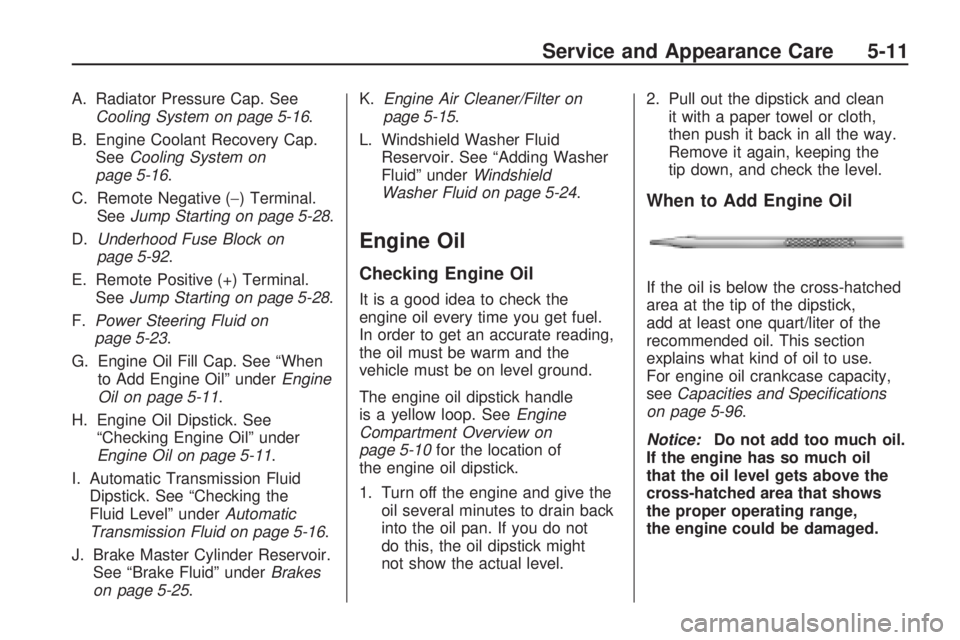
A. Radiator Pressure Cap. See
Cooling System on page 5-16.
B. Engine Coolant Recovery Cap.
SeeCooling System on
page 5-16.
C. Remote Negative (−) Terminal.
SeeJump Starting on page 5-28.
D.Underhood Fuse Block on
page 5-92.
E. Remote Positive (+) Terminal.
SeeJump Starting on page 5-28.
F.Power Steering Fluid on
page 5-23.
G. Engine Oil Fill Cap. See “When
to Add Engine Oil” underEngine
Oil on page 5-11.
H. Engine Oil Dipstick. See
“Checking Engine Oil” under
Engine Oil on page 5-11.
I. Automatic Transmission Fluid
Dipstick. See “Checking the
Fluid Level” underAutomatic
Transmission Fluid on page 5-16.
J. Brake Master Cylinder Reservoir.
See “Brake Fluid” underBrakes
on page 5-25.K.Engine Air Cleaner/Filter on
page 5-15.
L. Windshield Washer Fluid
Reservoir. See “Adding Washer
Fluid” underWindshield
Washer Fluid on page 5-24.
Engine Oil
Checking Engine Oil
It is a good idea to check the
engine oil every time you get fuel.
In order to get an accurate reading,
the oil must be warm and the
vehicle must be on level ground.
The engine oil dipstick handle
is a yellow loop. SeeEngine
Compartment Overview on
page 5-10for the location of
the engine oil dipstick.
1. Turn off the engine and give the
oil several minutes to drain back
into the oil pan. If you do not
do this, the oil dipstick might
not show the actual level.2. Pull out the dipstick and clean
it with a paper towel or cloth,
then push it back in all the way.
Remove it again, keeping the
tip down, and check the level.
When to Add Engine Oil
If the oil is below the cross-hatched
area at the tip of the dipstick,
add at least one quart/liter of the
recommended oil. This section
explains what kind of oil to use.
For engine oil crankcase capacity,
seeCapacities and Specifications
on page 5-96.
Notice:Do not add too much oil.
If the engine has so much oil
that the oil level gets above the
cross-hatched area that shows
the proper operating range,
the engine could be damaged.
Service and Appearance Care 5-11
Page 288 of 420
SeeEngine Compartment Overview
on page 5-10for the location of
the engine oil ll cap.
Add enough oil to put the level
somewhere in the proper operating
range in the cross-hatched area.
Push the dipstick all the way back
in when you are through.
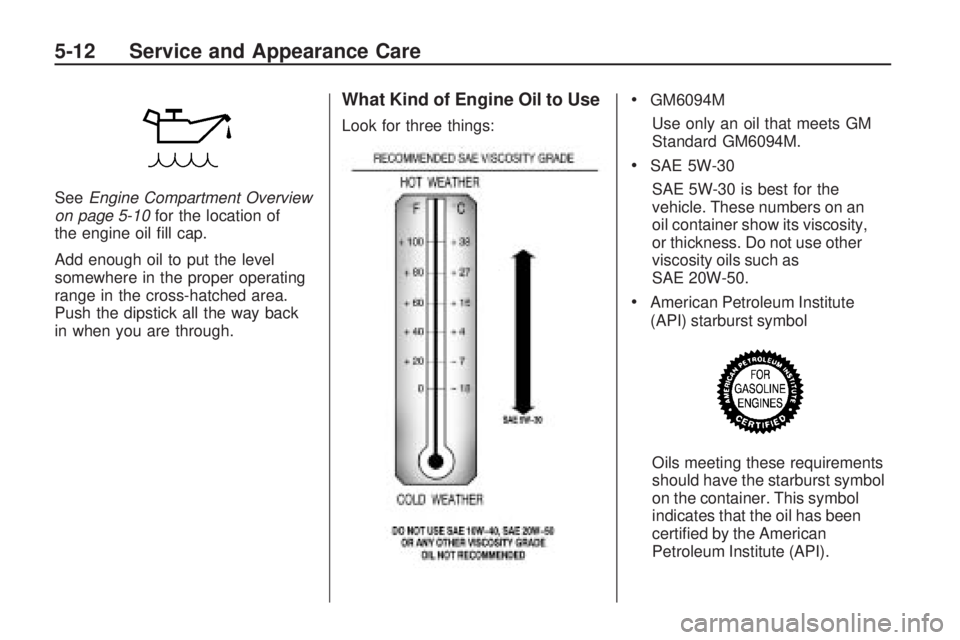
What Kind of Engine Oil to Use
Look for three things:
GM6094M
Use only an oil that meets GM
Standard GM6094M.
SAE 5W-30
SAE 5W-30 is best for the
vehicle. These numbers on an
oil container show its viscosity,
or thickness. Do not use other
viscosity oils such as
SAE 20W-50.
American Petroleum Institute
(API) starburst symbol
Oils meeting these requirements
should have the starburst symbol
on the container. This symbol
indicates that the oil has been
certied by the American
Petroleum Institute (API).
5-12 Service and Appearance Care