power steering GMC ACADIA 2009 User Guide
[x] Cancel search | Manufacturer: GMC, Model Year: 2009, Model line: ACADIA, Model: GMC ACADIA 2009Pages: 420, PDF Size: 2.23 MB
Page 287 of 420
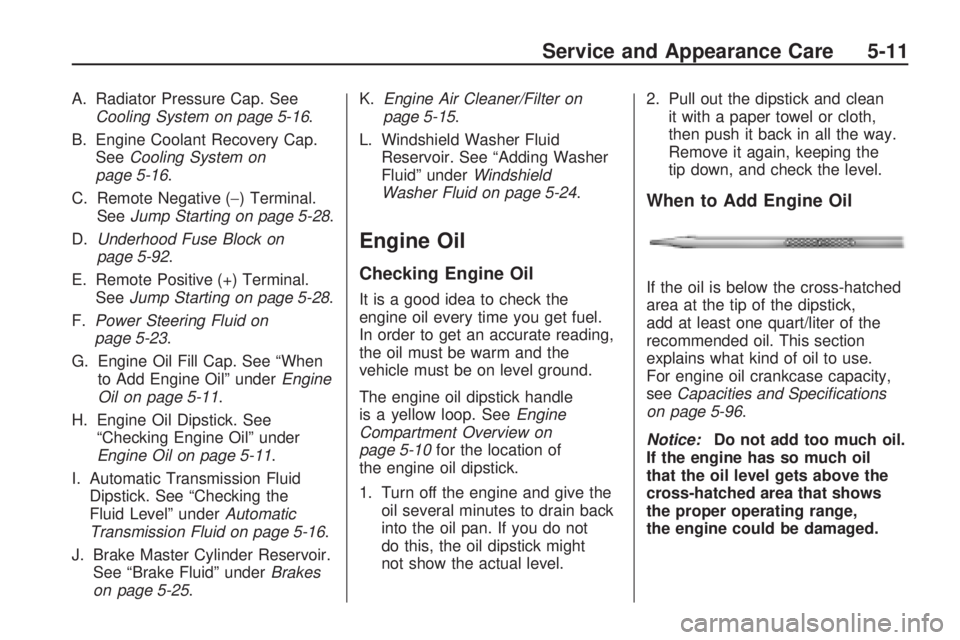
A. Radiator Pressure Cap. See
Cooling System on page 5-16.
B. Engine Coolant Recovery Cap.
SeeCooling System on
page 5-16.
C. Remote Negative (−) Terminal.
SeeJump Starting on page 5-28.
D.Underhood Fuse Block on
page 5-92.
E. Remote Positive (+) Terminal.
SeeJump Starting on page 5-28.
F.Power Steering Fluid on
page 5-23.
G. Engine Oil Fill Cap. See “When
to Add Engine Oil” underEngine
Oil on page 5-11.
H. Engine Oil Dipstick. See
“Checking Engine Oil” under
Engine Oil on page 5-11.
I. Automatic Transmission Fluid
Dipstick. See “Checking the
Fluid Level” underAutomatic
Transmission Fluid on page 5-16.
J. Brake Master Cylinder Reservoir.
See “Brake Fluid” underBrakes
on page 5-25.K.Engine Air Cleaner/Filter on
page 5-15.
L. Windshield Washer Fluid
Reservoir. See “Adding Washer
Fluid” underWindshield
Washer Fluid on page 5-24.
Engine Oil
Checking Engine Oil
It is a good idea to check the
engine oil every time you get fuel.
In order to get an accurate reading,
the oil must be warm and the
vehicle must be on level ground.
The engine oil dipstick handle
is a yellow loop. SeeEngine
Compartment Overview on
page 5-10for the location of
the engine oil dipstick.
1. Turn off the engine and give the
oil several minutes to drain back
into the oil pan. If you do not
do this, the oil dipstick might
not show the actual level.2. Pull out the dipstick and clean
it with a paper towel or cloth,
then push it back in all the way.
Remove it again, keeping the
tip down, and check the level.
When to Add Engine Oil
If the oil is below the cross-hatched
area at the tip of the dipstick,
add at least one quart/liter of the
recommended oil. This section
explains what kind of oil to use.
For engine oil crankcase capacity,
seeCapacities and Specifications
on page 5-96.
Notice:Do not add too much oil.
If the engine has so much oil
that the oil level gets above the
cross-hatched area that shows
the proper operating range,
the engine could be damaged.
Service and Appearance Care 5-11
Page 299 of 420
Overheated Engine
Protection
Operating Mode
This emergency operating mode lets
the vehicle be driven to a safe place
in an emergency situation. If an
overheated engine condition exists,
an overheat protection mode which
alternates ring groups of cylinders
helps prevent engine damage. In this
mode, there is a signicant loss in
power and engine performance.
The temperature gage indicates an
overheat condition exists. Driving
extended distances and/or towing a
trailer in the overheat protection
mode should be avoided.
Notice:After driving in the
overheated engine protection
operating mode, to avoid engine
damage, allow the engine to
cool before attempting any repair.
The engine oil will be severely
degraded. Repair the cause
of coolant loss, change the oil
and reset the oil life system.
SeeEngine Oil on page 5-11.
Power Steering Fluid
The power steering uid reservoir
is located toward the front of the
engine compartment on the
passenger side of the vehicle.
SeeEngine Compartment Overview
on page 5-10for reservoir location.
When to Check Power
Steering Fluid
It is not necessary to regularly
check power steering uid unless
you suspect there is a leak in
the system or you hear an unusual
noise. A uid loss in this system
could indicate a problem. Have the
system inspected and repaired.
How to Check Power Steering
Fluid
To check the power steering uid:
1. Turn the key off and let the
engine compartment cool down.
2. Remove engine oil ll cap.
3. Slide engine cover rearward and
lift to remove.
4. Wipe the cap and the top of the
reservoir clean.
5. Unscrew the cap and wipe the
dipstick with a clean rag.
6. Replace the cap and completely
tighten it.
7. Remove the cap again and look
at the uid level on the dipstick.
The uid level should be somewhere
between MAX and MIN line on the
dipstick in room temperature. If the
uid is on or below MIN line, you
should add uid close to MAX Line.
Service and Appearance Care 5-23
Page 314 of 420
Tire Size
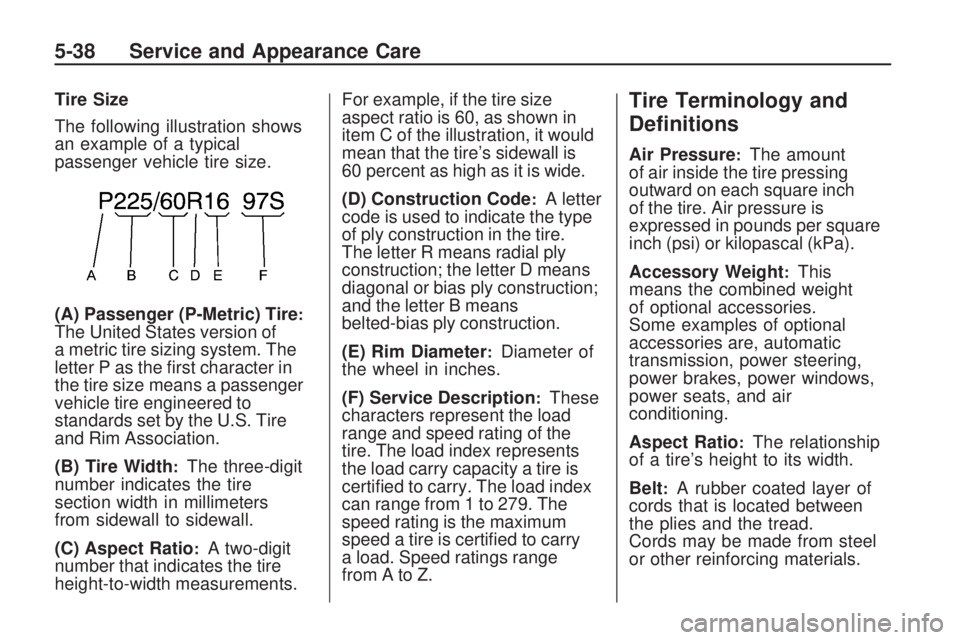
The following illustration shows
an example of a typical
passenger vehicle tire size.
(A) Passenger (P-Metric) Tire
:The United States version of
a metric tire sizing system. The
letter P as the rst character in
the tire size means a passenger
vehicle tire engineered to
standards set by the U.S. Tire
and Rim Association.
(B) Tire Width
:The three-digit
number indicates the tire
section width in millimeters
from sidewall to sidewall.
(C) Aspect Ratio
:A two-digit
number that indicates the tire
height-to-width measurements.For example, if the tire size
aspect ratio is 60, as shown in
item C of the illustration, it would
mean that the tire’s sidewall is
60 percent as high as it is wide.
(D) Construction Code
:A letter
code is used to indicate the type
of ply construction in the tire.
The letter R means radial ply
construction; the letter D means
diagonal or bias ply construction;
and the letter B means
belted-bias ply construction.
(E) Rim Diameter
:Diameter of
the wheel in inches.
(F) Service Description
:These
characters represent the load
range and speed rating of the
tire. The load index represents
the load carry capacity a tire is
certied to carry. The load index
can range from 1 to 279. The
speed rating is the maximum
speed a tire is certied to carry
a load. Speed ratings range
fromAtoZ.
Tire Terminology and
Denitions
Air Pressure:The amount
of air inside the tire pressing
outward on each square inch
of the tire. Air pressure is
expressed in pounds per square
inch (psi) or kilopascal (kPa).
Accessory Weight
:This
means the combined weight
of optional accessories.
Some examples of optional
accessories are, automatic
transmission, power steering,
power brakes, power windows,
power seats, and air
conditioning.
Aspect Ratio
:The relationship
of a tire’s height to its width.
Belt
:A rubber coated layer of
cords that is located between
the plies and the tread.
Cords may be made from steel
or other reinforcing materials.
5-38 Service and Appearance Care
Page 367 of 420
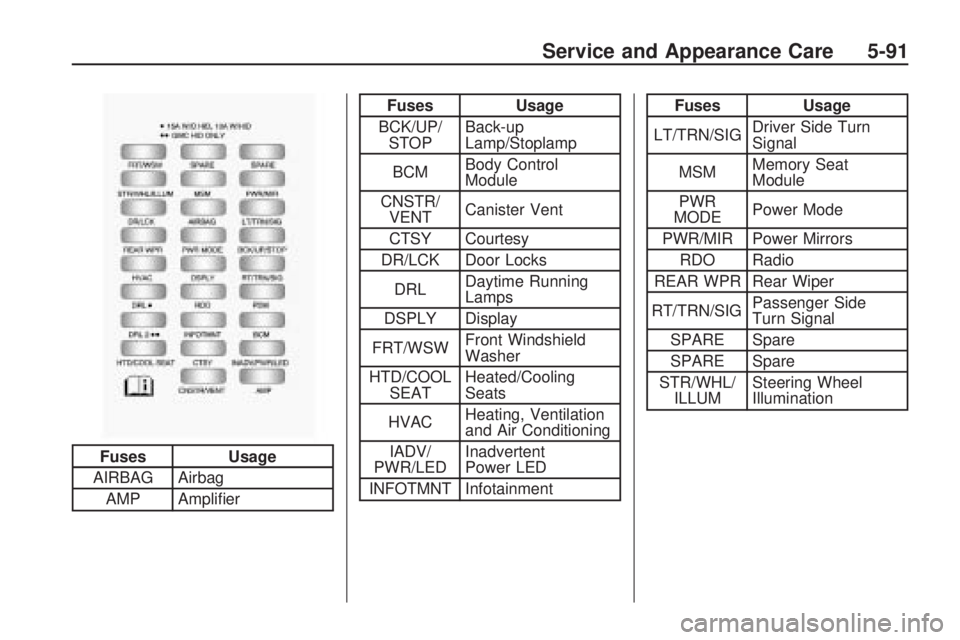
Fuses Usage
AIRBAG Airbag
AMP Amplier
Fuses Usage
BCK/UP/
STOPBack-up
Lamp/Stoplamp
BCMBody Control
Module
CNSTR/
VENTCanister Vent
CTSY Courtesy
DR/LCK Door Locks
DRLDaytime Running
Lamps
DSPLY Display
FRT/WSWFront Windshield
Washer
HTD/COOL
SEATHeated/Cooling
Seats
HVACHeating, Ventilation
and Air Conditioning
IADV/
PWR/LEDInadvertent
Power LED
INFOTMNT InfotainmentFuses Usage
LT/TRN/SIGDriver Side Turn
Signal
MSMMemory Seat
Module
PWR
MODEPower Mode
PWR/MIR Power Mirrors
RDO Radio
REAR WPR Rear Wiper
RT/TRN/SIGPassenger Side
Turn Signal
SPARE Spare
SPARE Spare
STR/WHL/
ILLUMSteering Wheel
Illumination
Fuse Side
Service and Appearance Care 5-91
Page 368 of 420

Relays Usage
LT/PWR/
SEATDriver Side Power
Seat Relay
RT/PWR/
SEATPassenger Side
Power Seat Relay
Relays Usage
PWR/
WNDWPower Windows
Relay
PWR/
COLUMNPower Steering
Column Relay
L/GATE Liftgate Relay
LCK Power Lock Relay
REAR/WSWRear Window
Washer Relay
UNLCK Power Unlock Relay
DRL2Daytime Running
Lamps 2 Relay
LT/UNLCKDriver Side Unlock
Relay
DRLDaytime Running
Lamps Relay
SPARE Spare
FRT/WSWFront Windshield
Washer RelayUnderhood Fuse Block
The underhood fuse block is located
in the engine compartment, on
the passenger side of the vehicle.
Lift the cover for access to the
fuse/relay block.
Notice:Spilling liquid on any
electrical components on
the vehicle may damage it.
Always keep the covers on
any electrical component.
To remove fuses, hold the end of the
fuse between your thumb and index
nger and pull straight out. Relay Side
5-92 Service and Appearance Care
Page 379 of 420
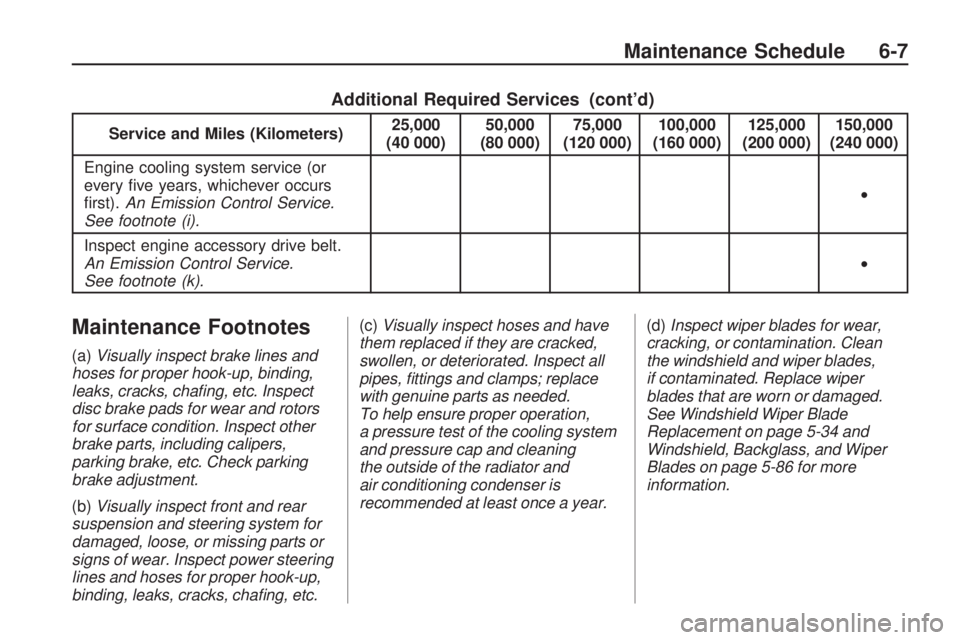
Additional Required Services (cont’d)
Service and Miles (Kilometers)25,000
(40 000) 50,000
(80 000) 75,000
(120 000) 100,000
(160 000) 125,000
(200 000) 150,000
(240 000)
Engine cooling system service (or
every ve years, whichever occurs
rst). An Emission Control Service.
See footnote (i). •
Inspect engine accessory drive belt.
An Emission Control Service.
See footnote (k). •
Maintenance Footnotes
(a)
Visually inspect brake lines and
hoses for proper hook-up, binding,
leaks, cracks, chafing, etc. Inspect
disc brake pads for wear and rotors
for surface condition. Inspect other
brake parts, including calipers,
parking brake, etc. Check parking
brake adjustment.
(b) Visually inspect front and rear
suspension and steering system for
damaged, loose, or missing parts or
signs of wear. Inspect power steering
lines and hoses for proper hook-up,
binding, leaks, cracks, chafing, etc. (c)
Visually inspect hoses and have
them replaced if they are cracked,
swollen, or deteriorated. Inspect all
pipes, fittings and clamps; replace
with genuine parts as needed.
To help ensure proper operation,
a pressure test of the cooling system
and pressure cap and cleaning
the outside of the radiator and
air conditioning condenser is
recommended at least once a year. (d)
Inspect wiper blades for wear,
cracking, or contamination. Clean
the windshield and wiper blades,
if contaminated. Replace wiper
blades that are worn or damaged.
See Windshield Wiper Blade
Replacement on page 5-34 and
Windshield, Backglass, and Wiper
Blades on page 5-86 for more
information.
Maintenance Schedule 6-7
Page 384 of 420
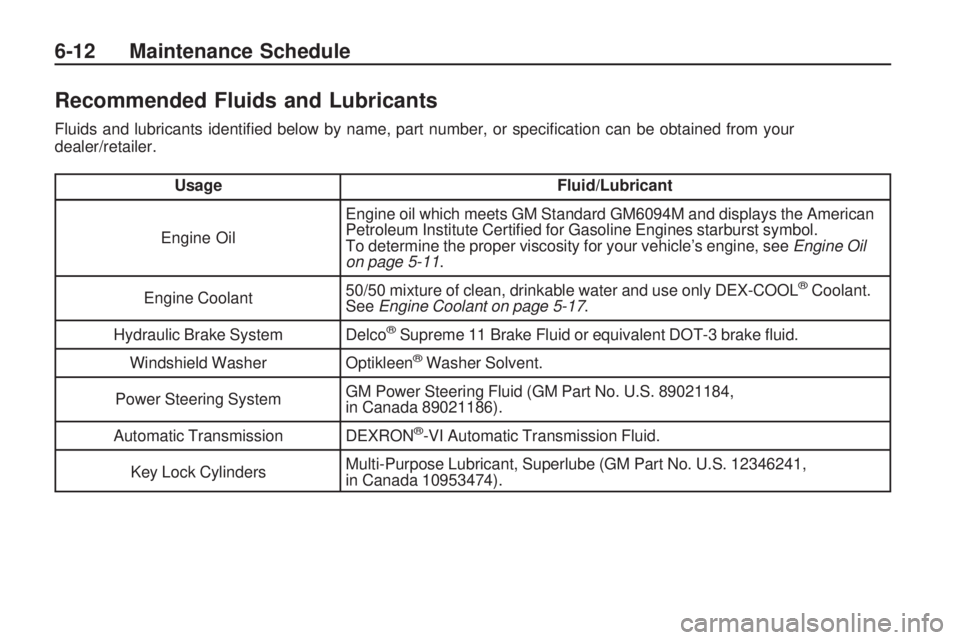
Recommended Fluids and Lubricants
Fluids and lubricants identied below by name, part number, or specication can be obtained from your
dealer/retailer.
UsageFluid/Lubricant
Engine Oil Engine oil which meets GM Standard GM6094M and displays the American
Petroleum Institute Certied for Gasoline Engines starburst symbol.
To determine the proper viscosity for your vehicle’s engine, see
Engine Oil
on page 5-11.
Engine Coolant 50/50 mixture of clean, drinkable water and use only DEX-COOL
®Coolant.
See Engine Coolant on page 5-17 .
Hydraulic Brake System Delco
®Supreme 11 Brake Fluid or equivalent DOT-3 brake uid.
Windshield Washer Optikleen
®Washer Solvent.
Power Steering System GM Power Steering Fluid (GM Part No. U.S. 89021184,
in Canada 89021186).
Automatic Transmission DEXRON
®-VI Automatic Transmission Fluid.
Key Lock Cylinders Multi-Purpose Lubricant, Superlube (GM Part No. U.S. 12346241,
in Canada 10953474).
6-12 Maintenance Schedule
Page 409 of 420
A
Accessories and
Modications...................... 5-3
Accessory Power Outlets......3-20
Adding Equipment to Your
Airbag-Equipped Vehicle....1-60
Additives, Fuel...................... 5-5
Add-On Electrical
Equipment.......................5-89
Air Cleaner/Filter, Engine.......5-15
Air Conditioning...........3-22, 3-25
Airbag
Passenger Status
Indicator.......................3-36
Readiness Light................3-36
Airbag System.....................1-48
Adding Equipment to
Your Airbag-Equipped
Vehicle........................1-60
How Does an Airbag
Restrain?.....................1-53
Passenger Sensing
System........................1-55
Servicing Your
Airbag-Equipped
Vehicle........................1-59Airbag System (cont.)
What Makes an Airbag
Inate?........................1-53
What Will You See After
an Airbag Inates?........1-54
When Should an
Airbag Inate?..............1-51
Where Are the Airbags?.....1-50
All-Wheel Drive....................5-33
All-Wheel-Drive (AWD)
System............................. 4-7
Antilock Brake
System (ABS).................... 4-4
Antilock Brake, System
Warning Light...................3-39
Appearance Care
Aluminum or
Chrome-Plated Wheels . . . 5-86
Care of Safety Belts..........5-84
Chemical Paint Spotting.....5-88
Cleaning Exterior Lamps/
Lenses........................5-85
Fabric/Carpet...................5-83
Finish Care......................5-85
Finish Damage.................5-88
Instrument Panel, Vinyl,
and Other Plastic
Surfaces......................5-84Appearance Care (cont.)
Interior Cleaning...............5-81
Leather...........................5-83
Sheet Metal Damage........5-87
Tires...............................5-87
Underbody Maintenance....5-88
Washing Your Vehicle........5-84
Weatherstrips...................5-84
Windshield, Backglass,
and Wiper Blades..........5-86
Appointments, Scheduling
Service............................. 7-8
Audio System......................3-72
Audio Steering Wheel
Controls.....................3-121
Navigation/Radio System,
see Navigation Manual . . . 3-99
Radio Reception.............3-121
Rear Audio
Controller (RAC)..........3-120
Rear Seat Audio (RSA)....3-118
Setting the Clock..............3-73
Theft-Deterrent Feature....3-120
Audio System(s)..................3-74
Automatic Transmission
Fluid...............................5-16
Operation........................2-24
INDEX i-1
Page 413 of 420
F
Filter
Engine Air Cleaner............5-15
Finish Damage....................5-88
Flashers, Hazard Warning....... 3-5
Flash-to-Pass........................ 3-7
Flat Tire..............................5-55
Flat Tire, Changing...............5-69
Flat Tire, Storing..................5-78
Floor Mats..........................2-50
Fluid
Automatic Transmission.....5-16
Power Steering.................5-23
Windshield Washer...........5-24
Fog Lamp
Fog ................................3-13
Fog Lamp Light...................3-44
Fuel..................................... 5-5
Additives........................... 5-5
California Fuel................... 5-5
Driving for Better Economy . . . 4-1
Filling a Portable Fuel
Container....................... 5-8
Filling the Tank.................. 5-7
Fuels in Foreign Countries . . . 5-6
Gage ..............................3-45Fuel (cont.)
Gasoline Octane................ 5-5
Gasoline Specications........ 5-5
Fuses
Fuses and Circuit
Breakers......................5-90
Instrument Panel
Fuse Block...................5-90
Underhood Fuse Block......5-92
Windshield Wiper..............5-90
G
Gage
Engine Coolant
Temperature.................3-40
Fuel................................3-45
Speedometer...................3-35
Tachometer......................3-35
Voltmeter Gage................3-38
Garage Door Opener............2-44
Gasoline
Octane............................. 5-5
Specications..................... 5-5
Glove Box...........................2-49
GM Mobility Reimbursement
Program............................ 7-5
H
Hazard Warning Flashers........ 3-5
Head Restraints..................... 1-2
Headlamp
Aiming ............................5-33
Headlamps
Bulb Replacement.............5-33
Daytime Running Lamps/
Automatic Headlamp
System........................3-13
Delayed..........................3-12
Exterior Lamps.................3-11
Flash-to-Pass..................... 3-7
Halogen Bulbs..................5-33
High/Low Beam Changer..... 3-7
Head-Up Display (HUD)........3-17
Heated Seats.................1-5, 1-6
Heater................................3-22
Engine Coolant.................2-23
Heater................................3-25
Height Adjuster, Driver Seat.... 1-3
High Voltage Devices and
Wiring.............................5-89
Highbeam On Light..............3-45
Highway Hypnosis................4-12
Hill and Mountain Roads.......4-12
INDEX i-5
Page 416 of 420
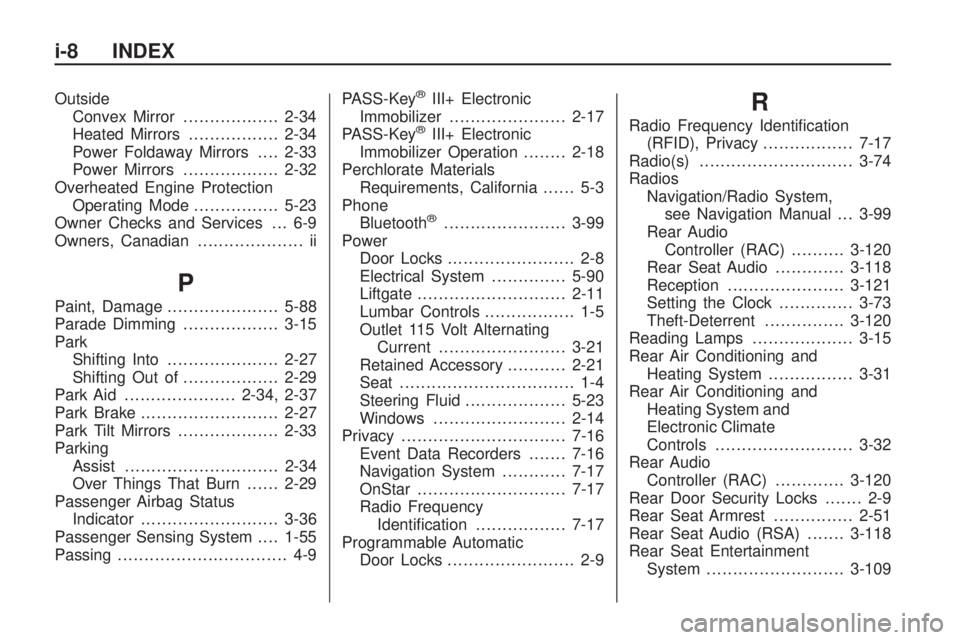
Outside
Convex Mirror..................2-34
Heated Mirrors.................2-34
Power Foldaway Mirrors....2-33
Power Mirrors..................2-32
Overheated Engine Protection
Operating Mode................5-23
Owner Checks and Services . . . 6-9
Owners, Canadian.................... ii
P
Paint, Damage.....................5-88
Parade Dimming..................3-15
Park
Shifting Into.....................2-27
Shifting Out of..................2-29
Park Aid.....................2-34, 2-37
Park Brake..........................2-27
Park Tilt Mirrors...................2-33
Parking
Assist.............................2-34
Over Things That Burn......2-29
Passenger Airbag Status
Indicator..........................3-36
Passenger Sensing System....1-55
Passing................................ 4-9PASS-Key
®III+ Electronic
Immobilizer......................2-17
PASS-Key
®III+ Electronic
Immobilizer Operation........2-18
Perchlorate Materials
Requirements, California...... 5-3
Phone
Bluetooth
®.......................3-99
Power
Door Locks........................ 2-8
Electrical System..............5-90
Liftgate............................2-11
Lumbar Controls................. 1-5
Outlet 115 Volt Alternating
Current........................3-21
Retained Accessory...........2-21
Seat................................. 1-4
Steering Fluid...................5-23
Windows.........................2-14
Privacy...............................7-16
Event Data Recorders.......7-16
Navigation System............7-17
OnStar............................7-17
Radio Frequency
Identication.................7-17
Programmable Automatic
Door Locks........................ 2-9
R
Radio Frequency Identication
(RFID), Privacy.................7-17
Radio(s).............................3-74
Radios
Navigation/Radio System,
see Navigation Manual . . . 3-99
Rear Audio
Controller (RAC)..........3-120
Rear Seat Audio.............3-118
Reception......................3-121
Setting the Clock..............3-73
Theft-Deterrent...............3-120
Reading Lamps...................3-15
Rear Air Conditioning and
Heating System................3-31
Rear Air Conditioning and
Heating System and
Electronic Climate
Controls..........................3-32
Rear Audio
Controller (RAC).............3-120
Rear Door Security Locks....... 2-9
Rear Seat Armrest...............2-51
Rear Seat Audio (RSA).......3-118
Rear Seat Entertainment
System..........................3-109
i-8 INDEX