brake light GMC ACADIA 2009 Owner's Guide
[x] Cancel search | Manufacturer: GMC, Model Year: 2009, Model line: ACADIA, Model: GMC ACADIA 2009Pages: 420, PDF Size: 2.23 MB
Page 305 of 420
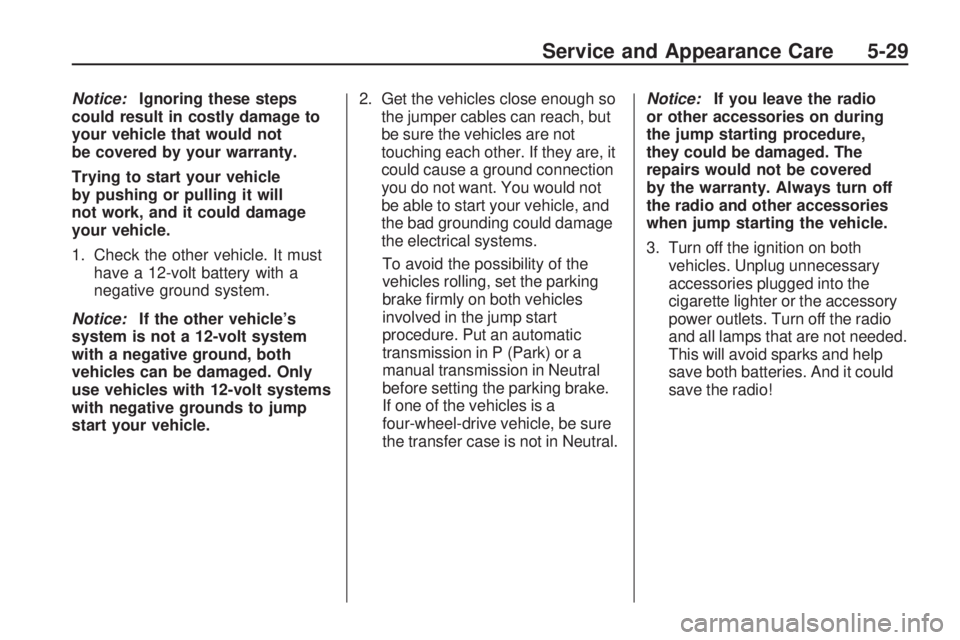
Notice:Ignoring these steps
could result in costly damage to
your vehicle that would not
be covered by your warranty.
Trying to start your vehicle
by pushing or pulling it will
not work, and it could damage
your vehicle.
1. Check the other vehicle. It must
have a 12-volt battery with a
negative ground system.
Notice:If the other vehicle’s
system is not a 12-volt system
with a negative ground, both
vehicles can be damaged. Only
use vehicles with 12-volt systems
with negative grounds to jump
start your vehicle.2. Get the vehicles close enough so
the jumper cables can reach, but
be sure the vehicles are not
touching each other. If they are, it
could cause a ground connection
you do not want. You would not
be able to start your vehicle, and
the bad grounding could damage
the electrical systems.
To avoid the possibility of the
vehicles rolling, set the parking
brake rmly on both vehicles
involved in the jump start
procedure. Put an automatic
transmission in P (Park) or a
manual transmission in Neutral
before setting the parking brake.
If one of the vehicles is a
four-wheel-drive vehicle, be sure
the transfer case is not in Neutral.Notice:If you leave the radio
or other accessories on during
the jump starting procedure,
they could be damaged. The
repairs would not be covered
by the warranty. Always turn off
the radio and other accessories
when jump starting the vehicle.
3. Turn off the ignition on both
vehicles. Unplug unnecessary
accessories plugged into the
cigarette lighter or the accessory
power outlets. Turn off the radio
and all lamps that are not needed.
This will avoid sparks and help
save both batteries. And it could
save the radio!
Service and Appearance Care 5-29
Page 327 of 420
Additionally, if your vehicle has
electronic systems such as anti-lock
brakes, rollover airbags, traction
control, and electronic stability
control, the performance of these
systems can be affected.
{CAUTION
If you add different sized wheels,
your vehicle may not provide an
acceptable level of performance
and safety if tires not
recommended for those wheels
are selected. You may increase
the chance that you will crash and
suffer serious injury. Only use GM
specic wheel and tire systems
developed for your vehicle, and
have them properly installed by
a GM certied technician.
SeeBuying New Tires on page 5-49
andAccessories and Modifications
on page 5-3for additional
information.
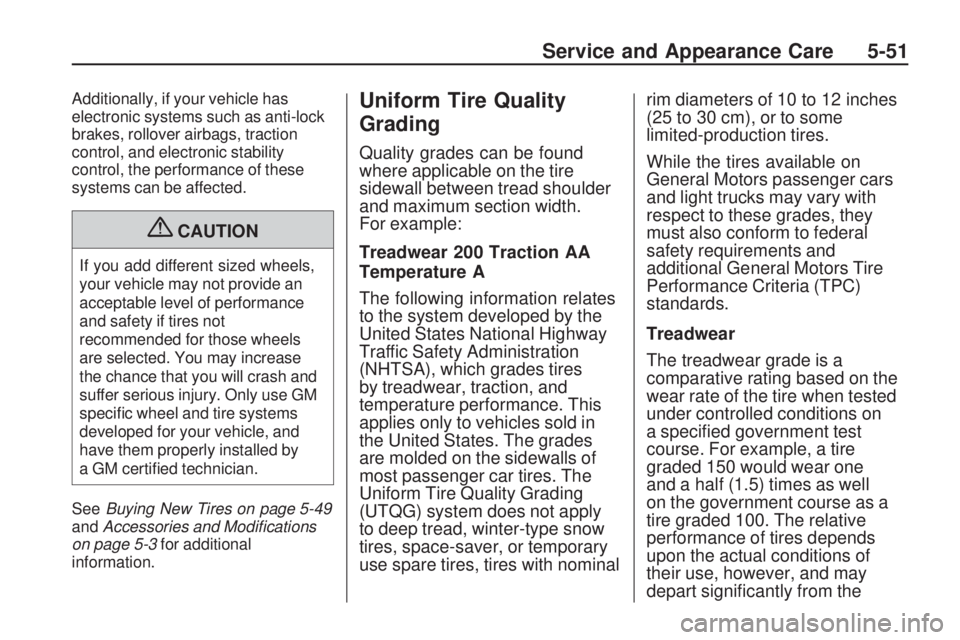
Uniform Tire Quality
Grading
Quality grades can be found
where applicable on the tire
sidewall between tread shoulder
and maximum section width.
For example:
Treadwear 200 Traction AA
Temperature A
The following information relates
to the system developed by the
United States National Highway
Traffic Safety Administration
(NHTSA), which grades tires
by treadwear, traction, and
temperature performance. This
applies only to vehicles sold in
the United States. The grades
are molded on the sidewalls of
most passenger car tires. The
Uniform Tire Quality Grading
(UTQG) system does not apply
to deep tread, winter-type snow
tires, space-saver, or temporary
use spare tires, tires with nominalrim diameters of 10 to 12 inches
(25 to 30 cm), or to some
limited-production tires.
While the tires available on
General Motors passenger cars
and light trucks may vary with
respect to these grades, they
must also conform to federal
safety requirements and
additional General Motors Tire
Performance Criteria (TPC)
standards.
Treadwear
The treadwear grade is a
comparative rating based on the
wear rate of the tire when tested
under controlled conditions on
a specied government test
course. For example, a tire
graded 150 would wear one
and a half (1.5) times as well
on the government course as a
tire graded 100. The relative
performance of tires depends
upon the actual conditions of
their use, however, and may
depart signicantly from the
Service and Appearance Care 5-51
Page 409 of 420
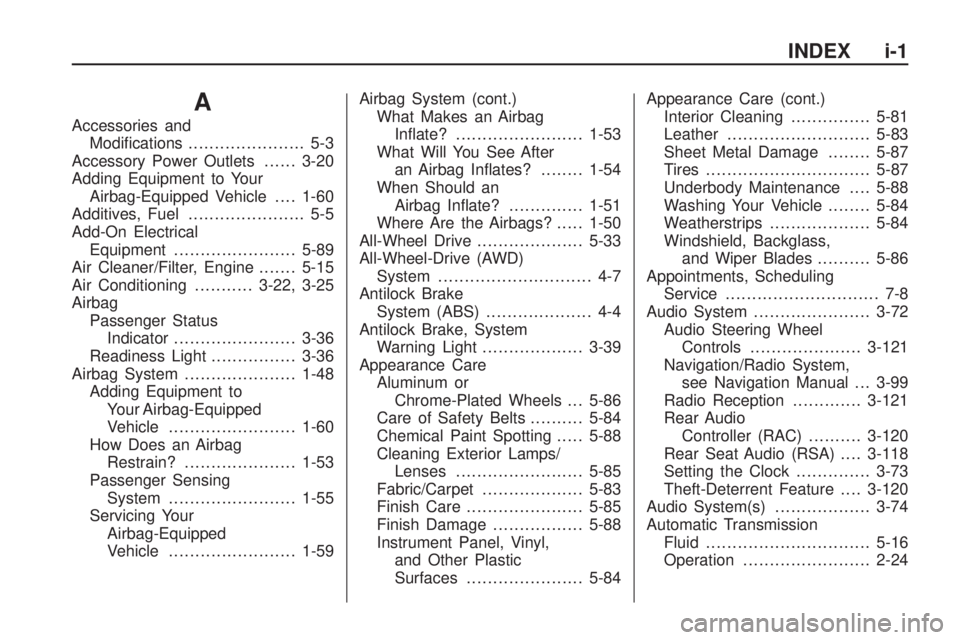
A
Accessories and
Modications...................... 5-3
Accessory Power Outlets......3-20
Adding Equipment to Your
Airbag-Equipped Vehicle....1-60
Additives, Fuel...................... 5-5
Add-On Electrical
Equipment.......................5-89
Air Cleaner/Filter, Engine.......5-15
Air Conditioning...........3-22, 3-25
Airbag
Passenger Status
Indicator.......................3-36
Readiness Light................3-36
Airbag System.....................1-48
Adding Equipment to
Your Airbag-Equipped
Vehicle........................1-60
How Does an Airbag
Restrain?.....................1-53
Passenger Sensing
System........................1-55
Servicing Your
Airbag-Equipped
Vehicle........................1-59Airbag System (cont.)
What Makes an Airbag
Inate?........................1-53
What Will You See After
an Airbag Inates?........1-54
When Should an
Airbag Inate?..............1-51
Where Are the Airbags?.....1-50
All-Wheel Drive....................5-33
All-Wheel-Drive (AWD)
System............................. 4-7
Antilock Brake
System (ABS).................... 4-4
Antilock Brake, System
Warning Light...................3-39
Appearance Care
Aluminum or
Chrome-Plated Wheels . . . 5-86
Care of Safety Belts..........5-84
Chemical Paint Spotting.....5-88
Cleaning Exterior Lamps/
Lenses........................5-85
Fabric/Carpet...................5-83
Finish Care......................5-85
Finish Damage.................5-88
Instrument Panel, Vinyl,
and Other Plastic
Surfaces......................5-84Appearance Care (cont.)
Interior Cleaning...............5-81
Leather...........................5-83
Sheet Metal Damage........5-87
Tires...............................5-87
Underbody Maintenance....5-88
Washing Your Vehicle........5-84
Weatherstrips...................5-84
Windshield, Backglass,
and Wiper Blades..........5-86
Appointments, Scheduling
Service............................. 7-8
Audio System......................3-72
Audio Steering Wheel
Controls.....................3-121
Navigation/Radio System,
see Navigation Manual . . . 3-99
Radio Reception.............3-121
Rear Audio
Controller (RAC)..........3-120
Rear Seat Audio (RSA)....3-118
Setting the Clock..............3-73
Theft-Deterrent Feature....3-120
Audio System(s)..................3-74
Automatic Transmission
Fluid...............................5-16
Operation........................2-24
INDEX i-1
Page 410 of 420
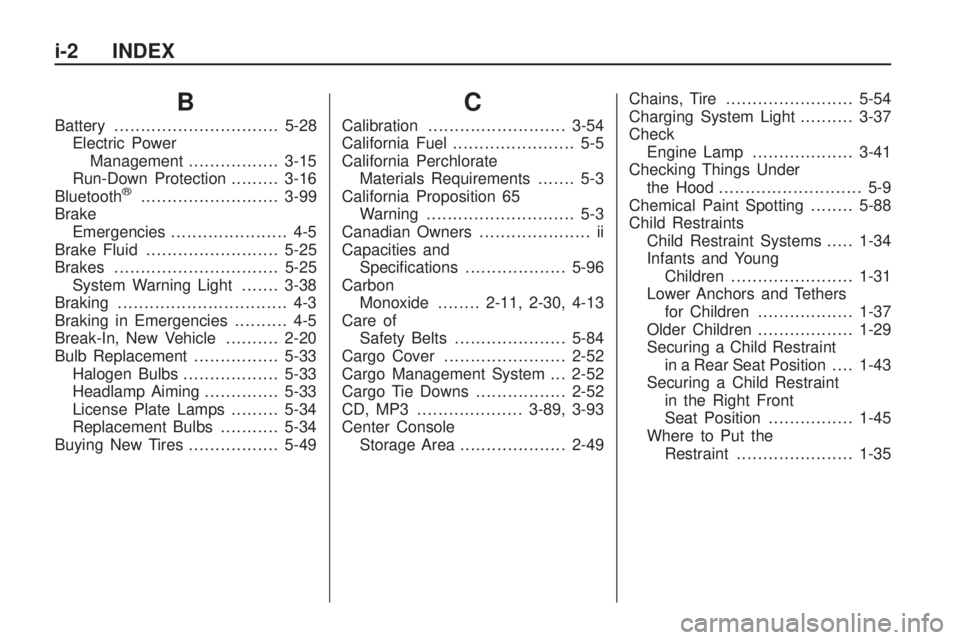
B
Battery...............................5-28
Electric Power
Management.................3-15
Run-Down Protection.........3-16
Bluetooth
®..........................3-99
Brake
Emergencies...................... 4-5
Brake Fluid.........................5-25
Brakes...............................5-25
System Warning Light.......3-38
Braking................................ 4-3
Braking in Emergencies.......... 4-5
Break-In, New Vehicle..........2-20
Bulb Replacement................5-33
Halogen Bulbs..................5-33
Headlamp Aiming..............5-33
License Plate Lamps.........5-34
Replacement Bulbs...........5-34
Buying New Tires.................5-49
C
Calibration..........................3-54
California Fuel....................... 5-5
California Perchlorate
Materials Requirements....... 5-3
California Proposition 65
Warning............................ 5-3
Canadian Owners..................... ii
Capacities and
Specications...................5-96
Carbon
Monoxide........2-11, 2-30, 4-13
Care of
Safety Belts.....................5-84
Cargo Cover.......................2-52
Cargo Management System . . . 2-52
Cargo Tie Downs.................2-52
CD, MP3 ....................3-89, 3-93
Center Console
Storage Area....................2-49Chains, Tire........................5-54
Charging System Light..........3-37
Check
Engine Lamp...................3-41
Checking Things Under
the Hood ........................... 5-9
Chemical Paint Spotting........5-88
Child Restraints
Child Restraint Systems.....1-34
Infants and Young
Children.......................1-31
Lower Anchors and Tethers
for Children..................1-37
Older Children..................1-29
Securing a Child Restraint
in a Rear Seat Position....1-43
Securing a Child Restraint
in the Right Front
Seat Position................1-45
Where to Put the
Restraint......................1-35
i-2 INDEX
Page 414 of 420
Hood
Checking Things Under....... 5-9
Release............................ 5-9
Horn .................................... 3-5
How to Wear Safety Belts
Properly..........................1-18
I
Ignition Positions..................2-20
Infants and Young Children,
Restraints........................1-31
Ination - Tire Pressure.........5-41
Inator Kit, Tire....................5-56
Instrument Panel
Brightness.......................3-14
Cluster............................3-34
Overview........................... 3-4
Storage Area....................2-49
J
Jump Starting......................5-28
K
Keyless Entry System............ 2-3
Keys.................................... 2-2
L
Labeling, Tire Sidewall..........5-36
Lamp
Malfunction Indicator.........3-41
Lamps
Courtesy.........................3-14
Dome .............................3-14
Dome Lamp Override........3-14
Reading..........................3-15
Lap-Shoulder Belt................1-23
LATCH System for Child
Restraints........................1-37
License Plate Lamps............5-34
Liftgate
Carbon Monoxide.............2-10
Liftgate, Power....................2-11
Light
Airbag Readiness.............3-36
Antilock Brake System
(ABS) Warning..............3-39
Brake System Warning......3-38
Charging System..............3-37
Cruise Control..................3-44
Engine Coolant
Temperature Warning.....3-40
Fog Lamp ........................3-44
Highbeam On...................3-45Light (cont.)
Oil Pressure.....................3-44
Passenger Airbag Status
Indicator.......................3-36
Safety Belt Reminders.......3-35
Security...........................3-44
StabiliTrak
®Indicator.........3-39
Tire Pressure...................3-41
Tow/Haul Mode................3-45
Lighting
Delayed Entry..................3-15
Delayed Exit....................3-15
Entry..............................3-14
Parade Dimming...............3-15
Lights
Exterior Lamps.................3-11
Flash-to-Pass..................... 3-7
High/Low Beam Changer..... 3-7
Loading Your Vehicle............4-16
Lockout Protection................. 2-9
Locks
Delayed Locking................. 2-8
Door ................................. 2-8
Lockout Protection.............. 2-9
Power Door....................... 2-8
Programmable Automatic
Door Locks.................... 2-9
Rear Door Security Locks.... 2-9
i-6 INDEX