towing GMC ACADIA 2009 Owner's Guide
[x] Cancel search | Manufacturer: GMC, Model Year: 2009, Model line: ACADIA, Model: GMC ACADIA 2009Pages: 420, PDF Size: 2.23 MB
Page 271 of 420
Safety Chains
Always attach chains between the
vehicle and the trailer. Cross
the safety chains under the tongue
of the trailer to help prevent the
tongue from contacting the road
if it becomes separated from
the hitch. Instructions about safety
chains may be provided by the
hitch manufacturer or by the
trailer manufacturer. Follow the
manufacturer’s recommendation
for attaching safety chains and do
not attach them to the bumper.
Always leave just enough slack
so the rig can turn. Never allow
safety chains to drag on the ground.
Trailer Brakes
A loaded trailer that weighs more
than 1,000 lbs (450 kg) needs
to have its own brake system that is
adequate for the weight of the
trailer. Be sure to read and follow
the instructions for the trailer brakes
so they are installed, adjusted
and maintained properly.Because the vehicle has antilock
brakes, do not try to tap into
the vehicle’s hydraulic brake system.
If you do, both brake systems will
not work well, or at all.
Driving with a Trailer
Towing a trailer requires a certain
amount of experience. Get to know
the rig before setting out for the open
road. Get acquainted with the feel of
handling and braking with the added
weight of the trailer. And always keep
in mind that the vehicle you are
driving is now longer and not as
responsive as the vehicle is by itself.
Before starting, check all trailer hitch
parts and attachments, safety
chains, electrical connectors, lamps,
tires and mirror adjustments. If the
trailer has electric brakes, start the
vehicle and trailer moving and then
apply the trailer brake controller by
hand to be sure the brakes are
working. This checks the electrical
connection at the same time.During the trip, check occasionally
to be sure that the load is secure,
and that the lamps and any
trailer brakes are still working.
Following Distance
Stay at least twice as far behind the
vehicle ahead as you would when
driving the vehicle without a trailer.
This can help to avoid situations
that require heavy braking and
sudden turns.
Passing
More passing distance is needed
when towing a trailer. Because the
rig is longer, it is necessary to go
much farther beyond the passed
vehicle before returning to the lane.
Driving Your Vehicle 4-29
Page 272 of 420
Backing Up
Hold the bottom of the steering
wheel with one hand. Then, to move
the trailer to the left, move that
hand to the left. To move the trailer
to the right, move your hand to
the right. Always back up slowly
and, if possible, have someone
guide you.
Making Turns
Notice:Making very sharp turns
while trailering could cause
the trailer to come in contact with
the vehicle. The vehicle could
be damaged. Avoid making very
sharp turns while trailering.
When turning with a trailer, make
wider turns than normal. Do this so
the trailer won’t strike soft shoulders,
curbs, road signs, trees or other
objects. Avoid jerky or sudden
maneuvers. Signal well in advance.
Turn Signals When Towing a
Trailer
The arrows on the instrument panel
ash whenever signaling a turn
or lane change. Properly hooked up,
the trailer lamps also ash, telling
other drivers the vehicle is turning,
changing lanes or stopping.
When towing a trailer, the arrows on
the instrument panel ash for turns
even if the bulbs on the trailer are
burned out. For this reason you may
think other drivers are seeing the
signal when they are not. It is
important to check occasionally to be
sure the trailer bulbs are still working.
Driving on Grades
Because of the added load of the
trailer, the vehicle’s engine may
overheat on hot days, when going
up a long or steep grade with a
trailer. If the engine coolant
temperature gage indicates
overheating, turn off the air
conditioning to reduce engine load,
pull off the road and stop in a
safe spot. Let the engine run while
parked, preferably on level
ground, with the transmission in
P (Park) for a few minutes before
turning the engine off.
Reduce speed and shift to a lower
gearbeforestarting down a long
or steep downgrade. If the
transmission is not shifted down, the
brakes might have to be used so
much that they would get hot and no
longer work well.
On a long uphill grade, shift down
and reduce the vehicle speed
to around 55 mph (88 km/h) to
reduce the possibility of the engine
and the transmission overheating.
4-30 Driving Your Vehicle
Page 274 of 420
Parking on Hills
{CAUTION
Parking the vehicle on a hill with
the trailer attached can be
dangerous. If something goes
wrong, the rig could start to move.
People can be injured, and both
the vehicle and the trailer can be
damaged. When possible, always
park the rig on a at surface.
If parking the rig on a hill:
1. Press the brake pedal, but do
not shift into P (Park) yet.
Turn the wheels into the curb if
facing downhill or into traffic
if facing uphill.
2. Have someone place chocks
under the trailer wheels.
3. When the wheel chocks are in
place, release the brake pedal
until the chocks absorb the load.4. Reapply the brake pedal. Then
apply the parking brake and
shift the transmission into
P (Park).
5. Release the brake pedal.
Leaving After Parking
on a Hill
1. Apply and hold the brake pedal
while you:
start the engine,
shift into a gear, and
release the parking brake.
2. Let up on the brake pedal.
3. Drive slowly until the trailer is
clear of the chocks.
4. Stop and have someone pick up
and store the chocks.
Maintenance When Trailer
Towing
The vehicle needs service more
often when pulling a trailer.
SeeScheduled Maintenance on
page 6-3for more information.
Things that are especially important
in trailer operation are automatic
transmission uid, engine oil,
axle lubricant, belts, cooling system
and brake system. It is a good
idea to inspect these before and
during the trip.
Check periodically to see that all
hitch nuts and bolts are tight.
Trailer Wiring Harness
The vehicle is equipped with the
following wiring harness for towing
a trailer.
4-32 Driving Your Vehicle
Page 275 of 420
Basic Trailer Wiring
The trailer wiring harness, with a
seven-pin connector, is located
at the rear of the vehicle and is
tied to the vehicle’s frame.
The harness connector can be
plugged into a seven-pin universal
heavy-duty trailer connector
available through your
dealer/retailer.
The seven-wire harness contains
the following trailer circuits:
Yellow: Left Stop/Turn Signal
Dark Green: Right Stop/Turn
Signal
Brown: Taillamps
Black: Ground
Light Green: Back-up Lamps
Red/Black: Battery Feed
Dark Blue: Trailer Brake*
*The fuse for this circuit is installed
in the underhood electrical center,
but the wires are not connected.
They should be connected by your
dealer/retailer or a qualied
service center.
If the back-up lamp circuit is not
functional, contact your
dealer/retailer.If a remote (non-vehicle) battery is
being charged, press the Tow/Haul
mode switch located on the center
console near the climate controls.
This will boost the vehicle system
voltage and properly charge the
battery. If the trailer is too light for
Tow/Haul mode, turn on the
headlamps (Non-HID only) as a
second way to boost the vehicle
system and charge the battery.
Engine Cooling When Trailer
Towing
The cooling system may temporarily
overheat during severe operating
conditions. SeeEngine Overheating
on page 5-21.
Driving Your Vehicle 4-33
Page 299 of 420
Overheated Engine
Protection
Operating Mode
This emergency operating mode lets
the vehicle be driven to a safe place
in an emergency situation. If an
overheated engine condition exists,
an overheat protection mode which
alternates ring groups of cylinders
helps prevent engine damage. In this
mode, there is a signicant loss in
power and engine performance.
The temperature gage indicates an
overheat condition exists. Driving
extended distances and/or towing a
trailer in the overheat protection
mode should be avoided.
Notice:After driving in the
overheated engine protection
operating mode, to avoid engine
damage, allow the engine to
cool before attempting any repair.
The engine oil will be severely
degraded. Repair the cause
of coolant loss, change the oil
and reset the oil life system.
SeeEngine Oil on page 5-11.
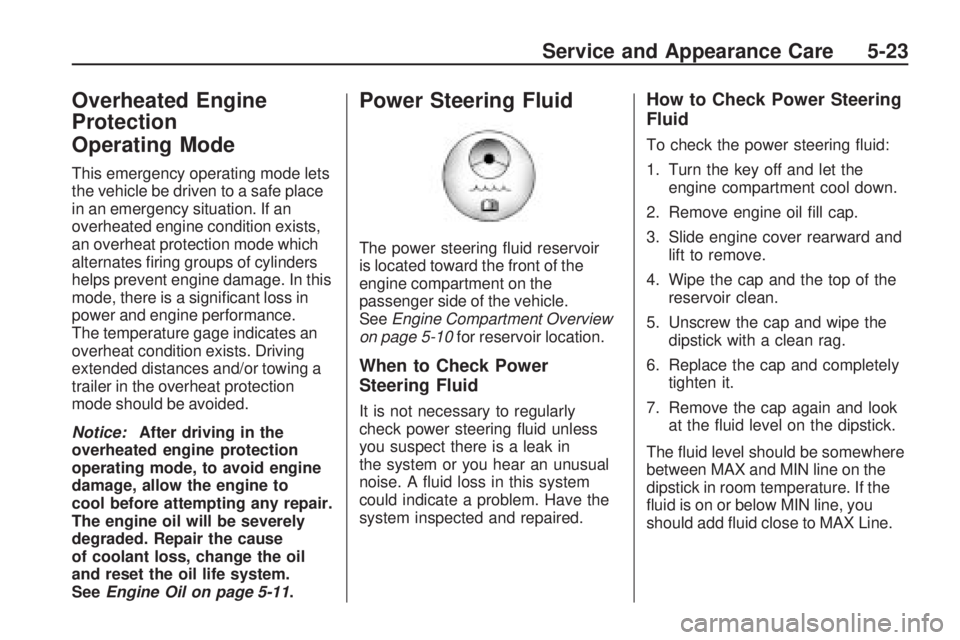
Power Steering Fluid
The power steering uid reservoir
is located toward the front of the
engine compartment on the
passenger side of the vehicle.
SeeEngine Compartment Overview
on page 5-10for reservoir location.
When to Check Power
Steering Fluid
It is not necessary to regularly
check power steering uid unless
you suspect there is a leak in
the system or you hear an unusual
noise. A uid loss in this system
could indicate a problem. Have the
system inspected and repaired.
How to Check Power Steering
Fluid
To check the power steering uid:
1. Turn the key off and let the
engine compartment cool down.
2. Remove engine oil ll cap.
3. Slide engine cover rearward and
lift to remove.
4. Wipe the cap and the top of the
reservoir clean.
5. Unscrew the cap and wipe the
dipstick with a clean rag.
6. Replace the cap and completely
tighten it.
7. Remove the cap again and look
at the uid level on the dipstick.
The uid level should be somewhere
between MAX and MIN line on the
dipstick in room temperature. If the
uid is on or below MIN line, you
should add uid close to MAX Line.
Service and Appearance Care 5-23
Page 380 of 420
(e)Make sure the safety belt
reminder light and safety belt
assemblies are working properly.
Look for any other loose or damaged
safety belt system parts. If you see
anything that might keep a safety belt
system from doing its job, have it
repaired. Have any torn or frayed
safety belts replaced. Also see
Checking the Restraint Systems on
page 1-61.
(f)Lubricate all key lock cylinders,
hood latch assemblies, secondary
latches, pivots, spring anchor and
release pawl, hood and door hinges,
rear folding seats, and liftgate
hinges. More frequent lubrication
may be required when exposed to a
corrosive environment. Applying
silicone grease on weatherstrips with
a clean cloth will make them last
longer, seal better, and not stick or
squeak.
(g)A fluid loss in any vehicle
system could indicate a problem.
Have the system inspected
and repaired and the fluid level
checked. Add fluid if needed.(h)Change automatic transmission
fluid if the vehicle is mainly
driven under one or more of these
conditions:
In heavy city traffic where the
outside temperature regularly
reaches 90°F (32°C) or higher.
In hilly or mountainous terrain.
When doing frequent trailer
towing.
Uses such as found in taxi,
police, or delivery service.
(i)Drain, flush, and refill cooling
system. This service can be
complex; you should have your
dealer/retailer perform this service.
See Engine Coolant on page 5-17 for
what to use. Inspect hoses. Clean
radiator, condenser, pressure cap,
and filler neck. Pressure test the
cooling system and pressure cap.
(j)Check system for interference or
binding and for damaged or missing
parts. Replace parts as needed.
Replace any components that havehigh effort or excessive wear. Do not
lubricate accelerator or cruise control
cables.
(k)Visually inspect belt for fraying,
excessive cracks, or obvious
damage. Replace belt if necessary.
(l)If driving regularly under dusty
conditions, inspect the filter at each
engine oil change.
(m)Change transfer case fluid if the
vehicle is mainly driven under
one or more of these conditions:
In heavy city traffic where
the outside temperature regularly
reaches 90°F (32°C) or higher.
In hilly or mountainous terrain.
When doing frequent trailer
towing.
Uses such as found in taxi,
police, or delivery service.
6-8 Maintenance Schedule
Page 397 of 420
Services Provided
Emergency Fuel Delivery:
Delivery of enough fuel for the
vehicle to get to the nearest
service station.
Lock-Out Service:Service is
provided to unlock the vehicle if
you are locked out. A remote
unlock may be available if you
have OnStar
®. For security
reasons, the driver must present
identication before this service is
given.
Emergency Tow From a Public
Road or Highway:Tow to the
nearest GMC dealer for warranty
service, or if the vehicle was in a
crash and cannot be driven.
Assistance is also given when the
vehicle is stuck in the sand, mud,
or snow.
Flat Tire Change:Service is
provided to change a at tire with
the spare tire. The spare tire, if
equipped, must be in good
condition and properly inated. It
is the owner’s responsibility for
the repair or replacement of the
tire if it is not covered by the
warranty.
Battery Jump Start:Service is
provided to jump start a dead
battery.
Trip Routing Service:Detailed
maps of North America are
provided when requested either
with the most direct route or the
most scenic route. Additional
travel information is also
available. Allow three weeks
for delivery.
Trip Interruption Benets and
Assistance:If your trip is
interrupted due to a warranty
failure, incidental expenses may
be reimbursed during the 5 years/
100,000 miles (160 000 km)
Powertrain warranty period. Items
considered are hotel, meals, and
rental car.
Services Not Included in
Roadside Assistance
Impound towing caused by
violation of any laws.
Legal nes.
Mounting, dismounting or
changing of snow tires, chains,
or other traction devices.
Towing or services for vehicles
driven on a non-public road or
highway.
Customer Assistance Information 7-7
Page 402 of 420
If a Crash Occurs
Here is what to do if you are
involved in a crash.
Check to make sure that you are
all right. If you are uninjured,
make sure that no one else in
your vehicle, or the other vehicle,
is injured.
If there has been an injury, call
emergency services for help. Do
not leave the scene of a crash
until all matters have been taken
care of. Move your vehicle only if
its position puts you in danger or
you are instructed to move it by a
police officer.
Give only the necessary and
requested information to police
and other parties involved in the
crash. Do not discuss your
personal condition, mental frame
of mind, or anything unrelated to
the crash. This will help guard
against post-crash legal action.
If you need roadside assistance,
call GM Roadside Assistance.
SeeRoadside Assistance
Program on page 7-6for more
information.
If your vehicle cannot be driven,
know where the towing service
will be taking it. Get a card from
the tow truck operator or write
down the driver’s name, the
service’s name, and the phone
number.
Remove any valuables from your
vehicle before it is towed away.
Make sure this includes your
insurance information and
registration if you keep these
items in your vehicle.
Gather the important information
you will need from the other
driver. Things like name, address,
phone number, driver’s license
number, vehicle license plate,
vehicle make, model and model
year, Vehicle Identication
Number (VIN), insurance
company and policy number, and
a general description of the
damage to the other vehicle.
If possible, call your insurance
company from the scene of the
crash. They will walk you through
the information they will need. If
they ask for a police report, phone
or go to the police department
headquarters the next day and
you can get a copy of the report
for a nominal fee. In some
states/provinces with “no fault”
insurance laws, a report may not
be necessary. This is especially
true if there are no injuries and
both vehicles are driveable.
7-12 Customer Assistance Information
Page 417 of 420
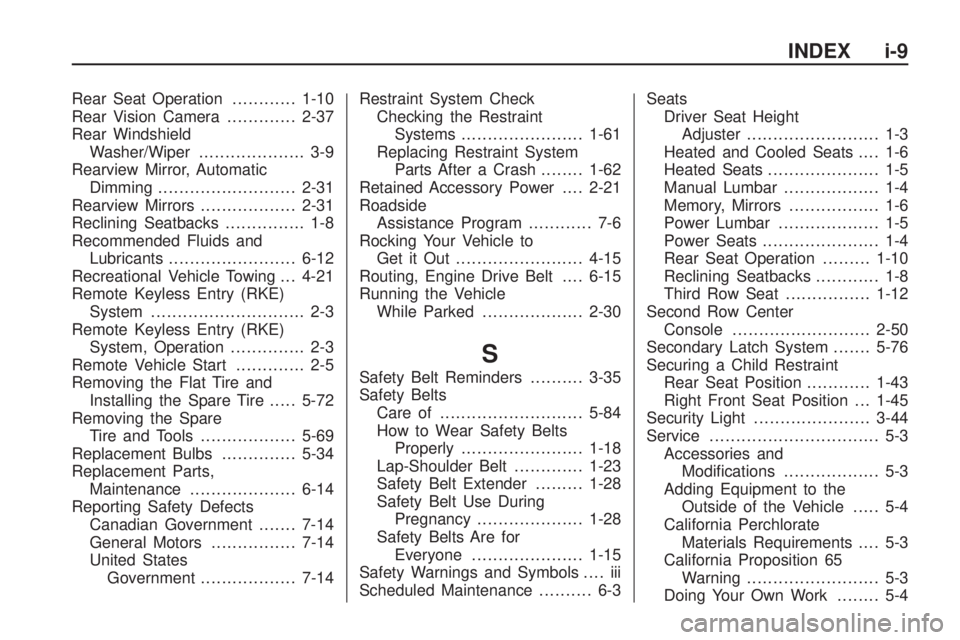
Rear Seat Operation............1-10
Rear Vision Camera.............2-37
Rear Windshield
Washer/Wiper.................... 3-9
Rearview Mirror, Automatic
Dimming ..........................2-31
Rearview Mirrors..................2-31
Reclining Seatbacks............... 1-8
Recommended Fluids and
Lubricants........................6-12
Recreational Vehicle Towing . . . 4-21
Remote Keyless Entry (RKE)
System............................. 2-3
Remote Keyless Entry (RKE)
System, Operation.............. 2-3
Remote Vehicle Start............. 2-5
Removing the Flat Tire and
Installing the Spare Tire.....5-72
Removing the Spare
Tire and Tools..................5-69
Replacement Bulbs..............5-34
Replacement Parts,
Maintenance....................6-14
Reporting Safety Defects
Canadian Government.......7-14
General Motors................7-14
United States
Government..................7-14Restraint System Check
Checking the Restraint
Systems.......................1-61
Replacing Restraint System
Parts After a Crash........1-62
Retained Accessory Power....2-21
Roadside
Assistance Program............ 7-6
Rocking Your Vehicle to
Get it Out ........................4-15
Routing, Engine Drive Belt....6-15
Running the Vehicle
While Parked...................2-30
S
Safety Belt Reminders..........3-35
Safety Belts
Care of ...........................5-84
How to Wear Safety Belts
Properly.......................1-18
Lap-Shoulder Belt.............1-23
Safety Belt Extender.........1-28
Safety Belt Use During
Pregnancy....................1-28
Safety Belts Are for
Everyone.....................1-15
Safety Warnings and Symbols.... iii
Scheduled Maintenance.......... 6-3Seats
Driver Seat Height
Adjuster......................... 1-3
Heated and Cooled Seats.... 1-6
Heated Seats..................... 1-5
Manual Lumbar.................. 1-4
Memory, Mirrors................. 1-6
Power Lumbar ................... 1-5
Power Seats...................... 1-4
Rear Seat Operation.........1-10
Reclining Seatbacks............ 1-8
Third Row Seat................1-12
Second Row Center
Console..........................2-50
Secondary Latch System.......5-76
Securing a Child Restraint
Rear Seat Position............1-43
Right Front Seat Position . . . 1-45
Security Light......................3-44
Service................................ 5-3
Accessories and
Modications.................. 5-3
Adding Equipment to the
Outside of the Vehicle..... 5-4
California Perchlorate
Materials Requirements.... 5-3
California Proposition 65
Warning......................... 5-3
Doing Your Own Work........ 5-4
INDEX i-9
Page 419 of 420
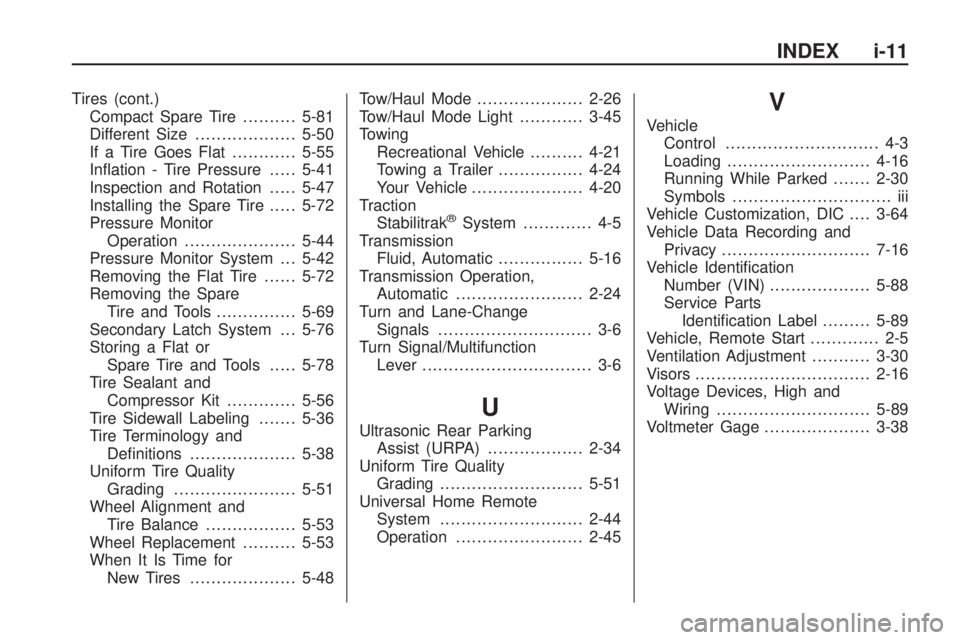
Tires (cont.)
Compact Spare Tire..........5-81
Different Size...................5-50
If a Tire Goes Flat............5-55
Ination - Tire Pressure.....5-41
Inspection and Rotation.....5-47
Installing the Spare Tire.....5-72
Pressure Monitor
Operation.....................5-44
Pressure Monitor System . . . 5-42
Removing the Flat Tire......5-72
Removing the Spare
Tire and Tools...............5-69
Secondary Latch System . . . 5-76
Storing a Flat or
Spare Tire and Tools.....5-78
Tire Sealant and
Compressor Kit.............5-56
Tire Sidewall Labeling.......5-36
Tire Terminology and
Denitions....................5-38
Uniform Tire Quality
Grading.......................5-51
Wheel Alignment and
Tire Balance.................5-53
Wheel Replacement..........5-53
When It Is Time for
New Tires....................5-48Tow/Haul Mode ....................2-26
Tow/Haul Mode Light............3-45
Towing
Recreational Vehicle..........4-21
Towing a Trailer................4-24
Your Vehicle.....................4-20
Traction
Stabilitrak
®System............. 4-5
Transmission
Fluid, Automatic................5-16
Transmission Operation,
Automatic........................2-24
Turn and Lane-Change
Signals............................. 3-6
Turn Signal/Multifunction
Lever................................ 3-6
U
Ultrasonic Rear Parking
Assist (URPA)..................2-34
Uniform Tire Quality
Grading...........................5-51
Universal Home Remote
System...........................2-44
Operation........................2-45
V
Vehicle
Control............................. 4-3
Loading...........................4-16
Running While Parked.......2-30
Symbols.............................. iii
Vehicle Customization, DIC....3-64
Vehicle Data Recording and
Privacy............................7-16
Vehicle Identication
Number (VIN)...................5-88
Service Parts
Identication Label.........5-89
Vehicle, Remote Start............. 2-5
Ventilation Adjustment...........3-30
Visors.................................2-16
Voltage Devices, High and
Wiring.............................5-89
Voltmeter Gage....................3-38
INDEX i-11