trailer GMC ACADIA 2009 Owner's Guide
[x] Cancel search | Manufacturer: GMC, Model Year: 2009, Model line: ACADIA, Model: GMC ACADIA 2009Pages: 420, PDF Size: 2.23 MB
Page 273 of 420
Tow/Haul Mode
Tow/Haul is a feature that assists
when pulling a heavy trailer or
a large or heavy load. The purpose
of the Tow/Haul mode is to:
Reduce the frequency and
improve the predictability of
transmission shifts when pulling
a heavy trailer or a large or
heavy load.
Provide the same solid shift feel
when pulling a heavy trailer or a
large or heavy load as when
the vehicle is unloaded.
Improve control of vehicle speed
while requiring less throttle pedal
activity when pulling a heavy
trailer or a large or heavy load.
Increase the charging system
voltage to assist in recharging
a battery installed in a trailer.Press this button located on the
console to turn on and turn off the
Tow/Haul mode.
The Tow/Haul light on the
instrument panel will come on to
indicate that Tow/Haul mode
has been selected.
Tow/Haul may be turned off by
pressing the button again, at which
time the indicator light on the
instrument panel will turn off. The
vehicle will automatically turn
off Tow/Haul every time it is started.
Tow/Haul is designed to be most
effective when the vehicle and
trailer combined weight is at
least 75 percent of the vehicle’s
Gross Combined Weight Rating
(GCWR). See Weight of the Trailerearlier in this section. Tow/Haul is
most useful under the following
driving conditions:
When pulling a heavy trailer or a
large or heavy load through
rolling terrain.
When pulling a heavy trailer or a
large or heavy load in stop and
go traffic.
When pulling a heavy trailer or a
large or heavy load in busy
parking lots where improved low
speed control of the vehicle is
desired.
Operating the vehicle in Tow/Haul
when lightly loaded or with no trailer
at all will not cause damage.
However, there is no benet to the
selection of Tow/Haul when the
vehicle is unloaded. Such a selection
when unloaded may result in
unpleasant engine and transmission
driving characteristics and reduced
fuel economy. Tow/Haul is
recommended only when pulling a
heavy trailer or a large or heavy load.
Driving Your Vehicle 4-31
Page 274 of 420
Parking on Hills
{CAUTION
Parking the vehicle on a hill with
the trailer attached can be
dangerous. If something goes
wrong, the rig could start to move.
People can be injured, and both
the vehicle and the trailer can be
damaged. When possible, always
park the rig on a at surface.
If parking the rig on a hill:
1. Press the brake pedal, but do
not shift into P (Park) yet.
Turn the wheels into the curb if
facing downhill or into traffic
if facing uphill.
2. Have someone place chocks
under the trailer wheels.
3. When the wheel chocks are in
place, release the brake pedal
until the chocks absorb the load.4. Reapply the brake pedal. Then
apply the parking brake and
shift the transmission into
P (Park).
5. Release the brake pedal.
Leaving After Parking
on a Hill
1. Apply and hold the brake pedal
while you:
start the engine,
shift into a gear, and
release the parking brake.
2. Let up on the brake pedal.
3. Drive slowly until the trailer is
clear of the chocks.
4. Stop and have someone pick up
and store the chocks.
Maintenance When Trailer
Towing
The vehicle needs service more
often when pulling a trailer.
SeeScheduled Maintenance on
page 6-3for more information.
Things that are especially important
in trailer operation are automatic
transmission uid, engine oil,
axle lubricant, belts, cooling system
and brake system. It is a good
idea to inspect these before and
during the trip.
Check periodically to see that all
hitch nuts and bolts are tight.
Trailer Wiring Harness
The vehicle is equipped with the
following wiring harness for towing
a trailer.
4-32 Driving Your Vehicle
Page 275 of 420
Basic Trailer Wiring
The trailer wiring harness, with a
seven-pin connector, is located
at the rear of the vehicle and is
tied to the vehicle’s frame.
The harness connector can be
plugged into a seven-pin universal
heavy-duty trailer connector
available through your
dealer/retailer.
The seven-wire harness contains
the following trailer circuits:
Yellow: Left Stop/Turn Signal
Dark Green: Right Stop/Turn
Signal
Brown: Taillamps
Black: Ground
Light Green: Back-up Lamps
Red/Black: Battery Feed
Dark Blue: Trailer Brake*
*The fuse for this circuit is installed
in the underhood electrical center,
but the wires are not connected.
They should be connected by your
dealer/retailer or a qualied
service center.
If the back-up lamp circuit is not
functional, contact your
dealer/retailer.If a remote (non-vehicle) battery is
being charged, press the Tow/Haul
mode switch located on the center
console near the climate controls.
This will boost the vehicle system
voltage and properly charge the
battery. If the trailer is too light for
Tow/Haul mode, turn on the
headlamps (Non-HID only) as a
second way to boost the vehicle
system and charge the battery.
Engine Cooling When Trailer
Towing
The cooling system may temporarily
overheat during severe operating
conditions. SeeEngine Overheating
on page 5-21.
Driving Your Vehicle 4-33
Page 298 of 420
If Steam Is Coming From The
Engine Compartment
{CAUTION
Steam from an overheated engine
can burn you badly, even if you
just open the hood. Stay away
from the engine if you see or hear
steam coming from it. Turn it off
and get everyone away from the
vehicle until it cools down. Wait
until there is no sign of steam or
coolant before you open the hood.
If you keep driving when the
vehicles engine is overheated, the
liquids in it can catch re. You or
others could be badly burned.
Stop the engine if it overheats,
and get out of the vehicle until the
engine is cool.
SeeOverheated Engine
Protection Operating Mode on
page 5-23for information on
driving to a safe place in an
emergency.
If No Steam Is Coming From
The Engine Compartment
If an engine overheat warning is
displayed but no steam can be seen
or heard, the problem may not be too
serious. Sometimes the engine can
get a little too hot when the vehicle:
Climbs a long hill on a hot day.
Stops after high-speed driving.
Idles for long periods in traffic.
Tows a trailer.
If the overheat warning is displayed
with no sign of steam:
1. Turn the air conditioning off.
2. Turn the heater on to the highest
temperature and to the highest
fan speed. Open the windows as
necessary.
3. If in a traffic jam, shift to
N (Neutral), otherwise, shift
to the highest gear while
driving—D(Drive) or L (Low).If the temperature overheat gage is
no longer in the overheat zone or an
overheat warning no longer displays,
the vehicle can be driven. Continue
to drive the vehicle slow for about
10 minutes. Keep a safe vehicle
distance from the car in front of you.
If the warning does not come back
on, continue to drive normally.
If the warning continues, pull
over, stop, and park the vehicle
right away.
If there is no sign of steam, idle
the engine for three minutes while
parked. If the warning is still
displayed, turn off the engine until it
cools down. Also, see “Overheated
Engine Protection Operating Mode”
next in this section.
5-22 Service and Appearance Care
Page 299 of 420
Overheated Engine
Protection
Operating Mode
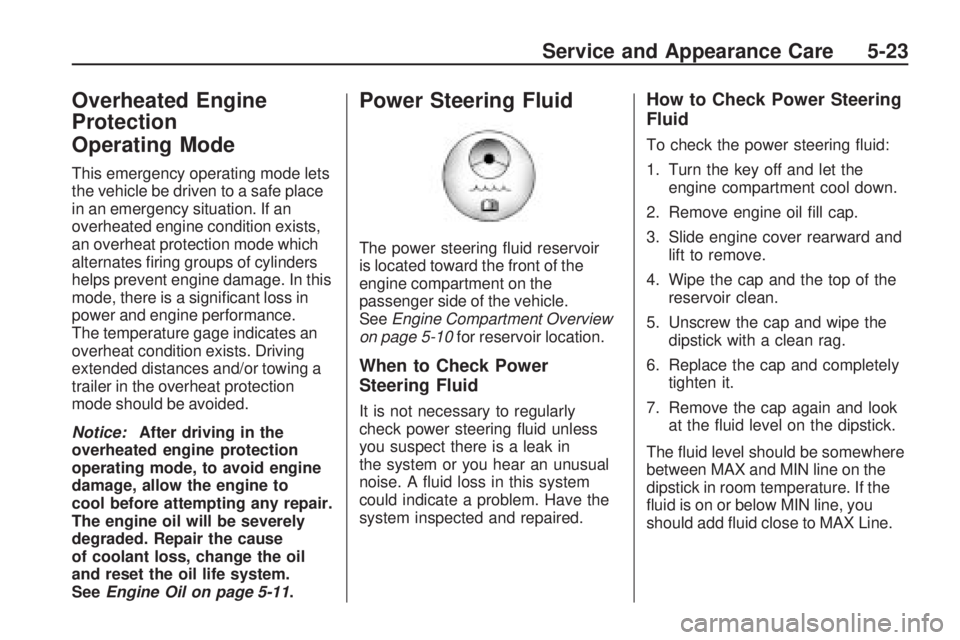
This emergency operating mode lets
the vehicle be driven to a safe place
in an emergency situation. If an
overheated engine condition exists,
an overheat protection mode which
alternates ring groups of cylinders
helps prevent engine damage. In this
mode, there is a signicant loss in
power and engine performance.
The temperature gage indicates an
overheat condition exists. Driving
extended distances and/or towing a
trailer in the overheat protection
mode should be avoided.
Notice:After driving in the
overheated engine protection
operating mode, to avoid engine
damage, allow the engine to
cool before attempting any repair.
The engine oil will be severely
degraded. Repair the cause
of coolant loss, change the oil
and reset the oil life system.
SeeEngine Oil on page 5-11.
Power Steering Fluid
The power steering uid reservoir
is located toward the front of the
engine compartment on the
passenger side of the vehicle.
SeeEngine Compartment Overview
on page 5-10for reservoir location.
When to Check Power
Steering Fluid
It is not necessary to regularly
check power steering uid unless
you suspect there is a leak in
the system or you hear an unusual
noise. A uid loss in this system
could indicate a problem. Have the
system inspected and repaired.
How to Check Power Steering
Fluid
To check the power steering uid:
1. Turn the key off and let the
engine compartment cool down.
2. Remove engine oil ll cap.
3. Slide engine cover rearward and
lift to remove.
4. Wipe the cap and the top of the
reservoir clean.
5. Unscrew the cap and wipe the
dipstick with a clean rag.
6. Replace the cap and completely
tighten it.
7. Remove the cap again and look
at the uid level on the dipstick.
The uid level should be somewhere
between MAX and MIN line on the
dipstick in room temperature. If the
uid is on or below MIN line, you
should add uid close to MAX Line.
Service and Appearance Care 5-23
Page 370 of 420
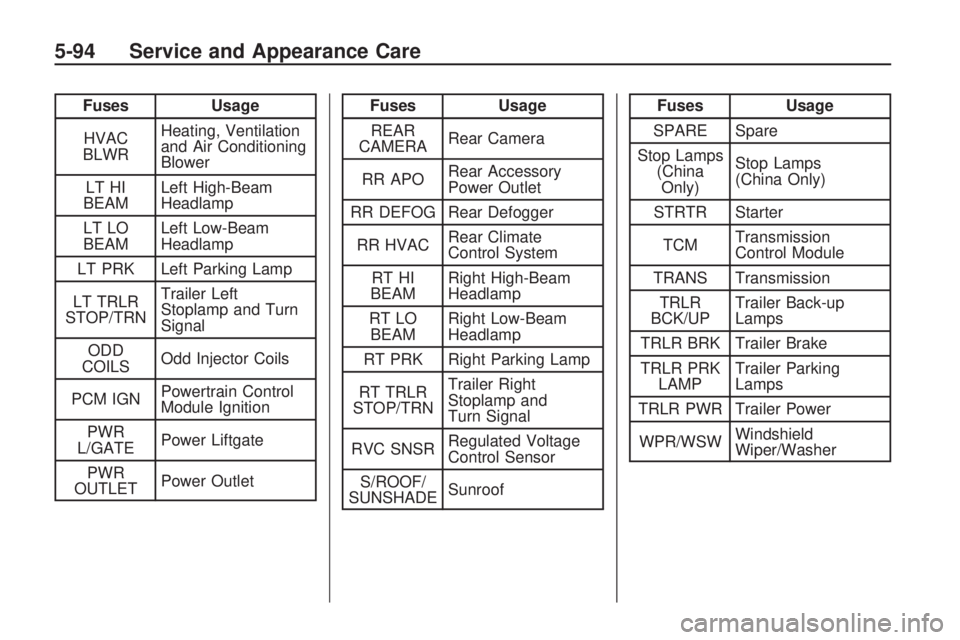
Fuses Usage
HVAC
BLWRHeating, Ventilation
and Air Conditioning
Blower
LT HI
BEAMLeft High-Beam
Headlamp
LT LO
BEAMLeft Low-Beam
Headlamp
LT PRK Left Parking Lamp
LT TRLR
STOP/TRNTrailer Left
Stoplamp and Turn
Signal
ODD
COILSOdd Injector Coils
PCM IGNPowertrain Control
Module Ignition
PWR
L/GATEPower Liftgate
PWR
OUTLETPower OutletFuses Usage
REAR
CAMERARear Camera
RR APORear Accessory
Power Outlet
RR DEFOG Rear Defogger
RR HVACRear Climate
Control System
RT HI
BEAMRight High-Beam
Headlamp
RT LO
BEAMRight Low-Beam
Headlamp
RT PRK Right Parking Lamp
RT TRLR
STOP/TRNTrailer Right
Stoplamp and
Turn Signal
RVC SNSRRegulated Voltage
Control Sensor
S/ROOF/
SUNSHADESunroofFuses Usage
SPARE Spare
Stop Lamps
(China
Only)Stop Lamps
(China Only)
STRTR Starter
TCMTransmission
Control Module
TRANS Transmission
TRLR
BCK/UPTrailer Back-up
Lamps
TRLR BRK Trailer Brake
TRLR PRK
LAMPTrailer Parking
Lamps
TRLR PWR Trailer Power
WPR/WSWWindshield
Wiper/Washer
5-94 Service and Appearance Care
Page 371 of 420

Relays Usage
A/C
CMPRSR
CLTCHAir Conditioning
Compressor Clutch
AUX VAC
PUMPAuxiliary Vacuum
Pump
CRNK Switched Power
FAN 1 Cooling Fan 1
FAN 2 Cooling Fan 2
FAN 3 Cooling Fan 3
FOG LAMP Fog Lamps
HI BEAMHigh-Beam
Headlamps
HID/LO
BEAMHigh Intensity
Discharge (HID)
Low-Beam
Headlamps
HORN Horn
IGN Ignition MainRelays Usage
LT TRLR
STOP/TRNTrailer Left
Stoplamp and Turn
Signal Lamp
PRK LAMP Park Lamp
PWR/TRN Powertrain
RR DEFOGRear Window
Defogger
RT TRLR
STOP/TRNTrailer Right
Stoplamp and Turn
Signal Lamp
Stop Lamps
(China
Only)Stop Lamps
(China Only)
TRLR
BCK/UPTrailer Back-up
Lamps
WPR Windshield Wiper
WPR HIWindshield Wiper
High Speed
Service and Appearance Care 5-95
Page 380 of 420
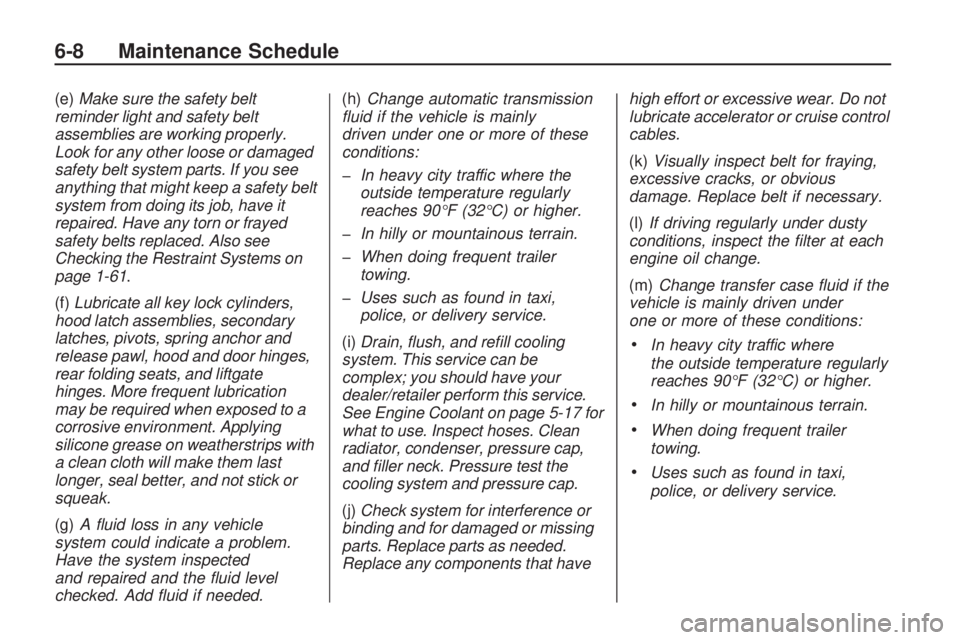
(e)Make sure the safety belt
reminder light and safety belt
assemblies are working properly.
Look for any other loose or damaged
safety belt system parts. If you see
anything that might keep a safety belt
system from doing its job, have it
repaired. Have any torn or frayed
safety belts replaced. Also see
Checking the Restraint Systems on
page 1-61.
(f)Lubricate all key lock cylinders,
hood latch assemblies, secondary
latches, pivots, spring anchor and
release pawl, hood and door hinges,
rear folding seats, and liftgate
hinges. More frequent lubrication
may be required when exposed to a
corrosive environment. Applying
silicone grease on weatherstrips with
a clean cloth will make them last
longer, seal better, and not stick or
squeak.
(g)A fluid loss in any vehicle
system could indicate a problem.
Have the system inspected
and repaired and the fluid level
checked. Add fluid if needed.(h)Change automatic transmission
fluid if the vehicle is mainly
driven under one or more of these
conditions:
In heavy city traffic where the
outside temperature regularly
reaches 90°F (32°C) or higher.
In hilly or mountainous terrain.
When doing frequent trailer
towing.
Uses such as found in taxi,
police, or delivery service.
(i)Drain, flush, and refill cooling
system. This service can be
complex; you should have your
dealer/retailer perform this service.
See Engine Coolant on page 5-17 for
what to use. Inspect hoses. Clean
radiator, condenser, pressure cap,
and filler neck. Pressure test the
cooling system and pressure cap.
(j)Check system for interference or
binding and for damaged or missing
parts. Replace parts as needed.
Replace any components that havehigh effort or excessive wear. Do not
lubricate accelerator or cruise control
cables.
(k)Visually inspect belt for fraying,
excessive cracks, or obvious
damage. Replace belt if necessary.
(l)If driving regularly under dusty
conditions, inspect the filter at each
engine oil change.
(m)Change transfer case fluid if the
vehicle is mainly driven under
one or more of these conditions:
In heavy city traffic where
the outside temperature regularly
reaches 90°F (32°C) or higher.
In hilly or mountainous terrain.
When doing frequent trailer
towing.
Uses such as found in taxi,
police, or delivery service.
6-8 Maintenance Schedule
Page 419 of 420
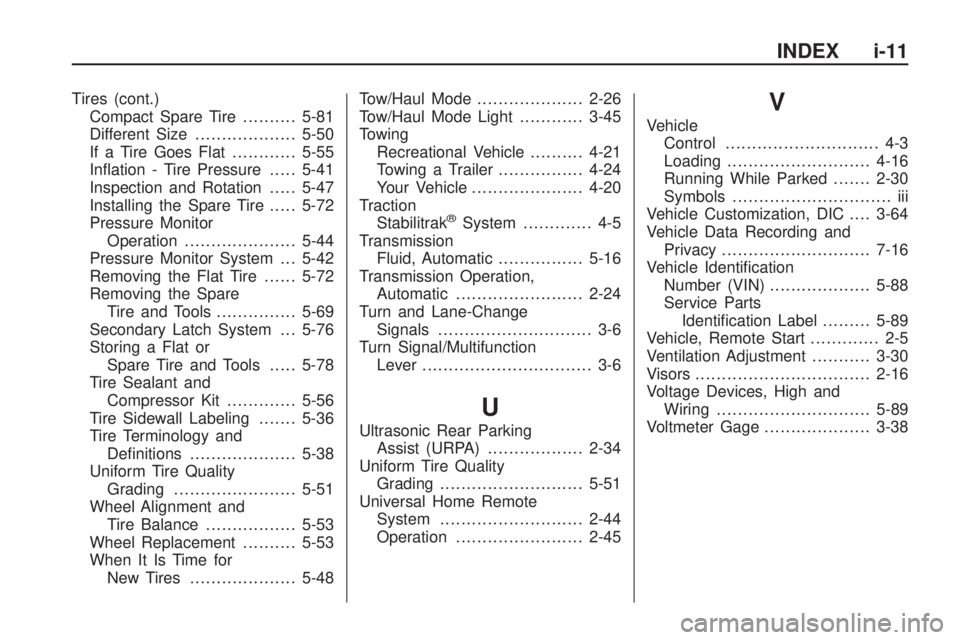
Tires (cont.)
Compact Spare Tire..........5-81
Different Size...................5-50
If a Tire Goes Flat............5-55
Ination - Tire Pressure.....5-41
Inspection and Rotation.....5-47
Installing the Spare Tire.....5-72
Pressure Monitor
Operation.....................5-44
Pressure Monitor System . . . 5-42
Removing the Flat Tire......5-72
Removing the Spare
Tire and Tools...............5-69
Secondary Latch System . . . 5-76
Storing a Flat or
Spare Tire and Tools.....5-78
Tire Sealant and
Compressor Kit.............5-56
Tire Sidewall Labeling.......5-36
Tire Terminology and
Denitions....................5-38
Uniform Tire Quality
Grading.......................5-51
Wheel Alignment and
Tire Balance.................5-53
Wheel Replacement..........5-53
When It Is Time for
New Tires....................5-48Tow/Haul Mode ....................2-26
Tow/Haul Mode Light............3-45
Towing
Recreational Vehicle..........4-21
Towing a Trailer................4-24
Your Vehicle.....................4-20
Traction
Stabilitrak
®System............. 4-5
Transmission
Fluid, Automatic................5-16
Transmission Operation,
Automatic........................2-24
Turn and Lane-Change
Signals............................. 3-6
Turn Signal/Multifunction
Lever................................ 3-6
U
Ultrasonic Rear Parking
Assist (URPA)..................2-34
Uniform Tire Quality
Grading...........................5-51
Universal Home Remote
System...........................2-44
Operation........................2-45
V
Vehicle
Control............................. 4-3
Loading...........................4-16
Running While Parked.......2-30
Symbols.............................. iii
Vehicle Customization, DIC....3-64
Vehicle Data Recording and
Privacy............................7-16
Vehicle Identication
Number (VIN)...................5-88
Service Parts
Identication Label.........5-89
Vehicle, Remote Start............. 2-5
Ventilation Adjustment...........3-30
Visors.................................2-16
Voltage Devices, High and
Wiring.............................5-89
Voltmeter Gage....................3-38
INDEX i-11