air condition GMC ACADIA 2009 Owner's Guide
[x] Cancel search | Manufacturer: GMC, Model Year: 2009, Model line: ACADIA, Model: GMC ACADIA 2009Pages: 420, PDF Size: 2.23 MB
Page 299 of 420
Overheated Engine
Protection
Operating Mode
This emergency operating mode lets
the vehicle be driven to a safe place
in an emergency situation. If an
overheated engine condition exists,
an overheat protection mode which
alternates ring groups of cylinders
helps prevent engine damage. In this
mode, there is a signicant loss in
power and engine performance.
The temperature gage indicates an
overheat condition exists. Driving
extended distances and/or towing a
trailer in the overheat protection
mode should be avoided.
Notice:After driving in the
overheated engine protection
operating mode, to avoid engine
damage, allow the engine to
cool before attempting any repair.
The engine oil will be severely
degraded. Repair the cause
of coolant loss, change the oil
and reset the oil life system.
SeeEngine Oil on page 5-11.
Power Steering Fluid
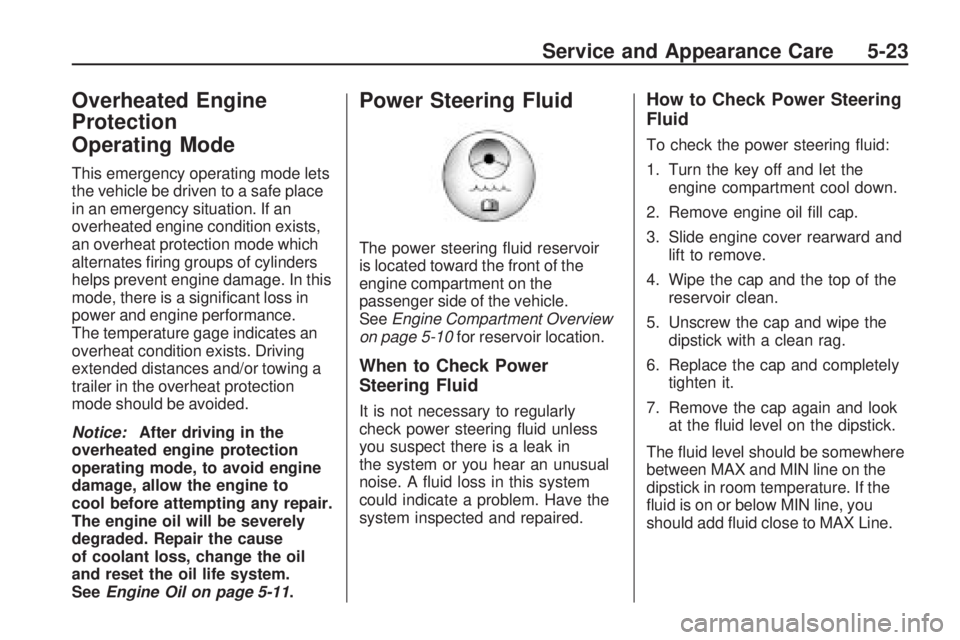
The power steering uid reservoir
is located toward the front of the
engine compartment on the
passenger side of the vehicle.
SeeEngine Compartment Overview
on page 5-10for reservoir location.
When to Check Power
Steering Fluid
It is not necessary to regularly
check power steering uid unless
you suspect there is a leak in
the system or you hear an unusual
noise. A uid loss in this system
could indicate a problem. Have the
system inspected and repaired.
How to Check Power Steering
Fluid
To check the power steering uid:
1. Turn the key off and let the
engine compartment cool down.
2. Remove engine oil ll cap.
3. Slide engine cover rearward and
lift to remove.
4. Wipe the cap and the top of the
reservoir clean.
5. Unscrew the cap and wipe the
dipstick with a clean rag.
6. Replace the cap and completely
tighten it.
7. Remove the cap again and look
at the uid level on the dipstick.
The uid level should be somewhere
between MAX and MIN line on the
dipstick in room temperature. If the
uid is on or below MIN line, you
should add uid close to MAX Line.
Service and Appearance Care 5-23
Page 314 of 420
Tire Size
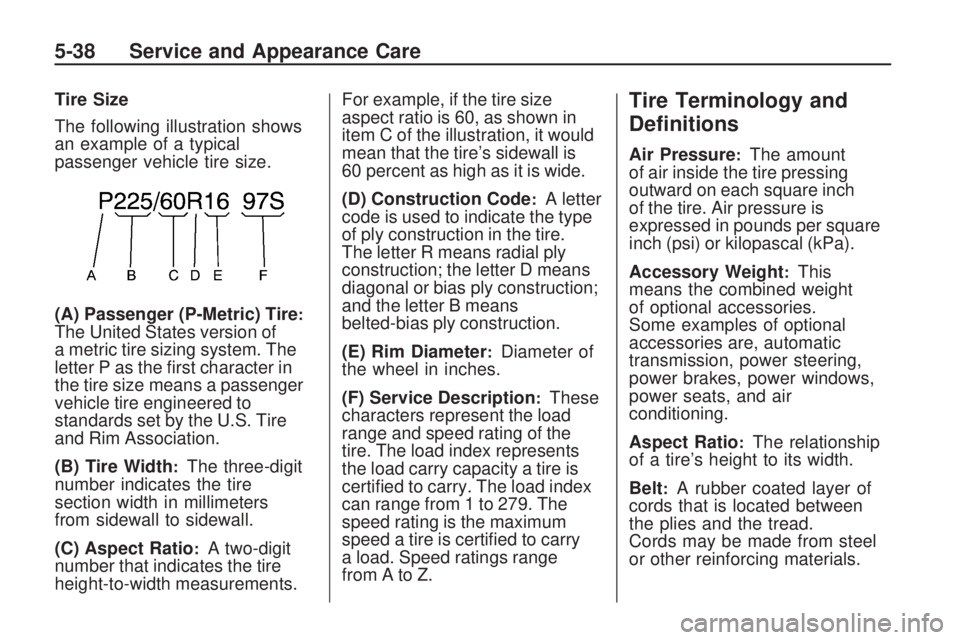
The following illustration shows
an example of a typical
passenger vehicle tire size.
(A) Passenger (P-Metric) Tire
:The United States version of
a metric tire sizing system. The
letter P as the rst character in
the tire size means a passenger
vehicle tire engineered to
standards set by the U.S. Tire
and Rim Association.
(B) Tire Width
:The three-digit
number indicates the tire
section width in millimeters
from sidewall to sidewall.
(C) Aspect Ratio
:A two-digit
number that indicates the tire
height-to-width measurements.For example, if the tire size
aspect ratio is 60, as shown in
item C of the illustration, it would
mean that the tire’s sidewall is
60 percent as high as it is wide.
(D) Construction Code
:A letter
code is used to indicate the type
of ply construction in the tire.
The letter R means radial ply
construction; the letter D means
diagonal or bias ply construction;
and the letter B means
belted-bias ply construction.
(E) Rim Diameter
:Diameter of
the wheel in inches.
(F) Service Description
:These
characters represent the load
range and speed rating of the
tire. The load index represents
the load carry capacity a tire is
certied to carry. The load index
can range from 1 to 279. The
speed rating is the maximum
speed a tire is certied to carry
a load. Speed ratings range
fromAtoZ.
Tire Terminology and
Denitions
Air Pressure:The amount
of air inside the tire pressing
outward on each square inch
of the tire. Air pressure is
expressed in pounds per square
inch (psi) or kilopascal (kPa).
Accessory Weight
:This
means the combined weight
of optional accessories.
Some examples of optional
accessories are, automatic
transmission, power steering,
power brakes, power windows,
power seats, and air
conditioning.
Aspect Ratio
:The relationship
of a tire’s height to its width.
Belt
:A rubber coated layer of
cords that is located between
the plies and the tread.
Cords may be made from steel
or other reinforcing materials.
5-38 Service and Appearance Care
Page 320 of 420
Changes or modications to
this system by other than an
authorized service facility could void
authorization to use this equipment.
Tire Pressure Monitor
Operation
This vehicle may have a Tire
Pressure Monitor System (TPMS).
The TPMS is designed to warn
the driver when a low tire pressure
condition exists. TPMS sensors
are mounted onto each tire
and wheel assembly, excluding the
spare tire and wheel assembly,
if the vehicle has one. The TPMS
sensors monitor the air pressure in
the vehicle’s tires and transmits
the tire pressure readings to
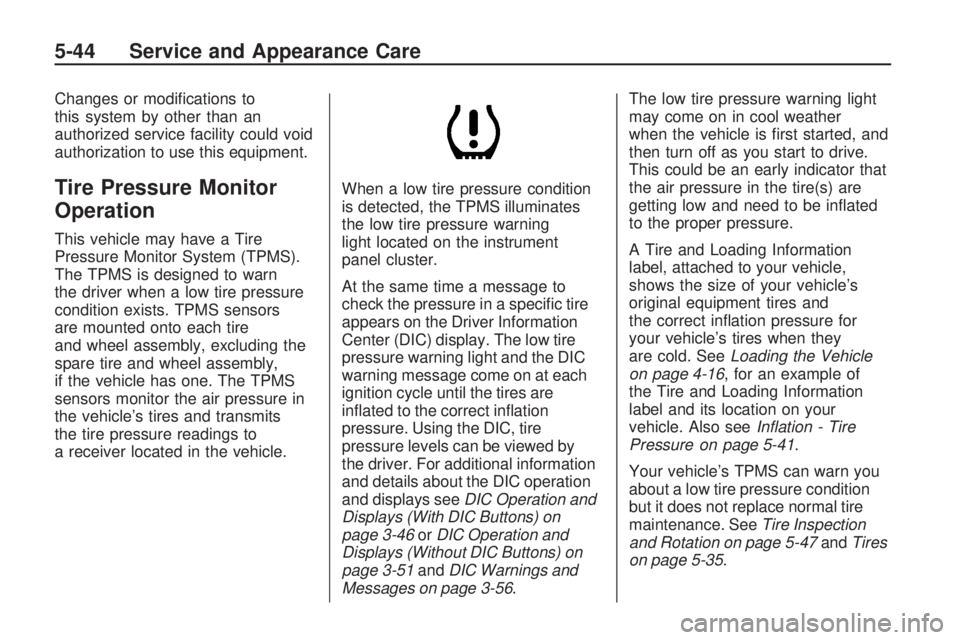
a receiver located in the vehicle.When a low tire pressure condition
is detected, the TPMS illuminates
the low tire pressure warning
light located on the instrument
panel cluster.
At the same time a message to
check the pressure in a specic tire
appears on the Driver Information
Center (DIC) display. The low tire
pressure warning light and the DIC
warning message come on at each
ignition cycle until the tires are
inated to the correct ination
pressure. Using the DIC, tire
pressure levels can be viewed by
the driver. For additional information
and details about the DIC operation
and displays seeDIC Operation and
Displays (With DIC Buttons) on
page 3-46orDIC Operation and
Displays (Without DIC Buttons) on
page 3-51andDIC Warnings and
Messages on page 3-56.The low tire pressure warning light
may come on in cool weather
when the vehicle is rst started, and
then turn off as you start to drive.
This could be an early indicator that
the air pressure in the tire(s) are
getting low and need to be inated
to the proper pressure.
A Tire and Loading Information
label, attached to your vehicle,
shows the size of your vehicle’s
original equipment tires and
the correct ination pressure for
your vehicle’s tires when they
are cold. SeeLoading the Vehicle
on page 4-16, for an example of
the Tire and Loading Information
label and its location on your
vehicle. Also seeInflation - Tire
Pressure on page 5-41.
Your vehicle’s TPMS can warn you
about a low tire pressure condition
but it does not replace normal tire
maintenance. SeeTire Inspection
and Rotation on page 5-47andTires
on page 5-35.
5-44 Service and Appearance Care
Page 325 of 420
You need new tires if any of the
following statements are true:
You can see the indicators at
three or more places around
the tire.
You can see cord or fabric
showing through the tire’s rubber.
The tread or sidewall is cracked,
cut, or snagged deep enough to
show cord or fabric.
The tire has a bump, bulge,
or split.
The tire has a puncture, cut, or
other damage that cannot be
repaired well because of the size
or location of the damage.
The rubber in tires degrades over
time, even if they are not being
used. This is also true for the spare
tire, if the vehicle has one. Multiple
conditions affect how fast this
aging takes place, including
temperatures, loading conditions,
and ination pressure maintenance.With proper care and maintenance
tires typically wear out before
they degrade due to age. If you are
unsure about the need to replace
the tires as they get older, consult
the tire manufacturer for more
information.
Buying New Tires
GM has developed and matched
specic tires for your vehicle. The
original equipment tires installed
on your vehicle, when it was new,
were designed to meet General
Motors Tire Performance Criteria
Specication (TPC Spec) system
rating. If you need replacement
tires, GM strongly recommends
that you get tires with the same
TPC Spec rating. This way, your
vehicle will continue to have tires
that are designed to give the
same performance and vehicle
safety, during normal use, as the
original tires.GM’s exclusive TPC Spec
system considers over a dozen
critical specications that impact
the overall performance of your
vehicle, including brake system
performance, ride and handling,
traction control, and tire pressure
monitoring performance. GM’s
TPC Spec number is molded
onto the tire’s sidewall near the
tire size. If the tires have an
all-season tread design, the TPC
Spec number will be followed
by an MS for mud and snow.
SeeTire Sidewall Labeling
on page 5-36for additional
information.
GM recommends replacing tires
in sets of four. This is because
uniform tread depth on all tires
will help keep your vehicle
performing most like it did
when the tires were new.
Service and Appearance Care 5-49
Page 327 of 420
Additionally, if your vehicle has
electronic systems such as anti-lock
brakes, rollover airbags, traction
control, and electronic stability
control, the performance of these
systems can be affected.
{CAUTION
If you add different sized wheels,
your vehicle may not provide an
acceptable level of performance
and safety if tires not
recommended for those wheels
are selected. You may increase
the chance that you will crash and
suffer serious injury. Only use GM
specic wheel and tire systems
developed for your vehicle, and
have them properly installed by
a GM certied technician.
SeeBuying New Tires on page 5-49
andAccessories and Modifications
on page 5-3for additional
information.
Uniform Tire Quality
Grading
Quality grades can be found
where applicable on the tire
sidewall between tread shoulder
and maximum section width.
For example:
Treadwear 200 Traction AA
Temperature A
The following information relates
to the system developed by the
United States National Highway
Traffic Safety Administration
(NHTSA), which grades tires
by treadwear, traction, and
temperature performance. This
applies only to vehicles sold in
the United States. The grades
are molded on the sidewalls of
most passenger car tires. The
Uniform Tire Quality Grading
(UTQG) system does not apply
to deep tread, winter-type snow
tires, space-saver, or temporary
use spare tires, tires with nominalrim diameters of 10 to 12 inches
(25 to 30 cm), or to some
limited-production tires.
While the tires available on
General Motors passenger cars
and light trucks may vary with
respect to these grades, they
must also conform to federal
safety requirements and
additional General Motors Tire
Performance Criteria (TPC)
standards.
Treadwear
The treadwear grade is a
comparative rating based on the
wear rate of the tire when tested
under controlled conditions on
a specied government test
course. For example, a tire
graded 150 would wear one
and a half (1.5) times as well
on the government course as a
tire graded 100. The relative
performance of tires depends
upon the actual conditions of
their use, however, and may
depart signicantly from the
Service and Appearance Care 5-51
Page 329 of 420
Wheel Alignment and
Tire Balance
The tires and wheels on your vehicle
were aligned and balanced carefully
at the factory to give you the longest
tire life and best overall performance.
Adjustments to wheel alignment and
tire balancing will not be necessary
on a regular basis. However, if you
notice unusual tire wear or your
vehicle pulling to one side or the
other, the alignment might need to be
checked. If you notice your vehicle
vibrating when driving on a smooth
road, the tires and wheels might
need to be rebalanced. See your
dealer/retailer for proper diagnosis.
Wheel Replacement
Replace any wheel that is bent,
cracked, or badly rusted or corroded.
If wheel nuts keep coming loose, the
wheel, wheel bolts, and wheel nuts
should be replaced. If the wheel
leaks air, replace it (except some
aluminum wheels, which can
sometimes be repaired). See your
dealer/retailer if any of these
conditions exist.
Your dealer/retailer will know the
kind of wheel you need.
Each new wheel should have the
same load-carrying capacity,
diameter, width, offset, and be
mounted the same way as the
one it replaces.
If you need to replace any of your
wheels, wheel bolts, wheel nuts,
or Tire Pressure Monitor System
(TPMS) sensors, replace them only
with new GM original equipment
parts. This way, you will be sure to
have the right wheel, wheel bolts,
wheel nuts, and TPMS sensors for
your vehicle.{CAUTION
Using the wrong replacement
wheels, wheel bolts, or wheel
nuts on your vehicle can be
dangerous. It could affect the
braking and handling of your
vehicle, make your tires lose air
and make you lose control. You
could have a collision in which
you or others could be injured.
Always use the correct wheel,
wheel bolts, and wheel nuts for
replacement.
Notice:The wrong wheel can
also cause problems with bearing
life, brake cooling, speedometer
or odometer calibration, headlamp
aim, bumper height, vehicle
ground clearance, and tire or tire
chain clearance to the body and
chassis.
SeeChanging a Flat Tire on
page 5-69for more information.
Service and Appearance Care 5-53
Page 364 of 420
Finish Damage
Any stone chips, fractures or deep
scratches in the nish should be
repaired right away. Bare metal will
corrode quickly and may develop
into major repair expense.
Minor chips and scratches can be
repaired with touch-up materials
available from your dealer/retailer.
Larger areas of nish damage
can be corrected in your dealer’s/
retailer’s body and paint shop.
Underbody Maintenance
Chemicals used for ice and snow
removal and dust control can collect
on the underbody. If these are not
removed, corrosion and rust can
develop on the underbody parts such
as fuel lines, frame, oor pan, and
exhaust system even though they
have corrosion protection.At least every spring, ush these
materials from the underbody
with plain water. Clean any areas
where mud and debris can collect.
Dirt packed in close areas of
the frame should be loosened before
being ushed. Your dealer/retailer
or an underbody car washing
system can do this.
Chemical Paint Spotting
Some weather and atmospheric
conditions can create a chemical
fallout. Airborne pollutants can
fall upon and attack painted surfaces
on the vehicle. This damage can
take two forms: blotchy, ring-shaped
discolorations, and small, irregular
dark spots etched into the paint
surface.
Although no defect in the paint job
causes this, we will repair, at no
charge to the owner, the surfaces
of new vehicles damaged by this
fallout condition within 12 months
or 12,000 miles (20 000 km) of
purchase, whichever occurs rst.
Vehicle Identication
Vehicle Identication
Number (VIN)
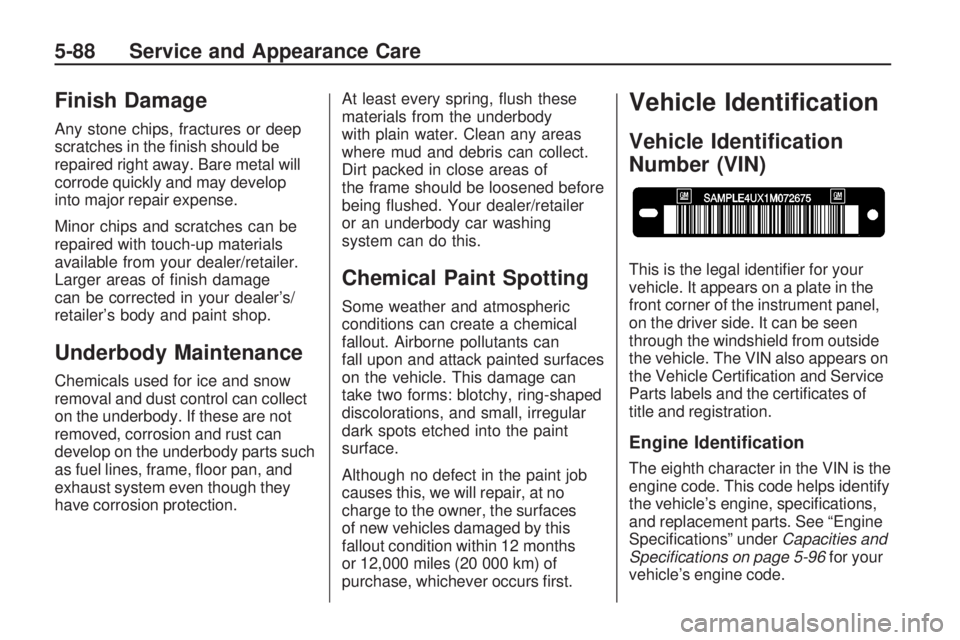
This is the legal identier for your
vehicle. It appears on a plate in the
front corner of the instrument panel,
on the driver side. It can be seen
through the windshield from outside
the vehicle. The VIN also appears on
the Vehicle Certication and Service
Parts labels and the certicates of
title and registration.
Engine Identication
The eighth character in the VIN is the
engine code. This code helps identify
the vehicle’s engine, specications,
and replacement parts. See “Engine
Specications” underCapacities and
Specifications on page 5-96for your
vehicle’s engine code.
5-88 Service and Appearance Care
Page 367 of 420
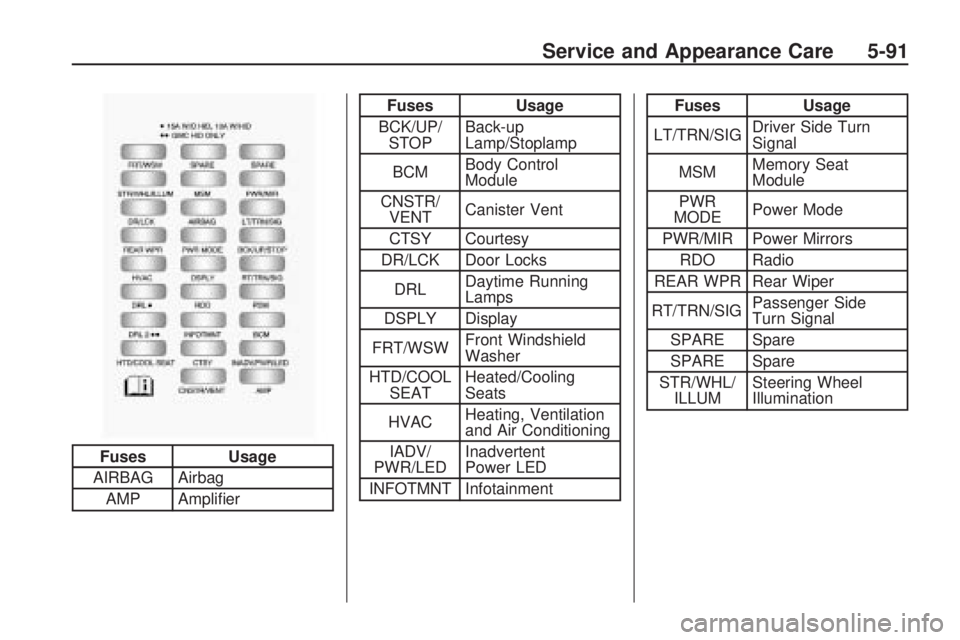
Fuses Usage
AIRBAG Airbag
AMP Amplier
Fuses Usage
BCK/UP/
STOPBack-up
Lamp/Stoplamp
BCMBody Control
Module
CNSTR/
VENTCanister Vent
CTSY Courtesy
DR/LCK Door Locks
DRLDaytime Running
Lamps
DSPLY Display
FRT/WSWFront Windshield
Washer
HTD/COOL
SEATHeated/Cooling
Seats
HVACHeating, Ventilation
and Air Conditioning
IADV/
PWR/LEDInadvertent
Power LED
INFOTMNT InfotainmentFuses Usage
LT/TRN/SIGDriver Side Turn
Signal
MSMMemory Seat
Module
PWR
MODEPower Mode
PWR/MIR Power Mirrors
RDO Radio
REAR WPR Rear Wiper
RT/TRN/SIGPassenger Side
Turn Signal
SPARE Spare
SPARE Spare
STR/WHL/
ILLUMSteering Wheel
Illumination
Fuse Side
Service and Appearance Care 5-91
Page 369 of 420
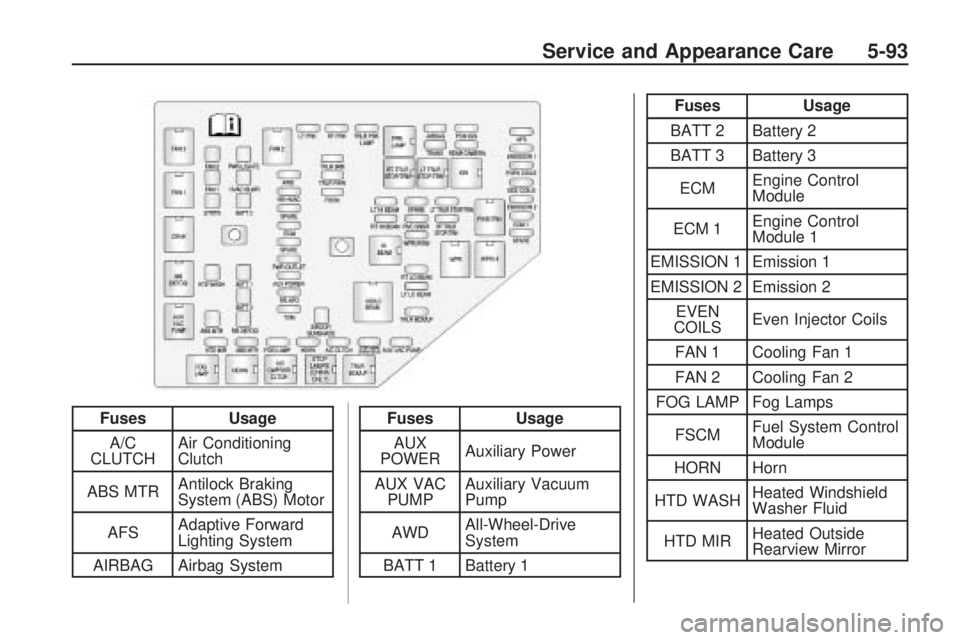
FusesUsage
A/C
CLUTCH Air Conditioning
Clutch
ABS MTR Antilock Braking
System (ABS) Motor
AFS Adaptive Forward
Lighting System
AIRBAG Airbag SystemFuses Usage
AUX
POWER Auxiliary Power
AUX VAC PUMP Auxiliary Vacuum
Pump
AWD All-Wheel-Drive
System
BATT 1 Battery 1
Fuses Usage
BATT 2 Battery 2
BATT 3 Battery 3
ECM Engine Control
Module
ECM 1 Engine Control
Module 1
EMISSION 1 Emission 1
EMISSION 2 Emission 2 EVEN
COILS Even Injector Coils
FAN 1 Cooling Fan 1
FAN 2 Cooling Fan 2
FOG LAMP Fog Lamps
FSCM Fuel System Control
Module
HORN Horn
HTD WASH Heated Windshield
Washer Fluid
HTD MIR Heated Outside
Rearview Mirror
Service and Appearance Care 5-93
Page 370 of 420
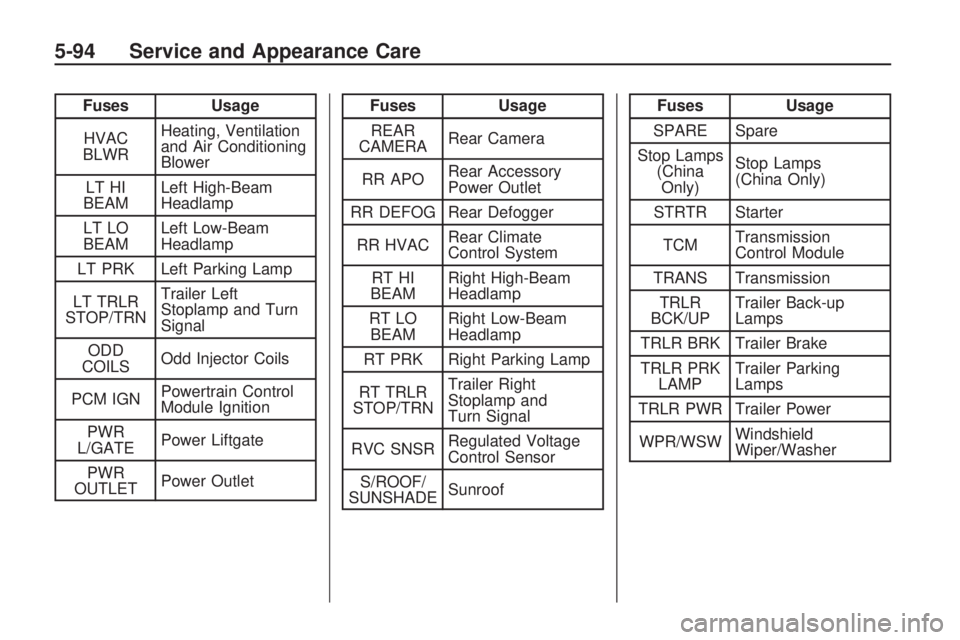
Fuses Usage
HVAC
BLWRHeating, Ventilation
and Air Conditioning
Blower
LT HI
BEAMLeft High-Beam
Headlamp
LT LO
BEAMLeft Low-Beam
Headlamp
LT PRK Left Parking Lamp
LT TRLR
STOP/TRNTrailer Left
Stoplamp and Turn
Signal
ODD
COILSOdd Injector Coils
PCM IGNPowertrain Control
Module Ignition
PWR
L/GATEPower Liftgate
PWR
OUTLETPower OutletFuses Usage
REAR
CAMERARear Camera
RR APORear Accessory
Power Outlet
RR DEFOG Rear Defogger
RR HVACRear Climate
Control System
RT HI
BEAMRight High-Beam
Headlamp
RT LO
BEAMRight Low-Beam
Headlamp
RT PRK Right Parking Lamp
RT TRLR
STOP/TRNTrailer Right
Stoplamp and
Turn Signal
RVC SNSRRegulated Voltage
Control Sensor
S/ROOF/
SUNSHADESunroofFuses Usage
SPARE Spare
Stop Lamps
(China
Only)Stop Lamps
(China Only)
STRTR Starter
TCMTransmission
Control Module
TRANS Transmission
TRLR
BCK/UPTrailer Back-up
Lamps
TRLR BRK Trailer Brake
TRLR PRK
LAMPTrailer Parking
Lamps
TRLR PWR Trailer Power
WPR/WSWWindshield
Wiper/Washer
5-94 Service and Appearance Care