ecu GMC CANYON 2004 Owner's Guide
[x] Cancel search | Manufacturer: GMC, Model Year: 2004, Model line: CANYON, Model: GMC CANYON 2004Pages: 420, PDF Size: 2.84 MB
Page 63 of 420
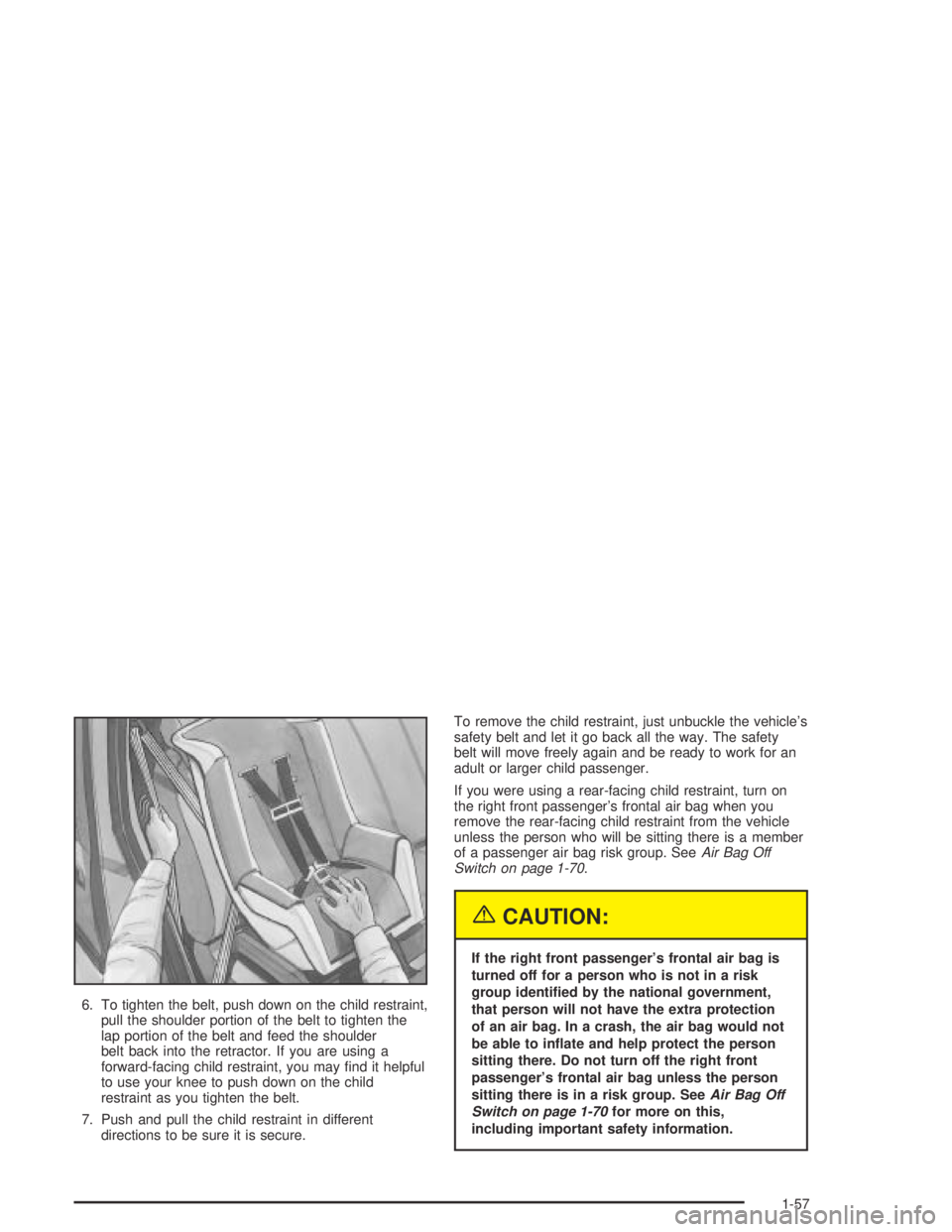
6. To tighten the belt, push down on the child restraint,
pull the shoulder portion of the belt to tighten the
lap portion of the belt and feed the shoulder
belt back into the retractor. If you are using a
forward-facing child restraint, you may nd it helpful
to use your knee to push down on the child
restraint as you tighten the belt.
7. Push and pull the child restraint in different
directions to be sure it is secure.To remove the child restraint, just unbuckle the vehicle’s
safety belt and let it go back all the way. The safety
belt will move freely again and be ready to work for an
adult or larger child passenger.
If you were using a rear-facing child restraint, turn on
the right front passenger’s frontal air bag when you
remove the rear-facing child restraint from the vehicle
unless the person who will be sitting there is a member
of a passenger air bag risk group. SeeAir Bag Off
Switch on page 1-70.
{CAUTION:
If the right front passenger’s frontal air bag is
turned off for a person who is not in a risk
group identied by the national government,
that person will not have the extra protection
of an air bag. In a crash, the air bag would not
be able to inate and help protect the person
sitting there. Do not turn off the right front
passenger’s frontal air bag unless the person
sitting there is in a risk group. SeeAir Bag Off
Switch on page 1-70for more on this,
including important safety information.
1-57
Page 64 of 420
Securing a Child Restraint in the
Right Front Seat Position (Models
without an Air Bag Off Switch)
Crew Cab Models and Extended Cab
Models with Rear Seats
If your child restraint is equipped with the LATCH
system, seeLower Anchorages and Top Tethers for
Children (LATCH System) on page 1-46. SeeTop Strap
on page 1-42if the child restraint has one.
Your vehicle has a right front passenger air bag.
Neverput a rear-facing child restraint in the right front
passenger’s seat. Here is why:
{CAUTION:
A child in a rear-facing child restraint can be
seriously injured or killed if the right front
passenger’s air bag inates. This is because
the back of the rear-facing child restraint
would be very close to the inating air bag.
Always secure a rear-facing child restraint in
a rear seat.A rear seat is a safer place to secure a forward-facing
child restraint. If you need to secure a forward-facing
child restraint in the right front seat position, seeWhere
to Put the Restraint on page 1-40.
If your child restraint does not have the LATCH system,
you will be using the lap-shoulder belt to secure the
child restraint in this position. Be sure to follow the
instructions that came with the child restraint. Secure
the child in the child restraint when and as the
instructions say.
1. Because your vehicle has a right front passenger’s
frontal air bag, always move the seat as far back as
it will go before securing a forward-facing child
restraint. SeeManual Seats on page 1-3orPower
Seats on page 1-4.
2. Put the child restraint on the seat.
3. Pick up the latch plate, and run the lap and shoulder
portions of the vehicle’s safety belt through or
around the restraint. The child restraint instructions
will show you how.
1-58
Page 66 of 420
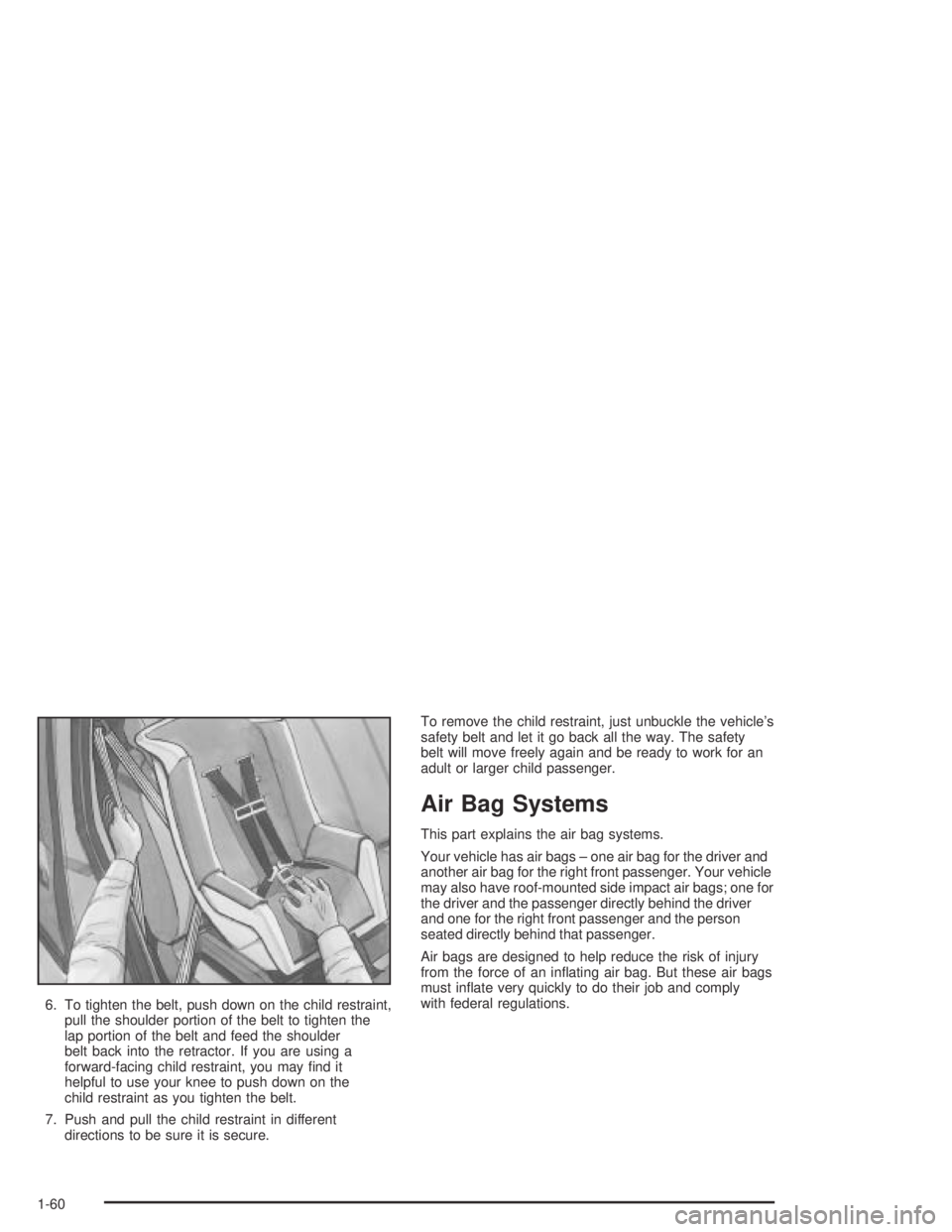
6. To tighten the belt, push down on the child restraint,
pull the shoulder portion of the belt to tighten the
lap portion of the belt and feed the shoulder
belt back into the retractor. If you are using a
forward-facing child restraint, you may nd it
helpful to use your knee to push down on the
child restraint as you tighten the belt.
7. Push and pull the child restraint in different
directions to be sure it is secure.To remove the child restraint, just unbuckle the vehicle’s
safety belt and let it go back all the way. The safety
belt will move freely again and be ready to work for an
adult or larger child passenger.
Air Bag Systems
This part explains the air bag systems.
Your vehicle has air bags – one air bag for the driver and
another air bag for the right front passenger. Your vehicle
may also have roof-mounted side impact air bags; one for
the driver and the passenger directly behind the driver
and one for the right front passenger and the person
seated directly behind that passenger.
Air bags are designed to help reduce the risk of injury
from the force of an inating air bag. But these air bags
must inate very quickly to do their job and comply
with federal regulations.
1-60
Page 68 of 420
{CAUTION:
Both frontal and side impact air bags inate
with great force, faster than the blink of an
eye. If you’re too close to an inating air bag,
as you would be if you were leaning forward,
it could seriously injure you. Safety belts help
keep you in position for air bag ination before
and during a crash. Always wear your safety
belt even with frontal air bags. The driver
should sit as far back as possible while still
maintaining control of the vehicle. Occupants
should not lean on or sleep against the door.
{CAUTION:
Anyone who is up against, or very close to,
any air bag when it inates can be seriously
injured or killed. Air bags plus lap-shoulder
belts offer the best protection for adults, but
not for young children and infants. Neither the
vehicle’s safety belt system nor its air bag
system is designed for them. Young children
and infants need the protection that a child
restraint system can provide. Always secure
children properly in your vehicle. To read how,
see the part of this manual called “Older
Children” or “Infants and Young Children.”
1-62
Page 71 of 420
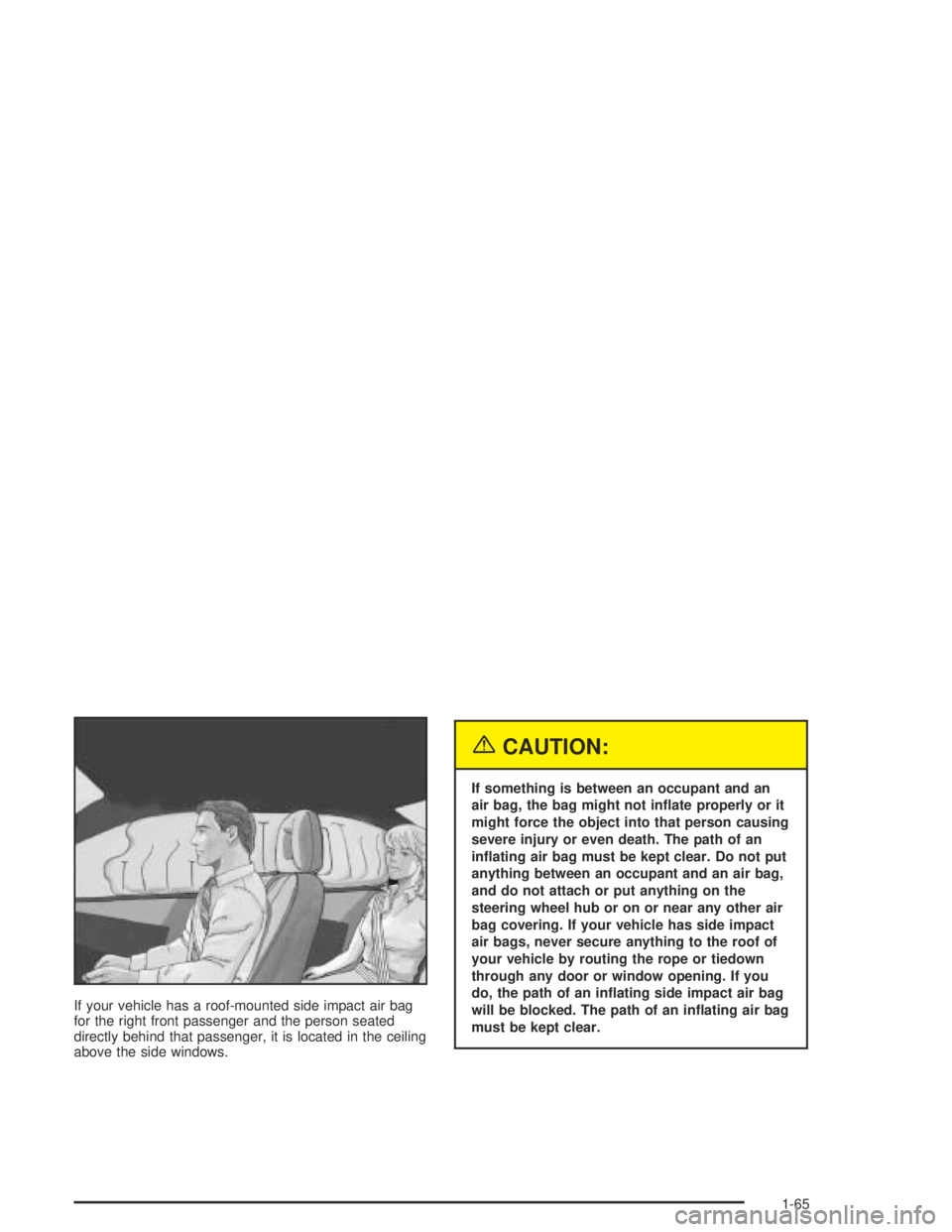
If your vehicle has a roof-mounted side impact air bag
for the right front passenger and the person seated
directly behind that passenger, it is located in the ceiling
above the side windows.
{CAUTION:
If something is between an occupant and an
air bag, the bag might not inate properly or it
might force the object into that person causing
severe injury or even death. The path of an
inating air bag must be kept clear. Do not put
anything between an occupant and an air bag,
and do not attach or put anything on the
steering wheel hub or on or near any other air
bag covering. If your vehicle has side impact
air bags, never secure anything to the roof of
your vehicle by routing the rope or tiedown
through any door or window opening. If you
do, the path of an inating side impact air bag
will be blocked. The path of an inating air bag
must be kept clear.
1-65
Page 78 of 420
{CAUTION:
If the air bag readiness light ever comes on
when you have turned off the air bag, it means
that something may be wrong with the air bag
system. The right front passenger’s frontal air
bag could inate even though the switch is off.
If this ever happens, do not let anyone whom
the national government has identied as a
member of a passenger air bag risk group
sit in the right front passenger’s position
(for example, do not secure a rear-facing child
restraint in the right front passenger’s seat)
until you have your vehicle serviced.
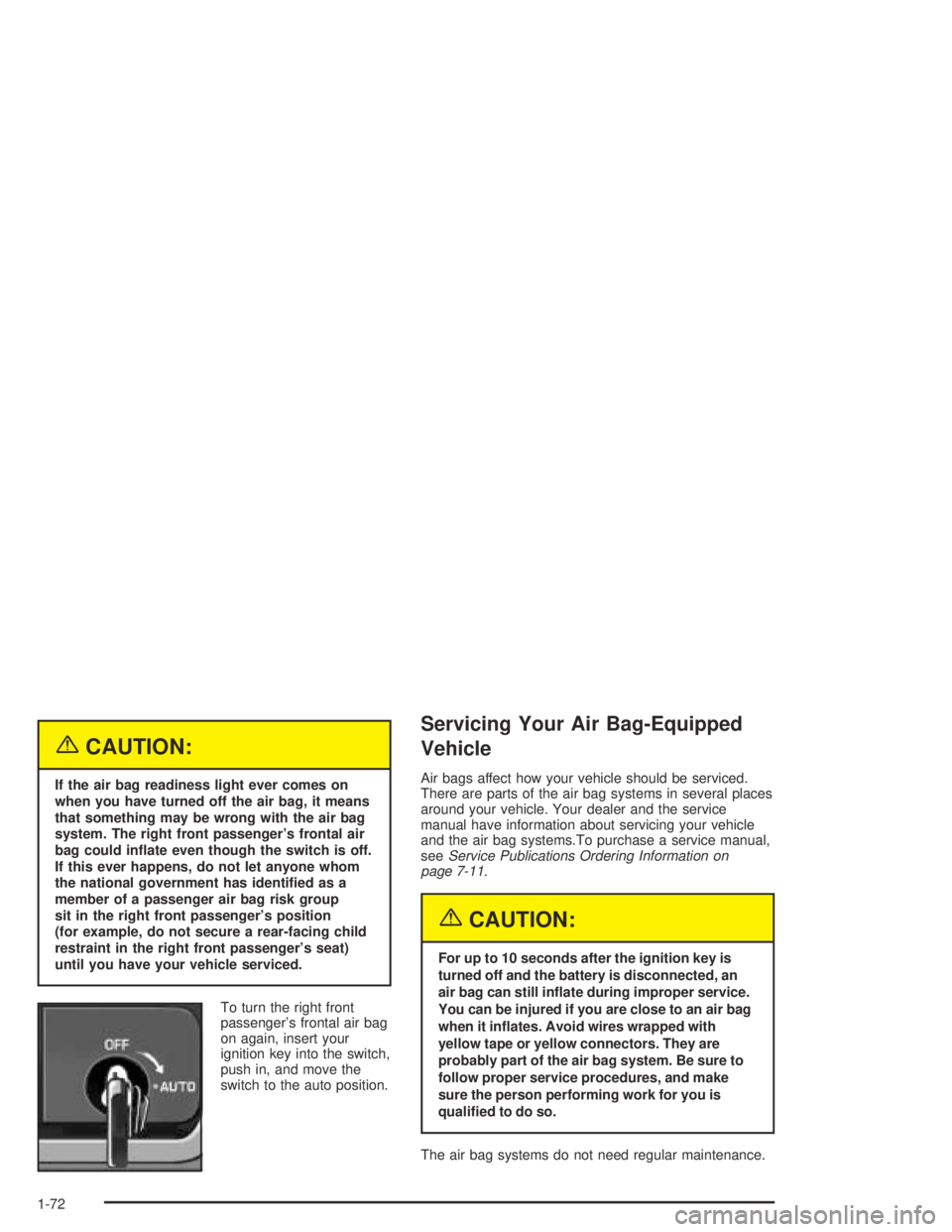
To turn the right front
passenger’s frontal air bag
on again, insert your
ignition key into the switch,
push in, and move the
switch to the auto position.
Servicing Your Air Bag-Equipped
Vehicle
Air bags affect how your vehicle should be serviced.
There are parts of the air bag systems in several places
around your vehicle. Your dealer and the service
manual have information about servicing your vehicle
and the air bag systems.To purchase a service manual,
seeService Publications Ordering Information on
page 7-11.
{CAUTION:
For up to 10 seconds after the ignition key is
turned off and the battery is disconnected, an
air bag can still inate during improper service.
You can be injured if you are close to an air bag
when it inates. Avoid wires wrapped with
yellow tape or yellow connectors. They are
probably part of the air bag system. Be sure to
follow proper service procedures, and make
sure the person performing work for you is
qualied to do so.
The air bag systems do not need regular maintenance.
1-72
Page 79 of 420
Adding Equipment to Your
Air Bag-Equipped Vehicle
Q:Is there anything I might add to the front of
the vehicle that could keep the air bags from
working properly?
A:Yes. If you add things that change your vehicle’s
frame, bumper system, front end sheet metal or
height, they may keep the air bag system from
working properly. Also, the air bag system may not
work properly if you relocate any of the air bag
sensors. If you have any questions about this,
you should contact Customer Assistance before
you modify your vehicle. The phone numbers
and addresses for Customer Assistance are in
Step Two of theCustomer Satisfaction Procedure
on page 7-2.
Restraint System Check
Checking Your Restraint Systems
Now and then, make sure the safety belt reminder light
and all your belts, buckles, latch plates, retractors
and anchorages are working properly. Look for any other
loose or damaged safety belt system parts. If you see
anything that might keep a safety belt system from doing
its job, have it repaired.
Torn or frayed safety belts may not protect you in a
crash. They can rip apart under impact forces. If a belt
is torn or frayed, get a new one right away.
Also look for any opened or broken air bag covers, and
have them repaired or replaced. (The air bag system
does not need regular maintenance.)
1-73
Page 81 of 420
Keys...............................................................2-2
Remote Keyless Entry System.........................2-4
Remote Keyless Entry System Operation...........2-5
Doors and Locks.............................................2-7
Door Locks....................................................2-7
Power Door Locks..........................................2-8
Programmable Automatic Door Locks................2-8
Rear Door Security Locks (Crew Cab)...............2-9
Lockout Protection..........................................2-9
Leaving Your Vehicle....................................2-10
Rear Doors (Extended Cab)...........................2-10
Tailgate.......................................................2-10
Windows........................................................2-12
Manual Windows..........................................2-12
Power Windows............................................2-13
Sliding Rear Window.....................................2-14
Sun Visors...................................................2-14
Theft-Deterrent Systems..................................2-14
Content Theft-Deterrent.................................2-14
Passlock
®....................................................2-16
Starting and Operating Your Vehicle................2-16
New Vehicle Break-In....................................2-16
Ignition Positions..........................................2-17
Starting Your Engine.....................................2-18
Engine Coolant Heater..................................2-20
Automatic Transmission Operation...................2-21
Manual Transmission Operation......................2-24Four-Wheel Drive..........................................2-26
Parking Brake..............................................2-29
Shifting Into Park (P)
(Automatic Transmission)............................2-30
Shifting Out of Park (P)
(Automatic Transmission)............................2-32
Parking Your Vehicle (Manual Transmission).......2-33
Parking Over Things That Burn.......................2-33
Engine Exhaust............................................2-34
Running Your Engine While You Are Parked.......2-34
Mirrors...........................................................2-36
Manual Rearview Mirror.................................2-36
Manual Rearview Mirror with OnStar
®..............2-36
Automatic Dimming Rearview Mirror with
Compass and Temperature Display..............2-37
Outside Manual Mirrors..................................2-39
Outside Power Mirrors...................................2-40
Outside Convex Mirror...................................2-40
OnStar
®System.............................................2-41
Storage Areas................................................2-42
Glove Box...................................................2-42
Cupholder(s)................................................2-42
Front Armrest Storage Area...........................2-43
Assist Handles.............................................2-43
Rear Storage Area........................................2-43
Bed Rails....................................................2-43
Section 2 Features and Controls
2-1
Page 89 of 420
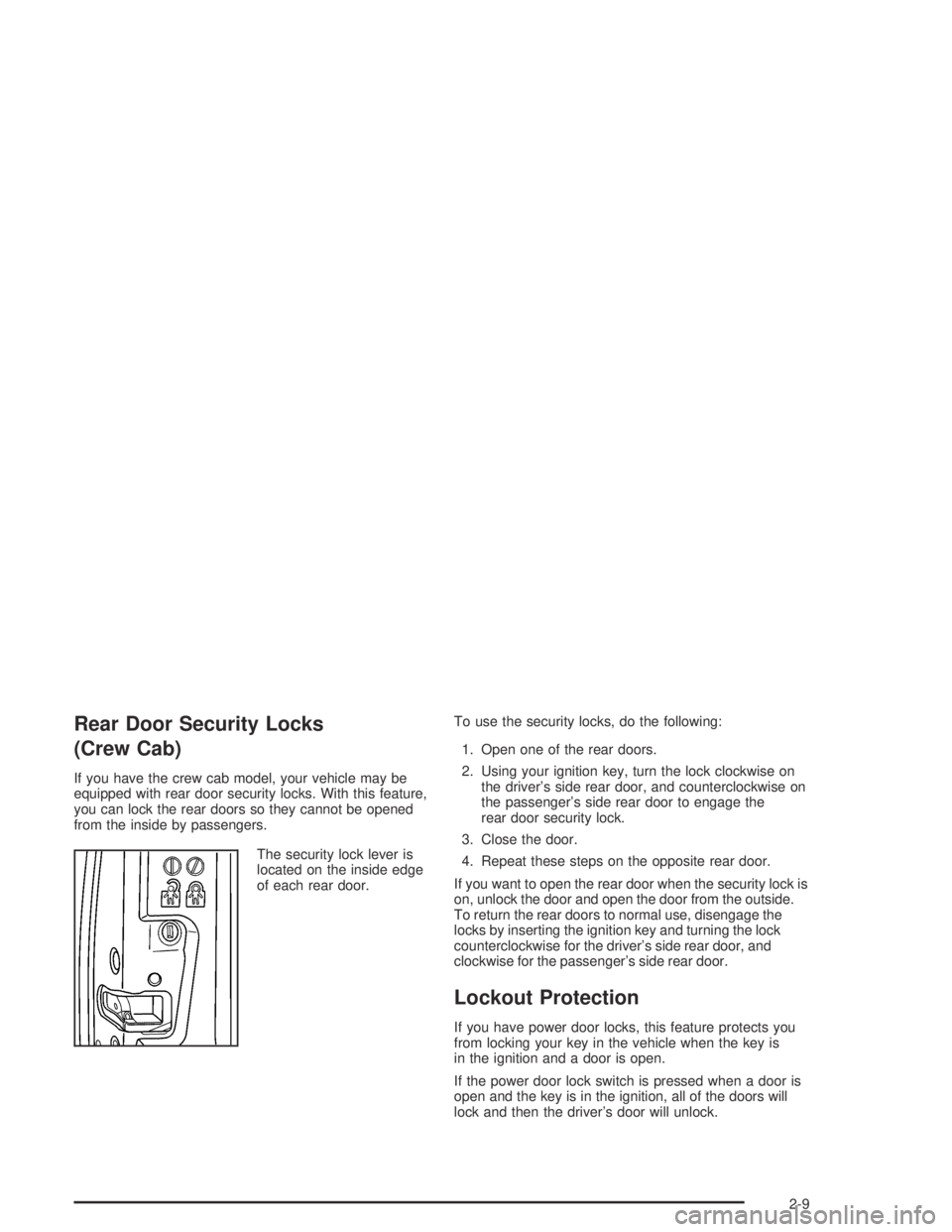
Rear Door Security Locks
(Crew Cab)
If you have the crew cab model, your vehicle may be
equipped with rear door security locks. With this feature,
you can lock the rear doors so they cannot be opened
from the inside by passengers.
The security lock lever is
located on the inside edge
of each rear door.To use the security locks, do the following:
1. Open one of the rear doors.
2. Using your ignition key, turn the lock clockwise on
the driver’s side rear door, and counterclockwise on
the passenger’s side rear door to engage the
rear door security lock.
3. Close the door.
4. Repeat these steps on the opposite rear door.
If you want to open the rear door when the security lock is
on, unlock the door and open the door from the outside.
To return the rear doors to normal use, disengage the
locks by inserting the ignition key and turning the lock
counterclockwise for the driver’s side rear door, and
clockwise for the passenger’s side rear door.
Lockout Protection
If you have power door locks, this feature protects you
from locking your key in the vehicle when the key is
in the ignition and a door is open.
If the power door lock switch is pressed when a door is
open and the key is in the ignition, all of the doors will
lock and then the driver’s door will unlock.
2-9
Page 90 of 420
Leaving Your Vehicle
If you are leaving the vehicle, take your keys, open your
door and set the locks from inside. Then get out and
close the door.
Rear Doors (Extended Cab)
If you have an extended cab, your vehicle has rear
doors for convenience in loading and unloading cargo.
To open a rear door, open the front door. Then, use
the handle located on the front edge of the rear
door panel to open it. You must close the rear door
before closing the front door.
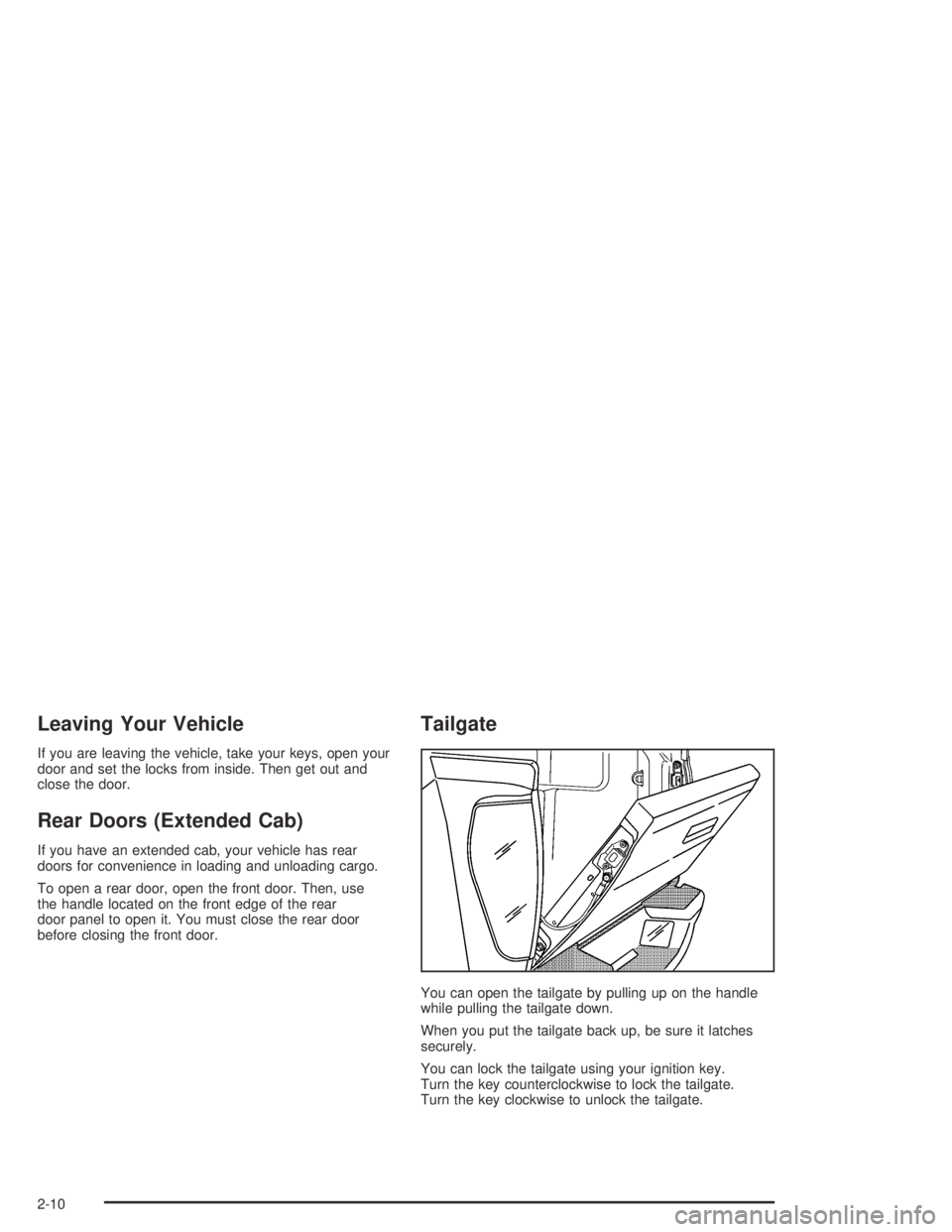
Tailgate
You can open the tailgate by pulling up on the handle
while pulling the tailgate down.
When you put the tailgate back up, be sure it latches
securely.
You can lock the tailgate using your ignition key.
Turn the key counterclockwise to lock the tailgate.
Turn the key clockwise to unlock the tailgate.
2-10