steering GMC CANYON 2004 Owner's Guide
[x] Cancel search | Manufacturer: GMC, Model Year: 2004, Model line: CANYON, Model: GMC CANYON 2004Pages: 420, PDF Size: 2.84 MB
Page 337 of 420
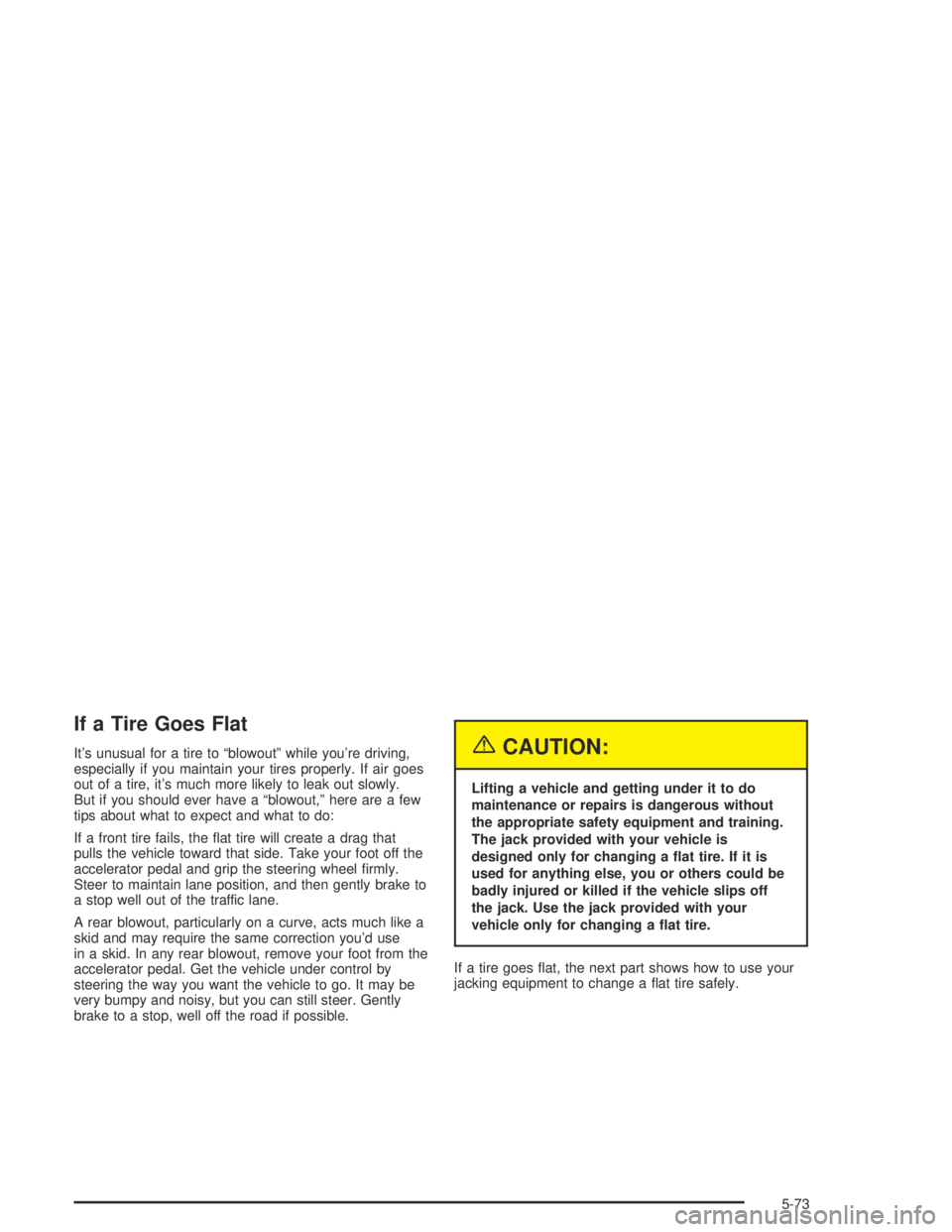
If a Tire Goes Flat
It’s unusual for a tire to “blowout” while you’re driving,
especially if you maintain your tires properly. If air goes
out of a tire, it’s much more likely to leak out slowly.
But if you should ever have a “blowout,” here are a few
tips about what to expect and what to do:
If a front tire fails, the at tire will create a drag that
pulls the vehicle toward that side. Take your foot off the
accelerator pedal and grip the steering wheel rmly.
Steer to maintain lane position, and then gently brake to
a stop well out of the traffic lane.
A rear blowout, particularly on a curve, acts much like a
skid and may require the same correction you’d use
in a skid. In any rear blowout, remove your foot from the
accelerator pedal. Get the vehicle under control by
steering the way you want the vehicle to go. It may be
very bumpy and noisy, but you can still steer. Gently
brake to a stop, well off the road if possible.{CAUTION:
Lifting a vehicle and getting under it to do
maintenance or repairs is dangerous without
the appropriate safety equipment and training.
The jack provided with your vehicle is
designed only for changing a at tire. If it is
used for anything else, you or others could be
badly injured or killed if the vehicle slips off
the jack. Use the jack provided with your
vehicle only for changing a at tire.
If a tire goes at, the next part shows how to use your
jacking equipment to change a at tire safely.
5-73
Page 379 of 420
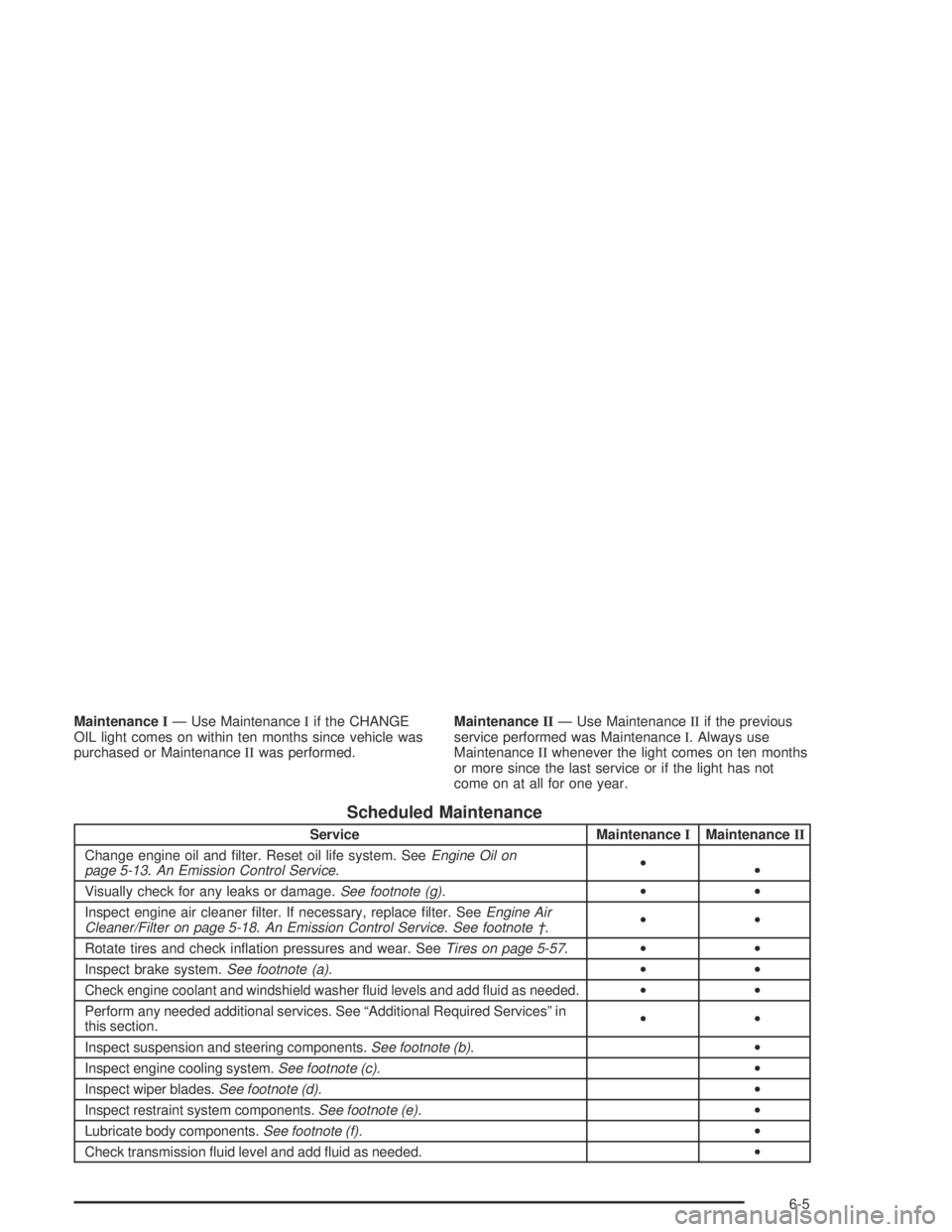
MaintenanceI— Use MaintenanceIif the CHANGE
OIL light comes on within ten months since vehicle was
purchased or MaintenanceIIwas performed.MaintenanceII— Use MaintenanceIIif the previous
service performed was MaintenanceI. Always use
MaintenanceIIwhenever the light comes on ten months
or more since the last service or if the light has not
come on at all for one year.
Scheduled Maintenance
Service MaintenanceIMaintenanceII
Change engine oil and lter. Reset oil life system. SeeEngine Oil on
page 5-13.An Emission Control Service.•
•
Visually check for any leaks or damage.See footnote (g).••
Inspect engine air cleaner lter. If necessary, replace lter. SeeEngine Air
Cleaner/Filter on page 5-18.An Emission Control Service. See footnote †.••
Rotate tires and check ination pressures and wear. SeeTires on page 5-57.••
Inspect brake system.See footnote (a).••
Check engine coolant and windshield washer uid levels and add uid as needed.••
Perform any needed additional services. See “Additional Required Services” in
this section.••
Inspect suspension and steering components.See footnote (b).•
Inspect engine cooling system.See footnote (c).•
Inspect wiper blades.See footnote (d).•
Inspect restraint system components.See footnote (e).•
Lubricate body components.See footnote (f).•
Check transmission uid level and add uid as needed.•
6-5
Page 381 of 420
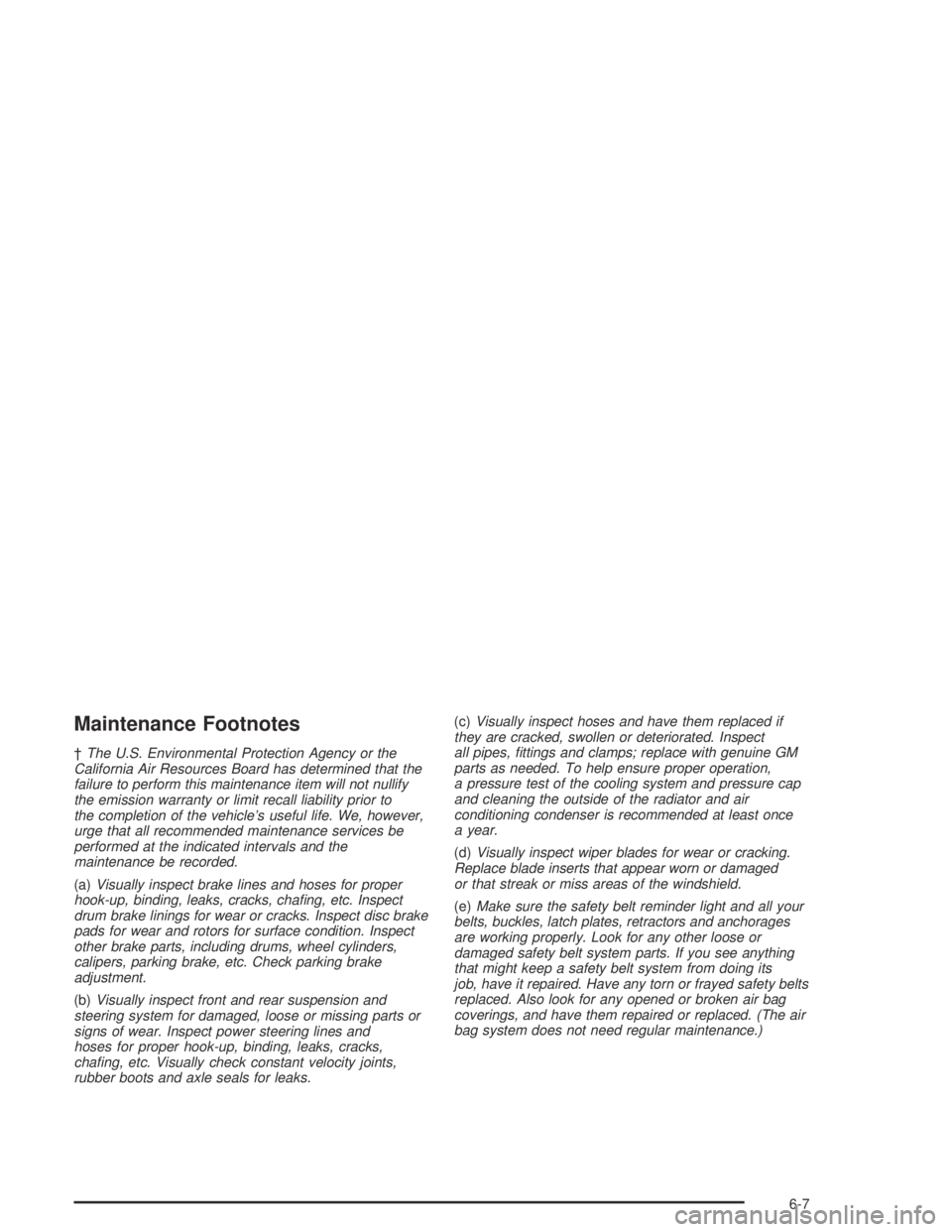
Maintenance Footnotes
†The U.S. Environmental Protection Agency or the
California Air Resources Board has determined that the
failure to perform this maintenance item will not nullify
the emission warranty or limit recall liability prior to
the completion of the vehicle’s useful life. We, however,
urge that all recommended maintenance services be
performed at the indicated intervals and the
maintenance be recorded.
(a)Visually inspect brake lines and hoses for proper
hook-up, binding, leaks, cracks, chang, etc. Inspect
drum brake linings for wear or cracks. Inspect disc brake
pads for wear and rotors for surface condition. Inspect
other brake parts, including drums, wheel cylinders,
calipers, parking brake, etc. Check parking brake
adjustment.
(b)Visually inspect front and rear suspension and
steering system for damaged, loose or missing parts or
signs of wear. Inspect power steering lines and
hoses for proper hook-up, binding, leaks, cracks,
chang, etc. Visually check constant velocity joints,
rubber boots and axle seals for leaks.(c)Visually inspect hoses and have them replaced if
they are cracked, swollen or deteriorated. Inspect
all pipes, ttings and clamps; replace with genuine GM
parts as needed. To help ensure proper operation,
a pressure test of the cooling system and pressure cap
and cleaning the outside of the radiator and air
conditioning condenser is recommended at least once
a year.
(d)Visually inspect wiper blades for wear or cracking.
Replace blade inserts that appear worn or damaged
or that streak or miss areas of the windshield.
(e)Make sure the safety belt reminder light and all your
belts, buckles, latch plates, retractors and anchorages
are working properly. Look for any other loose or
damaged safety belt system parts. If you see anything
that might keep a safety belt system from doing its
job, have it repaired. Have any torn or frayed safety belts
replaced. Also look for any opened or broken air bag
coverings, and have them repaired or replaced. (The air
bag system does not need regular maintenance.)
6-7
Page 387 of 420
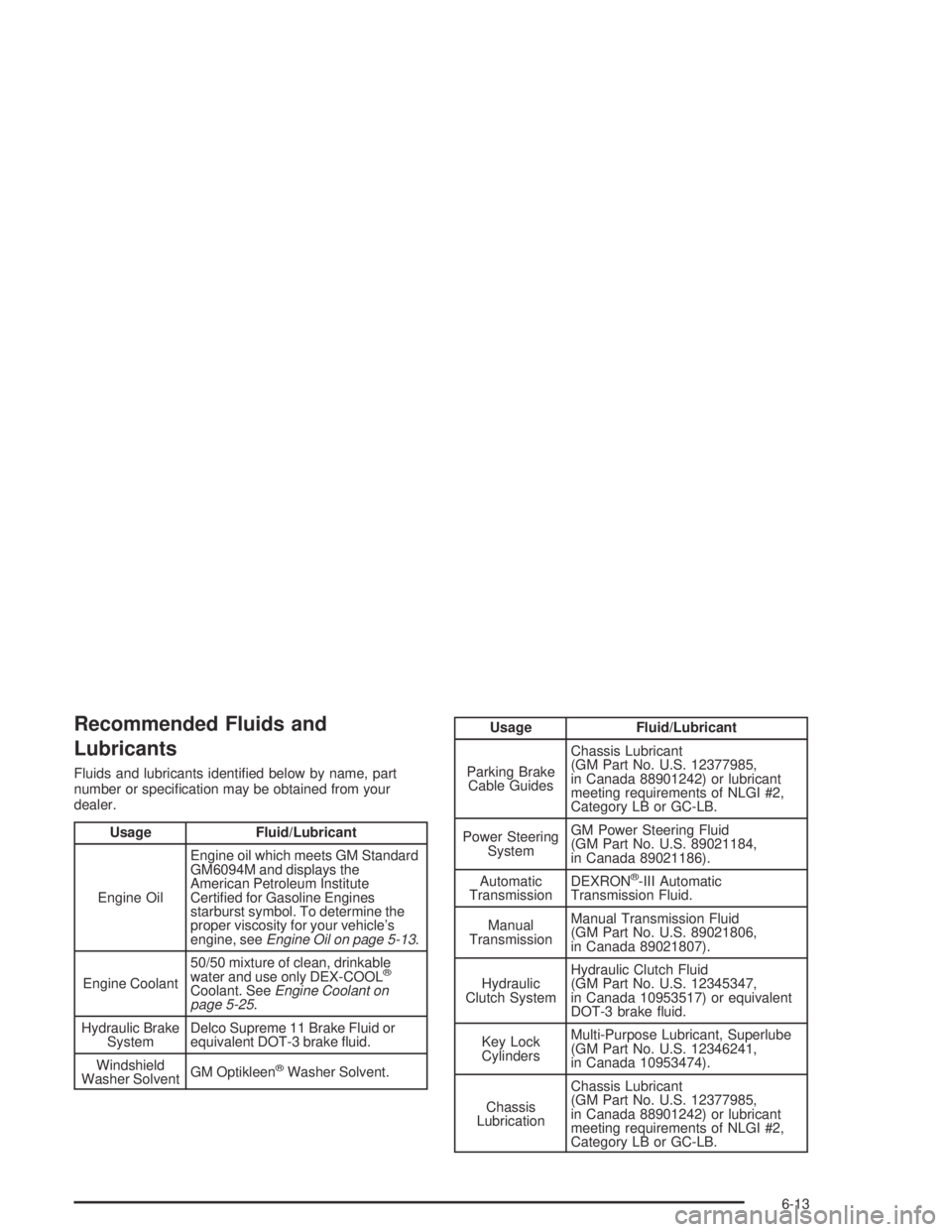
Recommended Fluids and
Lubricants
Fluids and lubricants identied below by name, part
number or specication may be obtained from your
dealer.
Usage Fluid/Lubricant
Engine OilEngine oil which meets GM Standard
GM6094M and displays the
American Petroleum Institute
Certied for Gasoline Engines
starburst symbol. To determine the
proper viscosity for your vehicle’s
engine, seeEngine Oil on page 5-13.
Engine Coolant50/50 mixture of clean, drinkable
water and use only DEX-COOL
®
Coolant. SeeEngine Coolant on
page 5-25.
Hydraulic Brake
SystemDelco Supreme 11 Brake Fluid or
equivalent DOT-3 brake uid.
Windshield
Washer SolventGM Optikleen
®Washer Solvent.
Usage Fluid/Lubricant
Parking Brake
Cable GuidesChassis Lubricant
(GM Part No. U.S. 12377985,
in Canada 88901242) or lubricant
meeting requirements of NLGI #2,
Category LB or GC-LB.
Power Steering
SystemGM Power Steering Fluid
(GM Part No. U.S. 89021184,
in Canada 89021186).
Automatic
TransmissionDEXRON
®-III Automatic
Transmission Fluid.
Manual
TransmissionManual Transmission Fluid
(GM Part No. U.S. 89021806,
in Canada 89021807).
Hydraulic
Clutch SystemHydraulic Clutch Fluid
(GM Part No. U.S. 12345347,
in Canada 10953517) or equivalent
DOT-3 brake uid.
Key Lock
CylindersMulti-Purpose Lubricant, Superlube
(GM Part No. U.S. 12346241,
in Canada 10953474).
Chassis
LubricationChassis Lubricant
(GM Part No. U.S. 12377985,
in Canada 88901242) or lubricant
meeting requirements of NLGI #2,
Category LB or GC-LB.
6-13
Page 403 of 420
Reporting Safety Defects to the
Canadian Government
If you live in Canada, and you believe that your vehicle
has a safety defect, you should immediately notify
Transport Canada, in addition to notifying General
Motors of Canada Limited. You may write to:
Transport Canada
330 Sparks Street
Tower C
Ottawa, Ontario K1A 0N5
Reporting Safety Defects to
General Motors
In addition to notifying NHTSA (or Transport Canada) in
a situation like this, we certainly hope you’ll notify us.
Please call us at 1-800-GMC-8782 (1-800-462-8782),
or write:
Pontiac-GMC Customer Assistance Center
P.O. Box 33172
Detroit, MI 48232-5172
In Canada, please call us at 1-800-263-3777 (English)
or 1-800-263-7854 (French). Or, write:
General Motors of Canada Limited
Customer Communication Centre, 163-005
1908 Colonel Sam Drive
Oshawa, Ontario L1H 8P7
Service Publications Ordering
Information
Service Manuals
Service Manuals have the diagnosis and repair
information on engines, transmission, axle, suspension,
brakes, electrical, steering, body, etc.
RETAIL SELL PRICE: $120.00
Transmission, Transaxle, Transfer
Case Unit Repair Manual
This manual provides information on unit repair service
procedures, adjustments, and specications for GM
transmissions, transaxles, and transfer cases.
RETAIL SELL PRICE: $50.00
Service Bulletins
Service Bulletins give technical service information
needed to knowledgeably service General Motors cars
and trucks. Each bulletin contains instructions to
assist in the diagnosis and service of your vehicle.
In Canada, information pertaining to Product Service
Bulletins can be obtained by contacting your General
Motors dealer or by calling 1-800-GM-DRIVE
(1-800-463-7483).
7-11
Page 410 of 420
Event Data Recorders (EDR)............................. 7-9
Exit Lighting...................................................3-16
Express Down Windows..................................2-13
Extender, Safety Belt.......................................1-30
Exterior Lamps...............................................3-12
F
Fan Knob......................................................3-18
Filter
Engine Air Cleaner......................................5-18
Finding a Program Type (PTY) Station.........3-50, 3-59
Finding a Station............................3-44, 3-48, 3-57
Finish Care....................................................5-98
Finish Damage.............................................5-100
Five-Speed....................................................2-24
Fixed Mast Antenna........................................3-68
Flash-to-Pass................................................... 3-7
Flat Tire........................................................5-73
Flat Tire, Changing.........................................5-74
FLUID...........................................................3-40
Fluid
Automatic Transmission................................5-19
Manual Transmission....................................5-22
Power Steering...........................................5-36
Windshield Washer......................................5-37
FM ...............................................................3-68
Fog Lamps....................................................3-14Following Distance..........................................4-70
Four-Wheel Drive....................................2-26, 5-48
Front Armrest Storage Area..............................2-43
Front Axle......................................................5-49
Fuel............................................................... 5-5
Additives...................................................... 5-6
California Fuel.............................................. 5-6
Filling a Portable Fuel Container....................5-10
Filling Your Tank........................................... 5-7
Fuels in Foreign Countries.............................. 5-7
Gage.........................................................3-36
Gasoline Octane........................................... 5-5
Gasoline Specications.................................. 5-5
FUEL CAP.....................................................3-40
Fuses
Fuses and Circuit Breakers.........................5-104
Windshield Wiper.......................................5-104
G
Gage
Engine Coolant Temperature.........................3-30
Fuel..........................................................3-36
Speedometer..............................................3-24
Tachometer.................................................3-24
Gasoline
Octane........................................................ 5-5
Specications............................................... 5-5
6
Page 411 of 420
Getting Familiar with Off-Road Driving................4-18
Glove Box.....................................................2-42
GM Mobility Program for Persons with
Disabilities.................................................... 7-5
GM Oil Life System™......................................3-38
H
Hazard Warning Flashers................................... 3-4
Head Restraints............................................... 1-7
Headlamp High/Low-Beam Changer.................... 3-7
Headlamps....................................................5-50
Bulb Replacement.......................................5-50
Front Turn Signal, Sidemarker and
Daytime Running Lamps...........................5-52
Halogen Bulbs............................................5-50
Heated Seats................................................... 1-5
Highbeam On Light.........................................3-35
Highway Hypnosis...........................................4-37
Hill and Mountain Roads..................................4-38
Hitches..........................................................4-68
Hood
Checking Things Under................................5-10
Release.....................................................5-11
Horn............................................................... 3-4
How to Add Coolant to the Coolant
Recovery Tank............................................5-32
How to Add Coolant to the Radiator..................5-34How to Add Fluid....................................5-22, 5-23
How to Check................................5-20, 5-22, 5-65
How to Check and Add Fluid............................5-24
How to Check Lubricant..........................5-47, 5-49
How to Check Power Steering Fluid..................5-36
How to Inspect the Engine Air Cleaner/Filter.......5-18
How to Use This Manual...................................... ii
How to Wear Safety Belts Properly...................1-16
Hydraulic Clutch.............................................5-24
Hydroplaning..................................................4-33
I
If No Steam Is Coming From Your Engine..........5-29
If Steam Is Coming From Your Engine...............5-28
If the Light is Flashing.....................................3-32
If the Light Is On Steady.................................3-32
If You Are Caught in a Blizzard.........................4-42
If You Are Stuck in Sand, Mud, Ice or Snow.......4-44
If You Do Decide To Pull A Trailer.....................4-61
Ignition Positions.............................................2-17
Infants and Young Children, Restraints...............1-34
Ination - Tire Pressure...................................5-64
Instrument Panel
Cluster.......................................................3-23
Overview..................................................... 3-2
Instrument Panel Brightness.............................3-15
Interior Lamps................................................3-15
7
Page 414 of 420
O
Odometer......................................................3-24
Odometer, Trip...............................................3-24
Off-Road Recovery..........................................4-12
OIL ...............................................................3-41
Oil
Engine.......................................................5-13
Pressure Light.............................................3-34
OIL LIFE.......................................................3-41
Older Children, Restraints................................1-31
Online Owner Center........................................ 7-3
OnStar
®Personal Calling.................................2-42
OnStar®Services............................................2-41
OnStar®System.............................................2-41
OnStar®Virtual Advisor....................................2-42
Operating Your All-Wheel-Drive Vehicle
Off Paved Roads.........................................4-15
Other Warning Devices...................................... 3-4
Outlet Adjustment............................................3-21
Outside
Convex Mirror.............................................2-40
Manual Mirrors............................................2-39
Power Mirrors.............................................2-40
Owner Checks and Services.............................. 6-9
Owners, Canadian............................................... ii
Owner’s Information........................................7-12
P
PARK BRK (Brake).........................................3-41
Park (P)
Shifting Into................................................2-30
Shifting Out of............................................2-32
Parking
Brake........................................................2-29
Over Things That Burn.................................2-33
Parking on Hills..............................................4-71
Parking Your Vehicle.......................................2-33
Passing.................................................4-13, 4-70
Passlock
®......................................................2-16
Payload.........................................................4-57
Pickup Conversion to Chassis Cab....................4-59
Plan Ahead When Possible................................ 7-7
Playing a CD.........................................3-53, 3-62
Playing a Specic Loaded CD..........................3-63
Playing the Radio...........................3-44, 3-47, 3-56
Power
Accessory Outlets........................................3-16
Door Locks.................................................. 2-8
Electrical System.......................................5-104
Seat............................................................ 1-4
Steering Fluid.............................................5-36
Windows....................................................2-13
10
Page 415 of 420
Power and Heated Seat Circuit Breakers..........5-104
Power Steering...............................................4-10
Pretensioners, Safety Belt................................1-30
Programmable Automatic Door Locks.................. 2-8
Q
Questions and Answers About Safety Belts.........1-15
R
Radiator Pressure Cap....................................5-28
Radio Data System (RDS).......................3-50, 3-59
Radio Messages.....................................3-46, 3-53
Radios..........................................................3-42
AM-FM Radio.............................................3-44
Care of Your CD Player...............................3-68
Care of Your CDs........................................3-68
Radio with CD............................................3-47
Radio with Six-Disc CD................................3-56
Setting the Time for Radios with
Radio Data Systems (RDS).......................3-43
Setting the Time for Radios without
Radio Data Systems (RDS).......................3-43
Theft-Deterrent............................................3-67
Understanding Reception..............................3-68
RDS Messages......................................3-52, 3-61Rear Axle......................................................5-47
Rear Door Security Locks.................................. 2-9
Rear Doors....................................................2-10
Rear Safety Belt Comfort Guides......................1-28
Rear Seat Operation.................................1-9, 1-10
Rear Seat Passengers, Safety Belts..................1-26
Rear Storage Area..........................................2-43
Rearview Mirror, Automatic Dimming with
Compass and Temperature Display................2-37
Rearview Mirror with OnStar
®...........................2-36
Rearview Mirrors.............................................2-36
Reclining Seatbacks.......................................... 1-6
Recommended Fluids and Lubricants.................6-13
Recreational Vehicle Towing.............................4-47
REDUCED POWER........................................3-41
Regular Cab Models and
Extended Cab Models
without Rear Seats..............3-26, 1-48, 1-54, 1-70
Remote Keyless Entry System............................ 2-4
Remote Keyless Entry System, Operation............ 2-5
Removing the Flat Tire and Installing the
Spare Tire..................................................5-78
Removing the Spare Tire and Tools...................5-75
Replacement Bulbs.........................................5-54
Replacing Brake System Parts..........................5-41
Replacing Restraint System Parts
After a Crash..............................................1-74
11
Page 417 of 420
Securing a Child Restraint
Center Front Seat Position............................1-53
Designed for the LATCH System...........1-48, 1-51
Rear Seat Position......................................1-51
Right Front Seat Position......................1-54, 1-58
Security Light.................................................3-35
Security While You Travel.................................. 7-6
SERV (Service) 4WD (Four-Wheel Drive)...........3-41
SERV VEH (Service Vehicle)............................3-42
Service........................................................... 5-3
Adding Equipment to the Outside of
Your Vehicle.............................................. 5-4
Doing Your Own Work................................... 5-4
Engine Soon Light.......................................3-30
Publications Ordering Information...................7-11
Service Bulletins.............................................7-11
Service Manuals.............................................7-11
Setting Preset PTYs................................3-51, 3-60
Setting Preset Stations....................3-45, 3-48, 3-57
Setting the Time
Radios with Radio Data Systems (RDS)............3-43
Radios without Radio Data
Systems (RDS)........................................3-43
Setting the Tone (Bass/Treble)..........3-45, 3-49, 3-58
Sheet Metal Damage.....................................5-100Shift Speeds..................................................2-25
Shifting Into Park (P).......................................2-30
Shifting Out of Park (P)...................................2-32
Shoulder Belt Height Adjuster...........................1-18
Skidding........................................................4-14
Sliding Rear Windows.....................................2-14
Some Other Rainy Weather Tips.......................4-33
Spare Tire.....................................................5-93
Special Fabric Cleaning Problems.....................5-96
Specications, Capacities...............................5-108
Speedometer..................................................3-24
Stalling on an Incline.......................................4-26
Starting Your Engine...............................2-18, 2-19
Steering........................................................4-10
Steering in Emergencies..................................4-11
Steering Tips..................................................4-10
Steering Wheel, Tilt Wheel................................. 3-5
Storage Areas
Cupholder(s)...............................................2-42
Front Armrest Storage Area...........................2-43
Glove Box..................................................2-42
Rear Storage Area.......................................2-43
Storing a Flat or Spare Tire, Jack and Tools.......5-86
Stuck in Sand, Mud, Ice or Snow......................4-44
Sun Visors.....................................................2-14
13