WINDOW GMC CANYON 2005 Owner's Guide
[x] Cancel search | Manufacturer: GMC, Model Year: 2005, Model line: CANYON, Model: GMC CANYON 2005Pages: 420, PDF Size: 2.73 MB
Page 237 of 420
Here are some things you can check before a trip:
Windshield Washer Fluid:Is the reservoir full?
Are all windows clean inside and outside?
Wiper Blades:Are they in good shape?
Fuel, Engine Oil, Other Fluids:Have you checked
all levels?
Lamps:Are they all working? Are the lenses clean?
Tires:They are vitally important to a safe,
trouble-free trip. Is the tread good enough for
long-distance driving? Are the tires all inated to the
recommended pressure?
Weather Forecasts:What is the weather outlook
along your route? Should you delay your trip a
short time to avoid a major storm system?
Maps:Do you have up-to-date maps?
Highway Hypnosis
Is there actually such a condition as highway hypnosis?
Or is it just plain falling asleep at the wheel? Call it
highway hypnosis, lack of awareness, or whatever.
There is something about an easy stretch of road with
the same scenery, along with the hum of the tires on
the road, the drone of the engine, and the rush of
the wind against the vehicle that can make you sleepy.
Do not let it happen to you! If it does, your vehicle
can leave the road in less than a second, and you could
crash and be injured.
What can you do about highway hypnosis?
First, be aware that it can happen.
Then here are some tips:
Make sure your vehicle is well ventilated, with a
comfortably cool interior.
Keep your eyes moving. Scan the road ahead and
to the sides. Check your mirrors and your
instruments frequently.
If you get sleepy, pull off the road into a rest,
service, or parking area and take a nap, get some
exercise, or both. For safety, treat drowsiness
on the highway as an emergency.
4-35
Page 243 of 420
{CAUTION:
Snow can trap exhaust gases under your
vehicle. This can cause deadly CO (carbon
monoxide) gas to get inside. CO could
overcome you and kill you. You cannot see it
or smell it, so you might not know it is in your
vehicle. Clear away snow from around the
base of your vehicle, especially any that is
blocking your exhaust pipe. And check around
again from time to time to be sure snow does
not collect there.
Open a window just a little on the side of the
vehicle that is away from the wind. This will
help keep CO out.Run your engine only as long as you must. This saves
fuel. When you run the engine, make it go a little
faster than just idle. That is, push the accelerator
slightly. This uses less fuel for the heat that you get
and it keeps the battery charged. You will need a
well-charged battery to restart the vehicle, and possibly
for signaling later on with your headlamps. Let the
heater run for a while.
Then, shut the engine off and close the window almost
all the way to preserve the heat. Start the engine
again and repeat this only when you feel really
uncomfortable from the cold. But do it as little as
possible. Preserve the fuel as long as you can. To help
keep warm, you can get out of the vehicle and do
some fairly vigorous exercises every half hour or so until
help comes.
4-41
Page 274 of 420
Tires..............................................................5-54
Tire Sidewall Labelling...................................5-55
Tire Terminology and Denitions.....................5-58
Ination - Tire Pressure.................................5-60
Tire Inspection and Rotation...........................5-62
When It Is Time for New Tires.......................5-63
Buying New Tires.........................................5-64
Uniform Tire Quality Grading..........................5-65
Wheel Alignment and Tire Balance..................5-66
Wheel Replacement......................................5-66
Tire Chains..................................................5-68
If a Tire Goes Flat........................................5-69
Changing a Flat Tire.....................................5-70
Removing the Spare Tire and Tools................5-71
Removing the Flat Tire and Installing the
Spare Tire................................................5-74
Secondary Latch System...............................5-81
Storing a Flat or Spare Tire and Tools............5-84
Spare Tire...................................................5-88
Appearance Care............................................5-89
Fabric/Carpet...............................................5-89
Vinyl...........................................................5-91
Leather.......................................................5-91
Instrument Panel..........................................5-92
Interior Plastic Components............................5-92Glass Surfaces.............................................5-92
Care of Safety Belts......................................5-92
Weatherstrips...............................................5-92
Washing Your Vehicle...................................5-93
Cleaning Exterior Lamps/Lenses.....................5-93
Finish Care..................................................5-93
Windshield and Wiper Blades.........................5-94
Aluminum Wheels.........................................5-95
Tires...........................................................5-95
Sheet Metal Damage.....................................5-96
Finish Damage.............................................5-96
Underbody Maintenance................................5-96
Chemical Paint Spotting.................................5-96
Vehicle Care/Appearance Materials..................5-97
Vehicle Identication......................................5-98
Vehicle Identication Number (VIN).................5-98
Service Parts Identication Label.....................5-98
Electrical System............................................5-98
Add-On Electrical Equipment..........................5-98
Windshield Wiper Fuses................................5-99
Power Windows and Other Power Options.......5-99
Fuses and Circuit Breakers............................5-99
Engine Compartment Fuse Block...................5-100
Capacities and Specications........................5-103
Section 5 Service and Appearance Care
5-2
Page 301 of 420
If No Steam Is Coming From Your
Engine
If you get an engine overheat warning but see or hear
no steam, the problem may not be too serious.
Sometimes the engine can get a little too hot when you:
Climb a long hill on a hot day.
Stop after high-speed driving.
Idle for long periods in traffic.
Tow a trailer. See “Driving on Grades” under
Towing a Trailer on page 4-56.
If you get the overheat warning with no sign of steam,
try this for a minute or so:
1. In heavy traffic, let the engine idle in NEUTRAL
while stopped. If it is safe to do so, pull off the
road, shift to PARK (P) or NEUTRAL and let the
engine idle.
2. Turn off the air conditioning.
3. Turn on your heater to full hot at the highest fan
speed and open the windows as necessary.If you no longer have the overheat warning, you can
drive. Just to be safe, drive slower for about 10 minutes.
If the warning does not come back on, you can drive
normally.
If the warning continues, pull over, stop, and park your
vehicle right away.
If there is still no sign of steam, idle the engine for
three minutes while you are parked. Push down
the accelerator until the engine speed is about twice as
fast as normal idle speed for at least three minutes
while you are parked. If you still have the warning,turn
off the engine and get everyone out of the vehicle
until it cools down.
You may decide not to lift the hood but to get service
help right away.
5-29
Page 330 of 420
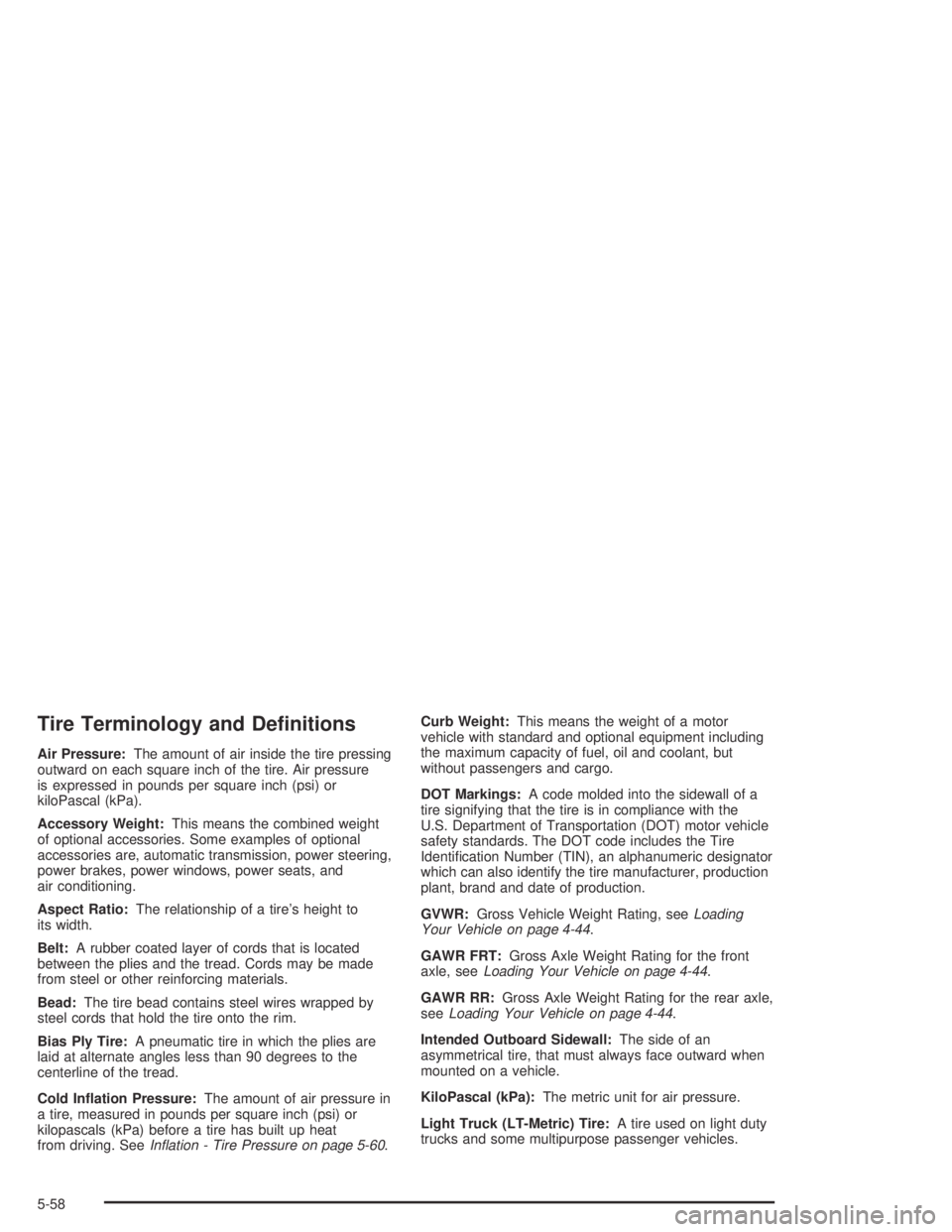
Tire Terminology and Denitions
Air Pressure:The amount of air inside the tire pressing
outward on each square inch of the tire. Air pressure
is expressed in pounds per square inch (psi) or
kiloPascal (kPa).
Accessory Weight:This means the combined weight
of optional accessories. Some examples of optional
accessories are, automatic transmission, power steering,
power brakes, power windows, power seats, and
air conditioning.
Aspect Ratio:The relationship of a tire’s height to
its width.
Belt:A rubber coated layer of cords that is located
between the plies and the tread. Cords may be made
from steel or other reinforcing materials.
Bead:The tire bead contains steel wires wrapped by
steel cords that hold the tire onto the rim.
Bias Ply Tire:A pneumatic tire in which the plies are
laid at alternate angles less than 90 degrees to the
centerline of the tread.
Cold Ination Pressure:The amount of air pressure in
a tire, measured in pounds per square inch (psi) or
kilopascals (kPa) before a tire has built up heat
from driving. SeeInation - Tire Pressure on page 5-60.Curb Weight:This means the weight of a motor
vehicle with standard and optional equipment including
the maximum capacity of fuel, oil and coolant, but
without passengers and cargo.
DOT Markings:A code molded into the sidewall of a
tire signifying that the tire is in compliance with the
U.S. Department of Transportation (DOT) motor vehicle
safety standards. The DOT code includes the Tire
Identication Number (TIN), an alphanumeric designator
which can also identify the tire manufacturer, production
plant, brand and date of production.
GVWR:Gross Vehicle Weight Rating, seeLoading
Your Vehicle on page 4-44.
GAWR FRT:Gross Axle Weight Rating for the front
axle, seeLoading Your Vehicle on page 4-44.
GAWR RR:Gross Axle Weight Rating for the rear axle,
seeLoading Your Vehicle on page 4-44.
Intended Outboard Sidewall:The side of an
asymmetrical tire, that must always face outward when
mounted on a vehicle.
KiloPascal (kPa):The metric unit for air pressure.
Light Truck (LT-Metric) Tire:A tire used on light duty
trucks and some multipurpose passenger vehicles.
5-58
Page 361 of 420
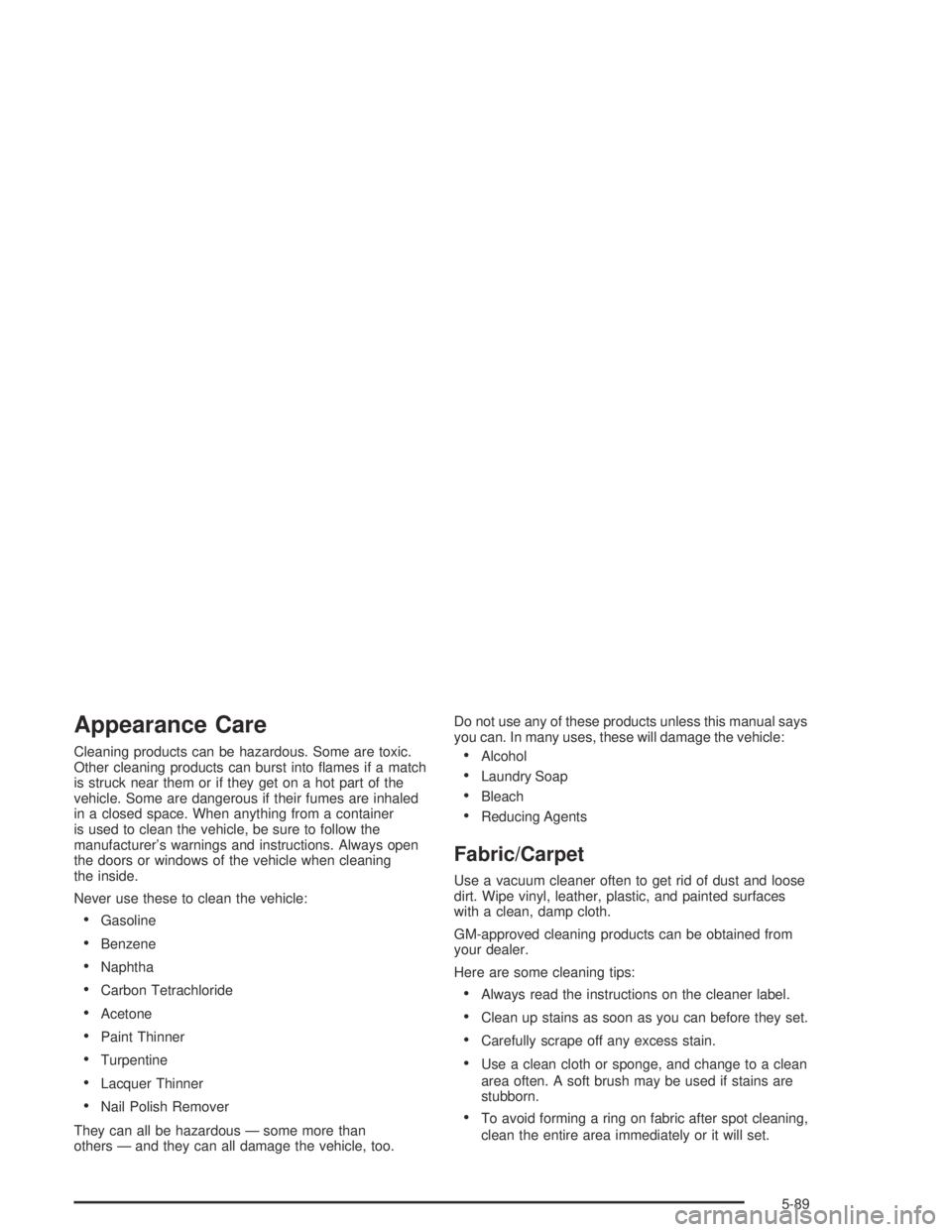
Appearance Care
Cleaning products can be hazardous. Some are toxic.
Other cleaning products can burst into ames if a match
is struck near them or if they get on a hot part of the
vehicle. Some are dangerous if their fumes are inhaled
in a closed space. When anything from a container
is used to clean the vehicle, be sure to follow the
manufacturer’s warnings and instructions. Always open
the doors or windows of the vehicle when cleaning
the inside.
Never use these to clean the vehicle:
Gasoline
Benzene
Naphtha
Carbon Tetrachloride
Acetone
Paint Thinner
Turpentine
Lacquer Thinner
Nail Polish Remover
They can all be hazardous — some more than
others — and they can all damage the vehicle, too.Do not use any of these products unless this manual says
you can. In many uses, these will damage the vehicle:
Alcohol
Laundry Soap
Bleach
Reducing Agents
Fabric/Carpet
Use a vacuum cleaner often to get rid of dust and loose
dirt. Wipe vinyl, leather, plastic, and painted surfaces
with a clean, damp cloth.
GM-approved cleaning products can be obtained from
your dealer.
Here are some cleaning tips:
Always read the instructions on the cleaner label.
Clean up stains as soon as you can before they set.
Carefully scrape off any excess stain.
Use a clean cloth or sponge, and change to a clean
area often. A soft brush may be used if stains are
stubborn.
To avoid forming a ring on fabric after spot cleaning,
clean the entire area immediately or it will set.
5-89
Page 371 of 420
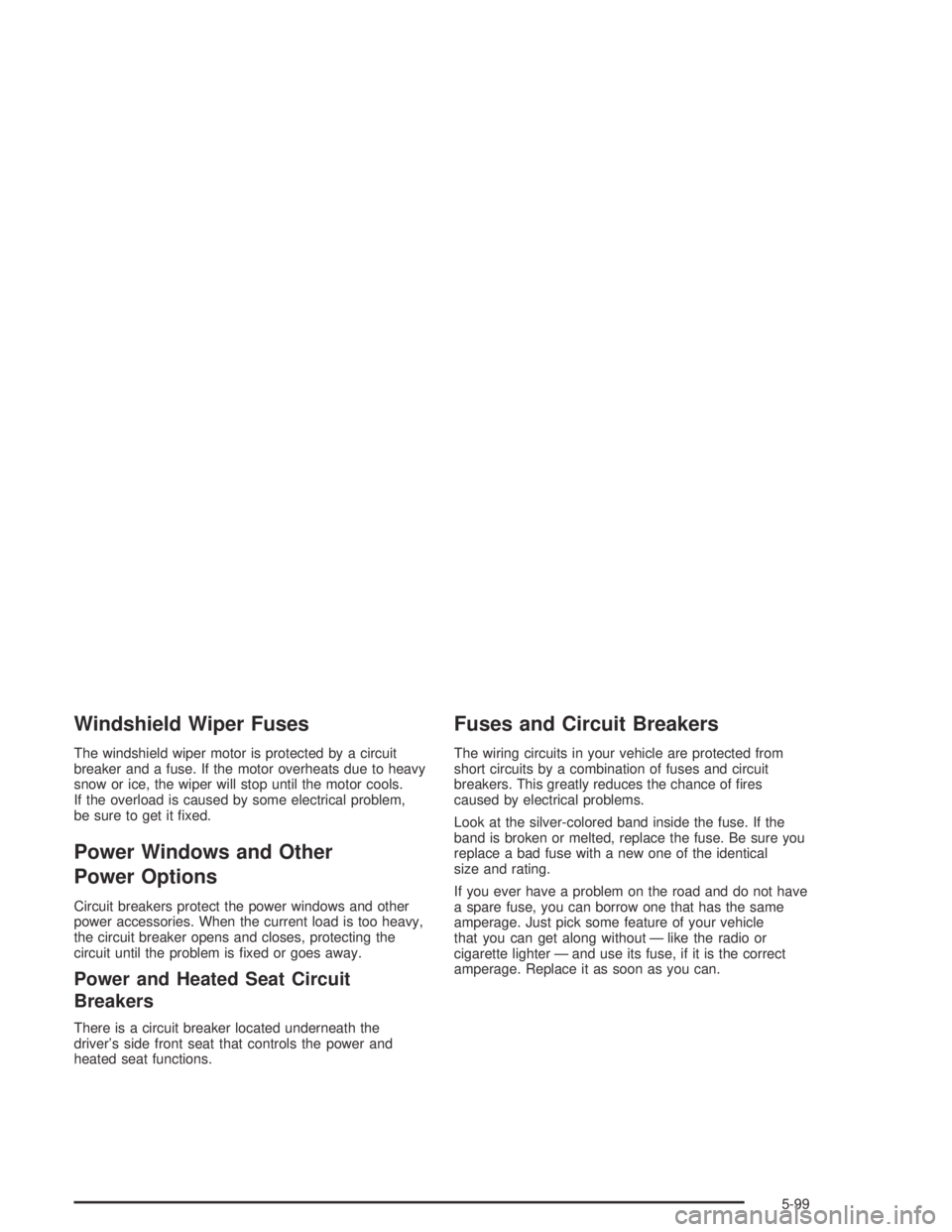
Windshield Wiper Fuses
The windshield wiper motor is protected by a circuit
breaker and a fuse. If the motor overheats due to heavy
snow or ice, the wiper will stop until the motor cools.
If the overload is caused by some electrical problem,
be sure to get it xed.
Power Windows and Other
Power Options
Circuit breakers protect the power windows and other
power accessories. When the current load is too heavy,
the circuit breaker opens and closes, protecting the
circuit until the problem is xed or goes away.
Power and Heated Seat Circuit
Breakers
There is a circuit breaker located underneath the
driver’s side front seat that controls the power and
heated seat functions.
Fuses and Circuit Breakers
The wiring circuits in your vehicle are protected from
short circuits by a combination of fuses and circuit
breakers. This greatly reduces the chance of res
caused by electrical problems.
Look at the silver-colored band inside the fuse. If the
band is broken or melted, replace the fuse. Be sure you
replace a bad fuse with a new one of the identical
size and rating.
If you ever have a problem on the road and do not have
a spare fuse, you can borrow one that has the same
amperage. Just pick some feature of your vehicle
that you can get along without — like the radio or
cigarette lighter — and use its fuse, if it is the correct
amperage. Replace it as soon as you can.
5-99
Page 374 of 420
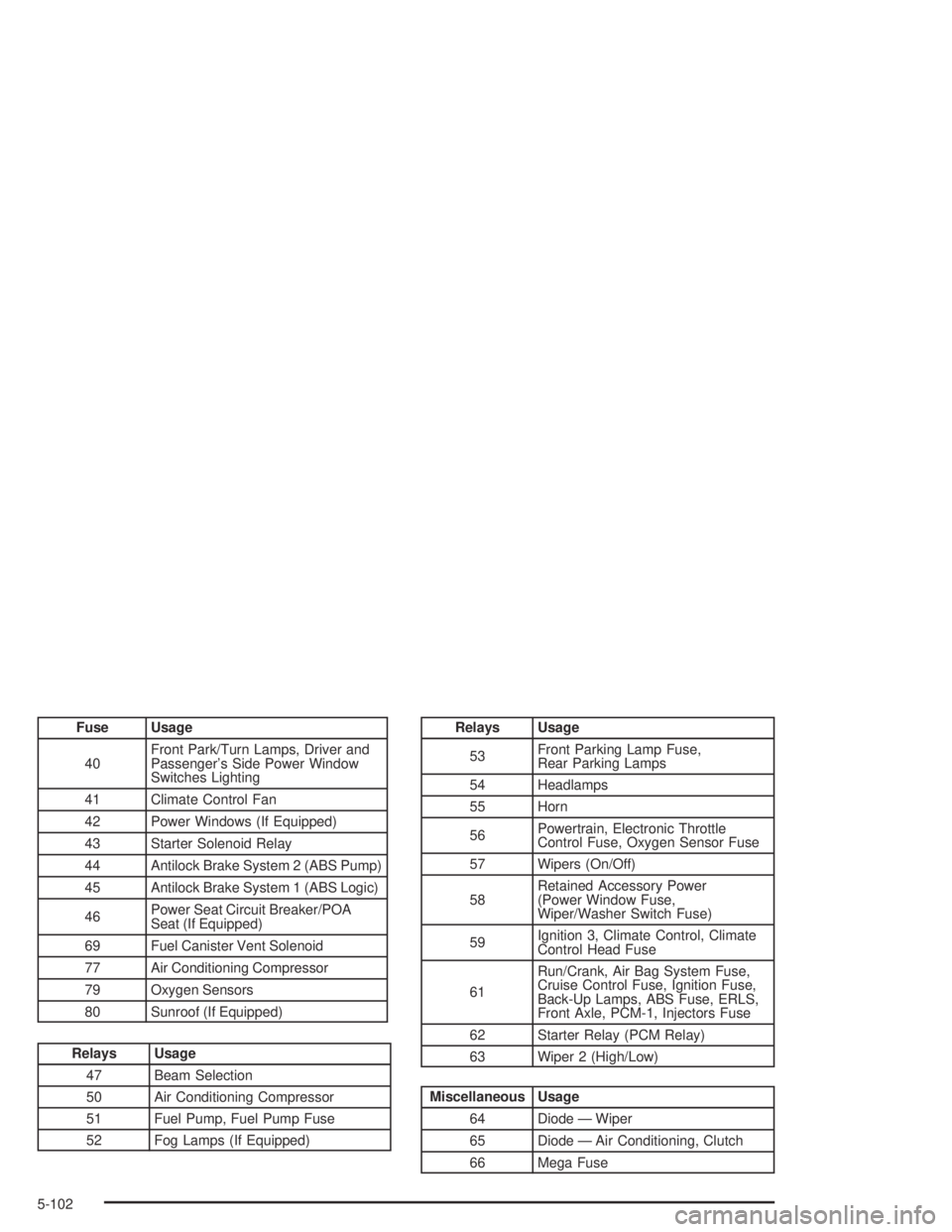
Fuse Usage
40Front Park/Turn Lamps, Driver and
Passenger’s Side Power Window
Switches Lighting
41 Climate Control Fan
42 Power Windows (If Equipped)
43 Starter Solenoid Relay
44 Antilock Brake System 2 (ABS Pump)
45 Antilock Brake System 1 (ABS Logic)
46Power Seat Circuit Breaker/POA
Seat (If Equipped)
69 Fuel Canister Vent Solenoid
77 Air Conditioning Compressor
79 Oxygen Sensors
80 Sunroof (If Equipped)
Relays Usage
47 Beam Selection
50 Air Conditioning Compressor
51 Fuel Pump, Fuel Pump Fuse
52 Fog Lamps (If Equipped)
Relays Usage
53Front Parking Lamp Fuse,
Rear Parking Lamps
54 Headlamps
55 Horn
56Powertrain, Electronic Throttle
Control Fuse, Oxygen Sensor Fuse
57 Wipers (On/Off)
58Retained Accessory Power
(Power Window Fuse,
Wiper/Washer Switch Fuse)
59Ignition 3, Climate Control, Climate
Control Head Fuse
61Run/Crank, Air Bag System Fuse,
Cruise Control Fuse, Ignition Fuse,
Back-Up Lamps, ABS Fuse, ERLS,
Front Axle, PCM-1, Injectors Fuse
62 Starter Relay (PCM Relay)
63 Wiper 2 (High/Low)
Miscellaneous Usage
64 Diode — Wiper
65 Diode — Air Conditioning, Clutch
66 Mega Fuse
5-102
Page 411 of 420
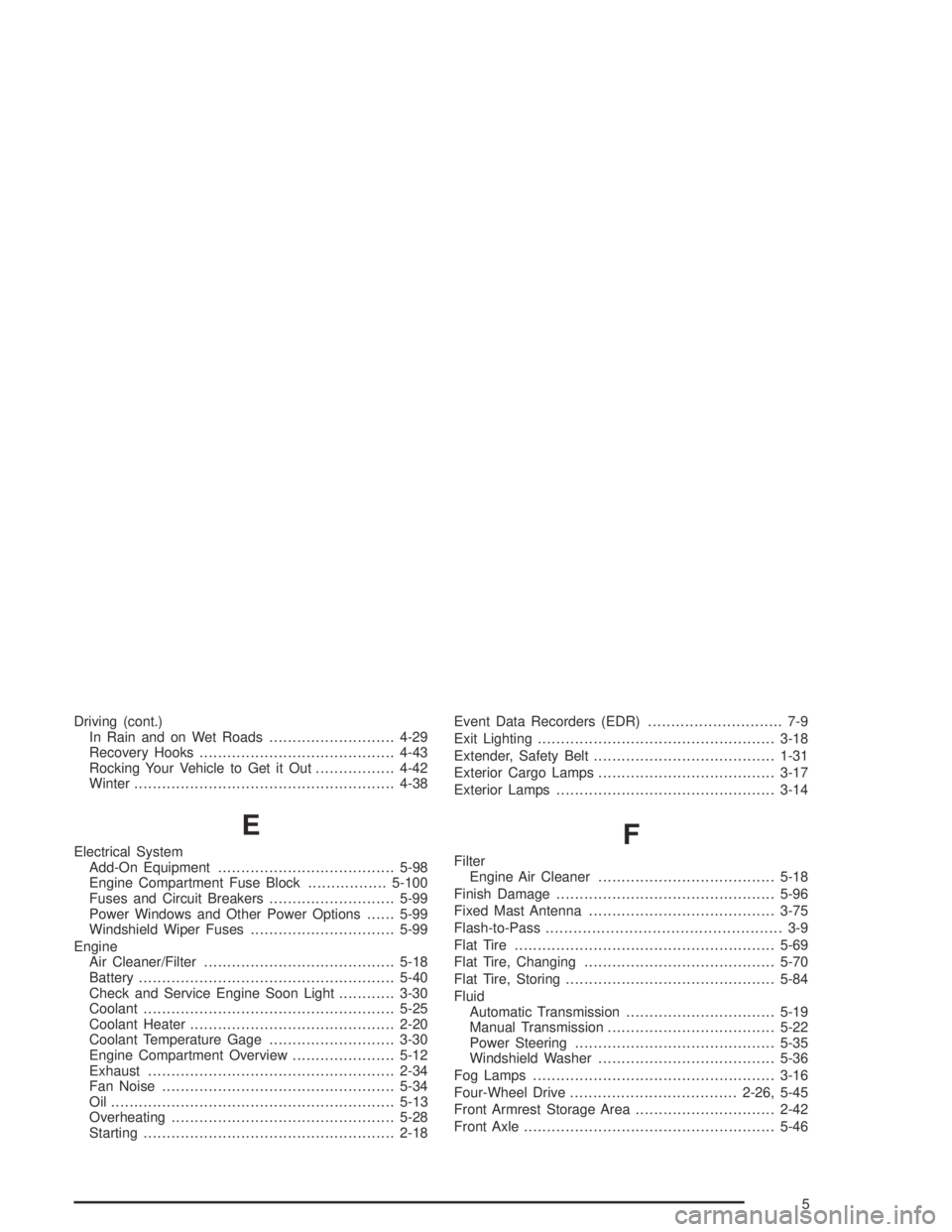
Driving (cont.)
In Rain and on Wet Roads...........................4-29
Recovery Hooks..........................................4-43
Rocking Your Vehicle to Get it Out.................4-42
Winter........................................................4-38
E
Electrical System
Add-On Equipment......................................5-98
Engine Compartment Fuse Block.................5-100
Fuses and Circuit Breakers...........................5-99
Power Windows and Other Power Options......5-99
Windshield Wiper Fuses...............................5-99
Engine
Air Cleaner/Filter.........................................5-18
Battery.......................................................5-40
Check and Service Engine Soon Light............3-30
Coolant......................................................5-25
Coolant Heater............................................2-20
Coolant Temperature Gage...........................3-30
Engine Compartment Overview......................5-12
Exhaust.....................................................2-34
Fan Noise..................................................5-34
Oil .............................................................5-13
Overheating................................................5-28
Starting......................................................2-18Event Data Recorders (EDR)............................. 7-9
Exit Lighting...................................................3-18
Extender, Safety Belt.......................................1-31
Exterior Cargo Lamps......................................3-17
Exterior Lamps...............................................3-14F
Filter
Engine Air Cleaner......................................5-18
Finish Damage...............................................5-96
Fixed Mast Antenna........................................3-75
Flash-to-Pass................................................... 3-9
Flat Tire........................................................5-69
Flat Tire, Changing.........................................5-70
Flat Tire, Storing.............................................5-84
Fluid
Automatic Transmission................................5-19
Manual Transmission....................................5-22
Power Steering...........................................5-35
Windshield Washer......................................5-36
Fog Lamps....................................................3-16
Four-Wheel Drive....................................2-26, 5-45
Front Armrest Storage Area..............................2-42
Front Axle......................................................5-46
5
Page 414 of 420
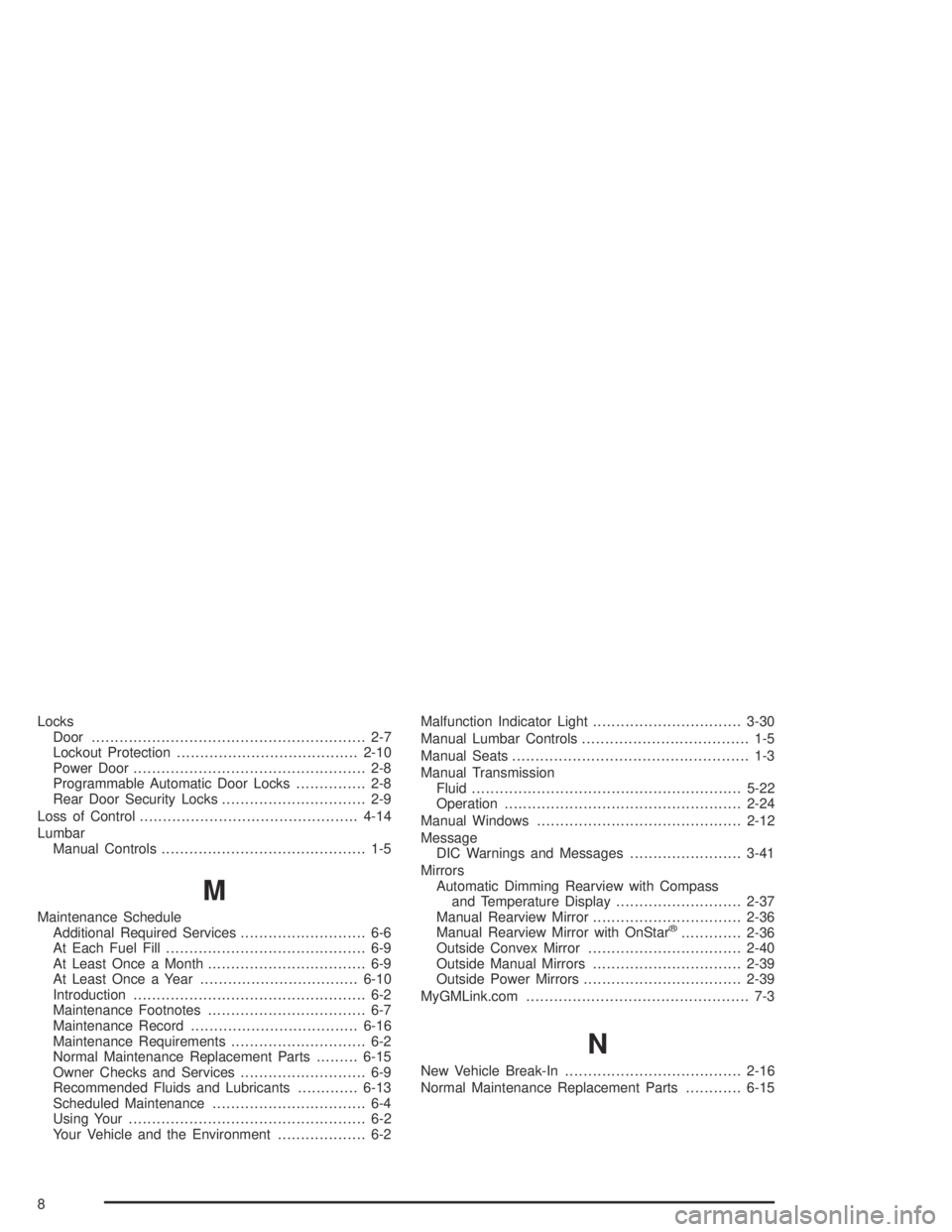
Locks
Door........................................................... 2-7
Lockout Protection.......................................2-10
Power Door.................................................. 2-8
Programmable Automatic Door Locks............... 2-8
Rear Door Security Locks............................... 2-9
Loss of Control...............................................4-14
Lumbar
Manual Controls............................................ 1-5
M
Maintenance Schedule
Additional Required Services........................... 6-6
At Each Fuel Fill........................................... 6-9
At Least Once a Month.................................. 6-9
At Least Once a Year..................................6-10
Introduction.................................................. 6-2
Maintenance Footnotes.................................. 6-7
Maintenance Record....................................6-16
Maintenance Requirements............................. 6-2
Normal Maintenance Replacement Parts.........6-15
Owner Checks and Services........................... 6-9
Recommended Fluids and Lubricants.............6-13
Scheduled Maintenance................................. 6-4
Using Your................................................... 6-2
Your Vehicle and the Environment................... 6-2Malfunction Indicator Light................................3-30
Manual Lumbar Controls.................................... 1-5
Manual Seats................................................... 1-3
Manual Transmission
Fluid..........................................................5-22
Operation...................................................2-24
Manual Windows............................................2-12
Message
DIC Warnings and Messages........................3-41
Mirrors
Automatic Dimming Rearview with Compass
and Temperature Display...........................2-37
Manual Rearview Mirror................................2-36
Manual Rearview Mirror with OnStar®.............2-36
Outside Convex Mirror.................................2-40
Outside Manual Mirrors................................2-39
Outside Power Mirrors..................................2-39
MyGMLink.com................................................ 7-3
N
New Vehicle Break-In......................................2-16
Normal Maintenance Replacement Parts............6-15
8