tow GMC CANYON 2006 Workshop Manual
[x] Cancel search | Manufacturer: GMC, Model Year: 2006, Model line: CANYON, Model: GMC CANYON 2006Pages: 434, PDF Size: 2.64 MB
Page 311 of 434
Engine Fan Noise
This vehicle has a clutched engine cooling fan. When the
clutch is engaged, the fan spins faster to provide more air
to cool the engine. In most everyday driving conditions,
the clutch is not engaged. This improves fuel economy
and reduces fan noise. Under heavy vehicle loading,
trailer towing and/or high outside temperatures, the fan
speed increases when the clutch engages. So you may
hear an increase in fan noise. This is normal and should
not be mistaken as the transmission slipping or making
extra shifts. It is merely the cooling system functioning
properly. The fan will slow down when additional cooling
is not required and the clutch disengages.
You may also hear this fan noise when you start the
engine. It will go away as the fan clutch disengages.
Power Steering Fluid
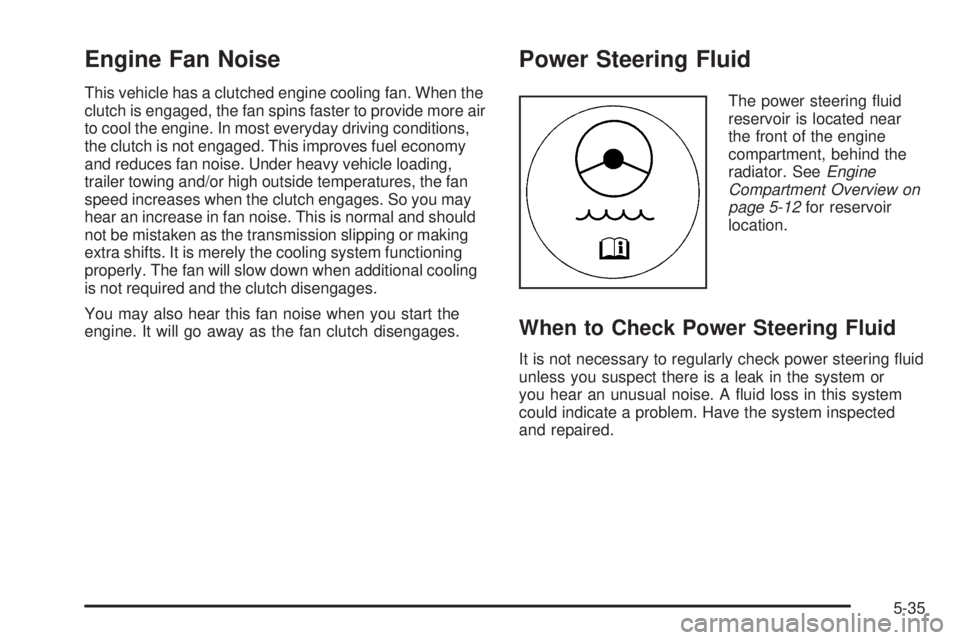
The power steering uid
reservoir is located near
the front of the engine
compartment, behind the
radiator. SeeEngine
Compartment Overview on
page 5-12for reservoir
location.
When to Check Power Steering Fluid
It is not necessary to regularly check power steering uid
unless you suspect there is a leak in the system or
you hear an unusual noise. A uid loss in this system
could indicate a problem. Have the system inspected
and repaired.
5-35
Page 326 of 434
Sealed Beam Headlamps
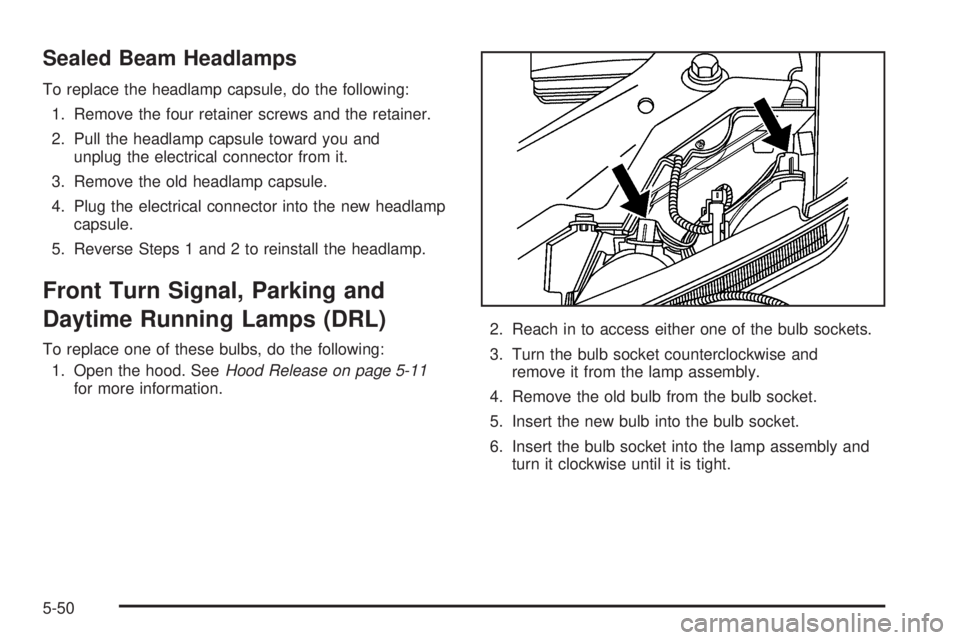
To replace the headlamp capsule, do the following:
1. Remove the four retainer screws and the retainer.
2. Pull the headlamp capsule toward you and
unplug the electrical connector from it.
3. Remove the old headlamp capsule.
4. Plug the electrical connector into the new headlamp
capsule.
5. Reverse Steps 1 and 2 to reinstall the headlamp.
Front Turn Signal, Parking and
Daytime Running Lamps (DRL)
To replace one of these bulbs, do the following:
1. Open the hood. SeeHood Release on page 5-11
for more information.2. Reach in to access either one of the bulb sockets.
3. Turn the bulb socket counterclockwise and
remove it from the lamp assembly.
4. Remove the old bulb from the bulb socket.
5. Insert the new bulb into the bulb socket.
6. Insert the bulb socket into the lamp assembly and
turn it clockwise until it is tight.
5-50
Page 339 of 434
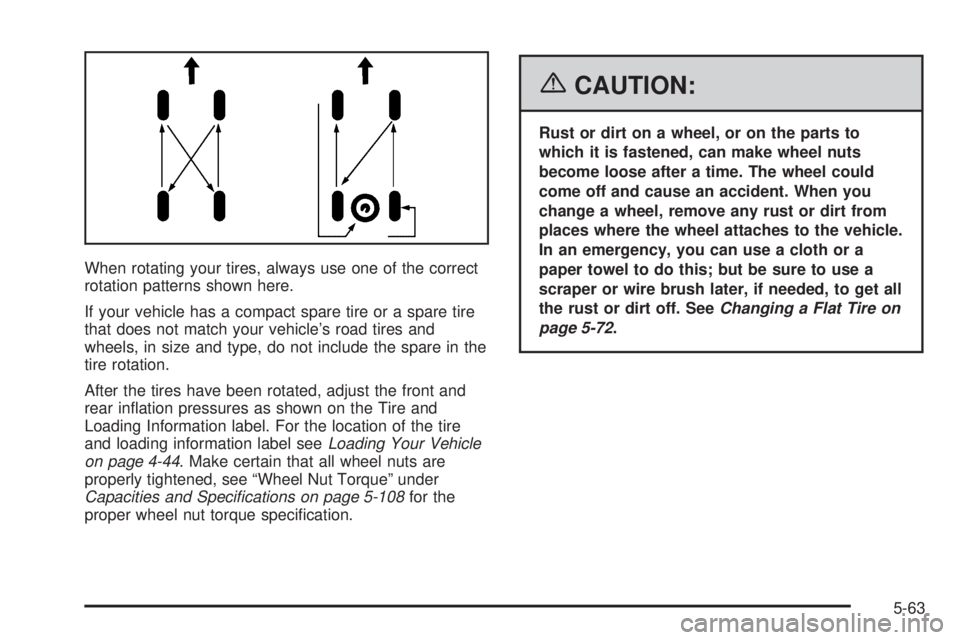
When rotating your tires, always use one of the correct
rotation patterns shown here.
If your vehicle has a compact spare tire or a spare tire
that does not match your vehicle’s road tires and
wheels, in size and type, do not include the spare in the
tire rotation.
After the tires have been rotated, adjust the front and
rear ination pressures as shown on the Tire and
Loading Information label. For the location of the tire
and loading information label seeLoading Your Vehicle
on page 4-44. Make certain that all wheel nuts are
properly tightened, see “Wheel Nut Torque” under
Capacities and Specications on page 5-108for the
proper wheel nut torque specication.
{CAUTION:
Rust or dirt on a wheel, or on the parts to
which it is fastened, can make wheel nuts
become loose after a time. The wheel could
come off and cause an accident. When you
change a wheel, remove any rust or dirt from
places where the wheel attaches to the vehicle.
In an emergency, you can use a cloth or a
paper towel to do this; but be sure to use a
scraper or wire brush later, if needed, to get all
the rust or dirt off. SeeChanging a Flat Tire on
page 5-72.
5-63
Page 347 of 434
If a Tire Goes Flat
It is unusual for a tire to blowout while you are driving,
especially if you maintain your vehicle’s tires properly.
If air goes out of a tire, it is much more likely to leak out
slowly. But if you should ever have a blowout, here
are a few tips about what to expect and what to do:
If a front tire fails, the at tire will create a drag that pulls
the vehicle toward that side. Take your foot off the
accelerator pedal and grip the steering wheel rmly.
Steer to maintain lane position, and then gently brake to
a stop well out of the traffic lane.
A rear blowout, particularly on a curve, acts much like a
skid and may require the same correction you would
use in a skid. In any rear blowout remove your foot from
the accelerator pedal. Get the vehicle under control
by steering the way you want the vehicle to go. It may
be very bumpy and noisy, but you can still steer. Gently
brake to a stop, well off the road if possible.{CAUTION:
Lifting a vehicle and getting under it to do
maintenance or repairs is dangerous without
the appropriate safety equipment and training.
The jack provided with your vehicle is
designed only for changing a at tire. If it is
used for anything else, you or others could be
badly injured or killed if the vehicle slips off
the jack. Use the jack provided with your
vehicle only for changing a at tire.
If a tire goes at, the next part shows how to use the
jacking equipment to change a at tire safely.
5-71
Page 357 of 434
{CAUTION:
Rust or dirt on the wheel, or on the parts to
which it is fastened, can make the wheel nuts
become loose after a time. The wheel could
come off and cause an accident. When you
change a wheel, remove any rust or dirt from
the places where the wheel attaches to the
vehicle. In an emergency, you can use a cloth or
a paper towel to do this; but be sure to use a
scraper or wire brush later, if needed, to get all
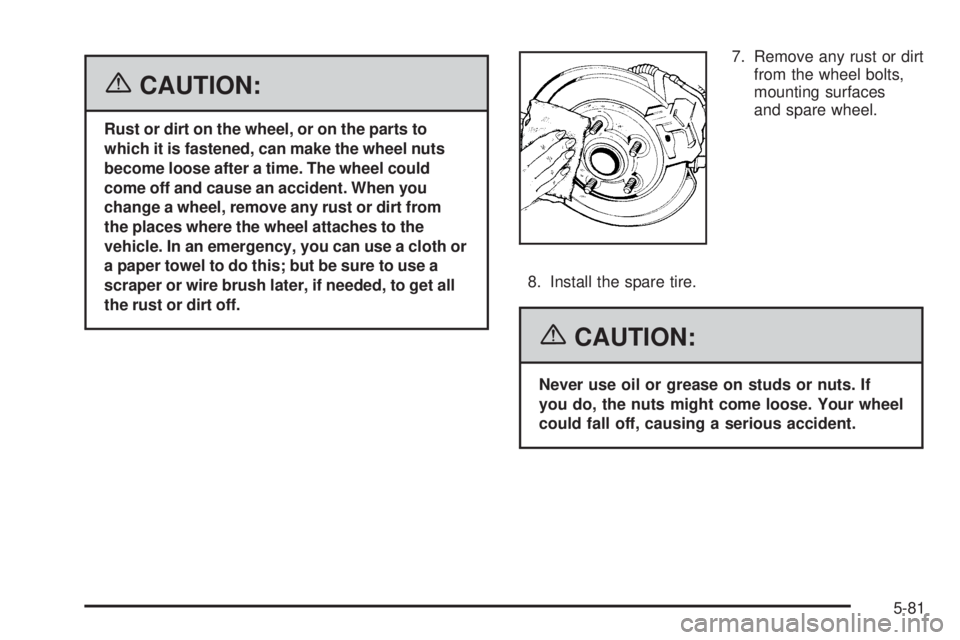
the rust or dirt off.7. Remove any rust or dirt
from the wheel bolts,
mounting surfaces
and spare wheel.
8. Install the spare tire.
{CAUTION:
Never use oil or grease on studs or nuts. If
you do, the nuts might come loose. Your wheel
could fall off, causing a serious accident.
5-81
Page 358 of 434
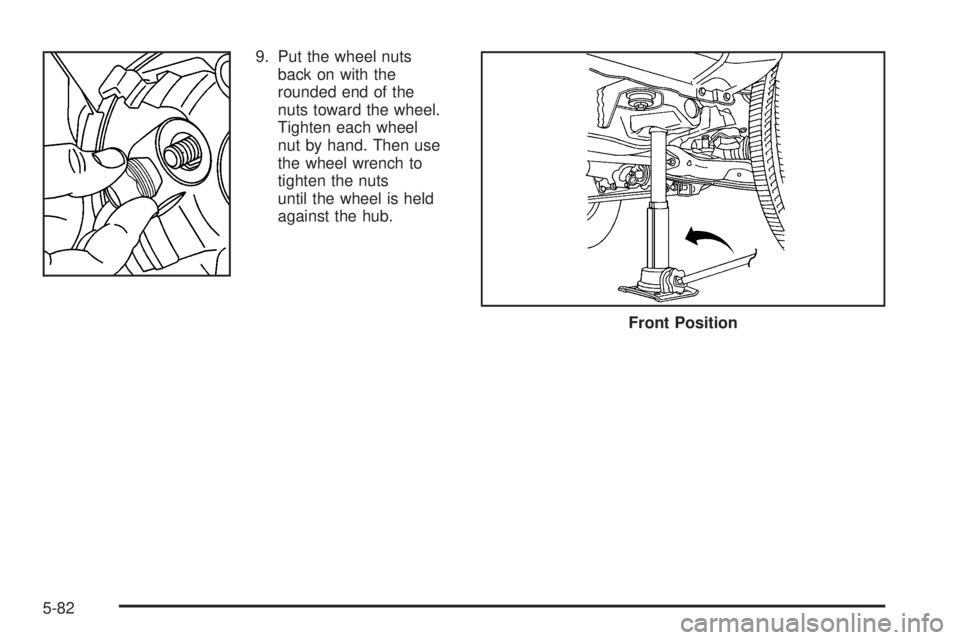
9. Put the wheel nuts
back on with the
rounded end of the
nuts toward the wheel.
Tighten each wheel
nut by hand. Then use
the wheel wrench to
tighten the nuts
until the wheel is held
against the hub.
Front Position
5-82
Page 362 of 434
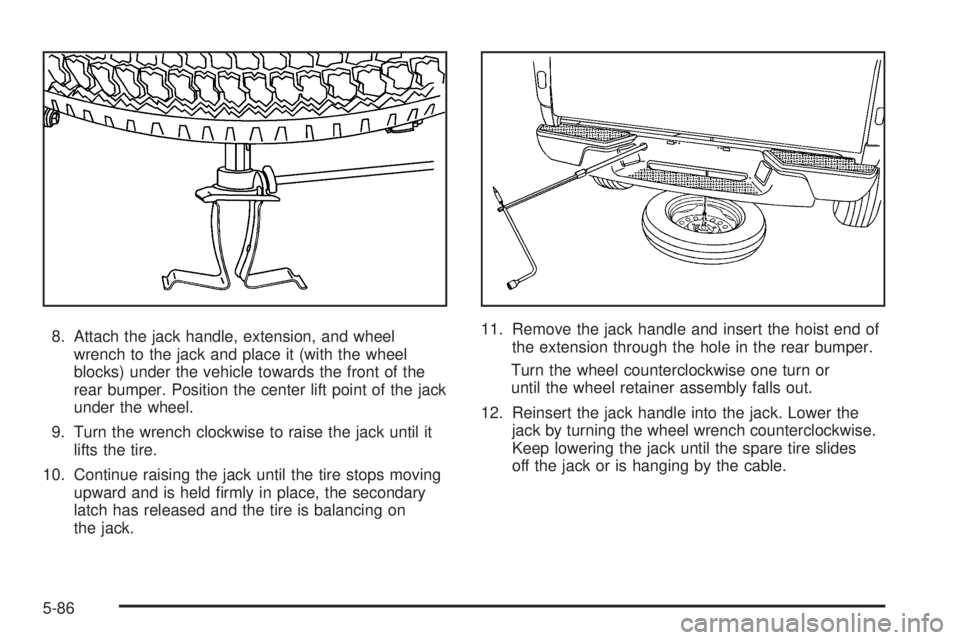
8. Attach the jack handle, extension, and wheel
wrench to the jack and place it (with the wheel
blocks) under the vehicle towards the front of the
rear bumper. Position the center lift point of the jack
under the wheel.
9. Turn the wrench clockwise to raise the jack until it
lifts the tire.
10. Continue raising the jack until the tire stops moving
upward and is held rmly in place, the secondary
latch has released and the tire is balancing on
the jack.11. Remove the jack handle and insert the hoist end of
the extension through the hole in the rear bumper.
Turn the wheel counterclockwise one turn or
until the wheel retainer assembly falls out.
12. Reinsert the jack handle into the jack. Lower the
jack by turning the wheel wrench counterclockwise.
Keep lowering the jack until the spare tire slides
off the jack or is hanging by the cable.
5-86
Page 364 of 434
Storing a Flat or Spare Tire and
Tools
{CAUTION:
Storing a jack, a tire, or other equipment in the
passenger compartment of the vehicle could
cause injury. In a sudden stop or collision,
loose equipment could strike someone. Store
all these in the proper place.
Notice:Storing an aluminum wheel with a at tire
under your vehicle for an extended period of time or
with the valve stem pointing up may damage the
wheel. Always stow the wheel with the valve
stem pointing down and have the wheel/tire repaired
as soon as possible.Store the tire under the rear of the vehicle in the spare tire
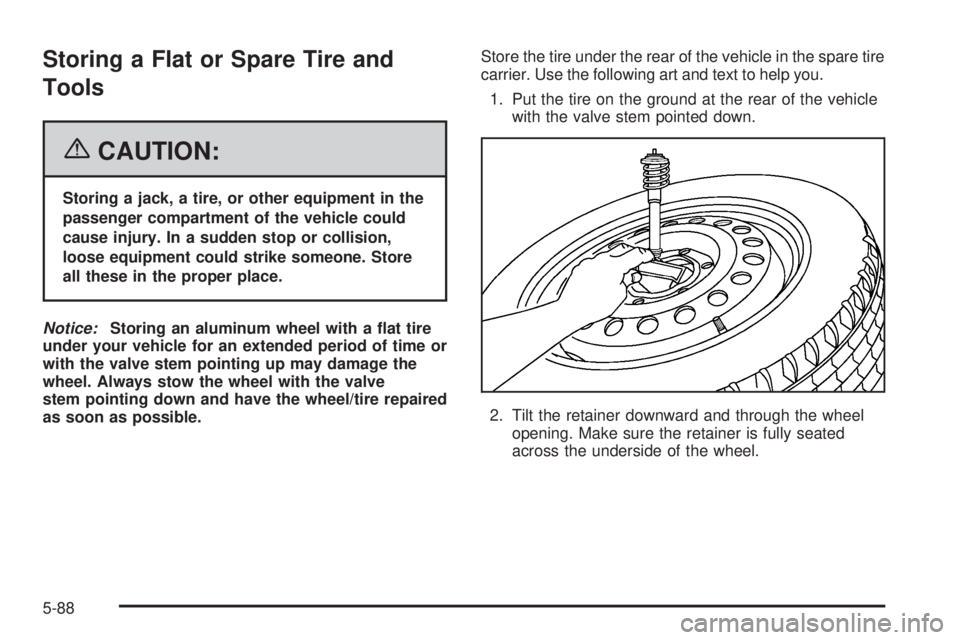
carrier. Use the following art and text to help you.
1. Put the tire on the ground at the rear of the vehicle
with the valve stem pointed down.
2. Tilt the retainer downward and through the wheel
opening. Make sure the retainer is fully seated
across the underside of the wheel.
5-88
Page 368 of 434
Spare Tire
Compact Spare Tire
Your vehicle may have a compact spare tire. Although
the compact spare tire was fully inated when your
vehicle was new, it can lose air over time. Check the
ination pressure regularly. It should be 60 psi (420 kPa).
Notice:If your vehicle has four-wheel drive and the
compact spare tire is installed on your vehicle,
do not drive in four-wheel drive until you can have
your at tire repaired and/or replaced. You could
damage your vehicle, and the repair costs would not
be covered by your warranty. Never use four-wheel
drive when the compact spare tire is installed
on your vehicle.
After installing the compact spare on your vehicle, you
should stop as soon as possible and make sure your
vehicle’s spare tire is correctly inated. The compact
spare is made to perform well at speeds up to 62 mph
(100 km/h) for distances up to 500 miles (804 km).
For heavy payloads or towing, and for low traction or
four-wheel-drive conditions, repair or replace the full-size
tire. Of course, it is best to replace your vehicle’s spare
with a full-size tire as soon as you can. The spare
tire will last longer and be in good shape in case you
need it again.Notice:When the compact spare is installed,
do not take your vehicle through an automatic
car wash with guide rails. The compact spare can
get caught on the rails. That can damage the tire and
wheel, and maybe other parts of your vehicle.
Do not use your compact spare on other vehicles.
And do not mix your compact spare tire or wheel with
other wheels or tires. They will not t. Keep your
spare tire and its wheel together.
Notice:Tire chains will not t your compact spare.
Using them can damage your vehicle and can
damage the chains too. Do not use tire chains on
your compact spare.
Full-Size Spare Tire
Your vehicle have a full-size spare tire, which, when
new, was fully inated. A spare tire, whether
compact-size or full-size, may lose air over time, so
check its ination pressure regularly. SeeInation - Tire
Pressure on page 5-61andLoading Your Vehicle on
page 4-44for information regarding proper tire ination
and loading your vehicle. For instruction on how to
remove, install, or store a spare tire, seeChanging a
Flat Tire on page 5-72
5-92
Page 369 of 434
Your vehicle may have a different size spare tire than
the road tires originally installed on your vehicle.
This spare was developed for use on your vehicle, so it
is all right to drive on it. If your vehicle has four-wheel
drive and the different size spare tire is installed,
keep the vehicle in two-wheel drive.
Notice:If your vehicle has four-wheel drive and the
different size spare tire is installed on your vehicle,
do not drive in four-wheel drive until you can
have your at tire repaired and/or replaced. You
could damage your vehicle, and the repair costs
would not be covered by your warranty. Never use
four-wheel drive when the different size spare
tire is installed on your vehicle.
After installing the spare tire on your vehicle, you should
stop as soon as possible and make sure the spare is
correctly inated. The spare tire is made to perform well
at speeds up to 62 mph (100 km/h) for distances up
to 500 miles (804 km). For heavy payloads or towing,
and for low traction or four-wheel-drive conditions, repair
or replace the full-size tire. Have the damaged or at
road tire repaired or replaced as soon as you can
and installed back onto your vehicle. This way, the spare
tire will be available in case you need it again.
Do not mix tires and wheels of different sizes, because
they will not t. Keep your spare tire and its wheel
together.Appearance Care
Cleaning the Inside of Your Vehicle
Your vehicle’s interior will continue to look its best if
it is cleaned often. Although not always visible, dust and
dirt can accumulate on your upholstery. Dirt can
damage carpet, fabric, leather, and plastic surfaces.
Regular vacuuming is recommended to remove particles
from your upholstery. It is important to keep your
upholstery from becoming and remaining heavily soiled.
Soils should be removed as quickly as possible. Your
vehicle’s interior may experience extremes of heat
that could cause stains to set rapidly.
Lighter colored interiors may require more frequent
cleaning. Use care because newspapers and garments
that transfer color to your home furnishings may also
transfer color to your vehicle’s interior.
When cleaning your vehicle’s interior, only use cleaners
specically designed for the surfaces being cleaned.
Permanent damage may result from using cleaners on
surfaces for which they were not intended. Use glass
cleaner only on glass. Remove any accidental over-spray
from other surfaces immediately. To prevent over-spray,
apply cleaner directly to the cleaning cloth.
5-93