lights GMC CANYON 2009 User Guide
[x] Cancel search | Manufacturer: GMC, Model Year: 2009, Model line: CANYON, Model: GMC CANYON 2009Pages: 414, PDF Size: 2.48 MB
Page 153 of 414
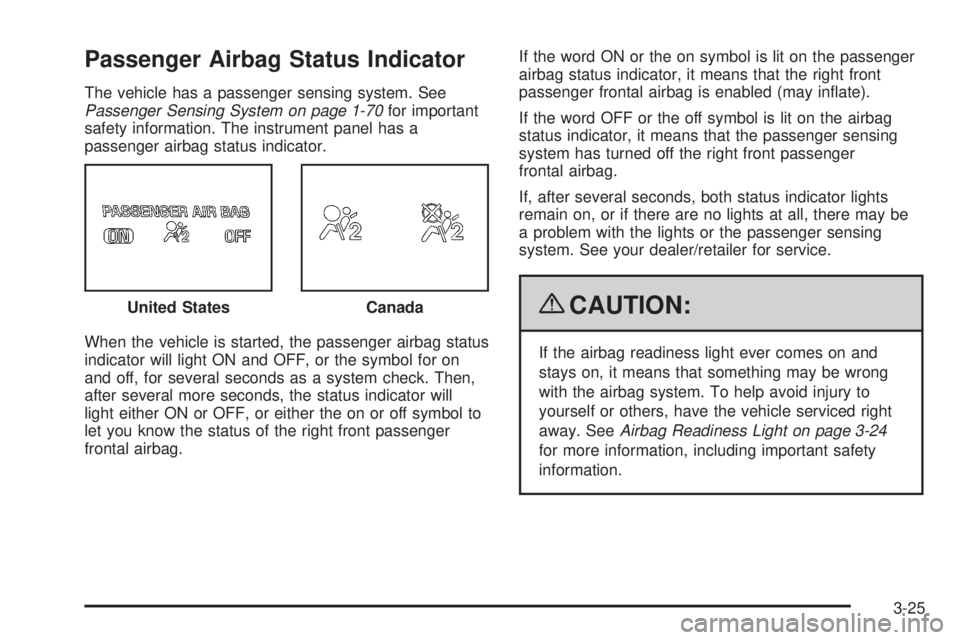
Passenger Airbag Status Indicator
The vehicle has a passenger sensing system. See
Passenger Sensing System on page 1-70for important
safety information. The instrument panel has a
passenger airbag status indicator.
When the vehicle is started, the passenger airbag status
indicator will light ON and OFF, or the symbol for on
and off, for several seconds as a system check. Then,
after several more seconds, the status indicator will
light either ON or OFF, or either the on or off symbol to
let you know the status of the right front passenger
frontal airbag.If the word ON or the on symbol is lit on the passenger
airbag status indicator, it means that the right front
passenger frontal airbag is enabled (may inate).
If the word OFF or the off symbol is lit on the airbag
status indicator, it means that the passenger sensing
system has turned off the right front passenger
frontal airbag.
If, after several seconds, both status indicator lights
remain on, or if there are no lights at all, there may be
a problem with the lights or the passenger sensing
system. See your dealer/retailer for service.
{CAUTION:
If the airbag readiness light ever comes on and
stays on, it means that something may be wrong
with the airbag system. To help avoid injury to
yourself or others, have the vehicle serviced right
away. SeeAirbag Readiness Light on page 3-24
for more information, including important safety
information. United States
Canada
3-25
Page 198 of 414
To turn off TCS and StabiliTrak, press and hold the
StabiliTrak/TCS button until the TRAC OFF and
STAB SYS OFF messages come on the DIC and the
StabiliTrak/TCS light comes on the instrument panel.
To turn TCS and StabiliTrak back on, press and release
the StabiliTrak/TCS button.
When the TCS or StabiliTrak system is turned off, the
StabiliTrak/TCS light and the appropriate TRAC OFF or
STAB SYS OFF message will be displayed on the DIC.
The vehicle will still have brake-traction control when TCS
or StabiliTrak is off, but will not be able to use the engine
speed management system. The StabiliTrak/TCS light
ashes when either system is actively working. See
Traction Control Operation following for more information.
Traction Control System (TCS)
The Traction Control System (TCS) is part of StabiliTrak.
TCS limits wheel slip which is especially useful in slippery
road conditions. The system operates only if it senses
that any of the wheels are spinning or beginning to lose
traction. When this happens, TCS applies the brakes to
limit wheel spin and also reduces engine power. The
system may be heard or felt while it is working. This is
normal and does not mean there is a problem with the
vehicle.Notice:If the wheel(s) of one axle is allowed to
spin excessively while the StabiliTrak, ABS
and brake warning lights and any relevant DIC
messages are displayed, the transfer case could be
damaged. The repairs would not be covered by
the vehicle warranty. Reduce engine power and do
not spin the wheel(s) excessively while these
lights and messages are displayed.
TCS can operate on dry roads under some conditions.
When this happens, the system may be heard
working or a reduction in acceleration may be noticed.
This is normal and does not mean there is a problem
with the vehicle. Examples of these conditions include
hard acceleration in a turn, an abrupt upshift or
downshift of the transmission or driving on rough roads.
If cruise control is being used when TCS begins to
limit wheel spin, the cruise control automatically
disengages. The cruise control can be re-engaged
when road conditions allow. SeeCruise Control
on page 3-10.
4-8
Page 207 of 414
Surface Obstacles:Unseen or hidden obstacles can
be hazardous. A rock, log, hole, rut, or bump can startle
you if you are not prepared for them. Often these
obstacles are hidden by grass, bushes, snow, or even
the rise and fall of the terrain itself.
Some things to consider:
Is the path ahead clear?
Will the surface texture change abruptly up ahead?
Does the travel take you uphill or downhill?
Will you have to stop suddenly or change direction
quickly?
When driving over obstacles or rough terrain, keep a rm
grip on the steering wheel. Ruts, troughs, or other surface
features can jerk the wheel out of your hands.
When driving over bumps, rocks, or other obstacles, the
wheels can leave the ground. If this happens, even with
one or two wheels, you cannot control the vehicle as well
or at all.
Because you will be on an unpaved surface, it is
especially important to avoid sudden acceleration,
sudden turns, or sudden braking.Off-roading requires a different kind of alertness from
driving on paved roads and highways. There are no road
signs, posted speed limits, or signal lights. Use good
judgment about what is safe and what is not.
Driving on Hills
Off-road driving often takes you up, down, or across a
hill. Driving safely on hills requires good judgment
and an understanding of what the vehicle can and
cannot do. There are some hills that simply cannot be
driven, no matter how well built the vehicle.
{CAUTION:
Many hills are simply too steep for any vehicle.
If you drive up them, you will stall. If you drive
down them, you cannot control your speed. If you
drive across them, you will roll over. You could be
seriously injured or killed. If you have any doubt
about the steepness, do not drive the hill.
4-17
Page 359 of 414
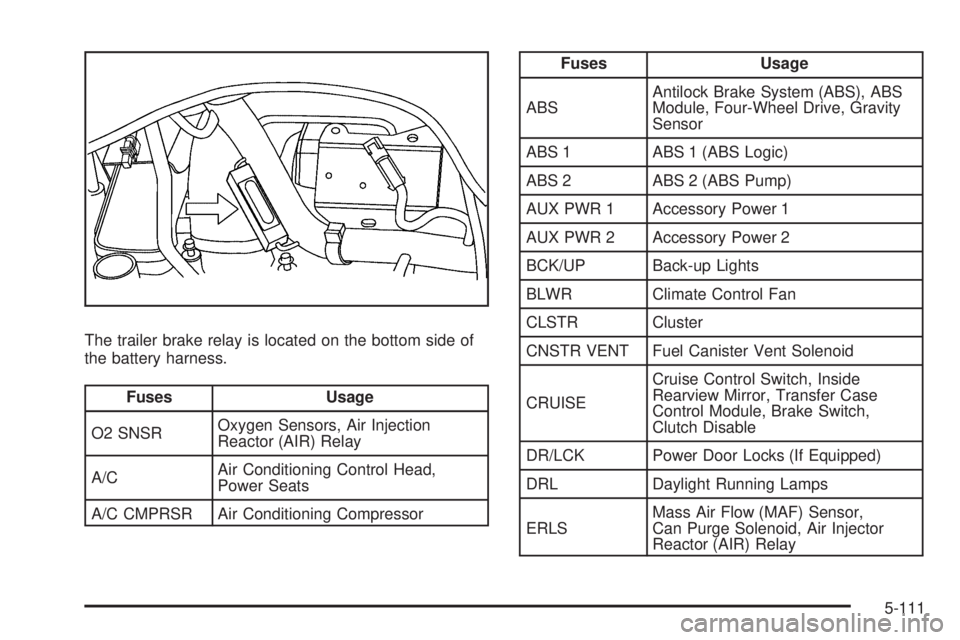
The trailer brake relay is located on the bottom side of
the battery harness.
Fuses Usage
O2 SNSROxygen Sensors, Air Injection
Reactor (AIR) Relay
A/CAir Conditioning Control Head,
Power Seats
A/C CMPRSR Air Conditioning Compressor
Fuses Usage
ABSAntilock Brake System (ABS), ABS
Module, Four-Wheel Drive, Gravity
Sensor
ABS 1 ABS 1 (ABS Logic)
ABS 2 ABS 2 (ABS Pump)
AUX PWR 1 Accessory Power 1
AUX PWR 2 Accessory Power 2
BCK/UP Back-up Lights
BLWR Climate Control Fan
CLSTR Cluster
CNSTR VENT Fuel Canister Vent Solenoid
CRUISECruise Control Switch, Inside
Rearview Mirror, Transfer Case
Control Module, Brake Switch,
Clutch Disable
DR/LCK Power Door Locks (If Equipped)
DRL Daylight Running Lamps
ERLSMass Air Flow (MAF) Sensor,
Can Purge Solenoid, Air Injector
Reactor (AIR) Relay
5-111
Page 361 of 414
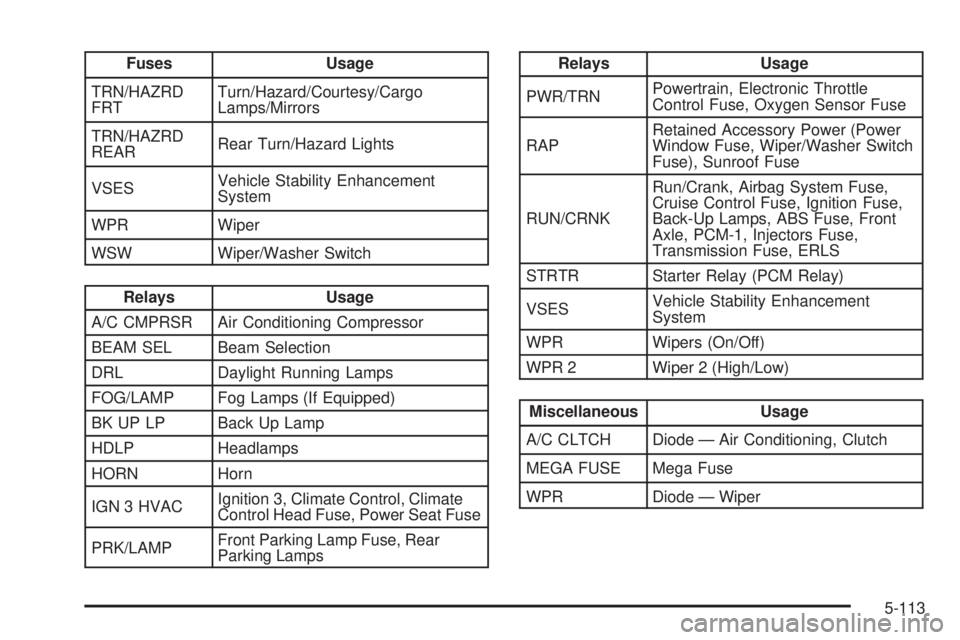
Fuses Usage
TRN/HAZRD
FRTTurn/Hazard/Courtesy/Cargo
Lamps/Mirrors
TRN/HAZRD
REARRear Turn/Hazard Lights
VSESVehicle Stability Enhancement
System
WPR Wiper
WSW Wiper/Washer Switch
Relays Usage
A/C CMPRSR Air Conditioning Compressor
BEAM SEL Beam Selection
DRL Daylight Running Lamps
FOG/LAMP Fog Lamps (If Equipped)
BK UP LP Back Up Lamp
HDLP Headlamps
HORN Horn
IGN 3 HVACIgnition 3, Climate Control, Climate
Control Head Fuse, Power Seat Fuse
PRK/LAMPFront Parking Lamp Fuse, Rear
Parking Lamps
Relays Usage
PWR/TRNPowertrain, Electronic Throttle
Control Fuse, Oxygen Sensor Fuse
RAPRetained Accessory Power (Power
Window Fuse, Wiper/Washer Switch
Fuse), Sunroof Fuse
RUN/CRNKRun/Crank, Airbag System Fuse,
Cruise Control Fuse, Ignition Fuse,
Back-Up Lamps, ABS Fuse, Front
Axle, PCM-1, Injectors Fuse,
Transmission Fuse, ERLS
STRTR Starter Relay (PCM Relay)
VSESVehicle Stability Enhancement
System
WPR Wipers (On/Off)
WPR 2 Wiper 2 (High/Low)
Miscellaneous Usage
A/C CLTCH Diode — Air Conditioning, Clutch
MEGA FUSE Mega Fuse
WPR Diode — Wiper
5-113
Page 408 of 414
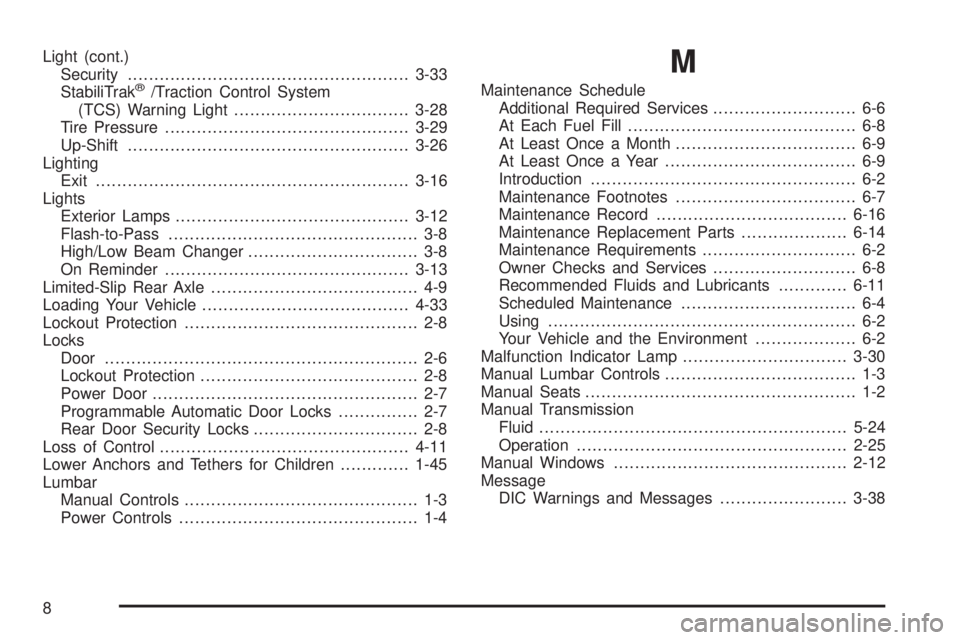
Light (cont.)
Security.....................................................3-33
StabiliTrak
®/Traction Control System
(TCS) Warning Light.................................3-28
Tire Pressure..............................................3-29
Up-Shift.....................................................3-26
Lighting
Exit ...........................................................3-16
Lights
Exterior Lamps............................................3-12
Flash-to-Pass............................................... 3-8
High/Low Beam Changer................................ 3-8
On Reminder..............................................3-13
Limited-Slip Rear Axle....................................... 4-9
Loading Your Vehicle.......................................4-33
Lockout Protection............................................ 2-8
Locks
Door ........................................................... 2-6
Lockout Protection......................................... 2-8
Power Door .................................................. 2-7
Programmable Automatic Door Locks............... 2-7
Rear Door Security Locks............................... 2-8
Loss of Control...............................................4-11
Lower Anchors and Tethers for Children.............1-45
Lumbar
Manual Controls............................................ 1-3
Power Controls............................................. 1-4
M
Maintenance Schedule
Additional Required Services........................... 6-6
At Each Fuel Fill........................................... 6-8
At Least Once a Month.................................. 6-9
At Least Once a Year.................................... 6-9
Introduction.................................................. 6-2
Maintenance Footnotes.................................. 6-7
Maintenance Record....................................6-16
Maintenance Replacement Parts....................6-14
Maintenance Requirements............................. 6-2
Owner Checks and Services........................... 6-8
Recommended Fluids and Lubricants.............6-11
Scheduled Maintenance................................. 6-4
Using.......................................................... 6-2
Your Vehicle and the Environment................... 6-2
Malfunction Indicator Lamp...............................3-30
Manual Lumbar Controls.................................... 1-3
Manual Seats................................................... 1-2
Manual Transmission
Fluid..........................................................5-24
Operation...................................................2-25
Manual Windows............................................2-12
Message
DIC Warnings and Messages........................3-38
8
Page 414 of 414
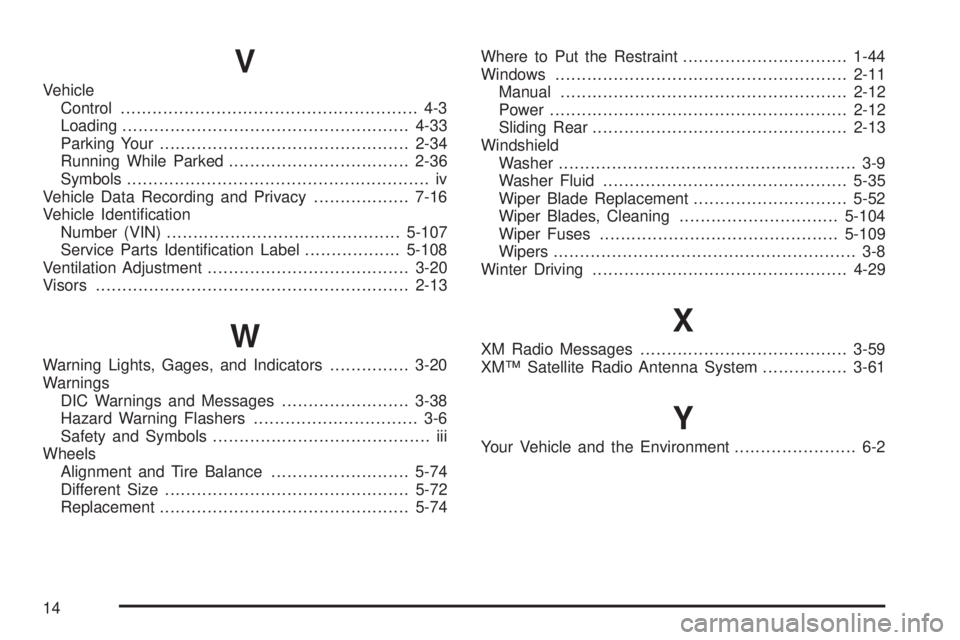
V
Vehicle
Control........................................................ 4-3
Loading......................................................4-33
Parking Your...............................................2-34
Running While Parked..................................2-36
Symbols......................................................... iv
Vehicle Data Recording and Privacy..................7-16
Vehicle Identication
Number (VIN)............................................5-107
Service Parts Identication Label..................5-108
Ventilation Adjustment......................................3-20
Visors...........................................................2-13
W
Warning Lights, Gages, and Indicators...............3-20
Warnings
DIC Warnings and Messages........................3-38
Hazard Warning Flashers............................... 3-6
Safety and Symbols......................................... iii
Wheels
Alignment and Tire Balance..........................5-74
Different Size..............................................5-72
Replacement...............................................5-74Where to Put the Restraint...............................1-44
Windows.......................................................2-11
Manual......................................................2-12
Power ........................................................2-12
Sliding Rear................................................2-13
Windshield
Washer........................................................ 3-9
Washer Fluid..............................................5-35
Wiper Blade Replacement.............................5-52
Wiper Blades, Cleaning..............................5-104
Wiper Fuses.............................................5-109
Wipers......................................................... 3-8
Winter Driving................................................4-29
X
XM Radio Messages.......................................3-59
XM™ Satellite Radio Antenna System................3-61
Y
Your Vehicle and the Environment....................... 6-2
14