four wheel GMC CANYON 2010 Owner's Guide
[x] Cancel search | Manufacturer: GMC, Model Year: 2010, Model line: CANYON, Model: GMC CANYON 2010Pages: 448, PDF Size: 2.62 MB
Page 370 of 448
3. Loosen the cable by turning the wheel wrench
counterclockwise three or four turns.
4. Repeat this procedure at least two times. If the
spare tire lowers to the ground, continue with
Step 5 underRemoving the Spare Tire and Tools
on page 6-81.
5. Turn the wrench counterclockwise until
approximately 6 inches (15 cm) of cable is
exposed.
6. Stand the wheel blocks on their shortest ends,
with the backs facing each other.
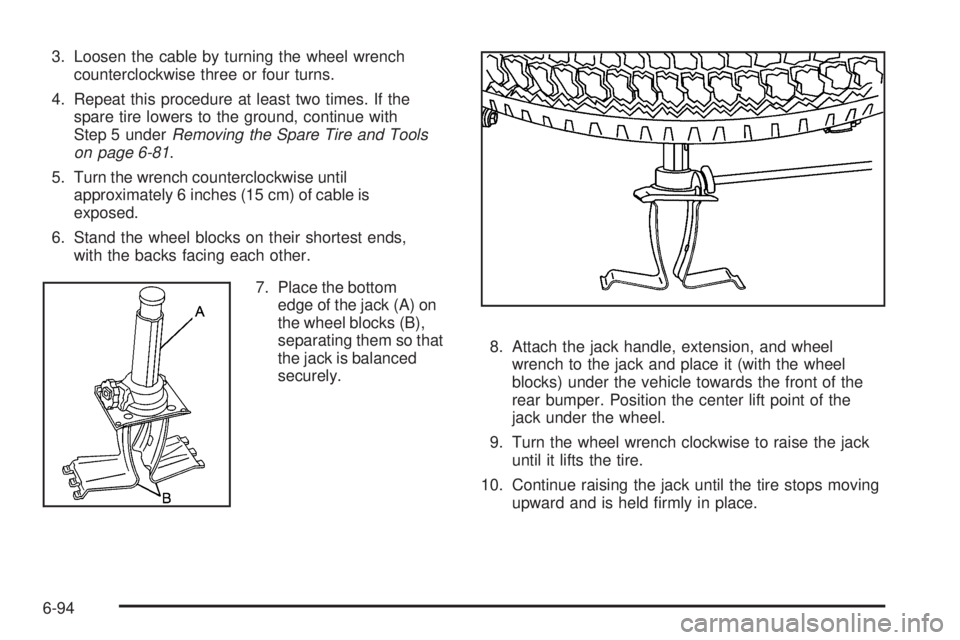
7. Place the bottom
edge of the jack (A) on
the wheel blocks (B),
separating them so that
the jack is balanced
securely.8. Attach the jack handle, extension, and wheel
wrench to the jack and place it (with the wheel
blocks) under the vehicle towards the front of the
rear bumper. Position the center lift point of the
jack under the wheel.
9. Turn the wheel wrench clockwise to raise the jack
until it lifts the tire.
10. Continue raising the jack until the tire stops moving
upward and is held firmly in place.
6-94
Page 377 of 448
Spare Tire
Compact Spare Tire
Your vehicle may have a compact spare tire. Although
the compact spare tire was fully inflated when your
vehicle was new, it can lose air over time. Check the
inflation pressure regularly. It should be 60 psi (420 kPa).
Notice:If the vehicle has four-wheel drive and the
compact spare tire is installed on the vehicle, do not
drive in four-wheel drive until you can have the at
tire repaired and/or replaced. You could damage the
vehicle, and the repair costs would not be covered by
your warranty. Never use four-wheel drive when the
compact spare tire is installed on the vehicle.
After installing the compact spare on your vehicle, you
should stop as soon as possible and make sure your
vehicle’s spare tire is correctly inflated. The compact
spare is made to perform well at speeds up to 62 mph
(100 km/h) for distances up to 500 miles (804 km).
For heavy payloads or towing, and for low traction or
four-wheel-drive conditions, repair or replace the full-size
tire. Of course, it is best to replace your vehicle’s spare
with a full-size tire as soon as you can. The spare tire
will last longer and be in good shape in case you need
it again.Notice:When the compact spare is installed,
do not take the vehicle through an automatic car
wash with guide rails. The compact spare can
get caught on the rails which can damage the
tire, wheel and other parts of the vehicle.
Do not use your compact spare on other vehicles.
And do not mix your compact spare tire or wheel with
other wheels or tires. They will not fit. Keep your
spare tire and its wheel together.
Notice:Tire chains will not t the compact spare.
Using them can damage the vehicle and can damage
the chains too. Do not use tire chains on the
compact spare.
Full-Size Spare Tire
Your vehicle may have a full-size spare tire, which,
when new, was fully inflated. A spare tire may lose
air over time, so check its inflation pressure regularly.
SeeInation - Tire Pressure on page 6-64andLoading
the Vehicle on page 5-33for information regarding proper
tire inflation and loading your vehicle. For instruction
on how to remove, install, or store a spare tire, see
Removing the Flat Tire and Installing the Spare Tire
on page 6-85andStoring a Flat or Spare Tire and
Tools on page 6-96.
6-101
Page 378 of 448
Your vehicle may have a different size spare tire
than the road tires originally installed on your vehicle.
This spare was developed for use on your vehicle, so it
is alright to drive on it. If your vehicle has four-wheel
drive and the different size spare tire is installed, keep
the vehicle in two-wheel drive.
Notice:If the vehicle has four-wheel drive and the
different size spare tire is installed on the vehicle, do
not drive in four-wheel drive until you can have your
at tire repaired and/or replaced. You could damage
the vehicle, and the repair costs would not be
covered by your warranty. Never use four-wheel drive
when the different size spare tire is installed on the
vehicle.
After installing the spare tire on your vehicle, you should
stop as soon as possible and make sure the spare is
correctly inflated. The spare tire is made to perform well
at speeds up to 62 mph (100 km/h) for distances up to
500 miles (804 km). For heavy payloads or towing, and
for low traction or four-wheel-drive conditions, repair or
replace the full-size tire. Have the damaged or flat road
tire repaired or replaced as soon as you can and installed
back onto your vehicle. This way, the spare tire will be
available in case you need it again.
Do not mix tires and wheels of different sizes, because
they will not fit. Keep your spare tire and its wheel
together.Appearance Care
Interior Cleaning
The vehicle’s interior will continue to look its best if it is
cleaned often. Although not always visible, dust and
dirt can accumulate on the upholstery. Dirt can damage
carpet, fabric, leather, and plastic surfaces. Regular
vacuuming is recommended to remove particles from the
upholstery. It is important to keep the upholstery from
becoming and remaining heavily soiled. Soils should be
removed as quickly as possible. The vehicle’s interior
may experience extremes of heat that could cause
stains to set rapidly.
Lighter colored interiors may require more frequent
cleaning. Use care because newspapers and garments
that transfer color to home furnishings may also transfer
color to the vehicle’s interior.
When cleaning the vehicle’s interior, only use cleaners
specifically designed for the surfaces being cleaned.
Permanent damage may result from using cleaners on
surfaces for which they were not intended. Use glass
cleaner only on glass. Remove any accidental over-spray
from other surfaces immediately. To prevent over-spray,
apply cleaner directly to the cleaning cloth.
6-102
Page 390 of 448
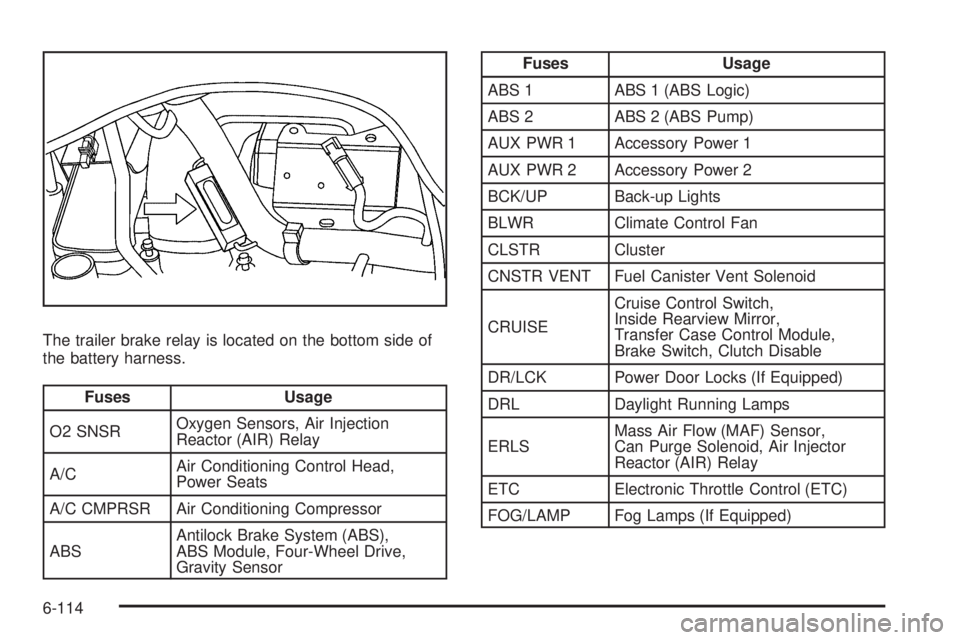
The trailer brake relay is located on the bottom side of
the battery harness.
Fuses Usage
O2 SNSROxygen Sensors, Air Injection
Reactor (AIR) Relay
A/CAir Conditioning Control Head,
Power Seats
A/C CMPRSR Air Conditioning Compressor
ABSAntilock Brake System (ABS),
ABS Module, Four-Wheel Drive,
Gravity Sensor
Fuses Usage
ABS 1 ABS 1 (ABS Logic)
ABS 2 ABS 2 (ABS Pump)
AUX PWR 1 Accessory Power 1
AUX PWR 2 Accessory Power 2
BCK/UP Back-up Lights
BLWR Climate Control Fan
CLSTR Cluster
CNSTR VENT Fuel Canister Vent Solenoid
CRUISECruise Control Switch,
Inside Rearview Mirror,
Transfer Case Control Module,
Brake Switch, Clutch Disable
DR/LCK Power Door Locks (If Equipped)
DRL Daylight Running Lamps
ERLSMass Air Flow (MAF) Sensor,
Can Purge Solenoid, Air Injector
Reactor (AIR) Relay
ETC Electronic Throttle Control (ETC)
FOG/LAMP Fog Lamps (If Equipped)
6-114
Page 395 of 448
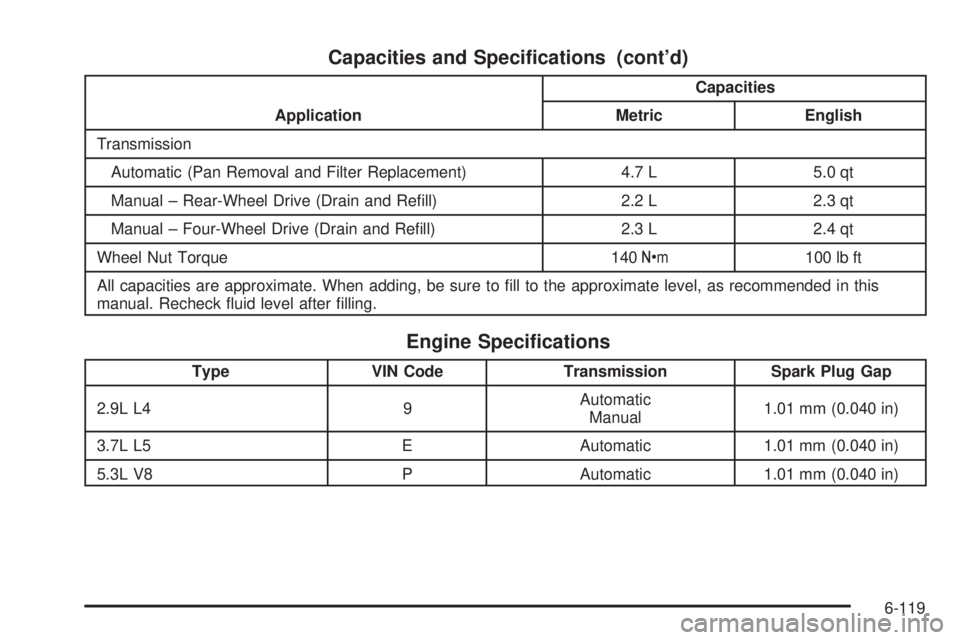
Capacities and Specications (cont’d)
ApplicationCapacities
Metric English
Transmission
Automatic (Pan Removal and Filter Replacement) 4.7 L 5.0 qt
Manual – Rear-Wheel Drive (Drain and Refill) 2.2 L 2.3 qt
Manual – Four-Wheel Drive (Drain and Refill) 2.3 L 2.4 qt
Wheel Nut Torque 140Y100 lb ft
All capacities are approximate. When adding, be sure to fill to the approximate level, as recommended in this
manual. Recheck fluid level after filling.
Engine Specications
Type VIN Code Transmission Spark Plug Gap
2.9L L4 9Automatic
Manual1.01 mm (0.040 in)
3.7L L5 E Automatic 1.01 mm (0.040 in)
5.3L V8 P Automatic 1.01 mm (0.040 in)
6-119
Page 400 of 448
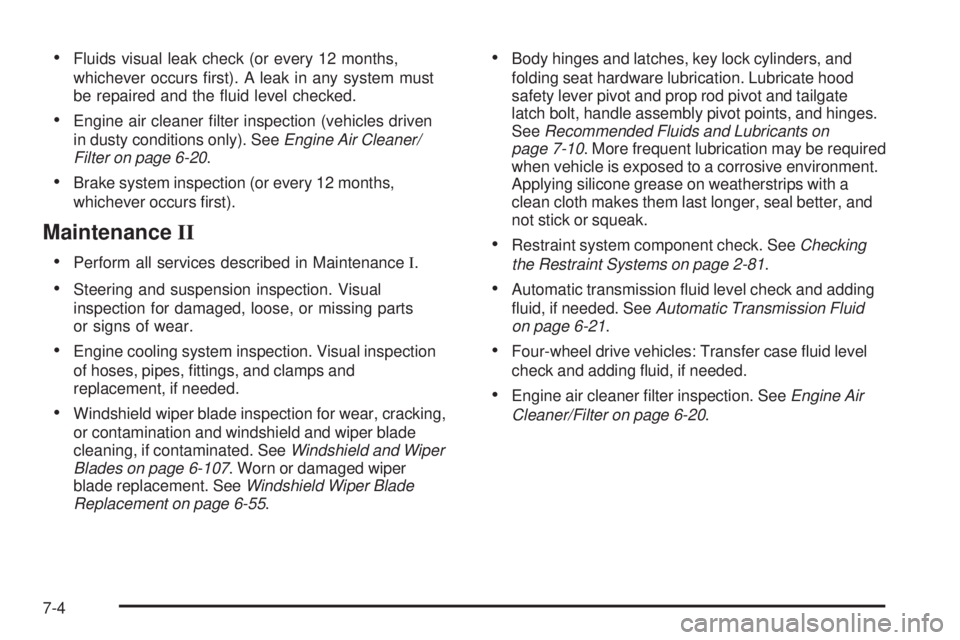
•Fluids visual leak check (or every 12 months,
whichever occurs first). A leak in any system must
be repaired and the fluid level checked.
•Engine air cleaner filter inspection (vehicles driven
in dusty conditions only). SeeEngine Air Cleaner/
Filter on page 6-20.
•Brake system inspection (or every 12 months,
whichever occurs first).
MaintenanceII
•Perform all services described in MaintenanceI.
•Steering and suspension inspection. Visual
inspection for damaged, loose, or missing parts
or signs of wear.
•Engine cooling system inspection. Visual inspection
of hoses, pipes, fittings, and clamps and
replacement, if needed.
•Windshield wiper blade inspection for wear, cracking,
or contamination and windshield and wiper blade
cleaning, if contaminated. SeeWindshield and Wiper
Blades on page 6-107. Worn or damaged wiper
blade replacement. SeeWindshield Wiper Blade
Replacement on page 6-55.
•Body hinges and latches, key lock cylinders, and
folding seat hardware lubrication. Lubricate hood
safety lever pivot and prop rod pivot and tailgate
latch bolt, handle assembly pivot points, and hinges.
SeeRecommended Fluids and Lubricants on
page 7-10. More frequent lubrication may be required
when vehicle is exposed to a corrosive environment.
Applying silicone grease on weatherstrips with a
clean cloth makes them last longer, seal better, and
not stick or squeak.
•Restraint system component check. SeeChecking
the Restraint Systems on page 2-81.
•Automatic transmission fluid level check and adding
fluid, if needed. SeeAutomatic Transmission Fluid
on page 6-21.
•Four-wheel drive vehicles: Transfer case fluid level
check and adding fluid, if needed.
•Engine air cleaner filter inspection. SeeEngine Air
Cleaner/Filter on page 6-20.
7-4
Page 403 of 448
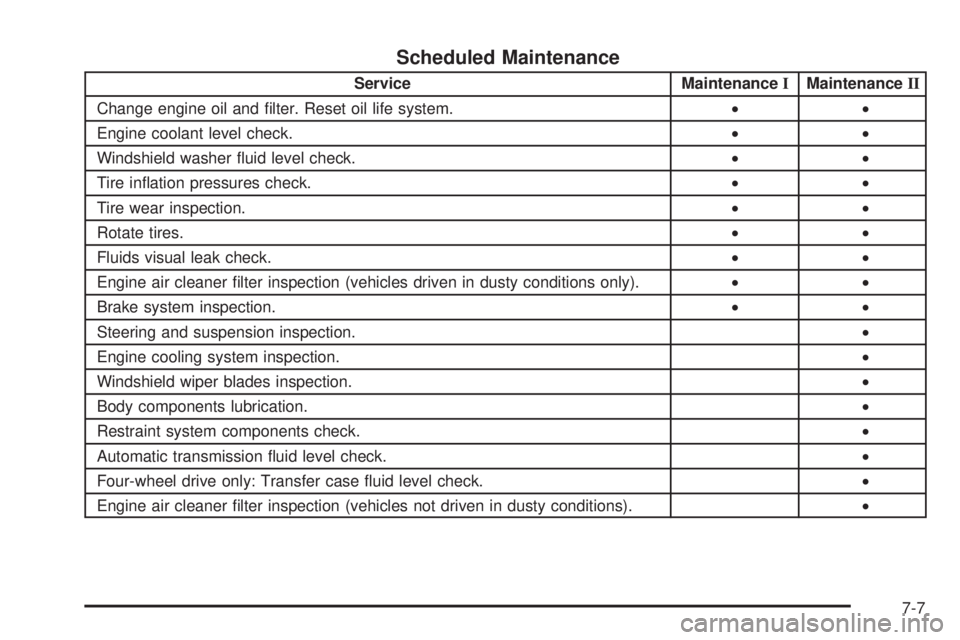
Scheduled Maintenance
Service MaintenanceIMaintenanceII
Change engine oil and filter. Reset oil life system.••
Engine coolant level check.••
Windshield washer fluid level check.••
Tire inflation pressures check.••
Tire wear inspection.••
Rotate tires.••
Fluids visual leak check.••
Engine air cleaner filter inspection (vehicles driven in dusty conditions only).••
Brake system inspection.••
Steering and suspension inspection.•
Engine cooling system inspection.•
Windshield wiper blades inspection.•
Body components lubrication.•
Restraint system components check.•
Automatic transmission fluid level check.•
Four-wheel drive only: Transfer case fluid level check.•
Engine air cleaner filter inspection (vehicles not driven in dusty conditions).•
7-7
Page 436 of 448
Engine
Air Cleaner/Filter.........................................6-20
Check and Service Engine Soon Lamp...........4-28
Compartment Overview................................6-12
Coolant......................................................6-29
Coolant Heater............................................3-20
Coolant Temperature Gage...........................4-27
Cooling System...........................................6-27
Drive Belt Routing.......................................7-13
Exhaust.....................................................3-34
Fan Noise..................................................6-36
Oil .............................................................6-15
Overheating................................................6-35
Starting......................................................3-18
Engine Identification......................................6-110
Engine Oil
Life System................................................6-18
Engine Oil Additives / Engine Oil Flushes...........6-18
Engine Oil Life System....................................4-34
Environmental Concerns..................................5-15
Event Data Recorders.....................................8-17
Exit Lighting...................................................4-14
Express-Down Windows...................................3-12
Extender, Safety Belt.......................................2-34
Exterior Cargo Lamps......................................4-13
Exterior Lamps...............................................4-10
Exterior Mirrors...............................................1-11F
Federal Communications Commission (FCC) and
Industry and Science Canada........................6-67
Filter
Engine Air Cleaner......................................6-20
Finding a Program Type (PTY) Station
(RDS and XM) ............................................4-49
Finding a Station............................................4-46
Finish Damage.............................................6-109
Fixed Mast Antenna........................................4-63
Flashers, Hazard Warning.................................. 4-3
Flash-to-Pass................................................... 4-5
Flat Tire........................................................6-79
Flat Tire, Changing.........................................6-80
Flat Tire, Storing.............................................6-96
FLUID ...........................................................4-38
Fluid
Automatic Transmission................................6-21
Power Steering...........................................6-37
Windshield Washer......................................6-38
FM Stereo.....................................................4-62
Fog Lamps
Bulb Replacement.......................................4-12
Following Distance..........................................5-57
Four-Wheel Drive....................................3-25, 6-48
Front Axle......................................................6-49
6
Page 444 of 448
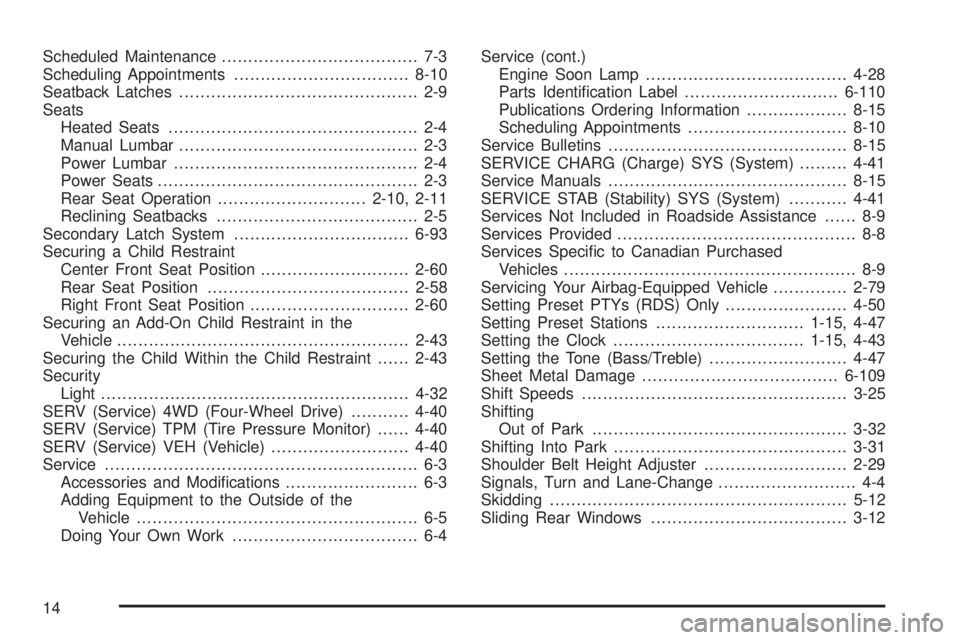
Scheduled Maintenance..................................... 7-3
Scheduling Appointments.................................8-10
Seatback Latches............................................. 2-9
Seats
Heated Seats............................................... 2-4
Manual Lumbar............................................. 2-3
Power Lumbar .............................................. 2-4
Power Seats................................................. 2-3
Rear Seat Operation............................2-10, 2-11
Reclining Seatbacks...................................... 2-5
Secondary Latch System.................................6-93
Securing a Child Restraint
Center Front Seat Position............................2-60
Rear Seat Position......................................2-58
Right Front Seat Position..............................2-60
Securing an Add-On Child Restraint in the
Vehicle.......................................................2-43
Securing the Child Within the Child Restraint......2-43
Security
Light..........................................................4-32
SERV (Service) 4WD (Four-Wheel Drive)...........4-40
SERV (Service) TPM (Tire Pressure Monitor)......4-40
SERV (Service) VEH (Vehicle)..........................4-40
Service........................................................... 6-3
Accessories and Modifications......................... 6-3
Adding Equipment to the Outside of the
Vehicle..................................................... 6-5
Doing Your Own Work................................... 6-4Service (cont.)
Engine Soon Lamp......................................4-28
Parts Identification Label.............................6-110
Publications Ordering Information...................8-15
Scheduling Appointments..............................8-10
Service Bulletins.............................................8-15
SERVICE CHARG (Charge) SYS (System).........4-41
Service Manuals.............................................8-15
SERVICE STAB (Stability) SYS (System)...........4-41
Services Not Included in Roadside Assistance...... 8-9
Services Provided............................................. 8-8
Services Specific to Canadian Purchased
Vehicles....................................................... 8-9
Servicing Your Airbag-Equipped Vehicle..............2-79
Setting Preset PTYs (RDS) Only.......................4-50
Setting Preset Stations............................
1-15, 4-47
Setting the Clock....................................1-15, 4-43
Setting the Tone (Bass/Treble)..........................4-47
Sheet Metal Damage.....................................6-109
Shift Speeds..................................................3-25
Shifting
Out of Park................................................3-32
Shifting Into Park............................................3-31
Shoulder Belt Height Adjuster...........................2-29
Signals, Turn and Lane-Change.......................... 4-4
Skidding........................................................5-12
Sliding Rear Windows.....................................3-12
14