towing GMC CANYON 2010 Owner's Guide
[x] Cancel search | Manufacturer: GMC, Model Year: 2010, Model line: CANYON, Model: GMC CANYON 2010Pages: 448, PDF Size: 2.62 MB
Page 276 of 448
Maintenance When Trailer Towing
The vehicle needs service more often when pulling a
trailer. SeeScheduled Maintenance on page 7-3or the
Index for more information. Things that are especially
important in trailer operation are automatic transmission
fluid, engine oil, axle lubricant, belts, cooling system
and brake system. It is a good idea to inspect
these before and during the trip.
Check periodically to see that all hitch nuts and bolts
are tight.
Trailer Wiring Harness
The vehicle may be equipped with a four-pin trailer
towing harness. This harness has a four-pin trailer
connector that is attached to a bracket on the hitch
platform. The four-wire harness contains the following
trailer circuits:
•Yellow: Left Stop/Turn Signal
•Green: Right Stop/Turn Signal
•Brown: Taillamps/Park lamps
•White: Ground
Trailer Recommendations
Subtract the hitch loads from the Cargo Weight Rating
(CWR). CWR is the maximum weight of the load
the vehicle can carry. It does not include the weight of
the people inside, but you can figure about 150 lbs.
(68 kg) for each passenger. The total cargo load must
not be more than the vehicles CWR.
Weigh the vehicle with the trailer attached, so the
GVWR or GAWR are not exceeded. If using a
weight-distributing hitch, weigh the vehicle without the
spring bars in place.
The best performance is obtained by correctly spreading
out the weight of the load and choosing the correct
hitch and trailer brakes.
For more information seeTowing a Trailer on page 5-48.
5-60
Page 312 of 448
If No Steam is Coming from the Engine
Compartment
If an engine overheat warning is displayed but no steam
can be seen or heard, the problem may not be too
serious. Sometimes the engine can get a little too hot
when the vehicle:
•Climbs a long hill on a hot day.
•Stops after high-speed driving.
•Idles for long periods in traffic.
•Tows a trailer. See “Driving on Grades” under
Towing a Trailer on page 5-48.
If the overheat warning is displayed with no sign of
steam:
1. Turn the air conditioning off.
2. Turn the heater on to the highest temperature and
to the highest fan speed. Open the windows as
necessary.
3. In heavy traffic, let the engine idle in N (Neutral)
while stopped. If it is safe to do so, pull off the
road, shift to P (Park) or N (Neutral) and let
the engine idle.
If the temperature overheat gage is no longer in the
overheat zone or an overheat warning no longer
displays, the vehicle can be driven. Continue to drivethe vehicle slow for about 10 minutes. Keep a safe
vehicle distance from the car in front of you. If the
warning does not come back on, continue to drive
normally.
If the warning continues, pull over, stop, and park the
vehicle right away.
If there is no sign of steam, idle the engine for three
minutes while parked. If the warning is still displayed,
turn off the engine until it cools down.Engine Fan Noise
This vehicle has a clutched engine cooling fan. When the
clutch is engaged, the fan spins faster to provide more air
to cool the engine. In most everyday driving conditions,
the clutch is not engaged. This improves fuel economy
and reduces fan noise. Under heavy vehicle loading,
trailer towing and/or high outside temperatures, the fan
speed increases when the clutch engages. So you may
hear an increase in fan noise. This is normal and should
not be mistaken as the transmission slipping or making
extra shifts. It is merely the cooling system functioning
properly. The fan will slow down when additional cooling
is not required and the clutch disengages.
You may also hear this fan noise when you start the
engine. It will go away as the fan clutch disengages.
6-36
Page 377 of 448
Spare Tire
Compact Spare Tire
Your vehicle may have a compact spare tire. Although
the compact spare tire was fully inflated when your
vehicle was new, it can lose air over time. Check the
inflation pressure regularly. It should be 60 psi (420 kPa).
Notice:If the vehicle has four-wheel drive and the
compact spare tire is installed on the vehicle, do not
drive in four-wheel drive until you can have the at
tire repaired and/or replaced. You could damage the
vehicle, and the repair costs would not be covered by
your warranty. Never use four-wheel drive when the
compact spare tire is installed on the vehicle.
After installing the compact spare on your vehicle, you
should stop as soon as possible and make sure your
vehicle’s spare tire is correctly inflated. The compact
spare is made to perform well at speeds up to 62 mph
(100 km/h) for distances up to 500 miles (804 km).
For heavy payloads or towing, and for low traction or
four-wheel-drive conditions, repair or replace the full-size
tire. Of course, it is best to replace your vehicle’s spare
with a full-size tire as soon as you can. The spare tire
will last longer and be in good shape in case you need
it again.Notice:When the compact spare is installed,
do not take the vehicle through an automatic car
wash with guide rails. The compact spare can
get caught on the rails which can damage the
tire, wheel and other parts of the vehicle.
Do not use your compact spare on other vehicles.
And do not mix your compact spare tire or wheel with
other wheels or tires. They will not fit. Keep your
spare tire and its wheel together.
Notice:Tire chains will not t the compact spare.
Using them can damage the vehicle and can damage
the chains too. Do not use tire chains on the
compact spare.
Full-Size Spare Tire
Your vehicle may have a full-size spare tire, which,
when new, was fully inflated. A spare tire may lose
air over time, so check its inflation pressure regularly.
SeeInation - Tire Pressure on page 6-64andLoading
the Vehicle on page 5-33for information regarding proper
tire inflation and loading your vehicle. For instruction
on how to remove, install, or store a spare tire, see
Removing the Flat Tire and Installing the Spare Tire
on page 6-85andStoring a Flat or Spare Tire and
Tools on page 6-96.
6-101
Page 378 of 448
Your vehicle may have a different size spare tire
than the road tires originally installed on your vehicle.
This spare was developed for use on your vehicle, so it
is alright to drive on it. If your vehicle has four-wheel
drive and the different size spare tire is installed, keep
the vehicle in two-wheel drive.
Notice:If the vehicle has four-wheel drive and the
different size spare tire is installed on the vehicle, do
not drive in four-wheel drive until you can have your
at tire repaired and/or replaced. You could damage
the vehicle, and the repair costs would not be
covered by your warranty. Never use four-wheel drive
when the different size spare tire is installed on the
vehicle.
After installing the spare tire on your vehicle, you should
stop as soon as possible and make sure the spare is
correctly inflated. The spare tire is made to perform well
at speeds up to 62 mph (100 km/h) for distances up to
500 miles (804 km). For heavy payloads or towing, and
for low traction or four-wheel-drive conditions, repair or
replace the full-size tire. Have the damaged or flat road
tire repaired or replaced as soon as you can and installed
back onto your vehicle. This way, the spare tire will be
available in case you need it again.
Do not mix tires and wheels of different sizes, because
they will not fit. Keep your spare tire and its wheel
together.Appearance Care
Interior Cleaning
The vehicle’s interior will continue to look its best if it is
cleaned often. Although not always visible, dust and
dirt can accumulate on the upholstery. Dirt can damage
carpet, fabric, leather, and plastic surfaces. Regular
vacuuming is recommended to remove particles from the
upholstery. It is important to keep the upholstery from
becoming and remaining heavily soiled. Soils should be
removed as quickly as possible. The vehicle’s interior
may experience extremes of heat that could cause
stains to set rapidly.
Lighter colored interiors may require more frequent
cleaning. Use care because newspapers and garments
that transfer color to home furnishings may also transfer
color to the vehicle’s interior.
When cleaning the vehicle’s interior, only use cleaners
specifically designed for the surfaces being cleaned.
Permanent damage may result from using cleaners on
surfaces for which they were not intended. Use glass
cleaner only on glass. Remove any accidental over-spray
from other surfaces immediately. To prevent over-spray,
apply cleaner directly to the cleaning cloth.
6-102
Page 402 of 448
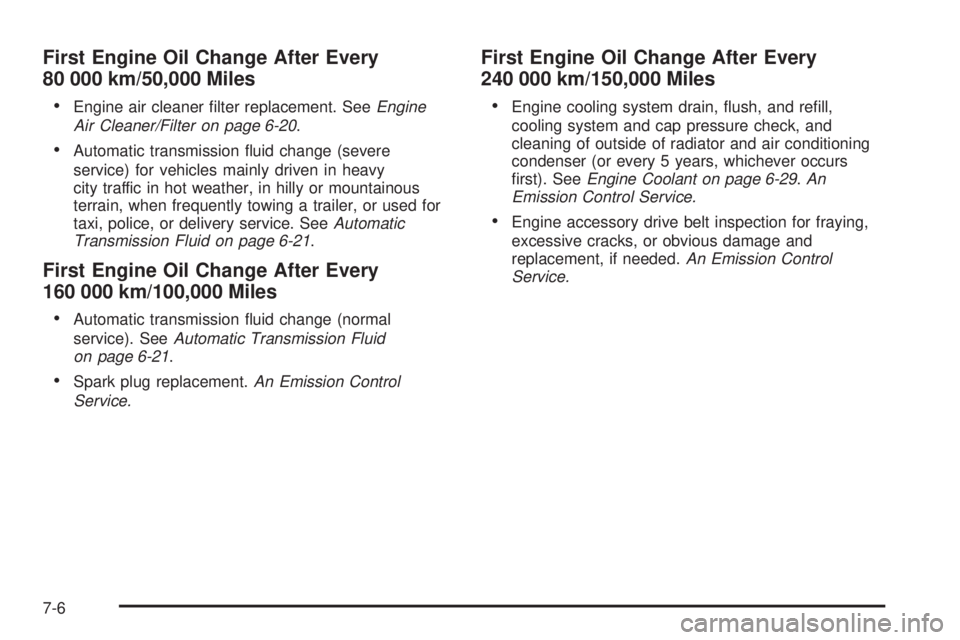
First Engine Oil Change After Every
80 000 km/50,000 Miles
•
Engine air cleaner filter replacement. SeeEngine
Air Cleaner/Filter on page 6-20.
•Automatic transmission fluid change (severe
service) for vehicles mainly driven in heavy
city traffic in hot weather, in hilly or mountainous
terrain, when frequently towing a trailer, or used for
taxi, police, or delivery service. SeeAutomatic
Transmission Fluid on page 6-21.
First Engine Oil Change After Every
160 000 km/100,000 Miles
•
Automatic transmission fluid change (normal
service). SeeAutomatic Transmission Fluid
on page 6-21.
•Spark plug replacement.An Emission Control
Service.
First Engine Oil Change After Every
240 000 km/150,000 Miles
•
Engine cooling system drain, flush, and refill,
cooling system and cap pressure check, and
cleaning of outside of radiator and air conditioning
condenser (or every 5 years, whichever occurs
first). SeeEngine Coolant on page 6-29.An
Emission Control Service.
•Engine accessory drive belt inspection for fraying,
excessive cracks, or obvious damage and
replacement, if needed.An Emission Control
Service.
7-6
Page 421 of 448
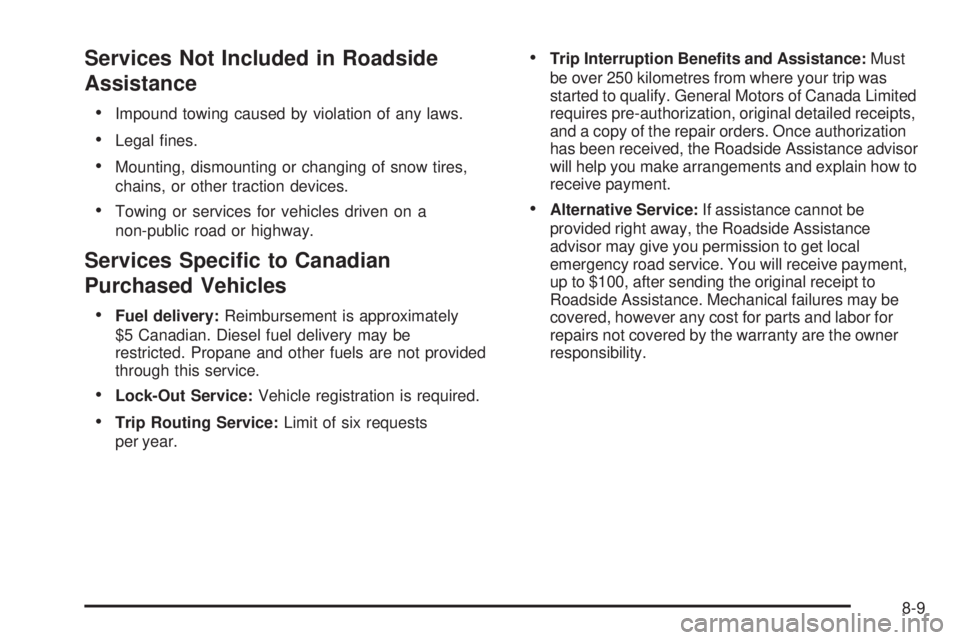
Services Not Included in Roadside
Assistance
•Impound towing caused by violation of any laws.
•Legal fines.
•Mounting, dismounting or changing of snow tires,
chains, or other traction devices.
•Towing or services for vehicles driven on a
non-public road or highway.
Services Specic to Canadian
Purchased Vehicles
•Fuel delivery:Reimbursement is approximately
$5 Canadian. Diesel fuel delivery may be
restricted. Propane and other fuels are not provided
through this service.
•Lock-Out Service:Vehicle registration is required.
•Trip Routing Service:Limit of six requests
per year.
•Trip Interruption Benets and Assistance:Must
be over 250 kilometres from where your trip was
started to qualify. General Motors of Canada Limited
requires pre-authorization, original detailed receipts,
and a copy of the repair orders. Once authorization
has been received, the Roadside Assistance advisor
will help you make arrangements and explain how to
receive payment.
•Alternative Service:If assistance cannot be
provided right away, the Roadside Assistance
advisor may give you permission to get local
emergency road service. You will receive payment,
up to $100, after sending the original receipt to
Roadside Assistance. Mechanical failures may be
covered, however any cost for parts and labor for
repairs not covered by the warranty are the owner
responsibility.
8-9
Page 425 of 448
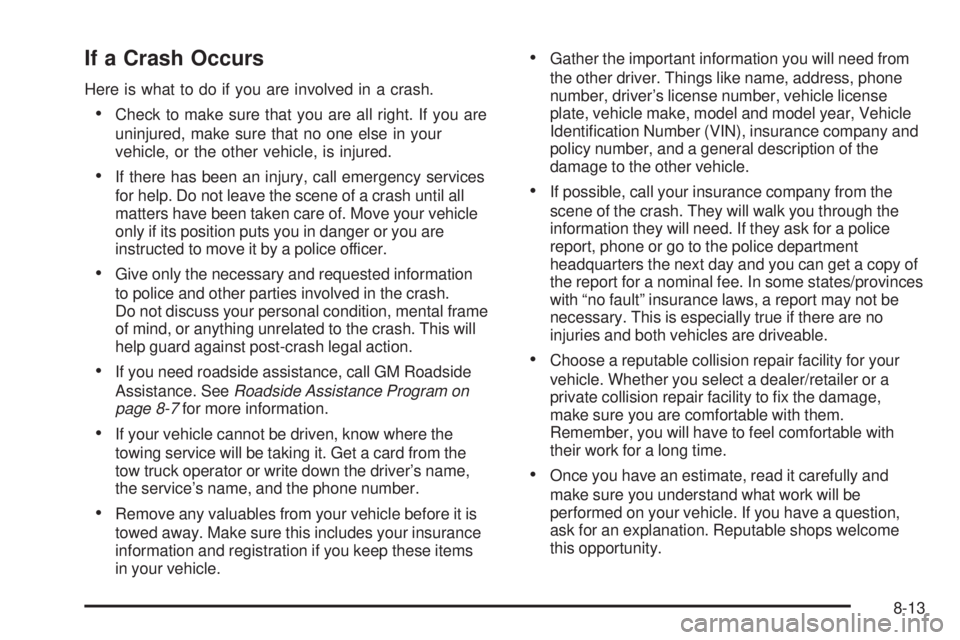
If a Crash Occurs
Here is what to do if you are involved in a crash.
•Check to make sure that you are all right. If you are
uninjured, make sure that no one else in your
vehicle, or the other vehicle, is injured.
•If there has been an injury, call emergency services
for help. Do not leave the scene of a crash until all
matters have been taken care of. Move your vehicle
only if its position puts you in danger or you are
instructed to move it by a police officer.
•Give only the necessary and requested information
to police and other parties involved in the crash.
Do not discuss your personal condition, mental frame
of mind, or anything unrelated to the crash. This will
help guard against post-crash legal action.
•If you need roadside assistance, call GM Roadside
Assistance. SeeRoadside Assistance Program on
page 8-7for more information.
•If your vehicle cannot be driven, know where the
towing service will be taking it. Get a card from the
tow truck operator or write down the driver’s name,
the service’s name, and the phone number.
•Remove any valuables from your vehicle before it is
towed away. Make sure this includes your insurance
information and registration if you keep these items
in your vehicle.
•Gather the important information you will need from
the other driver. Things like name, address, phone
number, driver’s license number, vehicle license
plate, vehicle make, model and model year, Vehicle
Identification Number (VIN), insurance company and
policy number, and a general description of the
damage to the other vehicle.
•If possible, call your insurance company from the
scene of the crash. They will walk you through the
information they will need. If they ask for a police
report, phone or go to the police department
headquarters the next day and you can get a copy of
the report for a nominal fee. In some states/provinces
with “no fault” insurance laws, a report may not be
necessary. This is especially true if there are no
injuries and both vehicles are driveable.
•Choose a reputable collision repair facility for your
vehicle. Whether you select a dealer/retailer or a
private collision repair facility to fix the damage,
make sure you are comfortable with them.
Remember, you will have to feel comfortable with
their work for a long time.
•Once you have an estimate, read it carefully and
make sure you understand what work will be
performed on your vehicle. If you have a question,
ask for an explanation. Reputable shops welcome
this opportunity.
8-13
Page 434 of 448
Circuit Breakers............................................6-111
Cleaning
Aluminum or Chrome-Plated Wheels.............6-108
Exterior Lamps/Lenses................................6-106
Fabric/Carpet............................................6-103
Finish Care...............................................6-107
Instrument Panel, Vinyl, and Other Plastic
Surfaces...............................................6-105
Interior.....................................................6-102
Leather....................................................6-104
Tires........................................................6-108
Underbody Maintenance.............................6-109
Washing Your Vehicle.................................6-106
Weatherstrips............................................6-105
Windshield and Wiper Blades......................6-107
Cleaning the Mirror.................................3-36, 3-37
Climate Control System...................................4-16
Outlet Adjustment........................................4-18
Climate Controls.............................................1-14
Clock, Setting.................................................4-43
Clutch, Hydraulic.............................................6-26
Cold Temperature Operation.............................6-17
Collision Damage Repair..................................8-11
Collision Parts................................................8-12
Compass.......................................................3-37
Compass Calibration.......................................3-37
Compass Operation.........................................3-37
Compass Variance..........................................3-38
Content Theft-Deterrent....................................3-13
Control of a Vehicle.......................................... 5-3Coolant
Engine.......................................................6-29
Engine Temperature Gage............................4-27
Cooling System..............................................6-27
Courtesy Transportation Program......................8-10
Coverage........................................................ 8-8
Cruise Control
.................................................. 4-7
Light..........................................................4-32
Cupholders....................................................3-40
Current and Past Model Order Forms................8-16
Customer Assistance......................................... 8-6
Offices......................................................... 8-6
Text Telephone (TTY) Users........................... 8-6
Customer Information
Service Publications Ordering Information........8-15
Customer Satisfaction Procedure........................ 8-2
D
Damage Repair, Collision.................................8-11
Data Recorders, Event....................................8-17
Daytime Running Lamps (DRL).........................4-11
Defensive Driving............................................. 5-2
Dinghy Towing................................................5-42
Disc, MP3......................................................4-56
Doing Your Own Service Work........................... 6-4
Dolly Towing..................................................5-44
Dome Lamp ...................................................4-13
Dome Lamp Override......................................4-14
4
Page 440 of 448
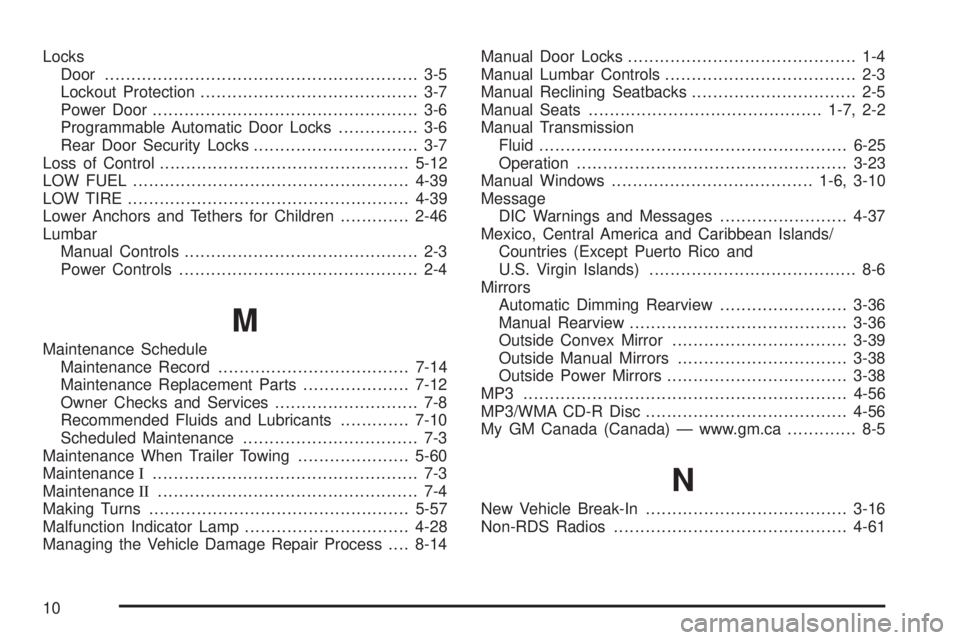
Locks
Door ........................................................... 3-5
Lockout Protection......................................... 3-7
Power Door .................................................. 3-6
Programmable Automatic Door Locks............... 3-6
Rear Door Security Locks............................... 3-7
Loss of Control...............................................5-12
LOW FUEL ....................................................4-39
LOW TIRE .....................................................4-39
Lower Anchors and Tethers for Children.............2-46
Lumbar
Manual Controls............................................ 2-3
Power Controls............................................. 2-4
M
Maintenance Schedule
Maintenance Record....................................7-14
Maintenance Replacement Parts....................7-12
Owner Checks and Services........................... 7-8
Recommended Fluids and Lubricants.............7-10
Scheduled Maintenance................................. 7-3
Maintenance When Trailer Towing.....................5-60
MaintenanceI.................................................. 7-3
MaintenanceII................................................. 7-4
Making Turns.................................................5-57
Malfunction Indicator Lamp...............................4-28
Managing the Vehicle Damage Repair Process....8-14Manual Door Locks........................................... 1-4
Manual Lumbar Controls.................................... 2-3
Manual Reclining Seatbacks............................... 2-5
Manual Seats............................................1-7, 2-2
Manual Transmission
Fluid..........................................................6-25
Operation...................................................3-23
Manual Windows......................................1-6, 3-10
Message
DIC Warnings and Messages........................4-37
Mexico, Central America and Caribbean Islands/
Countries (Except Puerto Rico and
U.S. Virgin Islands)....................................... 8-6
Mirrors
Automatic Dimming Rearview........................3-36
Manual Rearview.........................................3-36
Outside Convex Mirror.................................3-39
Outside Manual Mirrors................................3-38
Outside Power Mirrors..................................3-38
MP3 .............................................................4-56
MP3/WMA CD-R Disc ......................................4-56
My GM Canada (Canada) — www.gm.ca............. 8-5
N
New Vehicle Break-In......................................3-16
Non-RDS Radios............................................4-61
10
Page 443 of 448
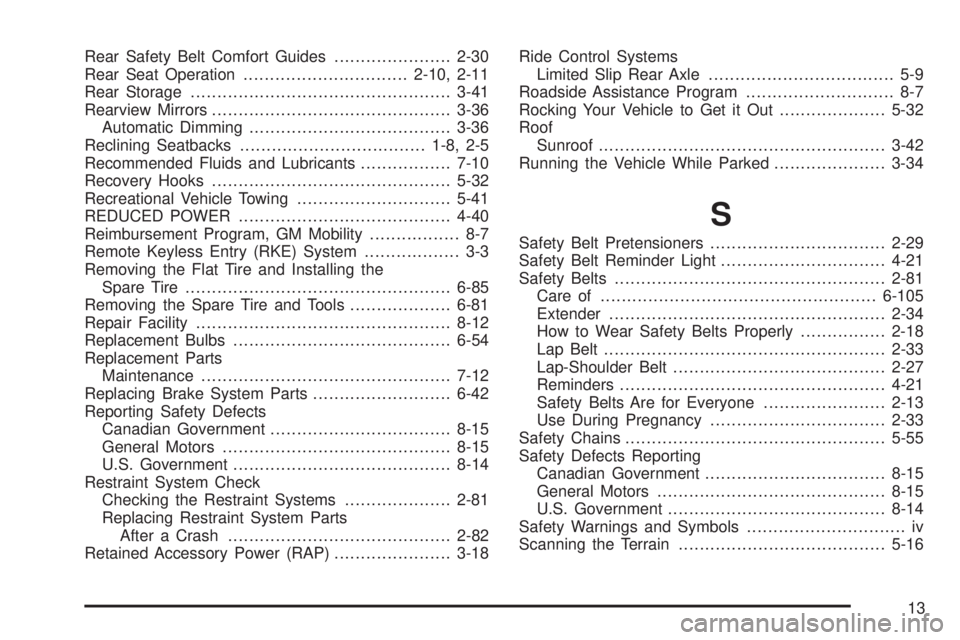
Rear Safety Belt Comfort Guides......................2-30
Rear Seat Operation...............................2-10, 2-11
Rear Storage.................................................3-41
Rearview Mirrors.............................................3-36
Automatic Dimming......................................3-36
Reclining Seatbacks...................................1-8, 2-5
Recommended Fluids and Lubricants.................7-10
Recovery Hooks.............................................5-32
Recreational Vehicle Towing.............................5-41
REDUCED POWER........................................4-40
Reimbursement Program, GM Mobility................. 8-7
Remote Keyless Entry (RKE) System.................. 3-3
Removing the Flat Tire and Installing the
Spare Tire..................................................6-85
Removing the Spare Tire and Tools...................6-81
Repair Facility................................................8-12
Replacement Bulbs.........................................6-54
Replacement Parts
Maintenance...............................................7-12
Replacing Brake System Parts..........................6-42
Reporting Safety Defects
Canadian Government..................................8-15
General Motors...........................................8-15
U.S. Government.........................................8-14
Restraint System Check
Checking the Restraint Systems....................2-81
Replacing Restraint System Parts
After a Crash..........................................2-82
Retained Accessory Power (RAP)......................3-18Ride Control Systems
Limited Slip Rear Axle................................... 5-9
Roadside Assistance Program............................ 8-7
Rocking Your Vehicle to Get it Out....................5-32
Roof
Sunroof......................................................3-42
Running the Vehicle While Parked.....................3-34
S
Safety Belt Pretensioners.................................2-29
Safety Belt Reminder Light...............................4-21
Safety Belts...................................................2-81
Care of ....................................................6-105
Extender....................................................2-34
How to Wear Safety Belts Properly................2-18
Lap Belt.....................................................2-33
Lap-Shoulder Belt........................................2-27
Reminders..................................................4-21
Safety Belts Are for Everyone.......................2-13
Use During Pregnancy.................................2-33
Safety Chains.................................................5-55
Safety Defects Reporting
Canadian Government..................................8-15
General Motors...........................................8-15
U.S. Government.........................................8-14
Safety Warnings and Symbols.............................. iv
Scanning the Terrain.......................................5-16
13