GMC CANYON 2010 Manual Online
CANYON 2010
GMC
GMC
https://www.carmanualsonline.info/img/44/35520/w960_35520-0.png
GMC CANYON 2010 Manual Online
Page 358 of 448
Regular/Extended Cab
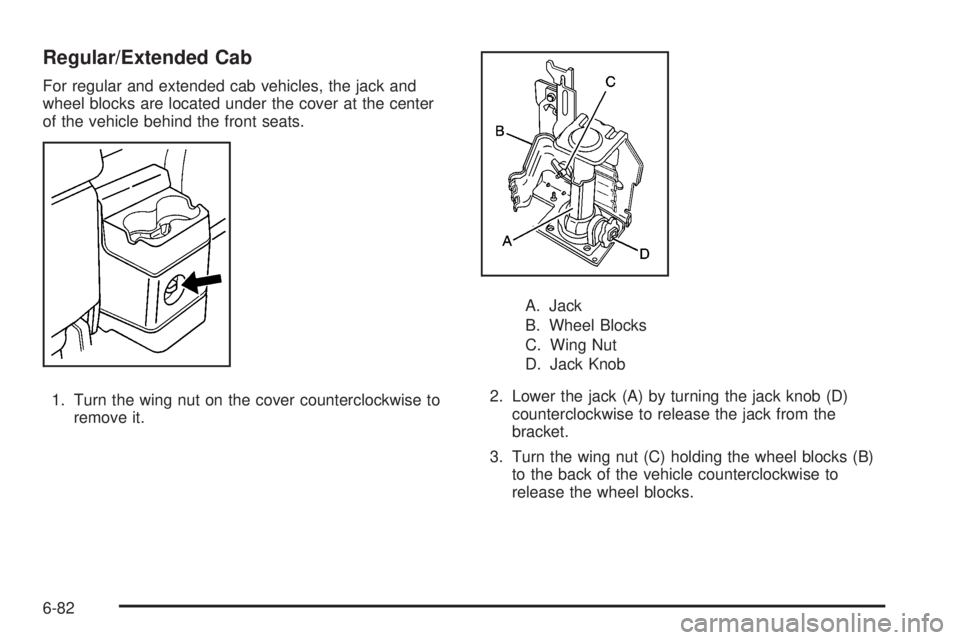
For regular and extended cab vehicles, the jack and
wheel blocks are located under the cover at the center
of the vehicle behind the front seats.
1. Turn the wing nut on the cover counterclockwise to
remove it.A. Jack
B. Wheel Blocks
C. Wing Nut
D. Jack Knob
2. Lower the jack (A) by turning the jack knob (D)
counterclockwise to release the jack from the
bracket.
3. Turn the wing nut (C) holding the wheel blocks (B)
to the back of the vehicle counterclockwise to
release the wheel blocks.
6-82
Page 359 of 448
Crew Cab
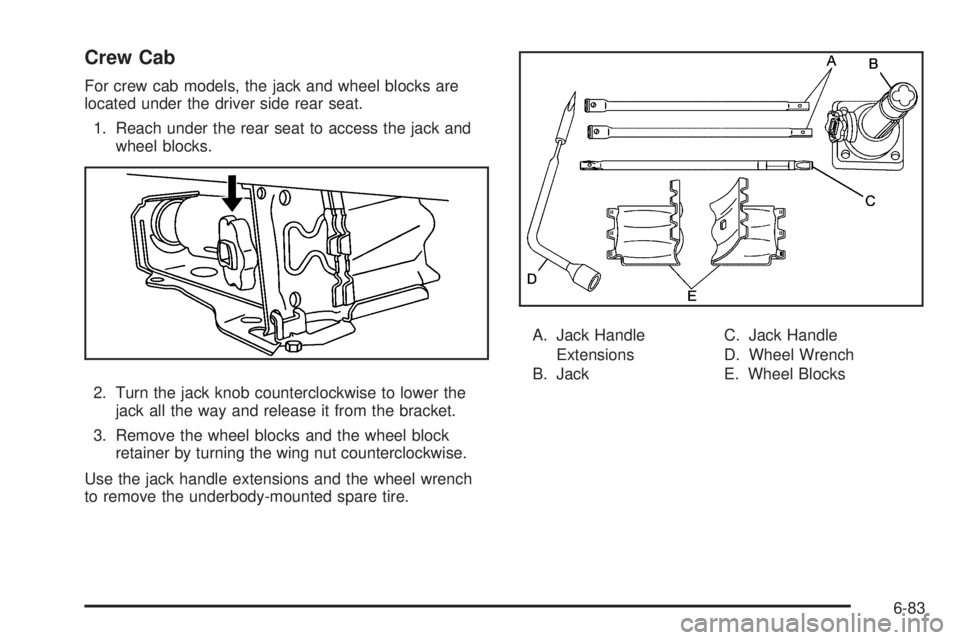
For crew cab models, the jack and wheel blocks are
located under the driver side rear seat.
1. Reach under the rear seat to access the jack and
wheel blocks.
2. Turn the jack knob counterclockwise to lower the
jack all the way and release it from the bracket.
3. Remove the wheel blocks and the wheel block
retainer by turning the wing nut counterclockwise.
Use the jack handle extensions and the wheel wrench
to remove the underbody-mounted spare tire.A. Jack Handle
Extensions
B. JackC. Jack Handle
D. Wheel Wrench
E. Wheel Blocks
6-83
Page 360 of 448
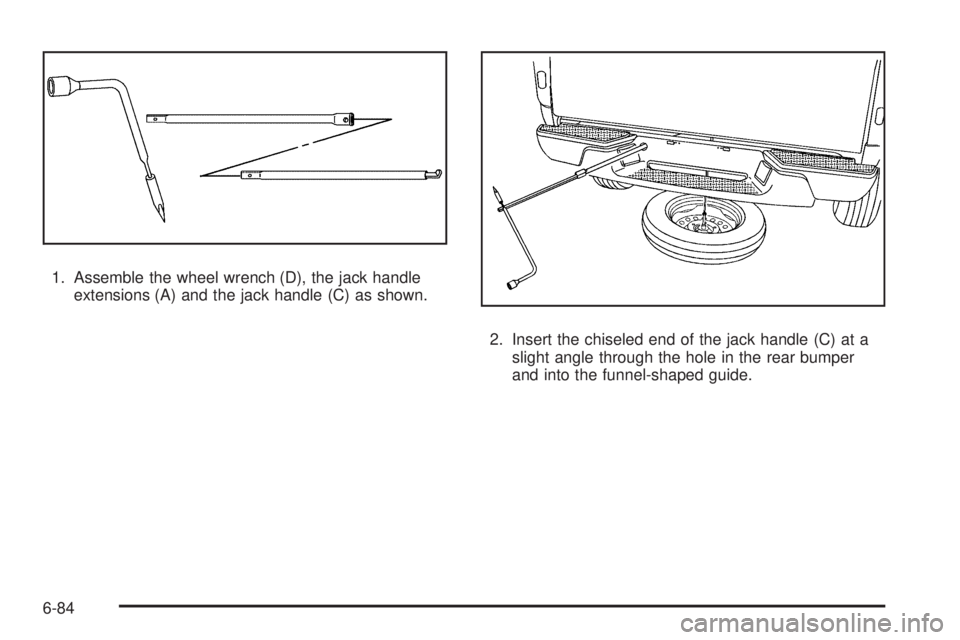
1. Assemble the wheel wrench (D), the jack handle
extensions (A) and the jack handle (C) as shown.
2. Insert the chiseled end of the jack handle (C) at a
slight angle through the hole in the rear bumper
and into the funnel-shaped guide.
6-84
Page 361 of 448
3. Turn the wheel wrench (D) counterclockwise to
lower the spare tire to the ground. Continue to
turn the wheel wrench until the spare tire can be
pulled out from under the vehicle.
If the spare tire does not lower to the ground,
the secondary latch is engaged causing the tire
not to lower. SeeSecondary Latch System
on page 6-93.
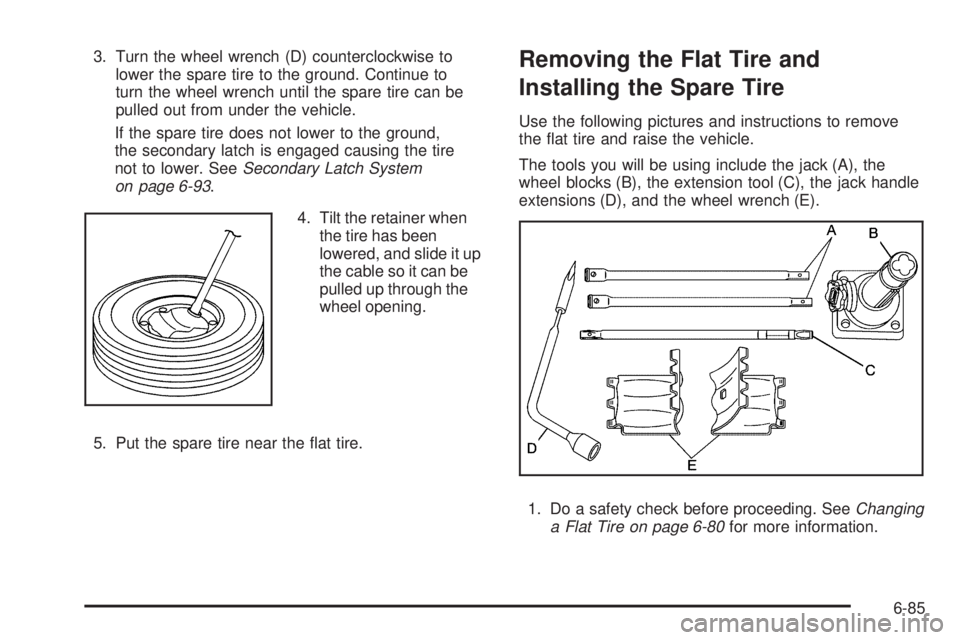
4. Tilt the retainer when
the tire has been
lowered, and slide it up
the cable so it can be
pulled up through the
wheel opening.
5. Put the spare tire near the flat tire.Removing the Flat Tire and
Installing the Spare Tire
Use the following pictures and instructions to remove
the flat tire and raise the vehicle.
The tools you will be using include the jack (A), the
wheel blocks (B), the extension tool (C), the jack handle
extensions (D), and the wheel wrench (E).
1. Do a safety check before proceeding. SeeChanging
a Flat Tire on page 6-80for more information.
6-85
Page 362 of 448
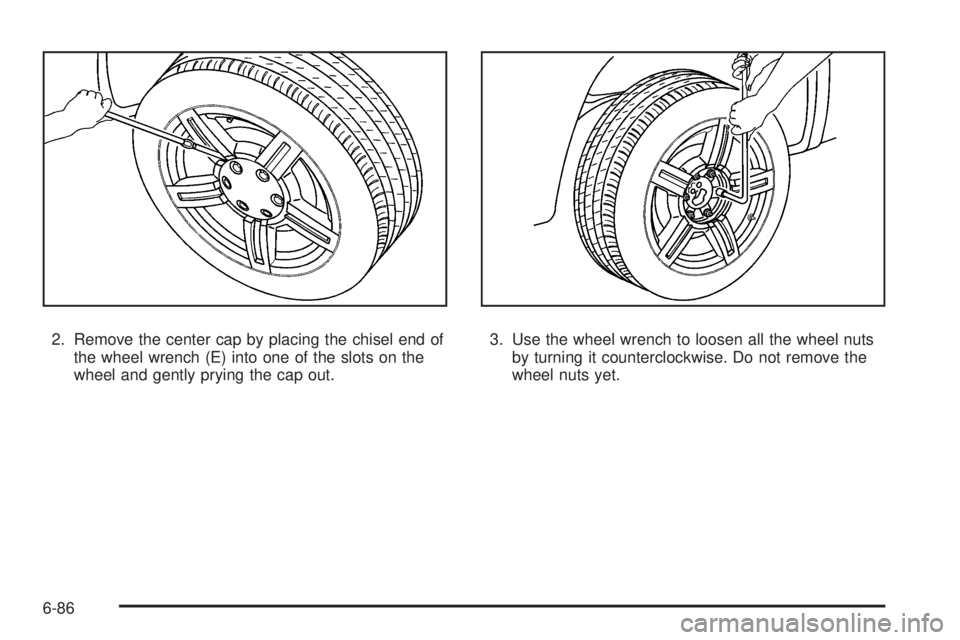
2. Remove the center cap by placing the chisel end of
the wheel wrench (E) into one of the slots on the
wheel and gently prying the cap out.3. Use the wheel wrench to loosen all the wheel nuts
by turning it counterclockwise. Do not remove the
wheel nuts yet.
6-86
Page 365 of 448
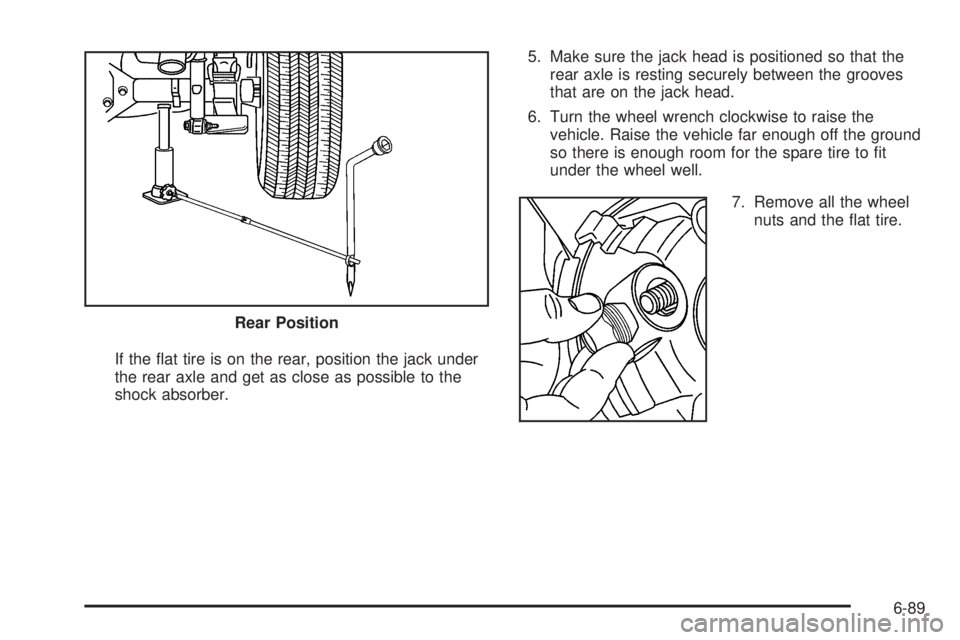
If the flat tire is on the rear, position the jack under
the rear axle and get as close as possible to the
shock absorber.5. Make sure the jack head is positioned so that the
rear axle is resting securely between the grooves
that are on the jack head.
6. Turn the wheel wrench clockwise to raise the
vehicle. Raise the vehicle far enough off the ground
so there is enough room for the spare tire to fit
under the wheel well.
7. Remove all the wheel
nuts and the flat tire.
Rear Position
6-89
Page 366 of 448
{WARNING:
Rust or dirt on a wheel, or on the parts to which it is
fastened, can make wheel nuts become loose after
time. The wheel could come off and cause an
accident. When changing a wheel, remove any rust
or dirt from places where the wheel attaches to the
vehicle. In an emergency, use a cloth or a paper
towel to do this; but be sure to use a scraper or wire
brush later, if needed, to get all the rust or dirt off.
SeeChanging a Flat Tire on page 6-80.
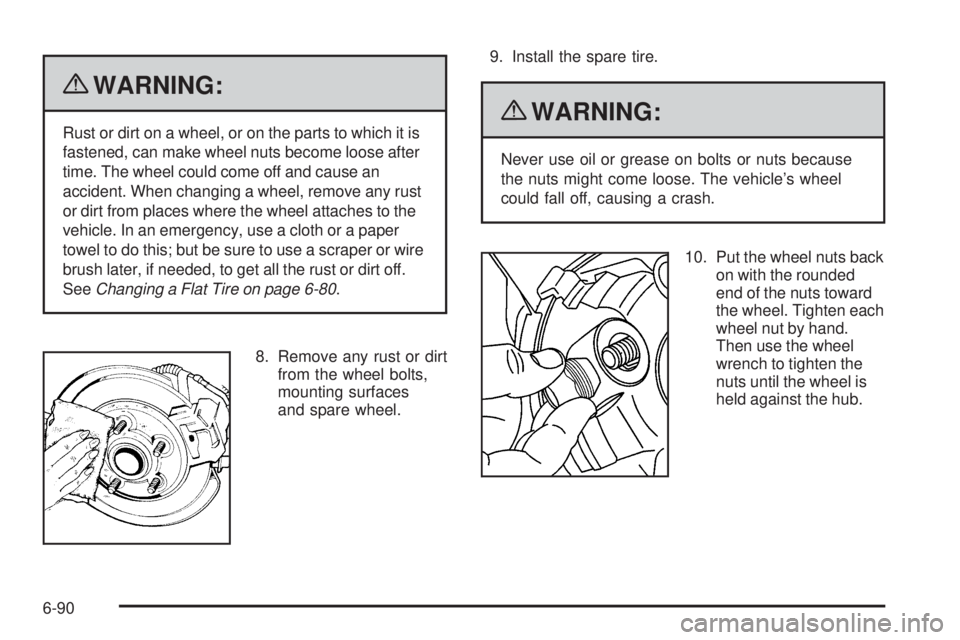
8. Remove any rust or dirt
from the wheel bolts,
mounting surfaces
and spare wheel.9. Install the spare tire.{WARNING:
Never use oil or grease on bolts or nuts because
the nuts might come loose. The vehicle’s wheel
could fall off, causing a crash.
10. Put the wheel nuts back
on with the rounded
end of the nuts toward
the wheel. Tighten each
wheel nut by hand.
Then use the wheel
wrench to tighten the
nuts until the wheel is
held against the hub.
6-90
Page 367 of 448
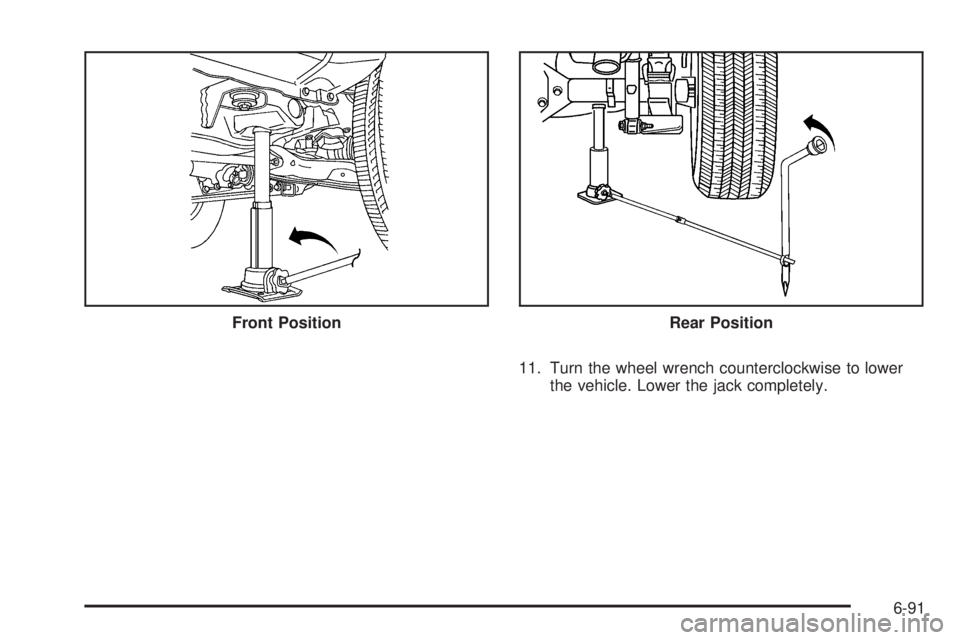
11. Turn the wheel wrench counterclockwise to lower
the vehicle. Lower the jack completely. Front Position
Rear Position
6-91
Page 368 of 448
{WARNING:
Wheel nuts that are improperly or incorrectly
tightened can cause the wheels to become loose or
come off. The wheel nuts should be tightened with
a torque wrench to the proper torque specification
after replacing. Follow the torque specification
supplied by the aftermarket manufacturer when
using accessory locking wheel nuts. SeeCapacities
and Specications on page 6-118for original
equipment wheel nut torque specifications.
Notice:Improperly tightened wheel nuts can lead
to brake pulsation and rotor damage. To avoid
expensive brake repairs, evenly tighten the wheel
nuts in the proper sequence and to the proper torque
specication. SeeCapacities and Specifications on
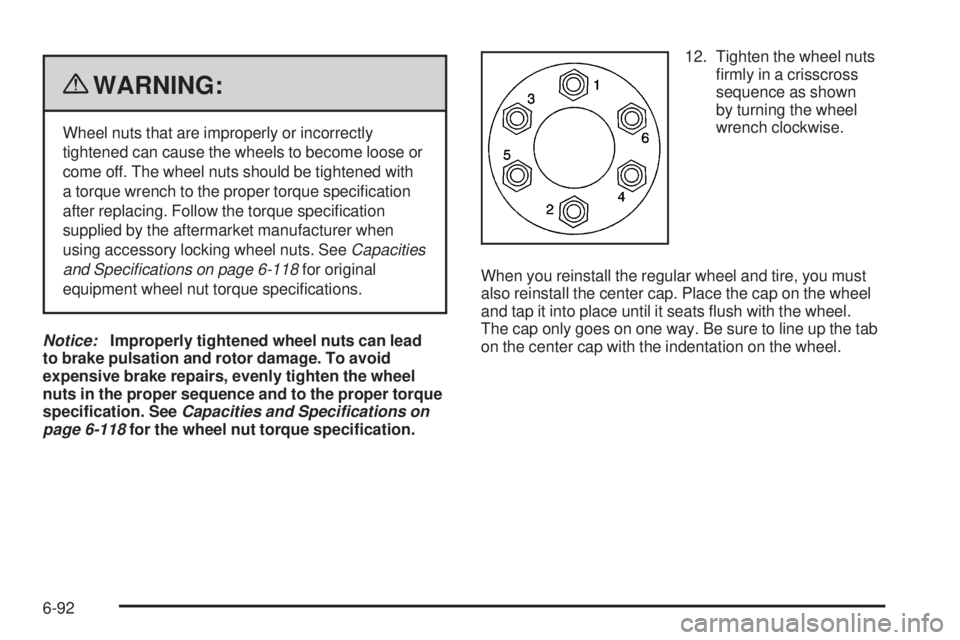
page 6-118for the wheel nut torque specication.12. Tighten the wheel nuts
firmly in a crisscross
sequence as shown
by turning the wheel
wrench clockwise.
When you reinstall the regular wheel and tire, you must
also reinstall the center cap. Place the cap on the wheel
and tap it into place until it seats flush with the wheel.
The cap only goes on one way. Be sure to line up the tab
on the center cap with the indentation on the wheel.
6-92
Page 369 of 448
Secondary Latch System
Your vehicle has an underbody-mounted tire hoist
assembly that has a secondary latch system. It is
designed to stop the spare tire from suddenly falling off
your vehicle. For the secondary latch to work, the spare
must be installed with the valve stem pointing down.
SeeStoring a Flat or Spare Tire and Tools on page 6-96.
{WARNING:
Before beginning this procedure read all the
instructions. Failure to read and follow the
instructions could damage the hoist assembly
and you and others could get hurt. Read and
follow the instructions listed next.To release the spare tire from the secondary latch:
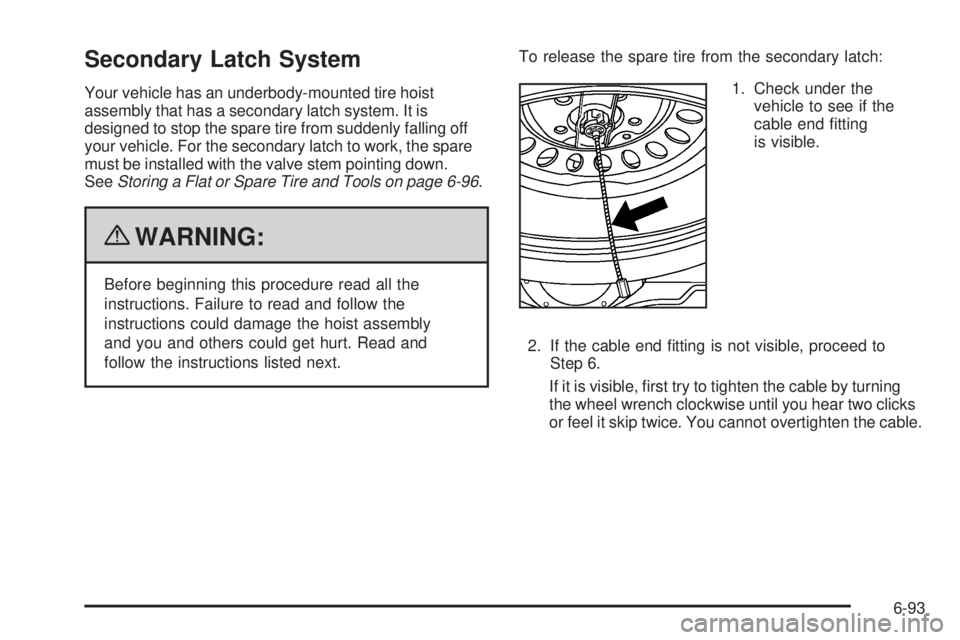
1. Check under the
vehicle to see if the
cable end fitting
is visible.
2. If the cable end fitting is not visible, proceed to
Step 6.
If it is visible, first try to tighten the cable by turning
the wheel wrench clockwise until you hear two clicks
or feel it skip twice. You cannot overtighten the cable.
6-93