ABS GMC CANYON 2012 User Guide
[x] Cancel search | Manufacturer: GMC, Model Year: 2012, Model line: CANYON, Model: GMC CANYON 2012Pages: 404, PDF Size: 5.25 MB
Page 223 of 404
Black plate (43,1)GMC Canyon Owner Manual - 2012
Driving and Operating 9-43
To release the parking brake,
hold the regular brake pedal down.
Pull the bottom edge of the lever,
located above the parking brake
pedal, with the parking brake
symbol, directly rearward to
release the parking brake.
If the ignition is on when the parking
brake is released, the brake system
warning light will go off.
Notice:Driving with the parking
brake on can overheat the brake
system and cause premature
wear or damage to brake system
parts. Make sure that the parking
brake is fully released and the
brake warning light is off before
driving.
If you are towing a trailer and are
parking on any hill, see Driving
Characteristics and Towing Tips on
page 9‑54.Brake Assist
This vehicle has a brake assist
feature designed to assist the driver
in stopping or decreasing vehicle
speed in emergency driving
conditions. This feature uses the
stability system hydraulic brake
control module to supplement the
power brake system under
conditions where the driver has
quickly and forcefully applied the
brake pedal in an attempt to quickly
stop or slow down the vehicle.
The stability system hydraulic brake
control module increases brake
pressure at each corner of the
vehicle until the ABS activates. Minor brake pedal pulsation or
pedal movement during this time is
normal and the driver should
continue to apply the brake pedal
as the driving situation dictates.
The brake assist feature will
automatically disengage when the
brake pedal is released or brake
pedal pressure is quickly
decreased.
Page 224 of 404
Black plate (44,1)GMC Canyon Owner Manual - 2012
9-44 Driving and Operating
Ride Control Systems
Traction Control
System (TCS)
The Traction Control System (TCS)
is part of StabiliTrak. TCS limits
wheel slip which is especially useful
in slippery road conditions. The
system operates only if it senses
that any of the wheels are spinning
or beginning to lose traction. When
this happens, TCS applies the
brakes to limit wheel spin and also
reduces engine power. The system
may be heard or felt while it is
working. This is normal and does
not mean there is a problem with
the vehicle.
Notice:If the wheel(s) of one axle
is allowed to spin excessively
while the StabiliTrak
®, ABS, brake
warning lights, and any relevant
DIC messages are displayed, the
transfer case could be damaged.
The repairs would not be covered
by the vehicle warranty. Reduce
engine power and do not spin the wheel(s) excessively while these
lights and messages are
displayed.
TCS can operate on dry roads
under some conditions. When this
happens, the system may be
heard working or a reduction in
acceleration may be noticed. This is
normal and does not mean there is
a problem with the vehicle.
Examples of these conditions
include hard acceleration in a turn,
an abrupt upshift or downshift of the
transmission or driving on rough
roads.
If cruise control is being used
when TCS begins to limit wheel
spin, the cruise control automatically
disengages. The cruise control
can be re-engaged when road
conditions allow. See
Cruise Control
on page 9‑47.
The message TRACTION FAULT
appears in the Driver Information
Center (DIC) when a TCS or
Antilock Brake System (ABS)
problem has been detected and the vehicle needs service. When
this message is on, the system will
not limit wheel spin. Adjust your
driving accordingly. See
Ride
Control System Messages on
page 5‑26.
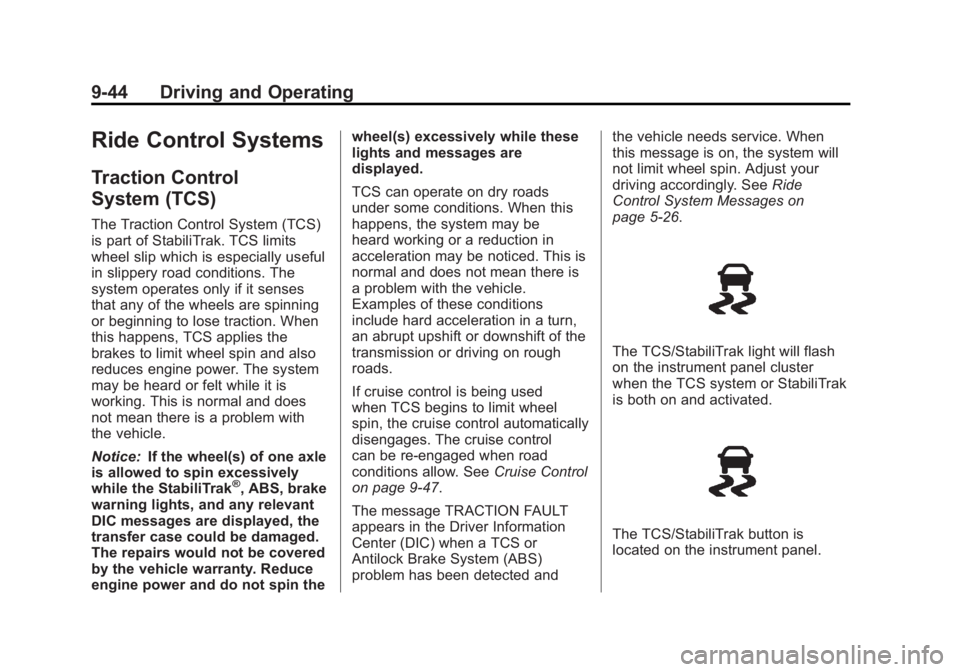
The TCS/StabiliTrak light will flash
on the instrument panel cluster
when the TCS system or StabiliTrak
is both on and activated.
The TCS/StabiliTrak button is
located on the instrument panel.
Page 237 of 404
Black plate (57,1)GMC Canyon Owner Manual - 2012
Driving and Operating 9-57
When towing at high altitude on
steep uphill grades, consider the
following: Engine coolant will boil at
a lower temperature than at normal
altitudes. If the engine is turned off
immediately after towing at high
altitude on steep uphill grades, the
vehicle may show signs similar to
engine overheating. To avoid this,
let the engine run while parked,
preferably on level ground, with an
automatic transmission in P (Park)
or a manual transmission in
N (Neutral) with the parking brake
applied, for a few minutes before
turning the engine off. If the
overheat warning comes on, see
Engine Overheating on page 10‑23.Parking on Hills
{WARNING
Parking the vehicle on a hill with
the trailer attached can be
dangerous. If something goes
wrong, the rig could start to move.
People can be injured, and both
the vehicle and the trailer can be
damaged. When possible, always
park the rig on a flat surface.
If parking the rig on a hill:
1. Press the brake pedal, but do not shift into P (Park) yet for
vehicles with an automatic
transmission, or into gear for
vehicles with a manual
transmission. Turn the wheels
into the curb if facing downhill or
into traffic if facing uphill. 2. Have someone place chocks
under the trailer wheels.
3. When the wheel chocks are in place, release the brake pedal
until the chocks absorb the load.
4. Reapply the brake pedal. Then apply the parking brake and shift
into P (Park) for vehicles with an
automatic transmission or into
gear for vehicles with a manual
transmission.
5. If the vehicle has four-wheel-drive, be sure the
transfer case is in a drive gear
and not in N (Neutral). See
Four-Wheel Drive on page 10‑30
for more information.
6. Release the brake pedal.
Page 286 of 404
Black plate (42,1)GMC Canyon Owner Manual - 2012
10-42 Vehicle Care
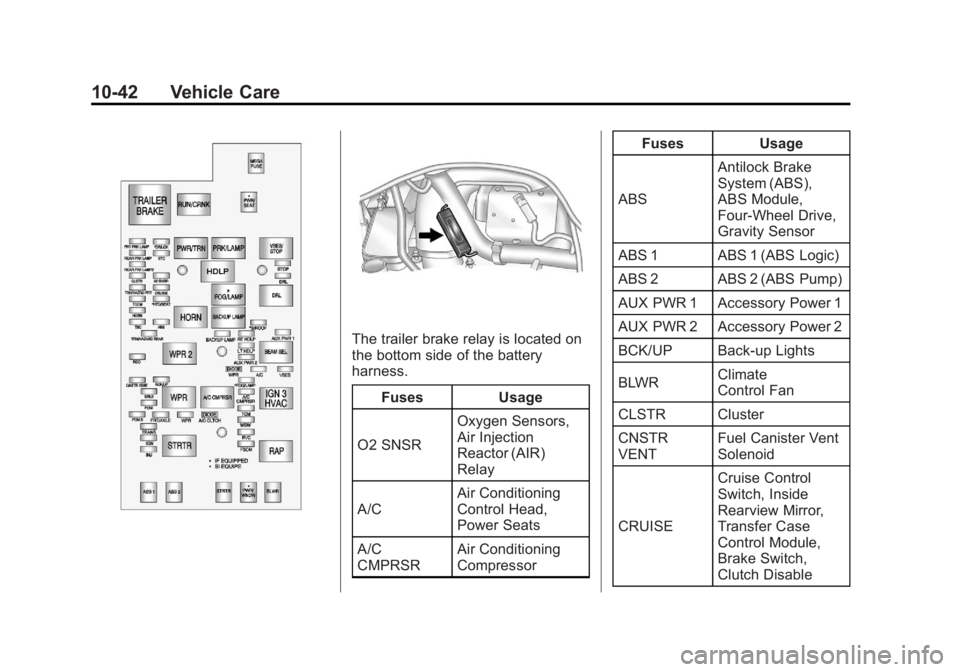
The trailer brake relay is located on
the bottom side of the battery
harness.Fuses Usage
O2 SNSR Oxygen Sensors,
Air Injection
Reactor (AIR)
Relay
A/C Air Conditioning
Control Head,
Power Seats
A/C
CMPRSR Air Conditioning
Compressor Fuses Usage
ABS Antilock Brake
System (ABS),
ABS Module,
Four‐Wheel Drive,
Gravity Sensor
ABS 1 ABS 1 (ABS Logic)
ABS 2 ABS 2 (ABS Pump)
AUX PWR 1 Accessory Power 1
AUX PWR 2 Accessory Power 2
BCK/UP Back-up Lights
BLWR Climate
Control Fan
CLSTR Cluster
CNSTR
VENT Fuel Canister Vent
Solenoid
CRUISE Cruise Control
Switch, Inside
Rearview Mirror,
Transfer Case
Control Module,
Brake Switch,
Clutch Disable
Page 289 of 404
Black plate (45,1)GMC Canyon Owner Manual - 2012
Vehicle Care 10-45
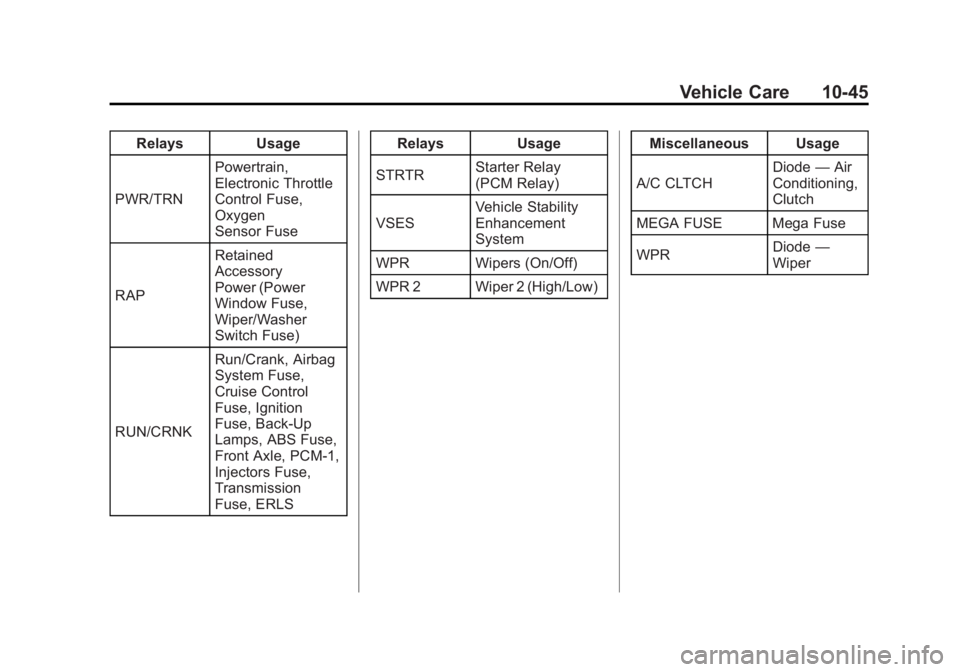
RelaysUsage
PWR/TRN Powertrain,
Electronic Throttle
Control Fuse,
Oxygen
Sensor Fuse
RAP Retained
Accessory
Power (Power
Window Fuse,
Wiper/Washer
Switch Fuse)
RUN/CRNK Run/Crank, Airbag
System Fuse,
Cruise Control
Fuse, Ignition
Fuse, Back-Up
Lamps, ABS Fuse,
Front Axle, PCM-1,
Injectors Fuse,
Transmission
Fuse, ERLS Relays
Usage
STRTR Starter Relay
(PCM Relay)
VSES Vehicle Stability
Enhancement
System
WPR Wipers (On/Off)
WPR 2 Wiper 2 (High/Low) Miscellaneous Usage
A/C CLTCH Diode
—Air
Conditioning,
Clutch
MEGA FUSE Mega Fuse
WPR Diode
—
Wiper
Page 319 of 404
Black plate (75,1)GMC Canyon Owner Manual - 2012
Vehicle Care 10-75
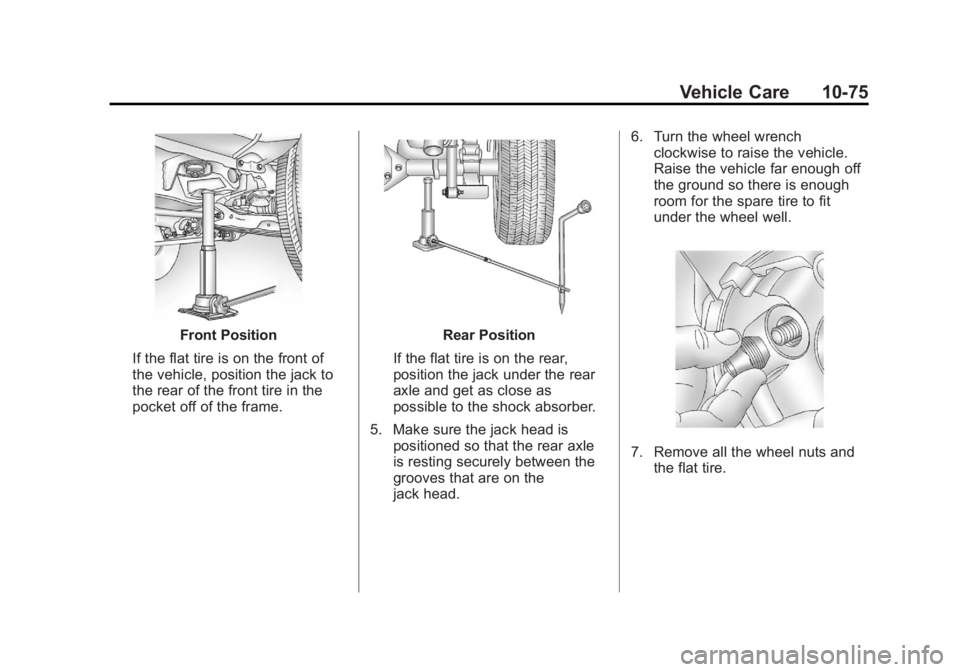
Front Position
If the flat tire is on the front of
the vehicle, position the jack to
the rear of the front tire in the
pocket off of the frame.Rear Position
If the flat tire is on the rear,
position the jack under the rear
axle and get as close as
possible to the shock absorber.
5. Make sure the jack head is positioned so that the rear axle
is resting securely between the
grooves that are on the
jack head. 6. Turn the wheel wrench
clockwise to raise the vehicle.
Raise the vehicle far enough off
the ground so there is enough
room for the spare tire to fit
under the wheel well.
7. Remove all the wheel nuts andthe flat tire.
Page 393 of 404
Black plate (1,1)GMC Canyon Owner Manual - 2012
INDEX i-1
A
Accessories andModifications . . . . . . . . . . . . . . . . . 10-4
Accessory Power . . . . . . . . . . . . . . 9-28
Add-On Electrical Equipment . . . . . . . . . . . . . . . . . . . 9-64
Adjustments
Lumbar, Front Seats . . . . . . . . . . . 3-4
Air Cleaner/Filter, Engine . . . . . 10-17
Air Vents . . . . . . . . . . . . . . . . . . . . . . . 8-3
Airbag System Check . . . . . . . . . . . . . . . . . . . . . . . . 3-35
How Does an AirbagRestrain? . . . . . . . . . . . . . . . . . . . 3-26
Passenger Sensing System . . . . . . . . . . . . . . . . . . . . . . 3-28
What Makes an Airbag Inflate? . . . . . . . . . . . . . . . . . . . . . . 3-26
What Will You See after an Airbag Inflates? . . . . . . . . . . . . . 3-27 Airbag System (cont'd)
When Should an Airbag
Inflate? . . . . . . . . . . . . . . . . . . . . . . 3-25
Where Are the Airbags? . . . . . . 3-23
Airbags Adding Equipment to theVehicle . . . . . . . . . . . . . . . . . . . . . . 3-34
Passenger Status Indicator . . . 5-11
Readiness Light . . . . . . . . . . . . . . 5-10
Servicing Airbag-Equipped Vehicles . . . . . . . . . . . . . . . . . . . . . 3-33
System Check . . . . . . . . . . . . . . . . 3-21
Alarm System Anti-theft . . . . . . . . . . . . . . . . . . . . . . 2-10
AM-FM Radio . . . . . . . . . . . . . . . . . . . 7-9
Antenna Satellite Radio . . . . . . . . . . . . . . . . 7-16
Anti-theft
Alarm System . . . . . . . . . . . . . . . . 2-10
Antilock Brake System (ABS) . . . . . . . . . . . . . . . . 9-41
Warning Light . . . . . . . . . . . . . . . . . 5-16 Appearance Care
Exterior . . . . . . . . . . . . . . . . . . . . . 10-96
Interior . . . . . . . . . . . . . . . . . . . . . 10-100
Ashtrays . . . . . . . . . . . . . . . . . . . . . . . . 5-5
Assistance Program, Roadside . . . . . . . . . . . . . . 13-8, 13-10
Audio Players . . . . . . . . . . . . . . . . . 7-16
CD . . . . . . . . . . . . . . . . . . . . . . . . . . . 7-16
Audio System Chime Level Adjustment . . . . . . . 5-6
Fixed Mast Antenna . . . . . . . . . . 7-16
Radio Reception . . . . . . . . . . . . . . 7-15
Theft-Deterrent Feature . . . . . . . . 7-3
Automatic Door Locks . . . . . . . . . . . . . . . . . . . . 2-6
Headlamp System . . . . . . . . . . . . . 6-4
Transmission . . . . . . . . . . . . . . . . . 9-33
Transmission Fluid . . . . . . . . . 10-13
Automatic Transmission Shift Lock ControlFunction Check . . . . . . . . . . . 10-33
Axle, Front . . . . . . . . . . . . . . . . . . . . 10-31
Axle, Rear . . . . . . . . . . . . . . . . . . . . 10-32
Page 398 of 404
Black plate (6,1)GMC Canyon Owner Manual - 2012
i-6 INDEX
J
Jump Starting . . . . . . . . . . . . . . . . . 10-87
K
Keyless EntryRemote (RKE) System . . . . . . . . 2-3
Keys . . . . . . . . . . . . . . . . . . . . . . . . . . . . 2-2
L
Labeling, Tire Sidewall . . . . . . . . 10-49
Lamps Daytime Running (DRL) . . . . . . . 6-3
Dome . . . . . . . . . . . . . . . . . . . . . . . . . . 6-7
Exterior Cargo . . . . . . . . . . . . . . . . . 6-6
Exterior Controls . . . . . . . . . . . . . . . 6-1
Exterior Lamps OffReminder . . . . . . . . . . . . . . . . . . . . 6-2
License Plate . . . . . . . . . . . . . . . 10-39
Malfunction Indicator . . . . . . . . . 5-12
Messages . . . . . . . . . . . . . . . . . . . . 5-25
Lap Belt . . . . . . . . . . . . . . . . . . . . . . . 3-19 Lap-Shoulder Belt . . . . . . . . . . . . . 3-14
LATCH System
Replacing Parts after aCrash . . . . . . . . . . . . . . . . . . . . . . . 3-54
LATCH, Lower Anchors and Tethers for Children . . . . . . . . . . 3-44
Latches, Seatback . . . . . . . . . . . . . . 3-7
Lighter, Cigarette . . . . . . . . . . . . . . . 5-5
Lighting
Exit . . . . . . . . . . . . . . . . . . . . . . . . . . . . 6-8
Illumination Control . . . . . . . . . . . . 6-7
Lights Airbag Readiness . . . . . . . . . . . . . 5-10
Antilock Brake System(ABS) Warning . . . . . . . . . . . . . . 5-16
Brake System Warning . . . . . . . 5-15
Charging System . . . . . . . . . . . . . 5-12
Cruise Control . . . . . . . . . . . . . . . . 5-19
Engine Oil Pressure . . . . . . . . . . 5-18
Flash-to-Pass . . . . . . . . . . . . . . . . . . 6-3
High-Beam On . . . . . . . . . . . . . . . . 5-19 Lights (cont'd)
High/Low Beam Changer . . . . . . 6-2
Safety Belt Reminders . . . . . . . . . 5-9
Security . . . . . . . . . . . . . . . . . . . . . . 5-19
StabiliTrak
®OFF . . . . . . . . . . . . . 5-17
Tire Pressure . . . . . . . . . . . . . . . . . 5-17
Traction Control System (TCS)/StabiliTrak
®. . . . . . . . . . 5-17
Limited-Slip Rear Axle . . . . . . . . . 9-46
Locks
Automatic Door . . . . . . . . . . . . . . . . 2-6
Door . . . . . . . . . . . . . . . . . . . . . . . . . . . 2-5
Lockout Protection . . . . . . . . . . . . . 2-6
Power Door . . . . . . . . . . . . . . . . . . . . 2-6
Safety . . . . . . . . . . . . . . . . . . . . . . . . . 2-6
Loss of Control . . . . . . . . . . . . . . . . . 9-5
Lower Anchors and Tethers for Children (LATCH
System) . . . . . . . . . . . . . . . . . . . . . . 3-44
Lumbar Adjustment . . . . . . . . . . . . . 3-4 Front Seats . . . . . . . . . . . . . . . . . . . . 3-4