inflation pressure GMC CANYON 2012 User Guide
[x] Cancel search | Manufacturer: GMC, Model Year: 2012, Model line: CANYON, Model: GMC CANYON 2012Pages: 404, PDF Size: 5.25 MB
Page 301 of 404
Black plate (57,1)GMC Canyon Owner Manual - 2012
Vehicle Care 10-57
As an added safety feature, your
vehicle has been equipped with a
tire pressure monitoring system
(TPMS) that illuminates a low tire
pressure telltale when one or more
of your tires is significantly under‐
inflated.
Accordingly, when the low tire
pressure telltale illuminates, you
should stop and check your tires as
soon as possible, and inflate them
to the proper pressure. Driving on a
significantly under‐inflated tire
causes the tire to overheat and can
lead to tire failure. Under‐inflation
also reduces fuel efficiency and tire
tread life, and may affect the
vehicle's handling and stopping
ability.
Please note that the TPMS is not a
substitute for proper tire
maintenance, and it is the driver's
responsibility to maintain correct tire
pressure, even if under‐inflation has
not reached the level to trigger
illumination of the TPMS low tire
pressure telltale.Your vehicle has also been
equipped with a TPMS malfunction
indicator to indicate when the
system is not operating properly.
The TPMS malfunction indicator is
combined with the low tire pressure
telltale. When the system detects a
malfunction, the telltale will flash for
approximately one minute and then
remain continuously illuminated.
This sequence will continue upon
subsequent vehicle start‐ups as
long as the malfunction exists.
When the malfunction indicator is
illuminated, the system may not be
able to detect or signal low tire
pressure as intended. TPMS
malfunctions may occur for a variety
of reasons, including the installation
of replacement or alternate tires or
wheels on the vehicle that prevent
the TPMS from functioning properly.
Always check the TPMS malfunction
telltale after replacing one or more
tires or wheels on your vehicle to
ensure that the replacement or
alternate tires and wheels allow the
TPMS to continue to function
properly.
See
Tire Pressure Monitor
Operation on page 10‑58 for
additional information.
Federal Communications
Commission (FCC) Rules and
with Industry Canada
Standards
See Radio Frequency Statement on
page 13‑22 for information
regarding Part 15 of the Federal
Communications Commission (FCC)
Rules and with Industry Canada
Standards RSS-GEN/210/220/310.
Page 302 of 404
Black plate (58,1)GMC Canyon Owner Manual - 2012
10-58 Vehicle Care
Tire Pressure Monitor
Operation
This vehicle may have a Tire
Pressure Monitor System (TPMS).
The TPMS is designed to warn the
driver when a low tire pressure
condition exists. TPMS sensors are
mounted onto each tire and wheel
assembly on your vehicle, excluding
the spare tire. The TPMS sensors
monitor the air pressure in your tires
and transmit the tire pressure
readings to a receiver located in
the vehicle.
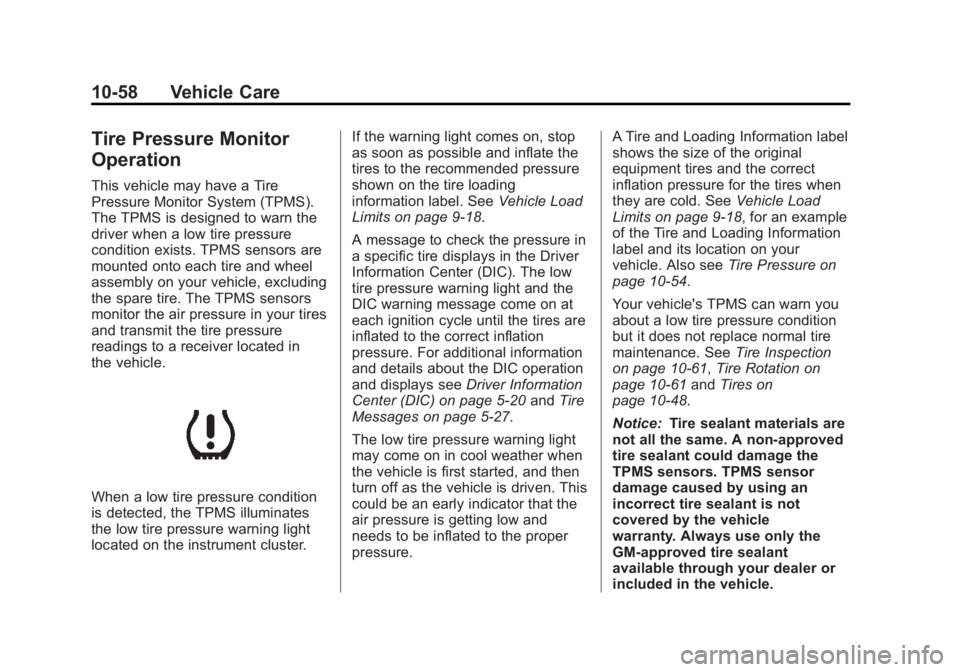
When a low tire pressure condition
is detected, the TPMS illuminates
the low tire pressure warning light
located on the instrument cluster.If the warning light comes on, stop
as soon as possible and inflate the
tires to the recommended pressure
shown on the tire loading
information label. See
Vehicle Load
Limits on page 9‑18.
A message to check the pressure in
a specific tire displays in the Driver
Information Center (DIC). The low
tire pressure warning light and the
DIC warning message come on at
each ignition cycle until the tires are
inflated to the correct inflation
pressure. For additional information
and details about the DIC operation
and displays see Driver Information
Center (DIC) on page 5‑20 andTire
Messages on page 5‑27.
The low tire pressure warning light
may come on in cool weather when
the vehicle is first started, and then
turn off as the vehicle is driven. This
could be an early indicator that the
air pressure is getting low and
needs to be inflated to the proper
pressure. A Tire and Loading Information label
shows the size of the original
equipment tires and the correct
inflation pressure for the tires when
they are cold. See
Vehicle Load
Limits on page 9‑18, for an example
of the Tire and Loading Information
label and its location on your
vehicle. Also see Tire Pressure on
page 10‑54.
Your vehicle's TPMS can warn you
about a low tire pressure condition
but it does not replace normal tire
maintenance. See Tire Inspection
on page 10‑61, Tire Rotation on
page 10‑61 andTires on
page 10‑48.
Notice: Tire sealant materials are
not all the same. A non-approved
tire sealant could damage the
TPMS sensors. TPMS sensor
damage caused by using an
incorrect tire sealant is not
covered by the vehicle
warranty. Always use only the
GM-approved tire sealant
available through your dealer or
included in the vehicle.
Page 305 of 404
Black plate (61,1)GMC Canyon Owner Manual - 2012
Vehicle Care 10-61
Tire Inspection
We recommend that the tires,
including the spare tire, if the
vehicle has one, be inspected
for signs of wear or damage at
least once a month.
Replace the tire if:
.The indicators at three or
more places around the tire
can be seen.
.There is cord or fabric
showing through the tire's
rubber.
.The tread or sidewall is
cracked, cut, or snagged
deep enough to show cord or
fabric.
.The tire has a bump, bulge,
or split.
.The tire has a puncture, cut,
or other damage that cannot
be repaired well because of
the size or location of the
damage.
Tire Rotation
Tires should be rotated every
12 000 km (7,500 mi). See
Maintenance Schedule on
page 11‑3.
Tires are rotated to achieve a
uniform wear for all tires. The
first rotation is the most
important.
Any time unusual wear is
noticed, rotate the tires as soon
as possible and check the wheel
alignment. Also check for
damaged tires or wheels. See
When It Is Time for New Tires
on page 10‑62andWheel
Replacement on page 10‑67.
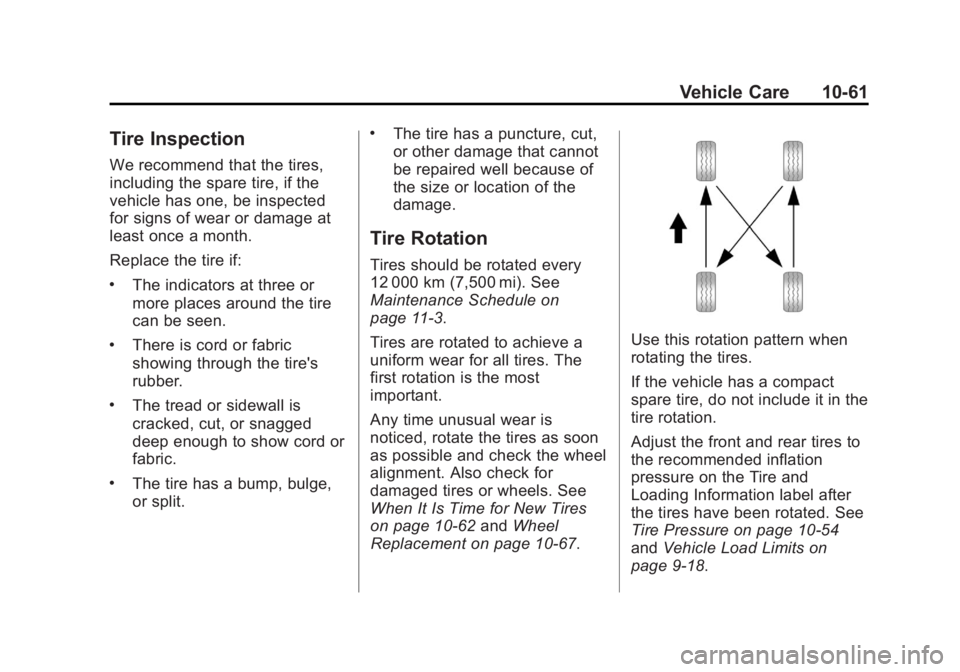
Use this rotation pattern when
rotating the tires.
If the vehicle has a compact
spare tire, do not include it in the
tire rotation.
Adjust the front and rear tires to
the recommended inflation
pressure on the Tire and
Loading Information label after
the tires have been rotated. See
Tire Pressure on page 10‑54
and Vehicle Load Limits on
page 9‑18.
Page 307 of 404
Black plate (63,1)GMC Canyon Owner Manual - 2012
Vehicle Care 10-63
SeeTire Inspection on page 10‑61
and Tire Rotation on page 10‑61 for
additional information.
The rubber in tires ages over time.
This also applies to the spare tire,
if the vehicle has one, even if it is
never used. Multiple conditions
including temperatures, loading
conditions, and inflation pressure
maintenance affect how fast aging
takes place. Tires will typically need
to be replaced due to wear before
they may need to be replaced
due to age. Consult the tire
manufacturer for more information
on when tires should be replaced.Vehicle Storage
Tires age when stored normally
mounted on a parked vehicle. Park
a vehicle that will be stored for at
least a month in a cool, dry, clean
area away from direct sunlight to
slow aging. This area should be
free of grease, gasoline or other
substances that can deteriorate
rubber.
Parking for an extended period can
cause flat spots on the tires that
may result in vibrations while
driving. When storing a vehicle for
at least a month, remove the tires or
raise the vehicle to reduce the
weight from the tires.
Buying New Tires
GM has developed and matched
specific tires for the vehicle. The
original equipment tires installed
were designed to meet General
Motors Tire Performance Criteria
Specification (TPC Spec) system
rating. When replacement tires are
needed, GM strongly recommends
buying tires with the same TPC
Spec rating.
GM's exclusive TPC Spec system
considers over a dozen critical
specifications that impact the
overall performance of the
vehicle, including brake system
performance, ride and handling,
traction control, and tire pressure
monitoring performance. GM's TPC
Spec number is molded onto the
tire's sidewall near the tire size.
If the tires have an all‐season tread
design, the TPC Spec number will
be followed by MS for mud and
snow. See Tire Sidewall Labeling on
page 10‑49 for additional
information.
Page 329 of 404
Black plate (85,1)GMC Canyon Owner Manual - 2012
Vehicle Care 10-85
Compact Spare Tire
Your vehicle may have a compact
spare tire. Although the compact
spare tire was fully inflated when
your vehicle was new, it can lose air
over time. Check the inflation
pressure regularly. It should be
60 psi (420 kPa).
Notice:If the vehicle has
four-wheel drive and the compact
spare tire is installed on the
vehicle, do not drive in four-wheel
drive until you can have the flat
tire repaired and/or replaced. You
could damage the vehicle, and
the repair costs would not be
covered by your warranty. Never
use four-wheel drive when the
compact spare tire is installed on
the vehicle. After installing the compact spare
on your vehicle, you should stop as
soon as possible and make sure
your vehicle's spare tire is correctly
inflated. The compact spare is made
to perform well at speeds up to
62 mph (100 km/h) for distances up
to 500 miles (804 km). For heavy
payloads or towing, and for low
traction or four-wheel-drive
conditions, repair or replace the
full-size tire. Of course, it is best to
replace your vehicle's spare with a
full-size tire as soon as you can.
The spare tire will last longer and be
in good shape in case you need
it again.
Notice:
When the compact spare
is installed, do not take the
vehicle through an automatic
car wash with guide rails. The
compact spare can get caught on
the rails which can damage the
tire, wheel, and other parts of
the vehicle. Do not use your compact spare on
other vehicles.
And do not mix your compact spare
tire or wheel with other wheels or
tires. They will not fit. Keep your
spare tire and its wheel together.
Notice:
Tire chains will not fit the
compact spare. Using them can
damage the vehicle and can
damage the chains too. Do not
use tire chains on the compact
spare.
Page 330 of 404
Black plate (86,1)GMC Canyon Owner Manual - 2012
10-86 Vehicle Care
Full-Size Spare Tire
Your vehicle may have a full-size
spare tire, which, when new, was
fully inflated. A spare tire may lose
air over time, so check its inflation
pressure regularly. SeeTire
Pressure on page 10‑54 and
Vehicle Load Limits on page 9‑18
for information regarding proper tire
inflation and loading your vehicle.
For instruction on how to remove,
install, or store a spare tire, see
“Removing the Flat Tire and
Installing the Spare Tire” and
“Storing a Flat or Spare Tire and
Tools” underTire Changing on
page 10‑70. Your vehicle may have a different
size spare tire than the road tires
originally installed on your vehicle.
This spare was developed for use
on your vehicle, so it is alright to
drive on it. If your vehicle has
four-wheel drive and the different
size spare tire is installed, keep the
vehicle in two-wheel drive.
Notice:
If the vehicle has
four-wheel drive and a different
size spare tire is installed, do not
drive in four-wheel drive until the
flat tire is repaired and/or
replaced. The vehicle could be
damaged and the repairs would
not be covered by the warranty.
Never use four-wheel drive when
a different size spare tire is
installed on the vehicle.
After installing the spare tire on your
vehicle, you should stop as soon as
possible and make sure the spare is
correctly inflated. The spare tire is
made to perform well at speeds up
to 62 mph (100 km/h) for distances
up to 500 miles (804 km). For heavy payloads or towing, and
for low traction or four-wheel-drive
conditions, repair or replace the
full-size tire. Have the damaged or
flat road tire repaired or replaced as
soon as you can and installed back
onto your vehicle. This way, the
spare tire will be available in case
you need it again.
Do not mix tires and wheels of
different sizes, because they will not
fit. Keep your spare tire and its
wheel together.
Page 349 of 404
Black plate (3,1)GMC Canyon Owner Manual - 2012
Service and Maintenance 11-3
Refer to the information in the
Maintenance Schedule Additional
Required Services‐Severe chart.
{WARNING
Performing maintenance work can
be dangerous and can cause
serious injury. Perform
maintenance work only if the
required information, proper tools,
and equipment are available.
If they are not, see your dealer to
have a trained technician do the
work. See Doing Your Own
Service Work on page 10‑4.
Maintenance
Schedule
Owner Checks and Services
At Each Fuel Stop
.Check the engine oil level.
See Engine Oil on page 10‑9.
Once a Month
.Check the tire inflation
pressures. See Tire Pressure on
page 10‑54.
.Inspect the tires for wear. See
Tire Inspection on page 10‑61.
.Check the windshield washer
fluid level. See Washer Fluid on
page 10‑26.
Engine Oil Change
When the CHANGE ENGINE OIL
SOON message displays, have the
engine oil and filter changed within
the next 1 000 km/600 mi. If driven
under the best conditions, the
engine oil life system might not
indicate the need for vehicle service
for more than a year. The engine oil
and filter must be changed at least
once a year and the oil life system
must be reset. Your trained dealer
technician can perform this work.
If the engine oil life system is reset
accidentally, service the vehicle
within 5 000 km/3,000 mi since the
last service. Reset the oil life
system when the oil is changed.
See Engine Oil Life System on
page 10‑12.
Page 350 of 404
Black plate (4,1)GMC Canyon Owner Manual - 2012
11-4 Service and Maintenance
Tire Rotation and Required
Services Every 12 000 km/
7,500 mi
Rotate the tires, if recommended for
the vehicle, and perform the
following services. SeeTire
Rotation on page 10‑61.
.Check engine oil level and oil
life percentage. If needed,
change engine oil and filter, and
reset oil life system. See Engine
Oil on page 10‑9 andEngine Oil
Life System on page 10‑12.
.Check engine coolant level. See
Engine Coolant on page 10‑19.
.Check windshield washer fluid
level. See Washer Fluid on
page 10‑26.
.Visually inspect windshield wiper
blades for wear, cracking,
or contamination. See Exterior
Care on page 10‑96. Replace
worn or damaged wiper blades.
See Wiper Blade Replacement
on page 10‑34.
.Check tire inflation pressures.
See Tire Pressure on
page 10‑54.
.Inspect tire wear. See Tire
Inspection on page 10‑61.
.Visually check for fluid leaks.
.Inspect engine air cleaner filter.
See Engine Air Cleaner/Filter on
page 10‑17.
.Inspect brake system.
.Visually inspect steering,
suspension, and chassis
components for damaged, loose,
or missing parts or signs of
wear. See Exterior Care on
page 10‑96.
.Check restraint system
components. See Safety System
Check on page 3‑20.
.Visually inspect fuel system for
damage or leaks.
.Visually inspect exhaust system
and nearby heat shields for
loose or damaged parts.
.Lubricate body components.
See Exterior Care on
page 10‑96.
Page 402 of 404
Black plate (10,1)GMC Canyon Owner Manual - 2012
i-10 INDEX
Shift Lock Control FunctionCheck, Automatic
Transmission . . . . . . . . . . . . . . . . 10-33
Shifting Into Park . . . . . . . . . . . . . . . . . . . . . . 9-28
Out of Park . . . . . . . . . . . . . . . . . . . 9-30
Signals, Turn and
Lane-Change . . . . . . . . . . . . . . . . . 6-5
Spare Tire Compact . . . . . . . . . . . . . . . . . . . . 10-85
Specifications and
Capacities . . . . . . . . . . . . . . . . . . . . 12-2
Speedometer . . . . . . . . . . . . . . . . . . . 5-8
StabiliTrak OFF Light . . . . . . . . . . . . . . . . . . . . . 5-17
System . . . . . . . . . . . . . . . . . . . . . . . 9-45
Starter Switch Check . . . . . . . . . 10-32
Starting the Engine . . . . . . . . . . . . 9-26
Steering . . . . . . . . . . . . . . . . . . . . . . . . 9-4 Fluid, Power . . . . . . . . . . . . . . . . 10-25
Wheel Adjustment . . . . . . . . . . . . . 5-2
Stoplamps and Back-up Lamps Bulb Replacement . . . . . . . . . . 10-38
Storage Rear . . . . . . . . . . . . . . . . . . . . . . . . . . . 4-1 Storage Areas
Center Console . . . . . . . . . . . . . . . . 4-2
Glove Box . . . . . . . . . . . . . . . . . . . . . 4-1
Stuck Vehicle . . . . . . . . . . . . . . . . . . 9-16
Sun Visors . . . . . . . . . . . . . . . . . . . . . 2-18
Symbols . . . . . . . . . . . . . . . . . . . . . . . . . . iv
System Infotainment . . . . . . . . . . . . . . . . . . . 7-1
T
Tachometer . . . . . . . . . . . . . . . . . . . . . 5-8
Tailgate . . . . . . . . . . . . . . . . . . . . . . . . . 2-8
TaillampsBulb Replacement . . . . . . . . . . 10-38
Text Telephone (TTY) Users . . . 13-6
Theft-Deterrent Systems . . . . . . . . . . . . . . . 2-11, 2-12
Immobilizer . . . . . . . . . . . . . . . . . . . 2-11
Time . . . . . . . . . . . . . . . . . . . . . . . . . . . . 5-4
Tires Buying New Tires . . . . . . . . . . . 10-63
Chains . . . . . . . . . . . . . . . . . . . . . . 10-68
Changing . . . . . . . . . . . . . . . . . . . 10-70
Compact Spare . . . . . . . . . . . . . 10-85
Designations . . . . . . . . . . . . . . . 10-51
Different Size . . . . . . . . . . . . . . . 10-65 Tires (cont'd)
Full-Size Spare . . . . . . . . . . . . . 10-86
If a Tire Goes Flat . . . . . . . . . . 10-69
Inflation Monitor System . . . . 10-58
Inspection . . . . . . . . . . . . . . . . . . 10-61
Messages . . . . . . . . . . . . . . . . . . . . 5-27
Pressure . . . . . . . . . . . . . . . . . . . . 10-56
Pressure Light . . . . . . . . . . . . . . . . 5-17
Pressure Monitor System . . . 10-56
Rotation . . . . . . . . . . . . . . . . . . . . 10-61
Secondary Latch System . . . 10-82
Sidewall Labeling . . . . . . . . . . . 10-49
Terminology and
Definitions . . . . . . . . . . . . . . . . . 10-51
Uniform Tire Quality Grading . . . . . . . . . . . . . . . . . . . 10-65
Wheel Alignment and Tire Balance . . . . . . . . . . . . . . . . . . . 10-67
Wheel Replacement . . . . . . . . 10-67
When It Is Time for New Tires . . . . . . . . . . . . . . . . . . . . . . 10-62
Towing Driving Characteristics . . . . . . . . 9-54
Equipment . . . . . . . . . . . . . . . . . . . . 9-63
General Information . . . . . . . . . . 9-54