four wheel drive GMC CANYON 2012 Owner's Guide
[x] Cancel search | Manufacturer: GMC, Model Year: 2012, Model line: CANYON, Model: GMC CANYON 2012Pages: 404, PDF Size: 5.25 MB
Page 314 of 404
Black plate (70,1)GMC Canyon Owner Manual - 2012
10-70 Vehicle Care
{WARNING
Changing a tire can be
dangerous. The vehicle can slip
off the jack and roll over or fall
causing injury or death. Find a
level place to change the tire.
To help prevent the vehicle
from moving:1. Set the parking brake firmly.
2. Put an automatic transmission in P (Park) or a
manual transmission in
1 (First) or R (Reverse).
3. For four-wheel-drive vehicles, be sure the
transfer case is in a drive
gear– not in N (Neutral).
4. Turn off the engine and do not restart while the vehicle
is raised.
5. Do not allow passengers to remain in the vehicle.
(Continued)
WARNING (Continued)
6. Place wheel blocks on bothsides of the tire at the
opposite corner of the tire
being changed.
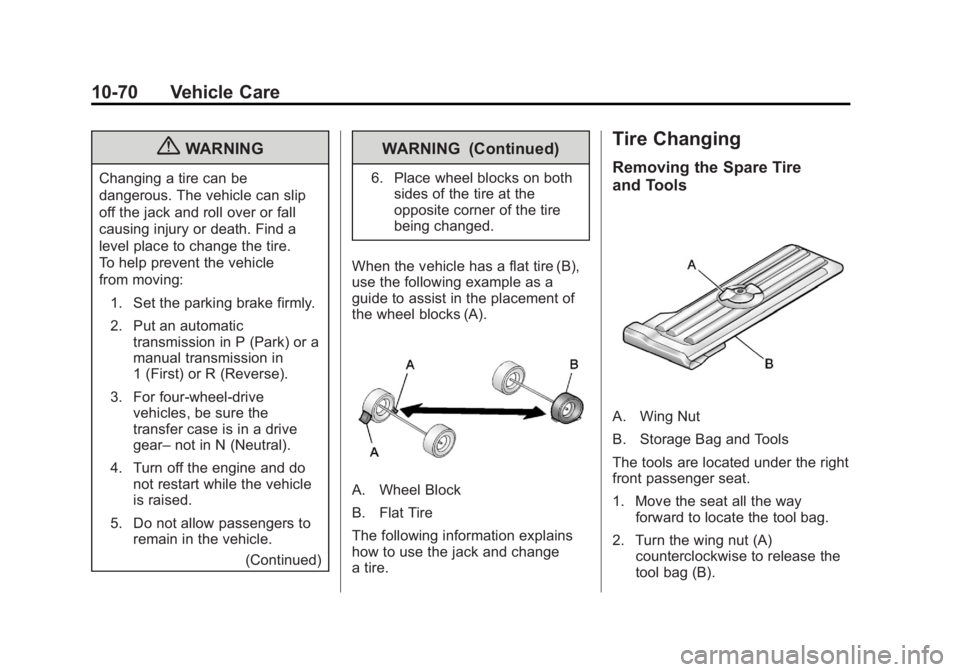
When the vehicle has a flat tire (B),
use the following example as a
guide to assist in the placement of
the wheel blocks (A).
A. Wheel Block
B. Flat Tire
The following information explains
how to use the jack and change
a tire.
Tire Changing
Removing the Spare Tire
and Tools
A. Wing Nut
B. Storage Bag and Tools
The tools are located under the right
front passenger seat.
1. Move the seat all the way forward to locate the tool bag.
2. Turn the wing nut (A) counterclockwise to release the
tool bag (B).
Page 329 of 404
Black plate (85,1)GMC Canyon Owner Manual - 2012
Vehicle Care 10-85
Compact Spare Tire
Your vehicle may have a compact
spare tire. Although the compact
spare tire was fully inflated when
your vehicle was new, it can lose air
over time. Check the inflation
pressure regularly. It should be
60 psi (420 kPa).
Notice:If the vehicle has
four-wheel drive and the compact
spare tire is installed on the
vehicle, do not drive in four-wheel
drive until you can have the flat
tire repaired and/or replaced. You
could damage the vehicle, and
the repair costs would not be
covered by your warranty. Never
use four-wheel drive when the
compact spare tire is installed on
the vehicle. After installing the compact spare
on your vehicle, you should stop as
soon as possible and make sure
your vehicle's spare tire is correctly
inflated. The compact spare is made
to perform well at speeds up to
62 mph (100 km/h) for distances up
to 500 miles (804 km). For heavy
payloads or towing, and for low
traction or four-wheel-drive
conditions, repair or replace the
full-size tire. Of course, it is best to
replace your vehicle's spare with a
full-size tire as soon as you can.
The spare tire will last longer and be
in good shape in case you need
it again.
Notice:
When the compact spare
is installed, do not take the
vehicle through an automatic
car wash with guide rails. The
compact spare can get caught on
the rails which can damage the
tire, wheel, and other parts of
the vehicle. Do not use your compact spare on
other vehicles.
And do not mix your compact spare
tire or wheel with other wheels or
tires. They will not fit. Keep your
spare tire and its wheel together.
Notice:
Tire chains will not fit the
compact spare. Using them can
damage the vehicle and can
damage the chains too. Do not
use tire chains on the compact
spare.
Page 330 of 404
Black plate (86,1)GMC Canyon Owner Manual - 2012
10-86 Vehicle Care
Full-Size Spare Tire
Your vehicle may have a full-size
spare tire, which, when new, was
fully inflated. A spare tire may lose
air over time, so check its inflation
pressure regularly. SeeTire
Pressure on page 10‑54 and
Vehicle Load Limits on page 9‑18
for information regarding proper tire
inflation and loading your vehicle.
For instruction on how to remove,
install, or store a spare tire, see
“Removing the Flat Tire and
Installing the Spare Tire” and
“Storing a Flat or Spare Tire and
Tools” underTire Changing on
page 10‑70. Your vehicle may have a different
size spare tire than the road tires
originally installed on your vehicle.
This spare was developed for use
on your vehicle, so it is alright to
drive on it. If your vehicle has
four-wheel drive and the different
size spare tire is installed, keep the
vehicle in two-wheel drive.
Notice:
If the vehicle has
four-wheel drive and a different
size spare tire is installed, do not
drive in four-wheel drive until the
flat tire is repaired and/or
replaced. The vehicle could be
damaged and the repairs would
not be covered by the warranty.
Never use four-wheel drive when
a different size spare tire is
installed on the vehicle.
After installing the spare tire on your
vehicle, you should stop as soon as
possible and make sure the spare is
correctly inflated. The spare tire is
made to perform well at speeds up
to 62 mph (100 km/h) for distances
up to 500 miles (804 km). For heavy payloads or towing, and
for low traction or four-wheel-drive
conditions, repair or replace the
full-size tire. Have the damaged or
flat road tire repaired or replaced as
soon as you can and installed back
onto your vehicle. This way, the
spare tire will be available in case
you need it again.
Do not mix tires and wheels of
different sizes, because they will not
fit. Keep your spare tire and its
wheel together.
Page 331 of 404
Black plate (87,1)GMC Canyon Owner Manual - 2012
Vehicle Care 10-87
Jump Starting
For more information about the
vehicle battery, seeBattery on
page 10‑30.
If the vehicle battery has run down,
you may want to use another
vehicle and some jumper cables to
start your vehicle. Be sure to use
the following steps to do it safely.
{WARNING
Batteries can hurt you. They can
be dangerous because:
.They contain acid that can
burn you.
.They contain gas that can
explode or ignite.
.They contain enough
electricity to burn you.
If you do not follow these steps
exactly, some or all of these
things can hurt you. Notice:
Ignoring these steps
could result in costly damage to
the vehicle that would not be
covered by the warranty.
Trying to start the vehicle by
pushing or pulling it will not
work, and it could damage the
vehicle.
1. Check the other vehicle. It must
have a 12‐volt battery with a
negative ground system.
Notice: Only use a vehicle that
has a 12-volt system with a
negative ground for jump
starting. If the other vehicle does
not have a 12-volt system with a
negative ground, both vehicles
can be damaged.
2. Get the vehicles close enough so the jumper cables can reach,
but be sure the vehicles are not
touching each other. If they are,
it could cause a ground
connection you do not want. You
would not be able to start your vehicle, and the bad grounding
could damage the electrical
systems.
To avoid the possibility of the
vehicles rolling, set the parking
brake firmly on both vehicles
involved in the jump start
procedure. Put an automatic
transmission in P (Park) or a
manual transmission in Neutral
before setting the parking brake.
If you have a four-wheel-drive
vehicle, be sure the transfer
case is not in Neutral.
Notice: If any accessories are left
on or plugged in during the jump
starting procedure, they could be
damaged. The repairs would not
be covered by the vehicle
warranty. Whenever possible,
turn off or unplug all accessories
on either vehicle when jump
starting the vehicle.
Page 336 of 404
Black plate (92,1)GMC Canyon Owner Manual - 2012
10-92 Vehicle Care
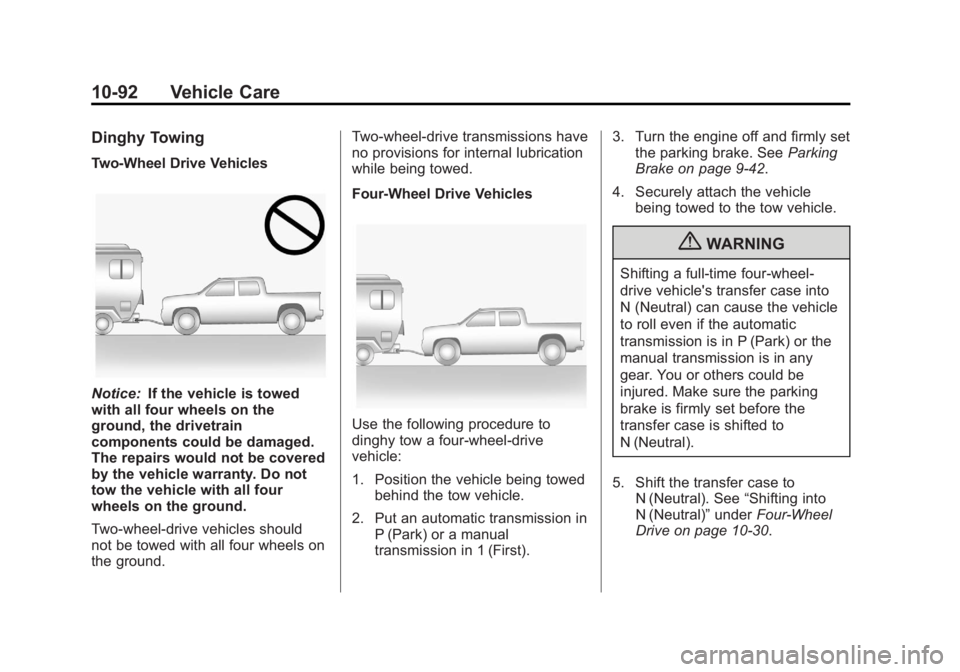
Dinghy Towing
Two-Wheel Drive Vehicles
Notice:If the vehicle is towed
with all four wheels on the
ground, the drivetrain
components could be damaged.
The repairs would not be covered
by the vehicle warranty. Do not
tow the vehicle with all four
wheels on the ground.
Two-wheel-drive vehicles should
not be towed with all four wheels on
the ground. Two-wheel-drive transmissions have
no provisions for internal lubrication
while being towed.
Four-Wheel Drive Vehicles
Use the following procedure to
dinghy tow a four-wheel-drive
vehicle:
1. Position the vehicle being towed
behind the tow vehicle.
2. Put an automatic transmission in P (Park) or a manual
transmission in 1 (First). 3. Turn the engine off and firmly set
the parking brake. See Parking
Brake on page 9‑42.
4. Securely attach the vehicle being towed to the tow vehicle.
{WARNING
Shifting a full‐time four‐wheel‐
drive vehicle's transfer case into
N (Neutral) can cause the vehicle
to roll even if the automatic
transmission is in P (Park) or the
manual transmission is in any
gear. You or others could be
injured. Make sure the parking
brake is firmly set before the
transfer case is shifted to
N (Neutral).
5. Shift the transfer case to N (Neutral). See “Shifting into
N (Neutral)” underFour-Wheel
Drive on page 10‑30.
Page 337 of 404
Black plate (93,1)GMC Canyon Owner Manual - 2012
Vehicle Care 10-93
6. Turn the ignition to LOCK/OFFand remove the key —the front
wheels will still turn.
7. Release the parking brake only after the vehicle being towed is
firmly attached to the towing
vehicle.
After towing see “Shifting Out of
N (Neutral)” underFour-Wheel Drive
on page 10‑30.
If the vehicle being towed will not be
started or driven for six weeks or
more, remove the battery cable from
the negative terminal (post) of the
battery to prevent the battery from
draining.Dolly Towing
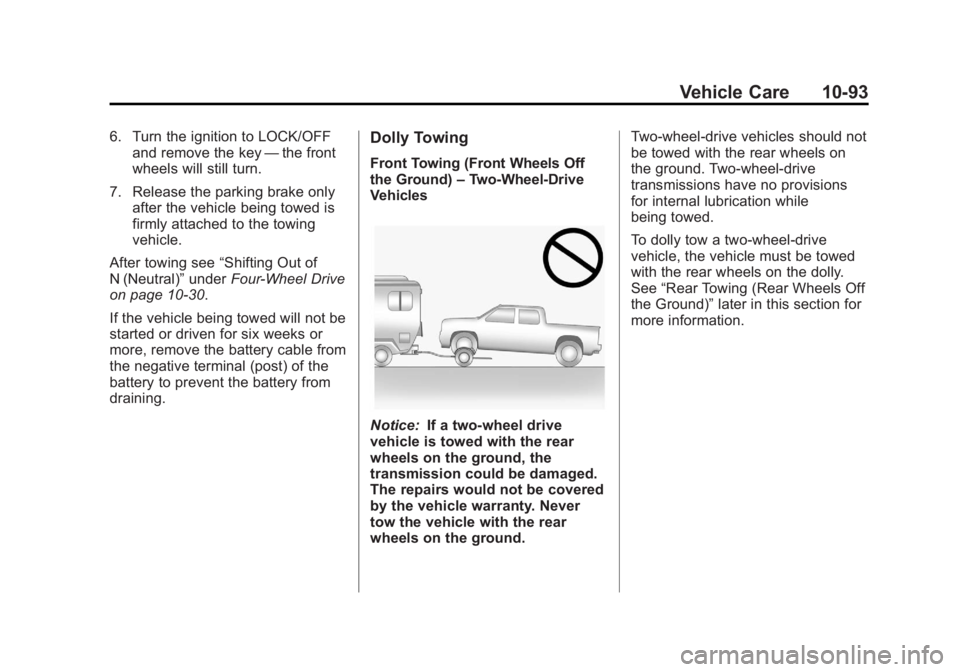
Front Towing (Front Wheels Off
the Ground) –Two‐Wheel‐Drive
Vehicles
Notice: If a two-wheel drive
vehicle is towed with the rear
wheels on the ground, the
transmission could be damaged.
The repairs would not be covered
by the vehicle warranty. Never
tow the vehicle with the rear
wheels on the ground. Two-wheel-drive vehicles should not
be towed with the rear wheels on
the ground. Two-wheel-drive
transmissions have no provisions
for internal lubrication while
being towed.
To dolly tow a two‐wheel‐drive
vehicle, the vehicle must be towed
with the rear wheels on the dolly.
See
“Rear Towing (Rear Wheels Off
the Ground)” later in this section for
more information.
Page 338 of 404
Black plate (94,1)GMC Canyon Owner Manual - 2012
10-94 Vehicle Care
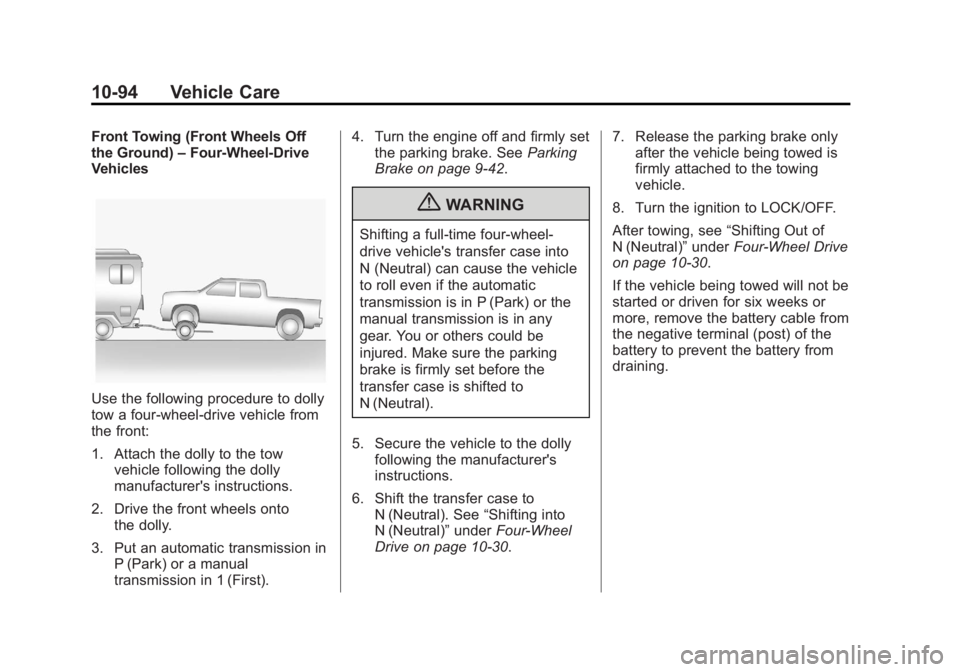
Front Towing (Front Wheels Off
the Ground)–Four-Wheel-Drive
Vehicles
Use the following procedure to dolly
tow a four-wheel-drive vehicle from
the front:
1. Attach the dolly to the tow
vehicle following the dolly
manufacturer's instructions.
2. Drive the front wheels onto the dolly.
3. Put an automatic transmission in P (Park) or a manual
transmission in 1 (First). 4. Turn the engine off and firmly set
the parking brake. See Parking
Brake on page 9‑42.
{WARNING
Shifting a full‐time four‐wheel‐
drive vehicle's transfer case into
N (Neutral) can cause the vehicle
to roll even if the automatic
transmission is in P (Park) or the
manual transmission is in any
gear. You or others could be
injured. Make sure the parking
brake is firmly set before the
transfer case is shifted to
N (Neutral).
5. Secure the vehicle to the dolly following the manufacturer's
instructions.
6. Shift the transfer case to N (Neutral). See “Shifting into
N (Neutral)” underFour-Wheel
Drive on page 10‑30. 7. Release the parking brake only
after the vehicle being towed is
firmly attached to the towing
vehicle.
8. Turn the ignition to LOCK/OFF.
After towing, see “Shifting Out of
N (Neutral)” underFour-Wheel Drive
on page 10‑30.
If the vehicle being towed will not be
started or driven for six weeks or
more, remove the battery cable from
the negative terminal (post) of the
battery to prevent the battery from
draining.
Page 339 of 404
Black plate (95,1)GMC Canyon Owner Manual - 2012
Vehicle Care 10-95
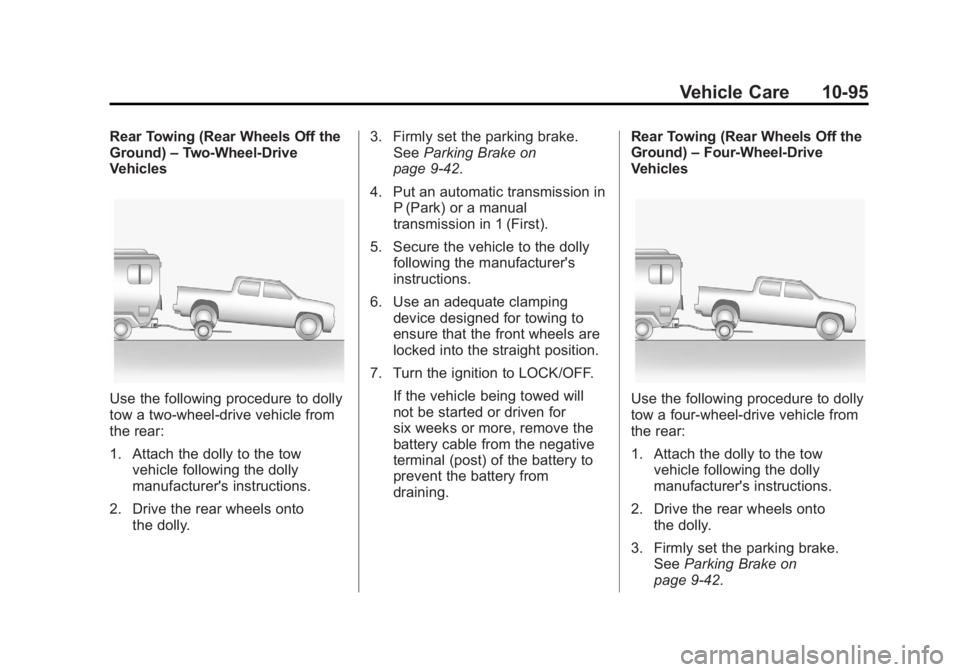
Rear Towing (Rear Wheels Off the
Ground)–Two‐Wheel‐Drive
Vehicles
Use the following procedure to dolly
tow a two-wheel-drive vehicle from
the rear:
1. Attach the dolly to the tow
vehicle following the dolly
manufacturer's instructions.
2. Drive the rear wheels onto the dolly. 3. Firmly set the parking brake.
See Parking Brake on
page 9‑42.
4. Put an automatic transmission in P (Park) or a manual
transmission in 1 (First).
5. Secure the vehicle to the dolly following the manufacturer's
instructions.
6. Use an adequate clamping device designed for towing to
ensure that the front wheels are
locked into the straight position.
7. Turn the ignition to LOCK/OFF. If the vehicle being towed will
not be started or driven for
six weeks or more, remove the
battery cable from the negative
terminal (post) of the battery to
prevent the battery from
draining. Rear Towing (Rear Wheels Off the
Ground)
–Four‐Wheel‐Drive
VehiclesUse the following procedure to dolly
tow a four-wheel-drive vehicle from
the rear:
1. Attach the dolly to the tow
vehicle following the dolly
manufacturer's instructions.
2. Drive the rear wheels onto the dolly.
3. Firmly set the parking brake. See Parking Brake on
page 9‑42.
Page 340 of 404
Black plate (96,1)GMC Canyon Owner Manual - 2012
10-96 Vehicle Care
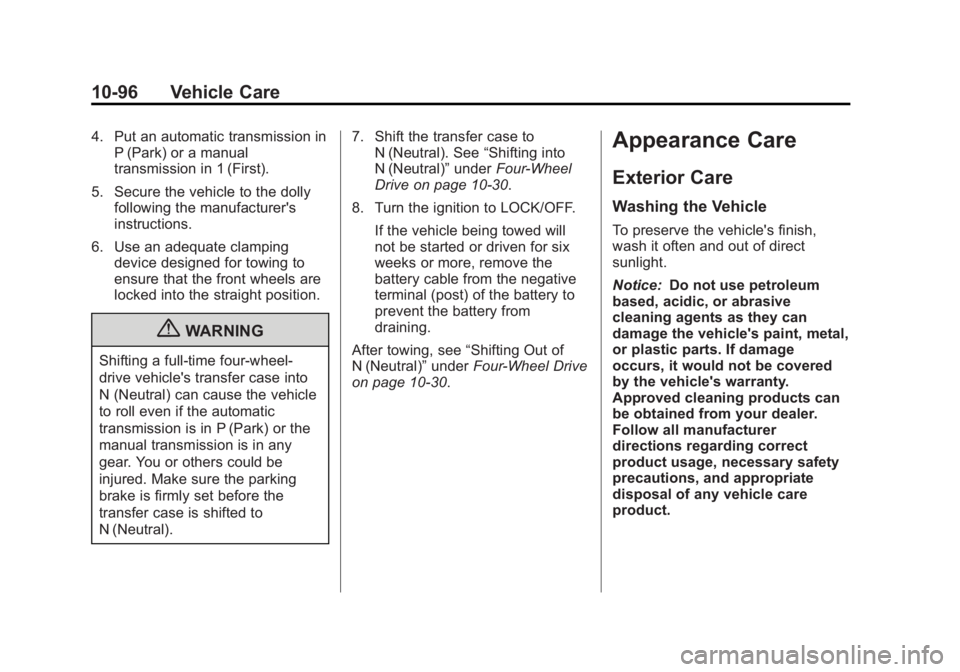
4. Put an automatic transmission inP (Park) or a manual
transmission in 1 (First).
5. Secure the vehicle to the dolly following the manufacturer's
instructions.
6. Use an adequate clamping device designed for towing to
ensure that the front wheels are
locked into the straight position.
{WARNING
Shifting a full‐time four‐wheel‐
drive vehicle's transfer case into
N (Neutral) can cause the vehicle
to roll even if the automatic
transmission is in P (Park) or the
manual transmission is in any
gear. You or others could be
injured. Make sure the parking
brake is firmly set before the
transfer case is shifted to
N (Neutral). 7. Shift the transfer case to
N (Neutral). See “Shifting into
N (Neutral)” underFour-Wheel
Drive on page 10‑30.
8. Turn the ignition to LOCK/OFF. If the vehicle being towed will
not be started or driven for six
weeks or more, remove the
battery cable from the negative
terminal (post) of the battery to
prevent the battery from
draining.
After towing, see “Shifting Out of
N (Neutral)” underFour-Wheel Drive
on page 10‑30.
Appearance Care
Exterior Care
Washing the Vehicle
To preserve the vehicle's finish,
wash it often and out of direct
sunlight.
Notice: Do not use petroleum
based, acidic, or abrasive
cleaning agents as they can
damage the vehicle's paint, metal,
or plastic parts. If damage
occurs, it would not be covered
by the vehicle's warranty.
Approved cleaning products can
be obtained from your dealer.
Follow all manufacturer
directions regarding correct
product usage, necessary safety
precautions, and appropriate
disposal of any vehicle care
product.
Page 369 of 404
Black plate (3,1)GMC Canyon Owner Manual - 2012
Technical Data 12-3
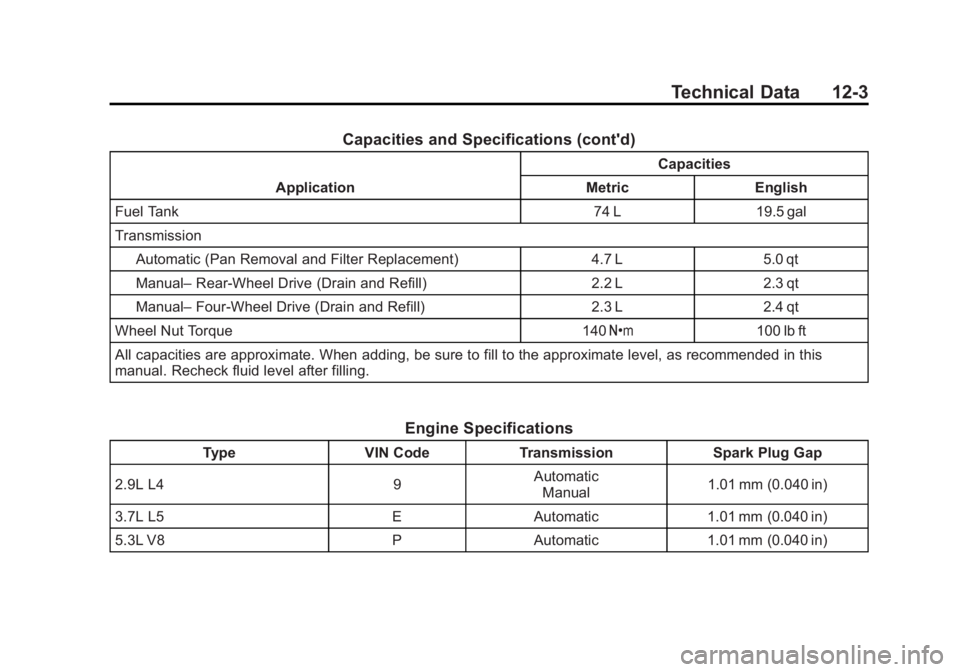
Capacities and Specifications (cont'd)
ApplicationCapacities
Metric English
Fuel Tank 74 L 19.5 gal
Transmission Automatic (Pan Removal and Filter Replacement) 4.7 L 5.0 qt
Manual– Rear-Wheel Drive (Drain and Refill) 2.2 L 2.3 qt
Manual– Four-Wheel Drive (Drain and Refill) 2.3 L 2.4 qt
Wheel Nut Torque 140 Y100 lb ft
All capacities are approximate. When adding, be sure to fill to the approximate level, as recommended in this
manual. Recheck fluid level after filling.
Engine Specifications
Type VIN CodeTransmission Spark Plug Gap
2.9L L4 9Automatic
Manual 1.01 mm (0.040 in)
3.7L L5 EAutomatic 1.01 mm (0.040 in)
5.3L V8 PAutomatic 1.01 mm (0.040 in)