change wheel GMC ENVOY 1998 User Guide
[x] Cancel search | Manufacturer: GMC, Model Year: 1998, Model line: ENVOY, Model: GMC ENVOY 1998Pages: 386, PDF Size: 20.33 MB
Page 218 of 386
Towing Your Vehicle
Try to have a GM dealer or a proressional towing
service tow your vehicle. See "Roadside Assistance"
in
the Index.
If your vehicle has been changed since it was
factory-new by adding things like fog lamps, aero
skirting, or special tires and wheels, these instructions
may not be correct.
Before you do anything, turn
on the hazard
warning flashers.
When you call,
tell the towing service:
0 That your vehicle has four-wheel drive.
0 The make, model and year of your vehicle.
0 Whether you can rnolle the shift lever for the
transmission and shift the transfer case.
0 If there was an accident, what was damaged.
When the towing service arrives,
let the tow operator
know that this manual contains these towing
instructions. The operator may want to see them.
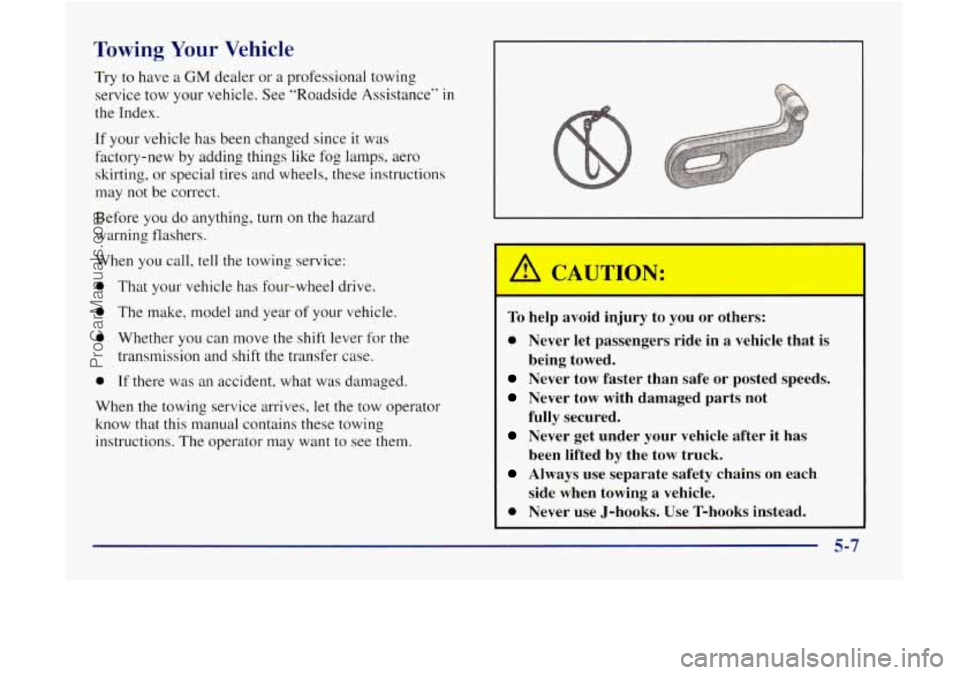
To help avoid injury to you or others:
0 Never let passengers ride in a vehicle that is
Never tow faster than safe or posted speeds.
Never tow with damaged parts not
Never get under your vehicle after it has
Always use separate safety chains on each
0 Never use J-hooks. Use T-hooks instead.
being
towed.
fully secured.
been lifted by the tow truck.
side when towing
a vehicle.
5-7
ProCarManuals.com
Page 231 of 386

Engine Fan Noise
This vehicle has a clutched engine cooling fan. When the
clutch is engaged, the fan spins faster to provide more air
to cool the engine. In most everyday driving conditions,
the clutch is
not engaged. This improves fuel economy and
reduces
fan noise. Under heavy vehicle loading, trailer
towing and/or high outside temperatures, the fan speed
increases when the clutch engages.
So you may hear an
increase in fan noise. This is normal and should not be
mistaken
as the transmission slipping or making extra
shifts. It is merely the cooling system functioning properly.
The fan will slow down when additional cooling is not
required and the clutch disengages.
You may
also hear this fan noise when you start the
engine. It will go away
as the fan clutch disengages.
If a Tire Goes Flat
It’s unusual for a tire to “blow out” while you’re driving,
especially if you maintain your tires properly.
If air goes
out of
a tire, it’s much more likely to leak out slowly.
But
if you should ever have a “blowout,” here are a few
tips about what to expect and what to do:
If
a front tire fails, the flat tire will create a drag that
pulls the vehicle toward that side.
Take your foot off the
accelerator pedal and grip
the steering wheel firmly.
Steer to maintain lane position, and then gently brake to
a stop well out of the traffic lane.
A rear blowout, particularly on a curve, acts much like a
skid and may require the same correction you’d use in a
skid. In any rear blowout, remove your foot from the
accelerator pedal. Get the vehicle under control by
steering the
way you want the vehicle to go. It may be
very bumpy and noisy, but you can
still steer. Gently
brake to
a stop -- well off the road if possible.
If a tire goes flat, the next part shows how to use your
iacking equipment to change
a flat tire safely. u Y a. c
5-20
ProCarManuals.com
Page 232 of 386

Changing a Flat Tire
If a tire goes flat, avoid further tire and wheel damage
by driving slowly to a level place. Turn on
your hazard
warning flashers.
A CAUTION:
I
Changing a tire can cause an injury. The vdcle
can slip
off the jack and roll over you or other
people. You and they could be badly injured.
Find a level place to change your tire. To help
prevent the vehicle from moving:
1. Set the parking brake firmly.
2. Put the shift lever in PARK (P).
3. lbrn off the engine.
4. Put the wheel blocks at the front and
rear of the tire farthest away from the
one being changed. That would be the
tire on the other side of the vehicle,
at
the opposite end.
The following steps will tell you how to use the jack and
change a tire.
5-21
ProCarManuals.com
Page 238 of 386
I
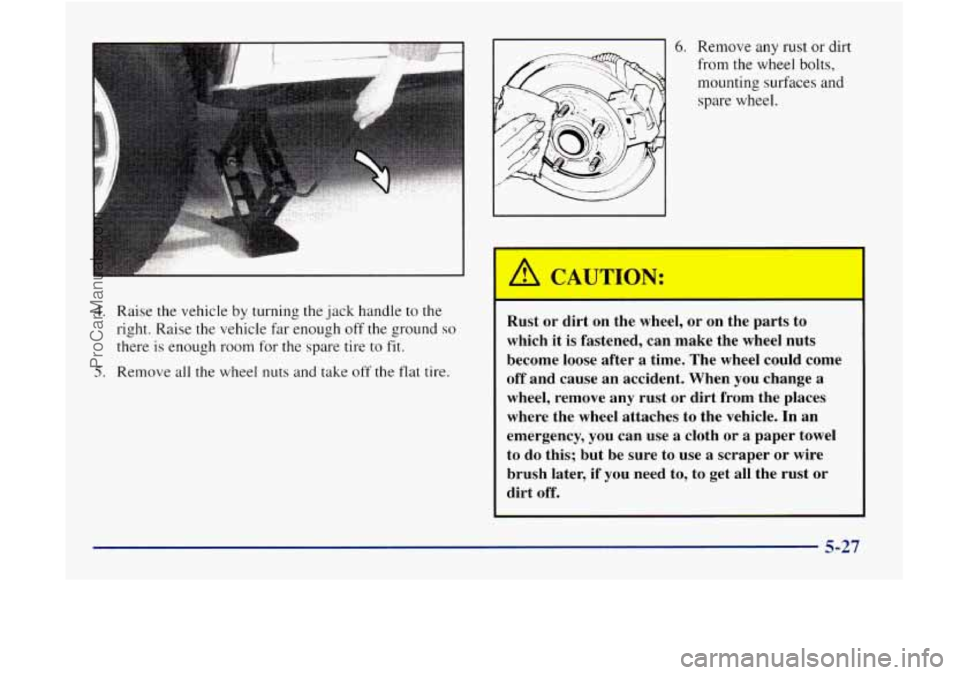
4. Raise the vehicle by turning the jack handle to the
right. Raise the vehicle
far enough off the ground so
there is enough room for the spare tire to fit.
5. Remove all the wheel nuts and take off the flat tire.
6. Remove any rust or dirt
from the wheel bolts,
mounting surfaces and
spare wheel.
Rust or dirt on the wheel, or on the parts to
which it is fastened, can make the wheel nuts
become loose after a time. The wheel could come
off and cause an accident. When you change
a
wheel, remove any rust or dirt from the places
where the wheel attaches to the vehicle. In an
emergency, you can use a cloth
or a paper towel
to do this; but be sure to use
a scraper or wire
brush later, if you need to, to get all the rust or
dirt
off.
I
5-27
ProCarManuals.com
Page 277 of 386
Some driving conditions or climates may cause a brake
squeal when the brakes are first applied or lightly
applied. This does not mean something is wrong with
your brakes.
Properly torqued wheel nuts are necessary to help
prevent brake pulsation. When tires are rotated, inspect
brake pads for wear and evenly torque
wheel nuts in the
proper sequence to
GM specifications.
Brake linings should always be replaced as complete
axle sets.
See “Brake System Inspection” in Section
7 of this manual
under Part
C “Periodic Maintenance Inspections.”
Brakc Jedal Travel
See your dealer if the brake pedal does not return to
normal height, or if there is a rapid increase in pedal
travel. This could be a sign of brake trouble.
Brake Adjustment
Every time you make a brake stop, your disc brakes
adjust for wear.
Replacing Brake System Parts
The braking system on a modern vehicle is complex.
Its many parts have to be
of top quality and work well
together
if the vehicle is to have really good braking.
Your vehicle was designed and tested with top-quality
GM brake parts. When you replace parts of your braking
system
-- for example, when your brake linings wear
down and
you have to have new ones put in -- be sure
you get new approved GM replacement parts.
If you
don’t, your brakes may
no longer work properly. For
example,
if someone puts in brake linings that are wrong
for your vehicle, the balance between your front and
rear brakes can change
-- for the worse. The braking
performance you’ve come to expect can change in many
other ways if someone puts
in the wrong replacement
brake parts.
Battery
Every new vehicle has an ACDelco Freedom@ battery.
You never have to add water to one of these. When it’s
time for a new battery, we recommend an ACDelco
Freedom battery. Get one that has the replacement
number shown on the original battery’s label.
6-30
ProCarManuals.com
Page 286 of 386
Q
+
I
!
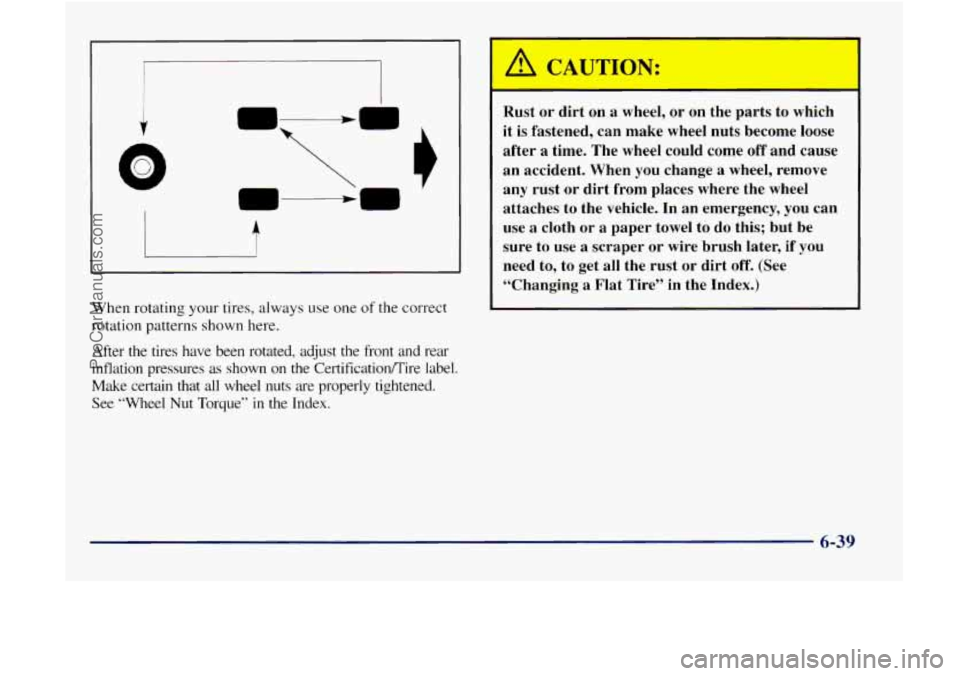
When rotating your tires, always use one of the correct
rotation. patterns shown here.
After the tires
have been rotated, adjust the front and rear
inflation pressures as shown on the Certificationflire
label.
Make certain that all wheel nuts are properly tightened.
See “Wheel Nut Torque”
in the Index.
Rust or dirt on a wheel, or on the parts to which
it is fastened, can make wheel nuts become loose
after
a time. The wheel could come off and cause
an accident. When
you change a wheel, remove
any rust or dirt from places where the wheel
attaches
to the vehicle. In an emergency, you can
use a cloth or
a paper towel to do this; but be
sure to use a scraper or wire brush later,
if you
need to, to get all the rust or dirt off. (See
“Changing a Flat Tire”
in the Index.)
6-39
ProCarManuals.com
Page 355 of 386
Throttle System Inspection
Inspect the throttle system for interference or binding,
and for damaged or missing parts. Replace parts as
needed. Replace any components that have high effort
or excessive wear.
Do not lubricate accelerator and
cruise control cables.
Drive Axle Service
Check readfront axle fluid level and add as needed.
Check constant velocity joints and axle seals for leaking.
Transfer Case (Four-wheel Drive)
Inspection
Every 12 months or at oil change intervals, check front
axle and transfer case and add lubricant when necessary.
Check vent hose at transfer case for kinks and proper
installation. More frequent lubrication may be required
on off-road
use.
Brake System Inspection
Inspect the complete system. Inspect brake lines and
hoses for proper hook-up, binding, leaks, cracks,
chafing, etc. Inspect disc brake pads for wear and rotors
for surface condition. Inspect other brake parts,
including calipers, parking brake, etc. Check parking
brake adjustment. You may need to have your brakes
inspected more often if your driving habits or conditions
result in frequent braking.
7-44
ProCarManuals.com
Page 377 of 386

Engine (Continued) .............................. 6-9
Exhaust
..................................... 2-24
FanNoise
................................... 5-20
Identification
................................ 6-54
OilLevelCheck
.............................. 7-39
Overheating
................................. 5-11
Specifications
................................ 6-60
Engine Compartment Fuse Block
.................. 6-58
Engineoil
.................................... 6-10
Adding
..................................... 6-11
Additives
................................... 6-13
Checking
................................... 6-11
Kindtouse
................................. 6-12
Pressure Gage
................................ 2-69
Used
....................................... 6-14
When to Change
.............................. 6- I3
Exhaust, Engine
................................ 2-24
Exit Lighting
.................................. 2-39
Express-Down Window
.......................... 2-29
Fabric Cleaning
............................... 6-46
Filling
a Portable Fuel Container .................... 6-7
FillingYourTank
................................ 6-5
Fi 1 ter
Air
........................................ 6-14
Remote Oil .................................. 6- 14
Finish Care .................................... 6-5 1
Finish Damage ................................. 6-52
Running While
Parked
......................... 2-25
Starting
..................................... 2-15
Engine Coolant
................................. 6-2 1
FirstGear ..................................... 2-20
Flashers. Hazard Warning
......................... 5-2
Flat Tire. Changing
............................. 5-21
Fluids and Lubricants
............................ 7-4.5
FogLampSwitch ............................... 2-38
Foreign Countries. Fuel ........................... 6-5
Four-wheel Drive
......................... 2-26. 6-20
French Language Manual 11
FrontAxle .................................... 6-21
Front Reading Lamps
....................... 2.39. 2.43
Front Storage Area .............................. 2-45
FrontTowing
................................... 5-9
Filling a Portable Container
...................... 6-7
Filling Your Tank
.............................. 6-5
Foreign Countries .............................. 6-5
Engine Compartment
.......................... 6-58
Instrument Panel
............................. 6-56
Fuses and Circuit Breakers
....................... 6-55
Gages
.. ...........................
Front Turn Signal Lamp Bulb Replacement .......... 6-33
Fuel
.......................................... 6-3
Cage
....................................... 2-72
Fuse Block
Engine Coolant Temperature
.................... 2-66
Fuel
....................................... 2-72
Engine Oil Pressure ........................... 2-69
GasCap
....................................... 6-5
Gate A-jar Light ................................ 2-71
GAWR
....................................... 4-40
Gear
Positions ................................. 2-18
9-4
ProCarManuals.com
Page 383 of 386

Tires (Continued)
Uniform Quality Grading
. . . . . . . . . . . . . . . . . . . . . . . 6-41
Wear Indicators
. . . . . . . . . . . . . . . . . . . . , . . . . . . . . . 6-40
When It’s Time for New
. . . . . . . . . . . . . . . . . . . . . . 6-40
TopStrap
..................................... 1-43
TorqueLock
.,..................................2-23
Torque, Wheel Nut . . . . . . . . . . . . . . . . . . . . . . . . . 5-29,6-60
Towing a Trailer
. . . . . . . . . . . . . . . . . . . . . . . . . . . . . . . . 4-43
Towing, Recreational Vehicle
. . . . . . . . . . . . . . . . . . . . . 4-39
Towing Your Vehicle
. . . . . . . . . . . . . . . . . . . . . . . . . . . . . 5-7
Trailer Brakes
.....................................4-47
Driving on Grades . . . . . . . . . . . . . . . . . . . . . . . . . . . . 4-50
Driving with a Trailer . . . . . . . . . , , . . . . . . . . . . . . . . . 4-48
Hitches
.........................................
Maintenance When Towing . . . . . . . . . . . . . . . . . . . . . 4-5 1
Parking on Hills . . . . . . . . . . . . , . . . . . . . . . . . . . . . . . 4-50
Safety Chains
. . . . . . . . . . . . . . . . . . . . . . . . . . . . . . . . 4-47
Tongueweight
...............................4-45
Total Weight on Tires . . . . , . . . . . . . . . . . . . . . . . . . . . 4-46
Towing
.........................................
TurnSignals .....................................
Weight .....................................4-45
Wiring Harness . . . . . . . . . . . . . . . . . . . . . . . . . . . . . . . 4-52
Transfer Case
. . . . . . . . . . . . . . . . . . . . . . . . . . . . . . . . . . 6-20
Electronic
. . . . . . . . . . . . . . . . . . . . . . . . . . . . . . . . . . 2-26
Transmission Fluid, Automatic
. . . . . . . . . . . . , . . . . . . . 6- 15
Transmitters, Keyless Entry . . . . . . . . . . . . . . . . . . . . . . . . 2-6
Transportation, Courtesy
. . . . . . . . . . . . . . . . . . . . . . . . . . 8-8
Trip, Before Leaving . . . . . . . . . . . . . . . . . . . . . . . . . . . . 4-33 Trip Odometer
. . . . . . . . . . . . . . . . . . . . . . . . . . . . . . . . . 2-61
TTYUsers
..................................... 8-4
Turn Signal and Lane Change Signals . . . . . . . . . . . . . . . 2-31
Turn Signals When Towing a Trailer
. . . . . . . . . . . . . . . . 4-49
Underbody Flushing
. . . . . . . . . . . . . . . . . . . . . . . . . . . 7-42
Underbody Maintenance
......................... 6-52
Universal Transmitter
. . . . . . . . . . . . . . . . . . . . . . . . . . . . 2-53
Accessories
.....................................
Erasing Channels . . . . . . . . . . . . . . . . . . . . . , . . . . . . . 2-57
Operation
. . . . . . . . . . . . . . , . . . . . . . . . . . . . . . . , . . . 2-55
Programming
................................2-54
Rolling Code Openers . . . . . . . . . . . . . . . . . . . . . . . . . 2-56
Used Replacement Wheels
. . . . . . . . . . . . . . . . . . . . . . . . 6-44
Vehicle Control
. . . . . . . . . . . . . . . . . . . . . . . . . . . . . . . . 4-6
Vehicle Damage Warnings
. . . . . . . . . . . . . . . . . . . . . . . . . . iv
Vehicle Dimensions
. . . . , . . . . . . . . . . . . . . . . . . . . . . . . 6-62
Vehicle Identification Number
. . . . . . . . . . . . . . . . . . . . . 6-54
Vehicle Loading
. . . . . . . . . . . . . . . . . . . . . . . . . . . . . . . 4-40
Vehiclestorage
....................................
Ventilation System . . . . . , . . . . . . . . . . . . . . . . . . . . . . . . . 3-5
Visors, Sun
. . . . , . . . . . . . . . . . . . . . . . . . . . . . . . . . . . . . 2-50
Voltmeter
........,............................2-64
warning Devices . . . . . . . . . . . . . . . . . . . . . . . . . . . . . . . 5-2
Warning Lights, Gages and Indicators
. . . . . . . . . . . . . . . 2-62
Washer Fluid, Windshield
. . . . . . . . . . . . . . . . . . . . , . . . 6-26
Washing Your Vehicle
. . . . . . . , . . . . . . . . . . . . . . . . , . . 6-5 1
9-10
ProCarManuals.com