parking brake GMC ENVOY 1998 User Guide
[x] Cancel search | Manufacturer: GMC, Model Year: 1998, Model line: ENVOY, Model: GMC ENVOY 1998Pages: 386, PDF Size: 20.33 MB
Page 126 of 386
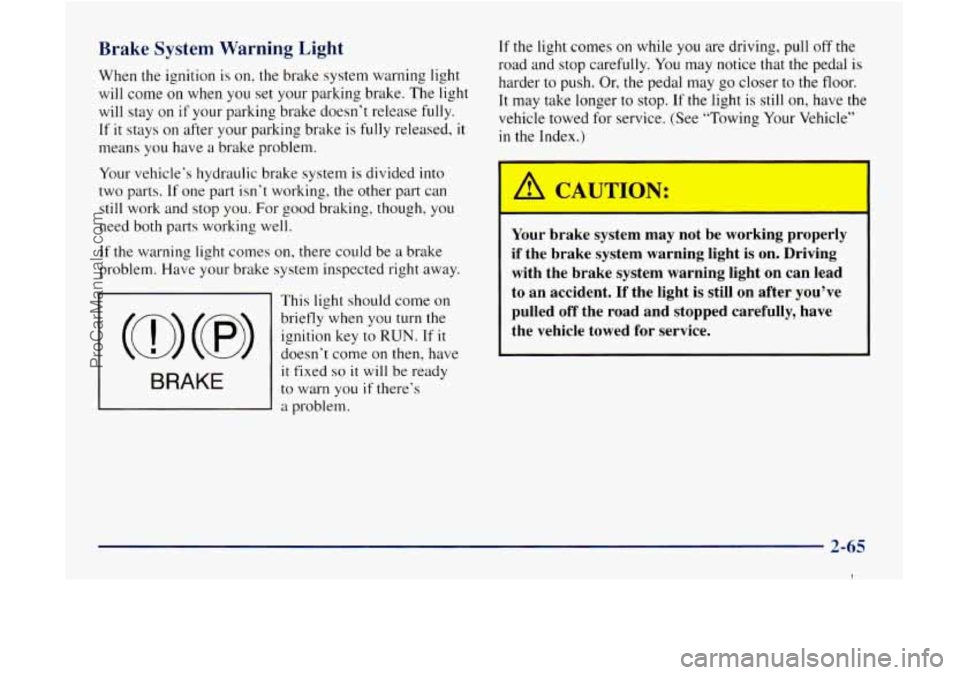
Brake System Warning Light
When the ignition is on, the brake system warning light
will come on when you set your parking brake. The light
will stay on
if your parking brake doesn’t release fully.
If it stays on after your parking brake is fully released, it
means you have a brake problem.
If the light comes on while you are driving, pull off the
road and stop carefully.
You may notice that the pedal is
harder to push.
Or, the pedal may go closer to the floor.
It may take longer to stop.
If the light is still on, have the
vehicle towed for service. (See “Towing Your Vehicle”
in the Index.)
Your vehicle’s hydraulic brake system is divided into
two parts.
If one part isn’t working, the other part can
still work and stop you. For good braking, though, you
need both parts working well.
If the warning light comes on, there could be a brake
problem. Have your brake system inspected right away.
This light should come
on
briefly when you turn the
ignition key to
RUN. If it
it fixed so it will be ready
to warn you if there’s
a problem.
(0) (8> doesn’t come on then, have
BRAKE
Your brake system may not be working properly
if the brake system warning light is on. Driving
with the brake system warning light on can lead
to an accident.
If the light is still on after you’ve
pulled off the road and stopped carefully, have
the vehicle towed for service.
2-65
1
ProCarManuals.com
Page 180 of 386

What should I do if my vehicle stalls, or is about
to stall, and
I can’t make it up the hill?
A: If this happens, there are some things you should
0
0
0
0
do, and there are some things you must not do.
First, here’s what you
should do:
Push the brake pedal to stop the vehicle and keep
it
from rolling backwards. Also, apply the
parking brake.
If your engine is still running, shift the transmission
to REVERSE
(R), release the parking brake, and
slowly back down the
hill in REVERSE (R).
If your engine has stopped running, you’ll need to restart
it. With the brake pedal depressed and the parking brake
still applied, shift the transmission
to PARK (P) and
restart the engine. Then, shift to REVERSE
(R), release
the parking brake, and slowly back down the
hill as
straight as possible
in REVERSE (R).
As you are backing down the hill, put your left hand
on the steering wheel at
the 12 o’clock position. This
way. you’ll be able to tell
if your wheels are straight
and maneuver
as you back down. It’s best that you
back down the
hill with your wheels straight rather
than
in the left or right direction. Turning the wheel
too far to the left or right will increase the possibility
of
a rollover. Here
are some things you
must r7ot do if you stall, or are
about to stall, when going up
a hill.
0 Never attempt to prevent a stall by shifting into
NEUTRAL
(N) to “rev-up” the engine and regain
forward momentum. This won’t work. Your vehicle
will roll backwards very quickly and you could go
out of control.
Instead, apply the regular brake to stop
the vehicle.
Then apply the parking brake. Shift to REVERSE
(R), release the parking brake, and slowly back
straight down.
0 Never attempt to turn around if you are about to stall
when going up
a hill. If the hill is steep enough to
stall your vehicle, it’s steep enough to cause you to
roll over if you turn around. If you can’t make it up
the
hill, you must back straight down the hill.
Q: Suppose, after stalling, I try to back down the
hill and decide
I just can’t do it. What should
I do?
A: Set the parking brake, put your transmission in
PARK (P) and turn off the engine. Leave the
vehicle and go get some help. Exit on the uphill
side and stay clear of the path the vehicle would
take
if it rolled downhill.
4-21
I
ProCarManuals.com
Page 182 of 386
Q.' Am I likely to stall when going downhill?
A: It's much nm-e likely to happen going uphill. But if
it happens going downhill, here's what to do.
0 Stop your vehicle by applying the regular brakes.
Shift to PARK (P) and. while still braking. restart
Apply the parking
brake.
the engine.
Shift back to a low gear, release the parking brake,
and drive straight d6wn.
0 If the engine won't start, get out and get
Driving Across an Incline
Sooner or later, an off-road trail will probab lelp. y go
across
the incline
of a hill. If this happens, you have to decide
whether to
try to dri\:e across the incline. Here are some
things to consider:
0 A hill that can be driven straight up or down may be
too steep to drive across. When you
go straight up or
down a
hill, the length of the wheel base (the
distance from the front wheels
to the rear wheels)
reduces the likelihood the vehicle
will tumble end
0
0
over end. But when you drive across an incline, the
much more narrow track width
(the distance between
the left and right wheels) may not prevent the vehicle
from tilting and rolling over.
Also. driving across an
incline puts more weight on the downhill wheels.
This could cause a downhill slide
or a rollover.
Surface conditions can be
a problem when you drive
across
a hill. Loose gravel, muddy spots, or even wet
If the vehicle slips sideways, it can hit something
that
will trip it (a rock, a rut, etc.) and roll over.
Hidden obstacles can make the steepness
of the
incline even worse.
If you drive across a rock with
the
uphill wheels. or if the downhill wheels drop into
a rut or depression, your vehicle can tilt even n1oI-e.
e orass can cause your tires to slip sideways. downhill.
For reasons like these.
you need to decide carefully
whether to
try to drive across an incline. Just because
the trail goes across the incline doesn't mean you have
to drive it. The last vehicle to try it might have
rolled over.
4-23
I
ProCarManuals.com
Page 209 of 386

Driving On Grades
Reduce speed and shift to a 1owe.r gear Iwfow you start
down a long or steep downgrade.
If you don’t shift
down. you might have to use your brakes
so much that
they would get hot and no longer work well.
On
a long uphill grade, shift down and reduce your
speed to around
45 mph (70 km/h) to reduce the
possibility of engine and transmission overheating.
You should use DRIVE
(D) when towing a trailer.
Operating your vehicle
in DRIVE (D) when towing a
trailer
will minimize heat buildup and extend the life of
your transmission.
When towing at high altitude
on steep uphill grades,
consider the following: Engine coolant
will boil at a lower
temperature than at normal altitudes.
If you twn your
engine off imnlediately after towing at high altitude on
steep uphill grades, your vehicle may show signs similar to
engine overheating.
To avoid this, let the engine run while
parked (preferably on level ground)
with the automatic
transmission
in PARK (PI for a few minutes before turning
the engine off.
If you do get the overheat warning. see
”Engine Overheating”
in the Index.
Parking on Hills
You really should not park your vehicle, with a trailer
attached.
on a hill. If‘ something goes wrong, your rig
could start
to move. People can be injured, and both
your vehicle and the trailer can be damaged.
But
if you ever have to park your rig on a hill, here‘s
how
to do it:
1.
-. 3
3.
4.
5.
Apply your regular brakes, but don’t shift into
PARK
(P) yet. Then turn your wheels into the curb
if facing downhill or into traffic if facing uphill.
Have someone place chocks under the trailer wheels.
When the wheel chocks are
in place, release the
regular brakes
until the chocks absorb the load.
Reapply the regular brakes. Then apply your parking
brake, and then shift into PARK
(P).
Release the regular brakes.
4-50
ProCarManuals.com
Page 210 of 386

When You Are Ready to Leave After
Parking on a Hill
1. Apply your regular brakes and hold the pedal down
while you:
0 Start your engine;
Shift into a gear; and
0 Release the parking brake.
2. Let up on the brake pedal.
3. Drive slowly until the trailer is clear of the chocks.
4. Stop and have someone pick up and store the chocks.
Maintenance When Trailer Towing
Your vehicle will need service more often when you’re
pulling
a trailer. See the Maintenance Schedule for more
on this. Things that are especially important in trailer
operation are automatic transmission fluid (don’t
overfill), engine
oil, axle lubricant, belt, cooling system
and brake adjustment. Each of these is covered in this
manual, and the Index will help you find them quickly.
If you’re trailering, it’s
a good idea to review these
sections before you start your trip.
Check periodically to see that all hitch nuts and bolts
are tight.
ProCarManuals.com
Page 211 of 386

Trailer Wiring Harness
The heavy-duty trailer wiring is an eight-wire harness
assembly. The harness is stored under the vehicle, on the
driver’s side corner frame rear crossmember. The
heavy-duty trailer wiring has a 30-amp feed wire
with
an in-line fuse located by the junct.ion block. See “Fuses
and Circuit Breakers”
in the Index. The harness does not
have a cannector and should be wired by
a qualified
electrical technician. The technician can use the
following color code chart when connecting the wiring
harness
to your trailer.
0
0
0
0
0
0
0
0
Dark Blue: Use for electric trailer brakes or
auxiliary wiring.
Red: Use for battery charging;
it connects to the
starter solenoid.
Light Green: Back-up lamps.
Brown: Taillamps and parking lamps.
Yellow: Left stoplamp and turn signal.
Dark Green: Right stoplamp
and turn signal.
White (Heavy Gage): Ground wire.
White (Light Gage): Auxiliary stoplamp.
Securely attach the harness to the trailer, then tape or
strap
it to your vehicle’s frame rail. Be sure you leave it
loose enough so the wiring doesn’t bend or break, but
not
so loose that it drags on the ground. Store the
harness
in its original place. Wrap the harness together
and tie
it neatly so it won’t be damaged.
4-52
ProCarManuals.com
Page 215 of 386

2. Get the vehicles close enough so the jumper cables
can reach, but be sure
the vehicles aren’t touching
each other.
If they are, it could cause a ground
connection you don’t want.
You wouldn’t be able to
start your vehicle, and the bad grounding could
damage
the electrical systems.
To avoid the possibility of the vehicles rolling, set
the parking brake firmly on each vehicle. Put your
vehicle
in PARK (P).
3. Turn off the ignition on both vehicles. Unplug
unnecessary accessories plugged into the cigarette
lighter or the accessory power outlets. Turn
off all
lamps that aren’t needed as well as radios. This will
avoid sparks and help save both batteries. In
addition, it could save your radio!
NOTICE:
If you leave your radio on, it could be badly
damaged. The repair wouldn’t be covered by
your warranty.
L
4. Open both hoods and locate the batteries. Find the
positive
(+) and negative (-) terminals on
each battery.
A
Using a match near a battery can cause battery
gas to explode. People have been hurt doing this,
and some have been blinded. Use
a flashlight if
you need more light.
Be sure the battery has enough water.
You don’t
need
to add water to the ACDelco Freedom’
battery installed in every new
GM vehicle. But if
a battery has filler caps, be sure the right amount
of fluid is there. If it is low, add water to take care
of that first. If you don’t, explosive gas could
be present.
Battery fluid contains acid that can burn you.
Don’t get it
on you. If you accidentally get it in
your eyes or on your skin, flush the place with
water and get medical help immediately.
5-4
ProCarManuals.com
Page 219 of 386
JTION:
A vehicle can fall from a car carrier if it isn’t
adequately secured. This can cause
a collision,
serious personal injury and vehicle damage. The
vehicle should be tightly secured with chains or
steel cables before it is transported.
Don’t use substitutes (ropes, leather straps,
canvas webbing, etc.) that can be cut by sharp
edges underneath the towed vehicle. Always use
T-hooks inserted in the T-hook slots. Never use
J-hooks. They will damage drivetrain and
suspension components.
When your vehicle is being towed, have the ignition key
turned
to the OFF position. The steering wheel should
be clamped
in a straight-ahead position with a clamping
device designed for towing service.
Do not use the
vehicle’s steering column lock for this. The transmission
should be in NEUTRAL
(N) and the transfer case
should be
in 2HI. The parking brake should be released.
If your vehicle has no electrical power, the electrical
solenoid lock
must be overridden to shift from
PARK (P) to NEUTRAL (N). Follow these steps:
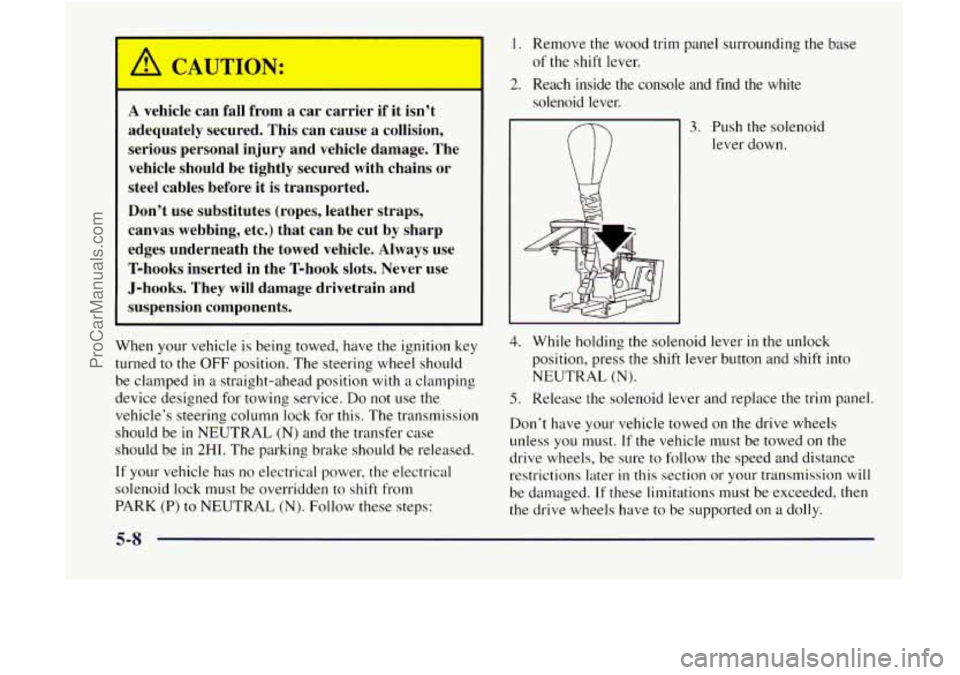
1 I Remove the wood trim panel surrounding the base
2. Reach inside the console and find the white of the shift lever.
solenoid lever.
(ii
3. Push the solenoid
lever down.
4. While holding the solenoid lever in the unlock
position, press the shift lever button and shift into
NEUTRAL
(N).
5. Release the solenoid lever and replace the trim panel.
Don’t have your vehicle towed on the drive wheels
unless
you must. If the vehicle must be towed on the
drive wheels, be sure to follow the speed and distance
restrictions later
in this section or your transmission will
be damaged. If these limitations must be exceeded, then
the drive wheels have to be supported
on a dolly.
5-8
ProCarManuals.com
Page 232 of 386

Changing a Flat Tire
If a tire goes flat, avoid further tire and wheel damage
by driving slowly to a level place. Turn on
your hazard
warning flashers.
A CAUTION:
I
Changing a tire can cause an injury. The vdcle
can slip
off the jack and roll over you or other
people. You and they could be badly injured.
Find a level place to change your tire. To help
prevent the vehicle from moving:
1. Set the parking brake firmly.
2. Put the shift lever in PARK (P).
3. lbrn off the engine.
4. Put the wheel blocks at the front and
rear of the tire farthest away from the
one being changed. That would be the
tire on the other side of the vehicle,
at
the opposite end.
The following steps will tell you how to use the jack and
change a tire.
5-21
ProCarManuals.com
Page 264 of 386

Checking Transmission Fluid Hot
Get the vehicle warmed up by driving about 15 miles
(24 km) when outside temperatures are above 50°F
(10°C). If it's colder than 50°F (lO"C), drive the
vehicle in THIRD (3) until the engine temperature gage
moves and
then remains steady for 10 minutes. Then
follow the hot check procedures.
Checking Transmission Fluid Cold
A cold check is made after the vehicle has been sitting
for eight hours or more with
the engine off and is used
only as
a reference. Let the engine run at idle for five
minutes
if outside temperatures are 50°F (10°C) or
more.
If it's colder than 50°F (lO"C), you may have to
idle the engine longer. Should the fluid level be low
during a cold check, you
1nust perform a hot check
before adding fluid. This will give you a more accurate
reading of the fluid level.
Checking the Fluid Hot or Cold
Park your vehicle on a level place. Keep the
engine running.
With the parking brake applied, place the shift lever
in PARK (P).
With your foot on the brake pedal, move the shift
lever through each gear range, pausing for about
three seconds in each range. Then, position the shift
lever
in PARK (P).
Let the engine run at idle for three minutes or more.
Then, without shutting
off the engine, follow these steps:
1. The transmission
dipstick has a red
handle and
is located at
the rear of the engine
compartment.
Flip the
handle up and then pull
out the dipstick and
wipe
it with a clean rag
or paper towel.
6- 17
ProCarManuals.com