transmission GMC ENVOY 1998 User Guide
[x] Cancel search | Manufacturer: GMC, Model Year: 1998, Model line: ENVOY, Model: GMC ENVOY 1998Pages: 386, PDF Size: 20.33 MB
Page 89 of 386
Shifting from 4LO to 4HI or 2HI
To shift from 4LO to 4H1 or 2H1, your vehicle must be
stopped or moving less than
3 mph (4.8 kdh) with the
transmission in NEUTRAL
(N). The preferred method
for shifting out of 4LO is to have your vehicle moving
1 to 2 mph (1.6 to 3.2 kdh). Press and release the 4HI
switch.
You must wait for the 4H1 indicator light to stop
flashing and remain illuminated before shifting your
transmission into gear.
If the 4HI switch is pressed when your vehicle is in gear
and/or moving, the 4HI indicator light will flash for
30 seconds but not complete the shift unless the vehicle
is moving slower than 3 mph (4.8 kmh) and the
transmission
is in NEUTRAL (N).
If your transfer case does not shift into 4H1, your
transmission indicator switch may require adjustment.
With your transmission in NEUTRAL
(N), press and
release the 4HI switch. While the 4HI indicator light is
flashing, shift your transmission into PARK
(P). Wait
until the 4HI indicator light remains illuminated before
shifting your transmission into gear. This will get you
into 4H1, but you should take your vehicle
in for service
to restore normal operation.
Windows
Power Windows
The controls for the power windows are on each of the
side doors. The switches control
the windows when the
ignition is on or when Retained Accessory Power (RAP)
is present. (See “Retained Accessory Power” in the
Index.) The driver’s door has
a switch to control the
passenger windows as well.
2-28
ProCarManuals.com
Page 116 of 386
3.
4.
Decide which one of the three channels you want to
program. Using both hands, press the hand-held
transmitter button and the desired button
on the
universal transmitter. Continue
to hold both buttons
through Step
4.
Hold down both buttons until you see the red light
on the universal transmitter flash rapidly. The rapid
flashing, which could take up to
90 seconds,
indicates that the universal transmitter has been
programmed. Release both buttons once the light
starts
to flash rapidly.
If you have trouble programming the universal
transmitter, make sure that you have followed the
directions exactly as described and that the battery
in the
hand-held transmitter is not dead. If you still cannot
program
it, rotate the hand-held transmitter end over end
and try again. The universal transmitter may not work
with older garage door openers that do not meet current
Federal Consumer Safety Standards.
If you cannot
program the transmitter after repeated attempts, consult
your
GMC dealer. Be
sure to keep the original hand-held transmitter
in case you need to erase and reprogram the
universal transmitter.
Operating the Transmitter
Press and hold the appropriate button on the universal
transmitter. The red light comes on while the signal is
being transmitted.
Note that the effective transmission range of the
universal transmitter may differ from the hand-held
transmitter and from one channel to another.
2-55
I
ProCarManuals.com
Page 180 of 386

What should I do if my vehicle stalls, or is about
to stall, and
I can’t make it up the hill?
A: If this happens, there are some things you should
0
0
0
0
do, and there are some things you must not do.
First, here’s what you
should do:
Push the brake pedal to stop the vehicle and keep
it
from rolling backwards. Also, apply the
parking brake.
If your engine is still running, shift the transmission
to REVERSE
(R), release the parking brake, and
slowly back down the
hill in REVERSE (R).
If your engine has stopped running, you’ll need to restart
it. With the brake pedal depressed and the parking brake
still applied, shift the transmission
to PARK (P) and
restart the engine. Then, shift to REVERSE
(R), release
the parking brake, and slowly back down the
hill as
straight as possible
in REVERSE (R).
As you are backing down the hill, put your left hand
on the steering wheel at
the 12 o’clock position. This
way. you’ll be able to tell
if your wheels are straight
and maneuver
as you back down. It’s best that you
back down the
hill with your wheels straight rather
than
in the left or right direction. Turning the wheel
too far to the left or right will increase the possibility
of
a rollover. Here
are some things you
must r7ot do if you stall, or are
about to stall, when going up
a hill.
0 Never attempt to prevent a stall by shifting into
NEUTRAL
(N) to “rev-up” the engine and regain
forward momentum. This won’t work. Your vehicle
will roll backwards very quickly and you could go
out of control.
Instead, apply the regular brake to stop
the vehicle.
Then apply the parking brake. Shift to REVERSE
(R), release the parking brake, and slowly back
straight down.
0 Never attempt to turn around if you are about to stall
when going up
a hill. If the hill is steep enough to
stall your vehicle, it’s steep enough to cause you to
roll over if you turn around. If you can’t make it up
the
hill, you must back straight down the hill.
Q: Suppose, after stalling, I try to back down the
hill and decide
I just can’t do it. What should
I do?
A: Set the parking brake, put your transmission in
PARK (P) and turn off the engine. Leave the
vehicle and go get some help. Exit on the uphill
side and stay clear of the path the vehicle would
take
if it rolled downhill.
4-21
I
ProCarManuals.com
Page 181 of 386
Driving Downhill
When off-roading takes you uownhill, you'll want to
consider
a number of things:
0
0
0
0
How steep is the downhill'? Will I be able to maintain
vehicle control?
What's the surface like'? Smooth'? Rough'? Slippery'?
Hard-packed dirt'? Gravel?
Are there hidden surface
obstacles'! Ruts?
Logs? Boulders'?
What's at the
bottom of the hill'! Is there a hidden
creek bank
or even a river bottom with large rocks?
If you decide you can go down a hill safely. then try to
keep your vehicle headed straight down. and use
a low
they won't have to do
all the work. Descend slowly,
keeping your vehicle under control at
all times.
b "ear. This way, engine drag can help your brakes and
0
0
A CAUTION:
Heavy braking when going down a hill can cause
your brakes
to overheat and fade. This could
cause
loss of control and a serious accident.
Apply the brakes lightly when descending a hill
and use a low gear to keep vehicle speed
under control.
Are there some things
I should not do when
driving down a hill?
A: Yes! These are important because if you ignore
them you could lose control and have
a
serious accident.
When driving downhill, avoid turns that take you
across the incline of the
hill. A hill that's not too
steep to drive down may be too steep to drive ~CI-OSS.
You could roll over
if you don't drive straight down.
Never
go downhill with the transmission in
NEUTRAL (N). This is crdled "free-wheeling." Your
brakes
will have to do all the work and could
overheat and fade.
4-22
ProCarManuals.com
Page 194 of 386

0
0
Keep your vehicle in good shape. Check all fluid
levels and also the brakes, tires, cooling system and
transmission. These parts can work hard on
mountain roads.
Know how to go down hills. The most important
thing to know is this: let your engine
do some of the
slowing down. Shift to a lower gear when you go
down a steep or long hill.
‘ A CAUTION:
If you don’t shift down, your I brakes could get so
hot that they wouldn’t work well. You would then
have poor braking or even none going down a
hill. You could crash. Shift down to let your
engine assist your brakes on a steep
downhill slope. 0
0
/I CAC rION:
Coasting downhill in NEUTRAL (N) or with the
ignition
off is dangerous. Your brakes will have to
do all the work of slowing down. They could get
so hot that they wouldn’t work well. You would
then have poor braking or even none going down
a hill. You could crash. Always have your engine
running and your vehicle in gear when you
go downhill.
0
Know how to go uphill. You may want to shift down
to a lower gear. The lower gears help cool your
engine and transmission,
and you can climb the
hill better.
Stay in your own lane when driving on two-lane
roads in hills or mountains. Don’t swing wide or cut
across the center
of the road. Drive at speeds that let
you stay in your own lane.
As you go over the top of a hill, be alert. There could
be something in your lane, like a stalled car or
an accident.
4-35
I
ProCarManuals.com
Page 203 of 386

Every vehicle is ready for some trailer towing. If yours
was built with trailering options, as many are, it’s ready
for heavier trailers. But trailering is different than just
driving your vehicle by itself. Trailering means changes
in handling, durability and fuel economy. Successful,
safe trailering takes correct equipment, and
it has to be
used properly.
That’s
the reason for this part. In it are many
time-tested, important trailering tips and safety rules. Many
of these are important for your safety and that of
your passengers.
So please read this section carefully
before you pull a trailer.
If You Do Decide To Pull A Trailer
If you do, here are some important points:
0
0
There are many different laws, including speed limit
restrictions, having to do with trailering. Make sure
your rig will be legal, not only where you live but
also where you’ll be driving.
A good source for this
information can be state or provincial police.
Consider using a sway control if your trailer
will
weigh 2,000 lbs. (900 kg) or less. You should always
use a sway control if your trailer will weigh more
than
2,000 Ibs. (900 kg). You can ask a hitch dealer
about sway controls.
0
0
0
Don’t tow a trailer at all during the first 500 miles
(800 km) your new vehicle is driven. Your engine,
axle or other parts could be damaged.
Then, during the first
500 miles (800 km) that you
tow a trailer, don’t drive over 50 mph (80 km/h) and
don’t make starts at full throttle. This helps your
engine and other parts of
your vehicle wear in at the
heavier loads.
You should use DRIVE
(D) (or, as you need to, a
lower gear) when towing a trailer. Operating your
vehicle
in DRIVE (D) when towing a trailer will
minimize heat buildup and extend the life
of
your transmission.
Three important considerations have to
do with weight:
the weight of the trailer,
0 the weight of the trailer tongue
0 and the weight on your vehicle’s tires.
4-44
ProCarManuals.com
Page 209 of 386

Driving On Grades
Reduce speed and shift to a 1owe.r gear Iwfow you start
down a long or steep downgrade.
If you don’t shift
down. you might have to use your brakes
so much that
they would get hot and no longer work well.
On
a long uphill grade, shift down and reduce your
speed to around
45 mph (70 km/h) to reduce the
possibility of engine and transmission overheating.
You should use DRIVE
(D) when towing a trailer.
Operating your vehicle
in DRIVE (D) when towing a
trailer
will minimize heat buildup and extend the life of
your transmission.
When towing at high altitude
on steep uphill grades,
consider the following: Engine coolant
will boil at a lower
temperature than at normal altitudes.
If you twn your
engine off imnlediately after towing at high altitude on
steep uphill grades, your vehicle may show signs similar to
engine overheating.
To avoid this, let the engine run while
parked (preferably on level ground)
with the automatic
transmission
in PARK (PI for a few minutes before turning
the engine off.
If you do get the overheat warning. see
”Engine Overheating”
in the Index.
Parking on Hills
You really should not park your vehicle, with a trailer
attached.
on a hill. If‘ something goes wrong, your rig
could start
to move. People can be injured, and both
your vehicle and the trailer can be damaged.
But
if you ever have to park your rig on a hill, here‘s
how
to do it:
1.
-. 3
3.
4.
5.
Apply your regular brakes, but don’t shift into
PARK
(P) yet. Then turn your wheels into the curb
if facing downhill or into traffic if facing uphill.
Have someone place chocks under the trailer wheels.
When the wheel chocks are
in place, release the
regular brakes
until the chocks absorb the load.
Reapply the regular brakes. Then apply your parking
brake, and then shift into PARK
(P).
Release the regular brakes.
4-50
ProCarManuals.com
Page 210 of 386

When You Are Ready to Leave After
Parking on a Hill
1. Apply your regular brakes and hold the pedal down
while you:
0 Start your engine;
Shift into a gear; and
0 Release the parking brake.
2. Let up on the brake pedal.
3. Drive slowly until the trailer is clear of the chocks.
4. Stop and have someone pick up and store the chocks.
Maintenance When Trailer Towing
Your vehicle will need service more often when you’re
pulling
a trailer. See the Maintenance Schedule for more
on this. Things that are especially important in trailer
operation are automatic transmission fluid (don’t
overfill), engine
oil, axle lubricant, belt, cooling system
and brake adjustment. Each of these is covered in this
manual, and the Index will help you find them quickly.
If you’re trailering, it’s
a good idea to review these
sections before you start your trip.
Check periodically to see that all hitch nuts and bolts
are tight.
ProCarManuals.com
Page 218 of 386
Towing Your Vehicle
Try to have a GM dealer or a proressional towing
service tow your vehicle. See "Roadside Assistance"
in
the Index.
If your vehicle has been changed since it was
factory-new by adding things like fog lamps, aero
skirting, or special tires and wheels, these instructions
may not be correct.
Before you do anything, turn
on the hazard
warning flashers.
When you call,
tell the towing service:
0 That your vehicle has four-wheel drive.
0 The make, model and year of your vehicle.
0 Whether you can rnolle the shift lever for the
transmission and shift the transfer case.
0 If there was an accident, what was damaged.
When the towing service arrives,
let the tow operator
know that this manual contains these towing
instructions. The operator may want to see them.
To help avoid injury to you or others:
0 Never let passengers ride in a vehicle that is
Never tow faster than safe or posted speeds.
Never tow with damaged parts not
Never get under your vehicle after it has
Always use separate safety chains on each
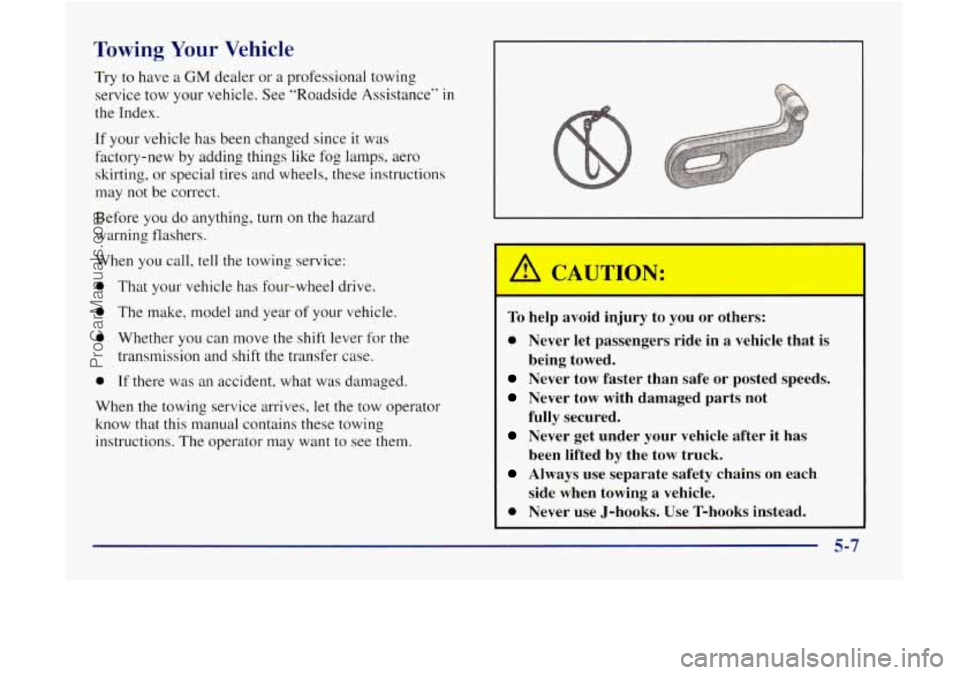
0 Never use J-hooks. Use T-hooks instead.
being
towed.
fully secured.
been lifted by the tow truck.
side when towing
a vehicle.
5-7
ProCarManuals.com
Page 219 of 386
JTION:
A vehicle can fall from a car carrier if it isn’t
adequately secured. This can cause
a collision,
serious personal injury and vehicle damage. The
vehicle should be tightly secured with chains or
steel cables before it is transported.
Don’t use substitutes (ropes, leather straps,
canvas webbing, etc.) that can be cut by sharp
edges underneath the towed vehicle. Always use
T-hooks inserted in the T-hook slots. Never use
J-hooks. They will damage drivetrain and
suspension components.
When your vehicle is being towed, have the ignition key
turned
to the OFF position. The steering wheel should
be clamped
in a straight-ahead position with a clamping
device designed for towing service.
Do not use the
vehicle’s steering column lock for this. The transmission
should be in NEUTRAL
(N) and the transfer case
should be
in 2HI. The parking brake should be released.
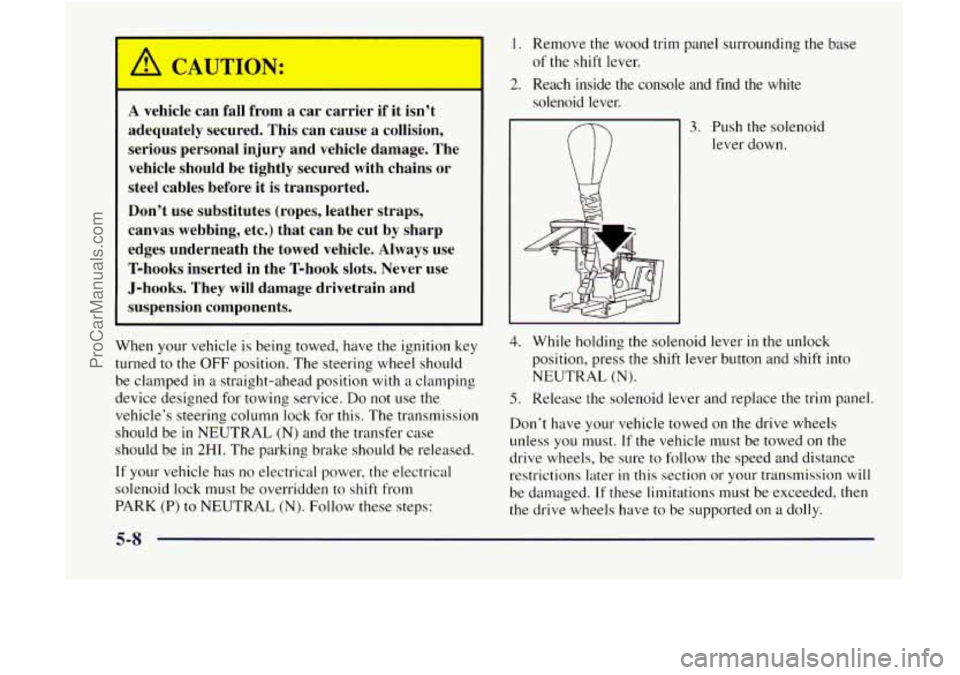
If your vehicle has no electrical power, the electrical
solenoid lock
must be overridden to shift from
PARK (P) to NEUTRAL (N). Follow these steps:
1 I Remove the wood trim panel surrounding the base
2. Reach inside the console and find the white of the shift lever.
solenoid lever.
(ii
3. Push the solenoid
lever down.
4. While holding the solenoid lever in the unlock
position, press the shift lever button and shift into
NEUTRAL
(N).
5. Release the solenoid lever and replace the trim panel.
Don’t have your vehicle towed on the drive wheels
unless
you must. If the vehicle must be towed on the
drive wheels, be sure to follow the speed and distance
restrictions later
in this section or your transmission will
be damaged. If these limitations must be exceeded, then
the drive wheels have to be supported
on a dolly.
5-8
ProCarManuals.com