window GMC ENVOY 1998 Owner's Manual
[x] Cancel search | Manufacturer: GMC, Model Year: 1998, Model line: ENVOY, Model: GMC ENVOY 1998Pages: 386, PDF Size: 20.33 MB
Page 138 of 386

Air Conditioning
On hot days, open the windows long enough to let hot
inside air escape. This reduces the time
it takes for your
vehicle to cool down. Then keep your windows closed
for the air conditioner to work its best.
Heating
For quick cool-down on very hot days, A/C should be
enabled with the temperature knob turned
to the left and
the OUTSIDE
AIR button should not be active. This
setting should be used to keep odors and/or dust from
entering the vehicle. For normal cooling on hot days,
use
A/C with the temperature knob turned to the left.
On cool but sunny days, use BI-LEVEL
A/C to deliver
warm air to the floor and cooler air to the instrument
panel outlets.
When the air conditioner is on, you may sometimes
notice slight changes
in your vehicle’s engine speed
and power.
This is normal because the system is
designed to cycle the compressor on and off to keep the
desired temperature. The heater
works best
if you keep your windows closed
while using it.
On cold days, use HEATER with the
temperature knob turned
to the right. BLEND is useful
in cool weather when
you have fog or ice on the
windshield
or side windows.
If you use the optional engine coolant heater before
starting your engine, your heating system will produce
warmer air faster to heat the passenger compartment in
cold weather. See “Engine Coolant Heater”
in the Index.
Ventilation System
For mild outside temperatures when little heating or
cooling is needed, use PANEL with the OUTSIDE
AIR
button enabled to direct outside air through your vehicle.
Airflow is through the instrument panel outlets.
Your vehicle’s ventilation system supplies outside air to
the inside
of your vehicle when it is moving. When the
vehicle is not moving, you can get outside air to flow
through by selecting
any mode and any fan speed.
3-5
!
ProCarManuals.com
Page 139 of 386
Ventilation Tips
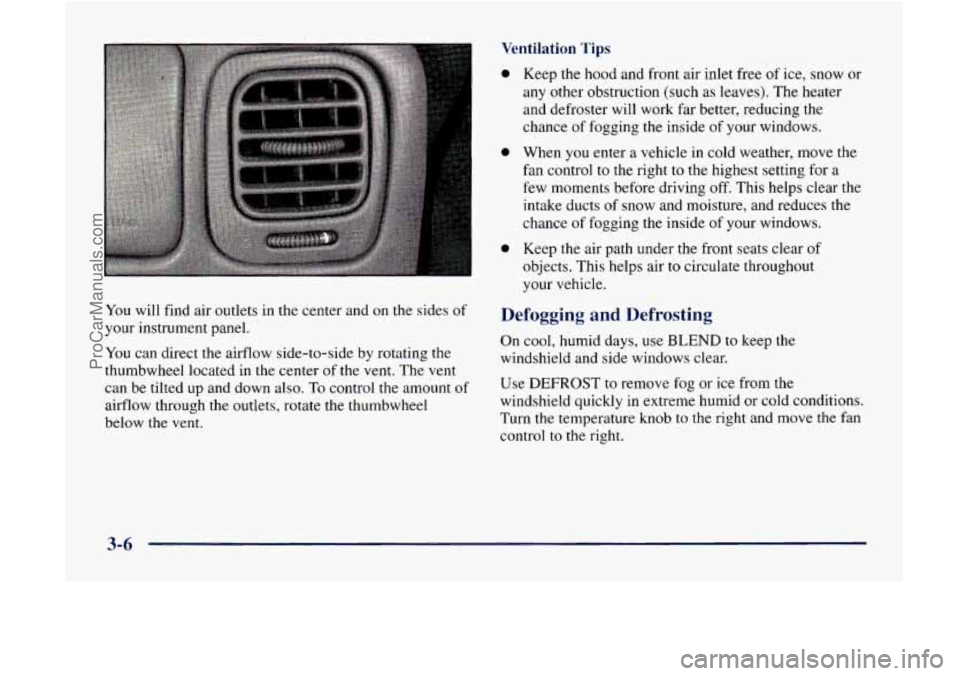
You will find air outlets in the center and on the sides of
your instrument panel.
You can direct the airflow side-to-side by rotating the
thumbwheel located in the center of the vent. The vent
can be tilted up and down also.
To control the amount of
airflow through the outlets, rotate the thumbwheel
below the vent.
0
e
0
Keep the hood and front air inlet free of ice, snow or
any other obstruction (such as leaves). The heater
and defroster will work far better, reducing the
chance
of fogging the inside of your windows.
When
you enter a vehicle in cold weather, move the
fan control to the right
to the highest setting for a
few moments before driving off. This helps clear the
intake ducts
of snow and moisture, and reduces the
chance of fogging the inside of your windows.
Keep the air path under the front seats clear
of
objects. This helps air to circulate throughout
your vehicle.
Defogging and Defrosting
On cool, humid days, use BLEND to keep the
windshield and side windows clear.
Use DEFROST
to remove fog or ice from the
windshield quickly in extreme humid or cold conditions.
Turn the temperature knob to the right and move the fan
control
to the right.
3-6
ProCarManuals.com
Page 140 of 386
Rear Window Defogger
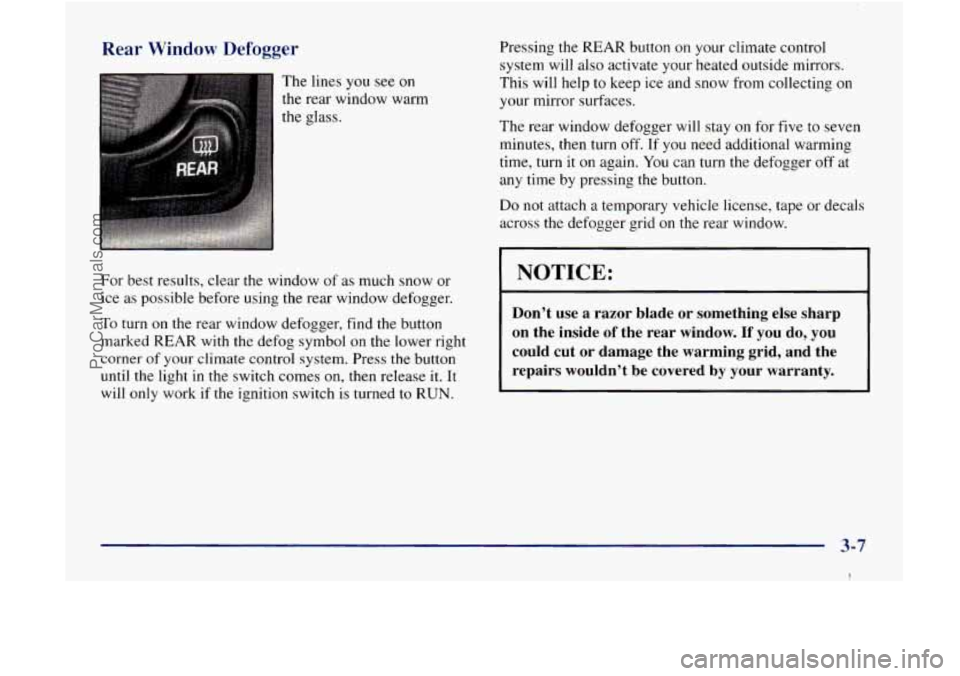
The lines you see on
the rear window warm
the glass.
For best results, clear the window of as much snow or
ice
as possible before using the rear window defogger.
To turn on the rear window defogger, find the button
marked REAR with the defog symbol
on the lower right
corner of your climate control system. Press
the button
until the light in the switch comes on, then release it. It
will only work
if the ignition switch is turned to RUN.
Pressing the REAR button on your climate control
system will also activate your heated outside mirrors.
This will help to keep ice and snow from collecting
on
your mirror surfaces.
The rear window defogger will stay on for five
to seven
minutes, then turn
off. If you need additional warming
time, turn it on again. You can turn the defogger off at
any time by pressing the button.
Do not attach a temporary vehicle license, tape or decals
across the defnqger grid on
the rear window.
NOTICE:
Don’t use a razor blade or something else sharp
on the inside of the rear window. If you do, you
could cut or damage the warming grid, and the
repairs wouldn’t be covered by your warranty.
3-7
I
ProCarManuals.com
Page 192 of 386
The exit speed is usually posted.
Reduce your speed according to your speedometer’
not
to your sense of motion. After driving for any distance
at higher speeds,
you may tend to think you are going
slower than you actually are.
Before Leaving on a Long Trip
Make sure you’re ready. Try to be well rested. If you
must start when you’re not fresh
-- such as after a day’s
work
-- don’t plan to make too many miles that first part
of the journey. Wear comfortable clothing and shoes you
can easily drive
in.
Is your vehicle ready for a long trip? If you keep it
serviced and maintained, it‘s ready to go. If it needs
service, have
it done before starting out. Of course,
you’ll find experienced and able service experts
in GM
dealerships all across North America. They’ll be ready
and willing to help if you need it.
Here are some things you can check before a trip:
0
0
0
0
0
0
0
WincJsl~ield Wcrshc~r- Fluid: Is the reservoir full? Are
all windows clean inside and outside?
Wiper Blcrdes: Are they in good shape?
Fuel, Elzgirze Oil, Other Flr.ds: Have you checked
all levels‘?
Lcunps: Are they all working? Are the lenses clean?
Tires: They are vitally important to a safe,
trouble-free trip.
Is the tread good enough for
long-distance drivingi? Are the tires all inflated
to the
recommended pressure?
Wecrther Forec*cr.sts: What’s the weather outlook
along your route? Should
you delay your trip a short
time to avoid
a major storm system?
A4crp.s: Do you have up-to-date maps?
4-33
I
ProCarManuals.com
Page 198 of 386

Snow can trap exhaust gases under your vehicle.
This can cause
deadly CO (carbon monoxide) gas
to get inside. CO could overcome
you and kill
you. You can’t see it
or smell it, so you might not
know it
is in your vehicle. Clear away snow from
around the base
of your vehicle, especially any
that is blocking your exhaust pipe. And check
around again from time to time to be sure snow
doesn’t collect there.
Open a window just
a little on the side of the
vehicle that’s away from the wind. This will help
keep
CO out.
Run your engine only as long as you must. This saves
fuel. When you
run the engine. make it go a little faster
than just idle. That is. push the accelerator slightly. This
uses less fuel for the heat that you get and
it keeps the
battery charged.
YOLI will need a well-charged battery to
restart the vehicle, and possibly for signaling later
on
with your headlamps. Let the heater run for a while.
Then, shut the engine off and close the window almost
all the way to preserve the heat. Start the engine again
and repeat this only when you feel really uncomfortable
from the cold.
But do it as little as possible. Preserve the
fuel
as long as you can. To help keep warm, you can get
out of the vehicle and do some fairly vigorous exercises
every half hour or
so until help comes.
Recreational Vehicle Towing
Vehicles with the electronic shift transfer case require
special modifications before they can be towed
in this
manner. Please contact your dealer
.for the towing
information that is appropriate
for yoc~r
particular vehicle.
4-39
ProCarManuals.com
Page 207 of 386

Driving with a Trailer
A CAUTION: I
0
0
0
If you have a rear-most window open and you
pull a trailer with your vehicle, carbon monoxide
(CO) could come into your vehicle. You can’t see
or smell
CO. It can cause unconsciousness or
death. (See ‘(Engine Exhaust” in the Index.) To
maximize your safety when towing a trailer:
Have your exhaust system inspected for
leaks, and make necessary repairs before
starting on your trip.
Keep the rear-most windows closed.
If exhaust does come into your vehicle
through a window in the rear or another
opening, drive with your front, main
heating or cooling system on and with the
fan on any speed. This will bring fresh,
outside air into your vehicle.
Do not use
RECIRCULATION because it only
recirculates the air inside your vehicle. (See
“Comfort Controls” in the Index.)
Towing a trailer requires a certain amount of experience, ~
Before setting out for the open road, you’ll want to get
to know your rig. Acquaint yourself with the feel of
handling and braking with the added weight of the
trailer. And always keep in mind that the vehicle you
arc
driving is now a good deal longer and not nearly as
responsive as your vehicle is by itself.
Before you
start, check the trailer hitch and platform
(and attachments), safety chains, electrical connector,
lamps, tires and mirror adjustment. If the trailer has
electric brakes, start your vehicle and trailer moving and
then apply the trailer brake controller by hand to be sure
the brakes are working. This lets you check your
electrical connection at the same time.
During your trip, check occasionally to
be sure that the
load is secure, and that the lamps and any trailer brakes
are still working.
Following Distance
Stay at least twice as far behind the vehicle ahead as you 1
would when driving your vehicle without a trailer. This
can help you avoid situations that require heavy braking
and sudden turns.
4-48
ProCarManuals.com
Page 223 of 386

io Stea 5 Coming From Your Engine
~i you get the overheat warning but see or hear no
steam, the problem may not be too serious. Sometimes
the engine can get
a little too hot when you:
0 Climb a long hill on a hot day.
Stop after high-speed driving.
Idle for long periods in traffic.
Tow a trailer. See “Driving on Grades” in the Index.
If you get the overheat.warning with no sign of steam,
try this for a minute or
so:
1. Turn off your air conditioner.
2. Turn on your heater to full hot at the highest fan
speed and open the window
as necessary.
3. If you’re in a traffic jam, shift to NEUTRAL (N);
otherwise, shift to the highest gear while
driving
-- DRIVE (D) or THIRD (3).
If you no longer have the overheat warning, you can
drive. Just to be safe, drive slower for about
10 minutes.
If the warning doesn’t come back on, you can
drive normally.
If the warning continues, pull over, stop, and park your
vehicle right away.
If there’s still no sign of steam, push the accelerator until
the engine speed is about twice as fast as normal idle
speed. Bring the engine speed back to normal idle speed
after two or three minutes.
Now see if the warning stops.
But then, if you still have the warning, turn ojfthe
engine nnd
get everyone out of the vehicle until it
cools down.
You may decide not to lift the hood but to get service
help right away.
5-12
ProCarManuals.com
Page 275 of 386
Checking Brake Fluid What to Add
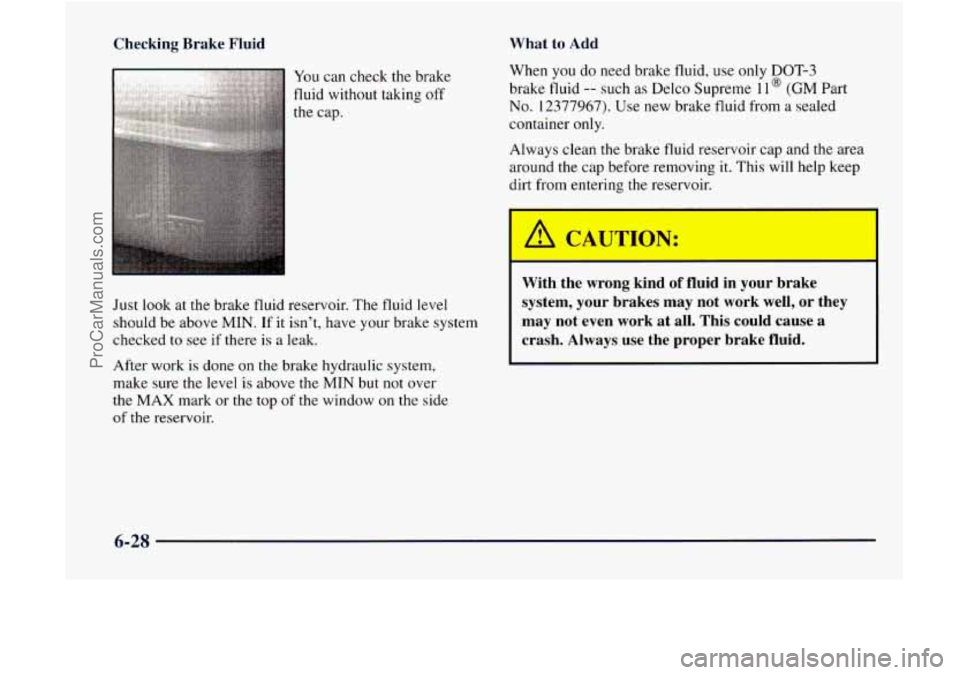
You can check the brake
fluid without taking off
the cap.
Just look at the brake fluid reservoir. The fluid level
should be above
MIN. If it isn’t, have your brake system
checked to see if there is a leak.
After work is done
on the brake hydraulic system,
make sure
the level is above the MTN but not over
the
MAX mark or the top of the window on the side
of the reservoir. When
you do need brake fluid, use only
DOT-3
brake fluid -- such as Delco Supreme 11 @ (GM Part
No.
12377967). Use new brake fluid from a sealed
container only.
Always clean the brake fluid reservoir cap and the
area
around the cap before removing it. This will help keep
dirt from entering the reservoir.
A CAUTION:
With the wrong kind of fluid in your brake
system, your brakes may not work well, or they
may not even work at
all. This could cause a
crash. Always use the proper brake fluid.
6-28
ProCarManuals.com
Page 292 of 386
Appearance Care
Remember, cleaning products can be hazardous. Some
are toxic. Others can burst into flame if you strike a
match or get them
on a hot part of the vehicle. Some are
dangerous if you breathe their fumes in a closed space.
When you use anything from a container to clean your
vehicle, be sure to follow the manufacturer’s warnings
and instructions. And always open your doors or
windows when you’re cleaning the inside.
Never use these to clean your VI cle:
Gasoline
..
0 Benzene
0 Naphtha
0 Carbon Tetrachloride
0 Acetone
0 Paint Thinner
0 Turpentine
0 Lacquer Thinner
0 Nail Polish Remover
They can all be hazardous
-- some more than
others
-- and they can all damage your vehicle, too.
Don’t use any of these unless this manual says you can.
In many uses, these will damage your vehicle:
Alcohol
Laundry Soap
Bleach
Reducing Agents
ProCarManuals.com
Page 296 of 386
Cleaning Glass Surfaces
Glass should be cleaned often. GM Glass Cleaner (GM
Part No. 1050427) or a liquid household glass cleaner
will remove normal tobacco smoke and dust films on
interior glass.
Don’t use abrasive cleaners on glass, because they may
cause scratches. Avoid placing decals on the inside rear
window, since they may have to be scraped off later.
If
abrasive cleaners are used on the inside of the rear
window, an electric defogger element may be damaged.
Any temporary license should not be attached across the
defogger grid.
Cleaning the Outside of the Windshield,
Backglass and Wiper Blades
If the windshield is not clear after using the windshield
washer,
or if the wiper blade chatters when running,
wax, sap or other material may be on the blade
or windshield. Clean
the outside of the windshield with
GM
Windshield Cleaner, Bon Ami@ Powder (non-scratching
glass cleaning powder),
GM Part No. 105001 1. The
windshield is clean
if beads do not form when you rinse
it with water.
Grime from the windshield will stick to the wiper blades
and affect their performance. Clean
the blade by wiping
vigorously with a cloth soaked in full-strength windshield
washer solvent. Then rinse the blade with water.
Check the wiper blades and clean them as necessary;
replace blades that look worn.
Weatherstrips
Silicone grease on weatherstrips will make them last
longer, seal better, and not stick or squeak. Apply
silicone grease with a clean cloth at least every six
months. During very cold, damp weather more frequent
application may be required. (See “Recommended
Fluids and Lubricants” in the Index.)
6-49
ProCarManuals.com