brake GMC ENVOY 1998 Service Manual
[x] Cancel search | Manufacturer: GMC, Model Year: 1998, Model line: ENVOY, Model: GMC ENVOY 1998Pages: 386, PDF Size: 20.33 MB
Page 215 of 386

2. Get the vehicles close enough so the jumper cables
can reach, but be sure
the vehicles aren’t touching
each other.
If they are, it could cause a ground
connection you don’t want.
You wouldn’t be able to
start your vehicle, and the bad grounding could
damage
the electrical systems.
To avoid the possibility of the vehicles rolling, set
the parking brake firmly on each vehicle. Put your
vehicle
in PARK (P).
3. Turn off the ignition on both vehicles. Unplug
unnecessary accessories plugged into the cigarette
lighter or the accessory power outlets. Turn
off all
lamps that aren’t needed as well as radios. This will
avoid sparks and help save both batteries. In
addition, it could save your radio!
NOTICE:
If you leave your radio on, it could be badly
damaged. The repair wouldn’t be covered by
your warranty.
L
4. Open both hoods and locate the batteries. Find the
positive
(+) and negative (-) terminals on
each battery.
A
Using a match near a battery can cause battery
gas to explode. People have been hurt doing this,
and some have been blinded. Use
a flashlight if
you need more light.
Be sure the battery has enough water.
You don’t
need
to add water to the ACDelco Freedom’
battery installed in every new
GM vehicle. But if
a battery has filler caps, be sure the right amount
of fluid is there. If it is low, add water to take care
of that first. If you don’t, explosive gas could
be present.
Battery fluid contains acid that can burn you.
Don’t get it
on you. If you accidentally get it in
your eyes or on your skin, flush the place with
water and get medical help immediately.
5-4
ProCarManuals.com
Page 219 of 386
JTION:
A vehicle can fall from a car carrier if it isn’t
adequately secured. This can cause
a collision,
serious personal injury and vehicle damage. The
vehicle should be tightly secured with chains or
steel cables before it is transported.
Don’t use substitutes (ropes, leather straps,
canvas webbing, etc.) that can be cut by sharp
edges underneath the towed vehicle. Always use
T-hooks inserted in the T-hook slots. Never use
J-hooks. They will damage drivetrain and
suspension components.
When your vehicle is being towed, have the ignition key
turned
to the OFF position. The steering wheel should
be clamped
in a straight-ahead position with a clamping
device designed for towing service.
Do not use the
vehicle’s steering column lock for this. The transmission
should be in NEUTRAL
(N) and the transfer case
should be
in 2HI. The parking brake should be released.
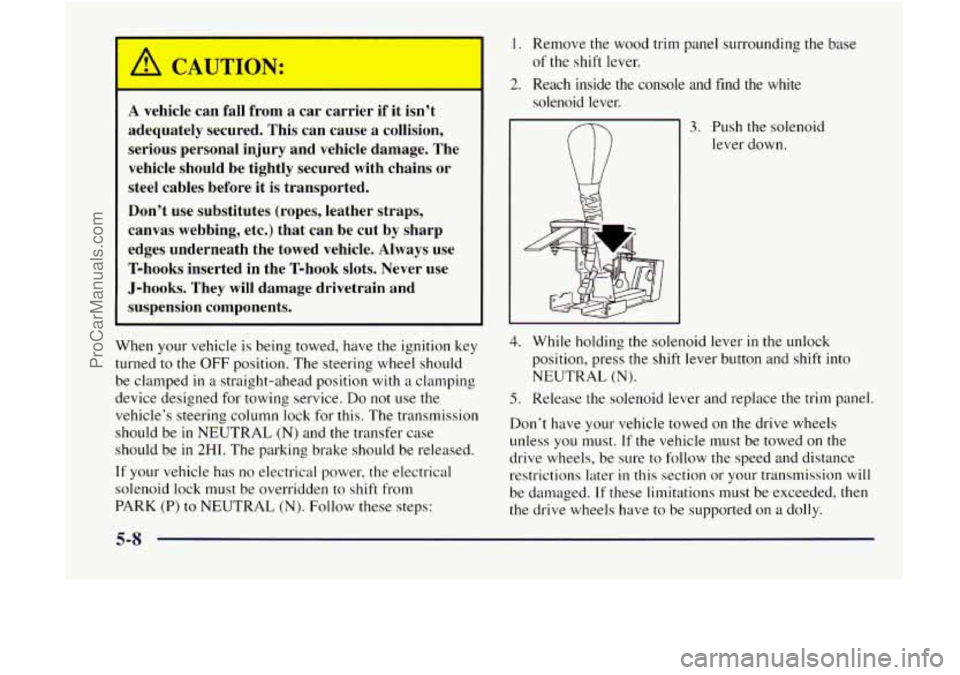
If your vehicle has no electrical power, the electrical
solenoid lock
must be overridden to shift from
PARK (P) to NEUTRAL (N). Follow these steps:
1 I Remove the wood trim panel surrounding the base
2. Reach inside the console and find the white of the shift lever.
solenoid lever.
(ii
3. Push the solenoid
lever down.
4. While holding the solenoid lever in the unlock
position, press the shift lever button and shift into
NEUTRAL
(N).
5. Release the solenoid lever and replace the trim panel.
Don’t have your vehicle towed on the drive wheels
unless
you must. If the vehicle must be towed on the
drive wheels, be sure to follow the speed and distance
restrictions later
in this section or your transmission will
be damaged. If these limitations must be exceeded, then
the drive wheels have to be supported
on a dolly.
5-8
ProCarManuals.com
Page 231 of 386

Engine Fan Noise
This vehicle has a clutched engine cooling fan. When the
clutch is engaged, the fan spins faster to provide more air
to cool the engine. In most everyday driving conditions,
the clutch is
not engaged. This improves fuel economy and
reduces
fan noise. Under heavy vehicle loading, trailer
towing and/or high outside temperatures, the fan speed
increases when the clutch engages.
So you may hear an
increase in fan noise. This is normal and should not be
mistaken
as the transmission slipping or making extra
shifts. It is merely the cooling system functioning properly.
The fan will slow down when additional cooling is not
required and the clutch disengages.
You may
also hear this fan noise when you start the
engine. It will go away
as the fan clutch disengages.
If a Tire Goes Flat
It’s unusual for a tire to “blow out” while you’re driving,
especially if you maintain your tires properly.
If air goes
out of
a tire, it’s much more likely to leak out slowly.
But
if you should ever have a “blowout,” here are a few
tips about what to expect and what to do:
If
a front tire fails, the flat tire will create a drag that
pulls the vehicle toward that side.
Take your foot off the
accelerator pedal and grip
the steering wheel firmly.
Steer to maintain lane position, and then gently brake to
a stop well out of the traffic lane.
A rear blowout, particularly on a curve, acts much like a
skid and may require the same correction you’d use in a
skid. In any rear blowout, remove your foot from the
accelerator pedal. Get the vehicle under control by
steering the
way you want the vehicle to go. It may be
very bumpy and noisy, but you can
still steer. Gently
brake to
a stop -- well off the road if possible.
If a tire goes flat, the next part shows how to use your
iacking equipment to change
a flat tire safely. u Y a. c
5-20
ProCarManuals.com
Page 232 of 386

Changing a Flat Tire
If a tire goes flat, avoid further tire and wheel damage
by driving slowly to a level place. Turn on
your hazard
warning flashers.
A CAUTION:
I
Changing a tire can cause an injury. The vdcle
can slip
off the jack and roll over you or other
people. You and they could be badly injured.
Find a level place to change your tire. To help
prevent the vehicle from moving:
1. Set the parking brake firmly.
2. Put the shift lever in PARK (P).
3. lbrn off the engine.
4. Put the wheel blocks at the front and
rear of the tire farthest away from the
one being changed. That would be the
tire on the other side of the vehicle,
at
the opposite end.
The following steps will tell you how to use the jack and
change a tire.
5-21
ProCarManuals.com
Page 240 of 386
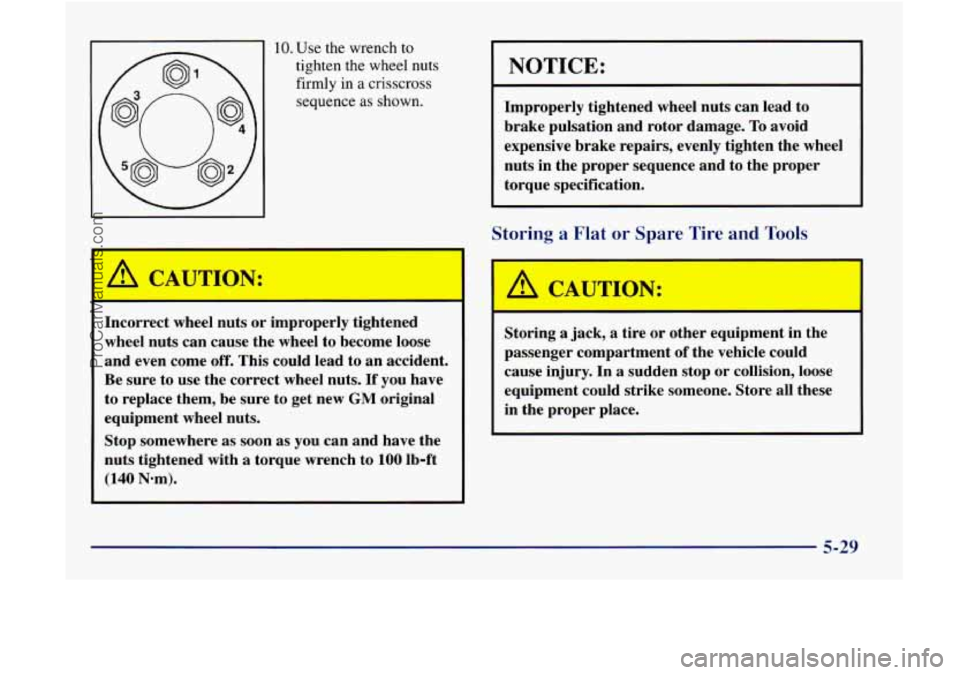
10. Use the wrench to
tighten the wheel nuts
firmly in
a crisscross
sequence
as shown.
NOTICE:
Improperly tightened wheel nuts can lead to
brake pulsation and rotor damage.
To avoid
expensive brake repairs, evenly tighten the wheel
nuts in the proper sequence and to the proper
torque specification.
Storing a Flat or Spare Tire and Tools
A CAUTION:
Incorrect wheel nuts or improperly tightened
wheel nuts can cause the wheel to become loose
and even come
off. This could lead to an accident.
Be sure to use the correct wheel nuts.
If you have
to replace them, be sure to get new
GM original
equipment wheel nuts.
Stop somewhere as soon as
you can and have the
nuts tightened with a torque wrench to
100 lb-ft
(140 Nom). Storing
a jack, a tire or other equipment in the
passenger compartment
of the vehicle could
cause injury.
In a sudden stop or collision, loose
equipment could strike someone. Store all these
in the proper place.
5-29
ProCarManuals.com
Page 248 of 386

Section 6 Service and Appearance Care
Here you will find information about the care of your vehicle. This section begins with service and fuel information,
and then
it shows how to check important fluid and lubricant levels. There is also technical information about your
vehicle, and a part devoted
to its appearance care.
6-2
6-3
6-5
6-5
6-7
6-8
6-
10
6-14
6- 15
6-19
6-20
6-2
1
6- 24
6-25
6-25
6-26
6-
2’7
Service
Fuel
Fuels in Foreign Countries
Filling Your Tank
Filling a Portable
Fuel Container
Checking Things Under the Hood
Engine Oil
Air Cleaner
Automatic Transmission Fluid
Rear Axle
Four- Wheel Drive
Engine Coolant
Radiator Pressure Cap
Thermostat
Power Steering Fluid
Windshield Washer Fluid
Brakes Battery
Bulb Replacement
Windshield Wiper Blade Replacement
Tires
Appearance Care
Cleaning the Inside
of Your Vehicle
Care of Safety Belts
Cleaning the Outside of Your Vehicle
Appearance Care Materials Chart
Vehicle Identification Number (VIN)
Service Parts Identification Label
Electrical System
Replacement Bulbs
Capacities and Specifications
Air Conditioning Refrigerants
6-30
6-3
1
6-34
6-36
6-45
6-46
6-48
6-50
6-53
6-54
6-54
6-54
6- 60
6- 60
6-62
6-1
ProCarManuals.com
Page 255 of 386

Checking Things Under the Hood Then go to the front of the vehicle and release the
secondary hood release.
Things that burn can get on hot engine parts and
start a fire. These include liquids like gasoline,
oil, coolant, brake fluid, windshield washer and
other fluids, and plastic or rubber. You
or others
could be burned. Be careful not to drop
or spill
things that will burn onto
a hot engine.
-
To open the hood, first pull
the handle inside the vehicle
on the lower driver’s side of
the instrument panel. Lift
the hood, release the hood prop from its retainer and
put the hood prop into the slot in the hood.
You may
have
a lamp that comes on when you lift the hood.
6-8
ProCarManuals.com
Page 256 of 386

When you lift the hood, you’ll see these items:
C
A. Battery
B. Coolant Recovery Tank
C. Engine
Oil Dipstick
D. Engine
Oil Fill
E. Transmission Dipstick
E Power Steering Reservoir
G. Brake Master Cylinder
H. Air Cleaner
I. Fuse Block
J. Windshield Washer Fluid
6-9
ProCarManuals.com
Page 264 of 386

Checking Transmission Fluid Hot
Get the vehicle warmed up by driving about 15 miles
(24 km) when outside temperatures are above 50°F
(10°C). If it's colder than 50°F (lO"C), drive the
vehicle in THIRD (3) until the engine temperature gage
moves and
then remains steady for 10 minutes. Then
follow the hot check procedures.
Checking Transmission Fluid Cold
A cold check is made after the vehicle has been sitting
for eight hours or more with
the engine off and is used
only as
a reference. Let the engine run at idle for five
minutes
if outside temperatures are 50°F (10°C) or
more.
If it's colder than 50°F (lO"C), you may have to
idle the engine longer. Should the fluid level be low
during a cold check, you
1nust perform a hot check
before adding fluid. This will give you a more accurate
reading of the fluid level.
Checking the Fluid Hot or Cold
Park your vehicle on a level place. Keep the
engine running.
With the parking brake applied, place the shift lever
in PARK (P).
With your foot on the brake pedal, move the shift
lever through each gear range, pausing for about
three seconds in each range. Then, position the shift
lever
in PARK (P).
Let the engine run at idle for three minutes or more.
Then, without shutting
off the engine, follow these steps:
1. The transmission
dipstick has a red
handle and
is located at
the rear of the engine
compartment.
Flip the
handle up and then pull
out the dipstick and
wipe
it with a clean rag
or paper towel.
6- 17
ProCarManuals.com
Page 274 of 386

Brakes
Brake Fluid
have your brake system fixed, since a leak means that
sooner or later your brakes won't work well, or won't
work at all.
So, it isn't a good idea to "top off' your brake fluid.
Adding brake fluid won't correct
a leak. If you add fluid
when your linings are worn, then you'll have too much
fluid when you get new brake linings. You should add
(or remove) brake fluid,
as necessary, only when work
is done
on the brake hydraulic system.
Your brake master cylinder reservoir is here.
It is filled
with DOT-3 brake fluid.
There are
only two reasons why the brake fluid level in
the reservoir might go down. The first is that the brake
fluid goes down
to an acceptable level during normal
brake lining wear. When new linings are
put in, the fluid
level goes back up. The other reason
is that fluid is
leaking out
of the brake system. If it is, you should
If you have too much brake fluid, it can spill
on the engine. The fluid will burn
if' the engine
is hot enough.
You or others could be burned,
and your vehicle could be damaged. Add brake
fluid only when work is done on the brake
hydraulic system.
Refer to the Maintenance Schedule to determine when to
check your brake fluid. See "Periodic Maintenance
Inspections"
in the Index.
6-27
ProCarManuals.com