mirror GMC ENVOY 1998 Owners Manual
[x] Cancel search | Manufacturer: GMC, Model Year: 1998, Model line: ENVOY, Model: GMC ENVOY 1998Pages: 386, PDF Size: 20.33 MB
Page 62 of 386

Section 2 Features and Controls
Here you can learn about the many standard and optional features on your vehicle, \
and information on starting,
shifting and braking. Also explained
are the instrument panel and the warning systems that tell you if everything is
working properly
-- and what to do if you have a problem.
2-2 2-4
2-6
2-9 2-10 2-1 1
2-12
2- 13
2- 14
2- 15
2- 16
2-18 2-20
2-2
1
2-23 2-24
2-24
2-25 Keys
Door Locks
Keyless Entry System
LiftgateLiftglass
Theft Content Theft-Deterrent
Passlock@ New Vehicle “Break-In’’
Ignition Positions Starting Your Engine
Engine Coolant Heater
(If Equipped)
Automatic Transmission Operation
Parking Brake Shifting Into PARK (P)
Shifting Out of PARK
(P)
Parking Over Things That Burn
Engine Exhaust Running Your Engine While You’re Parked 2-26
2-26
2-28 2-29
2-30
2-30 2-36
2-39
2-40
2-42
2-49 2-50
2-52 2-52
2-53 2-58 2-60
2-62 Locking Rear Axle
Four-wheel Drive
Windows Horn
Tilt Wheel Turn SignalMultifunction Lever
Exterior Lamps
Interior Lamps
Mirrors Storage Compartments
Ashtrays and Cigarette Lighter
Sun Visors
Accessory Power Outlets Sunroof (If Equipped)
Universal Transmitter Instrument Panel
Instrument Panel Cluster
Warning Lights, Gages and Indicators
2-1
ProCarManuals.com
Page 101 of 386

You can use the DOME OVERRIDE button, located Mirrors
below the parking/headlamp knob, to set the dome
lamps to come
on automatically when the doors are Electrochromic Daymight Inside Rearview
opened, or to remain off. To turn the lamps off, press the Mirror
button once into the “in” position. With the button in
this position, the dome lamps will remain off when the
doors are open.
To return the lamps to automatic
operation, press the button again and return it to the
“out” position. With the button in this position, the dome
lamps will come on when you open the door. This will
not override the illuminated entry feature.
Battery Run-Down Protection
This feature shuts off the dome, courtesy, vanity,
reading, glove
box and underhood lamps if they are left
on for more than
20 minutes when the ignition is off.
This will keep your battery from running down.
If the battery run-down protection shuts off the interior
lamps, it may be necessary to do one of the following to
return
to normal operation:
0 Shut off all lamps and close all doors, or
Turn the ignition key to RUN.
This mirror automatically changes to reduce glare from
headlamps behind you. A photocell on
the back of the
mirror senses when it is becoming dark outside. Another
photocell
built into the mirror surface senses when
headlamps are behind you.
At night, when the glare is too high, the mirror will
gradually darken
to reduce glare (this change may take a
few seconds). The mirror will return to its clear daytime
state when the glare
is reduced. The vehicle will also
return to its clear daytime state when the vehicle is put
into
REVERSE (R).
2-40
ProCarManuals.com
Page 102 of 386
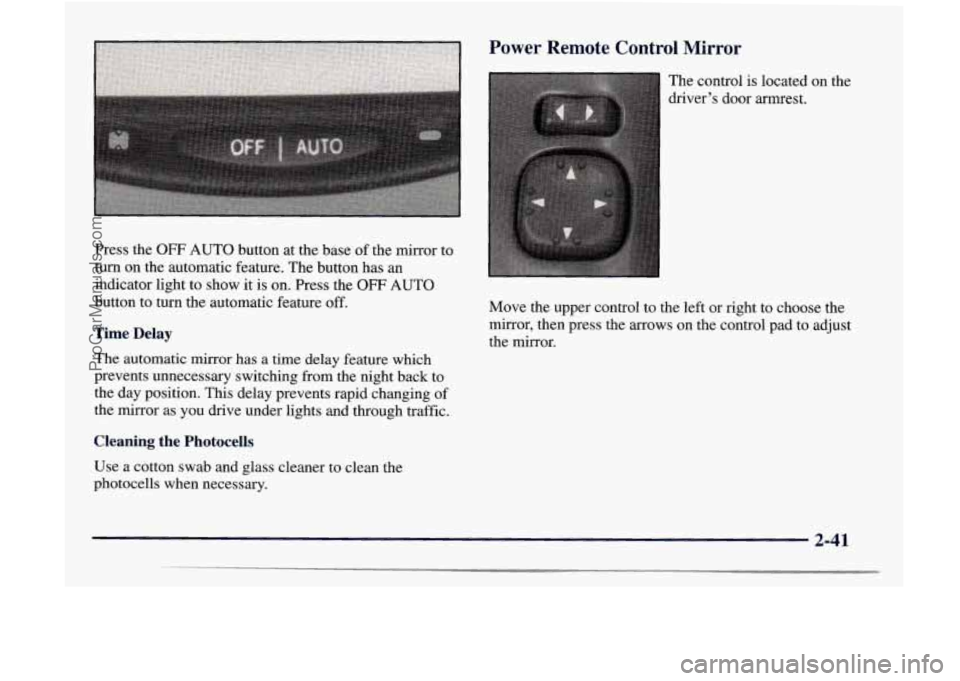
Press the OFF AUTO button at the base of the mirror to
turn on the automatic feature. The button has
an
indicator light to show it is on. Press the OFF AUTO
button to turn the automatic feature
off.
Time Delay
The automatic mirror has a time delay feature which
prevents unnecessary switching from the night back to
the day position. This delay prevents rapid changing of
the mirror as you drive under lights and through traffic.
Cleaning the Photocells
Use a cotton swab and glass cleaner to clean the
photocells when necessary. The
control is located on the
driver’s door armrest.
Move the upper control to the left or right to choose the mirror, then press the
arrows on the control pad to adjust
the mirror.
2-41
ProCarManuals.com
Page 103 of 386

Convex Outside Mirror
Your passenger’s side mirror is convex. A convex
mirror’s surface
is curved so you can see more from the
driver’s seat.
Storage Compartments
Glove Box
To open your glove box, lift the lever on the front of the
glove box and lower the door.
The glove box should not
1 be open while driving.
A convex mirror can make things (like other
vehicles)
look farther away than they really are.
If you cut
too sharply into the right lane, you
could hit a vehicle on your right. Check your
inside mirror or glance over your shoulder before
changing lanes.
4 Overhead Console
Heated Outside Rearview Mirror
When you operate the rear window defogger, a defogger
also warms the heated driver’s and passenger’s outside
rearview mirrors
to help clear them of ice and snow.
See “Rear Window Defogger” in the Index for
more information. The
overhead console includes reading lamps, a driver
information system,
a storage compartment for
sunglasses and a universal transmitter.
2-42
ProCarManuals.com
Page 111 of 386
NOTICE:
Don’t hold a cigarette lighter in with your hand
while
it is heating. If you do, it won’t be able to
back away from the heating element when it’s
ready. That can make it overload, damaging the
lighter and the heating element.
There is a smaller ashtray in the rear of the center
floor console.
Sun Visors
To block out glare, you can swing down the top and
bottom visors
(if your vehicle has them). You can also
swing the bottom visor from side-to-side. Your visors
may have an extension that can be pulled out for
additional glare protection and a strap for holding small
items, such
as maps.
Illuminated Visor Vanity Mirror
Pull the sun visor down and lift the mirror cover to turn
on the lamps.
Accessory Inflator
Your vehicle is equipped with an air inflator system.
With
it, you can inflate things like air mattresses and
basketballs, and you can also use it to bring your tires up
to the proper pressure.
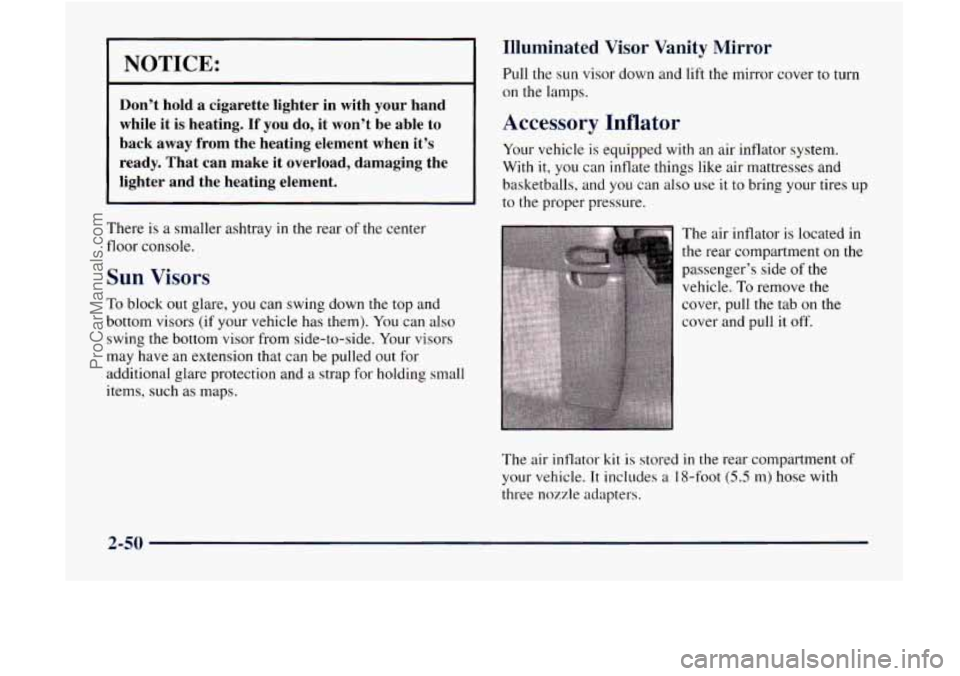
The air inflator is located in
the rear compartment on the
passenger’s side
of the
vehicle.
To remove the
cover, pull the tab on the
cover and pull
it off’.
The air inflator kit
is stored in the rear compartment of
your vehicle. It includes a I %foot (5.5 m) hose with
three nozzle adapters.
2-50
ProCarManuals.com
Page 140 of 386
Rear Window Defogger
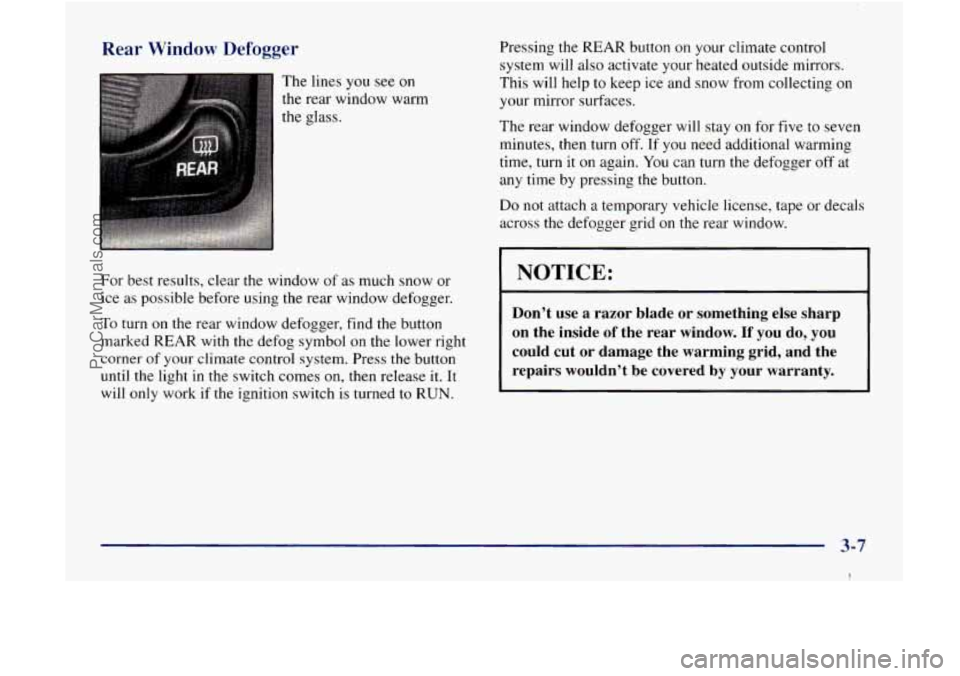
The lines you see on
the rear window warm
the glass.
For best results, clear the window of as much snow or
ice
as possible before using the rear window defogger.
To turn on the rear window defogger, find the button
marked REAR with the defog symbol
on the lower right
corner of your climate control system. Press
the button
until the light in the switch comes on, then release it. It
will only work
if the ignition switch is turned to RUN.
Pressing the REAR button on your climate control
system will also activate your heated outside mirrors.
This will help to keep ice and snow from collecting
on
your mirror surfaces.
The rear window defogger will stay on for five
to seven
minutes, then turn
off. If you need additional warming
time, turn it on again. You can turn the defogger off at
any time by pressing the button.
Do not attach a temporary vehicle license, tape or decals
across the defnqger grid on
the rear window.
NOTICE:
Don’t use a razor blade or something else sharp
on the inside of the rear window. If you do, you
could cut or damage the warming grid, and the
repairs wouldn’t be covered by your warranty.
3-7
I
ProCarManuals.com
Page 172 of 386
0 Check your mirrors, glance over your shoulder and
start your left lane change signal before moving out
of the right lane to pass. When you are far enough
ahead of the passed vehicle to see its front
in your
inside mirror, activate your right lane change signal
and move back into the right lane. (Remember that
your right outside mirror is convex. The vehicle you
just passed may seem to be farther away from you
than
it really is.)
Try not to pass more than one vehicle at a time on
two-lane roads. Reconsider before passing the
next vehicle.
Don’t overtake a slowly moving vehicle too rapidly.
Even though the brake lamps are not flashing, it may
be slowing down or starting to turn.
0 If you’re being passed, make it easy for the
following driver to get ahead of you. Perhaps
you
can ease a little to the right.
Loss of Control
Let’s review what driving experts say about what
happens
when the three control systems (brakes, steering
and acceleration) don’t have enough friction where the
tires meet the road
to do what the driver has asked.
In any emergency, don’t give up. Keep trying
to steer
and constantly seek an escape route or area of
less danger.
Skidding
In a skid, a driver can lose control of the vehicle.
Defensive drivers avoid most skids by taking reasonable
care suited to existing conditions, and by not
“overdriving” those conditions. But skids are
always possible.
The three types
of skids correspond to your vehicle’s
three control systems.
In the braking skid, your wheels
aren‘t rolling.
In the steering or cornering skid, too
much speed or steering
in a curve causes tires to slip and
lose cornering force. And
in the acceleration skid, too
much throttle causes the driving wheels to spin.
A cornering skid and an acceleration skid are best
handled by easing your foot off the accelerator pedal.
4-13
I
ProCarManuals.com
Page 173 of 386
If your vehicle starts to slide, ease your foot off the
accelerator pedal and quickly steer the way you want the
vehicle to go.
If you start steering quickly enough, your
vehicle may straighten out. Always be ready for
a
second skid if it occurs.
Of course, traction is reduced when water, snow, ice,
gravel or other material is
on the road. For safety, you‘ll
want to slow down and adjust your driving to these
conditions.
It is important to slow down on slippery
surfxes because stopping distance will be longer and
vehicle control more limited.
While driving on a surfxe
with reduced traction, try
your best to avoid sudden steering, acceleration
or
braking (including engine braking by shifting to a lower
gear). Any sudden changes could cause the tires to slide.
You may not realize the surfdce is slippery
until your
vehicle is skidding. Learn to recognize warning
clues
-- such as enough water, ice or packed snow on
the road to make a “mirrored surface”
-- and slow
down when
you have any doubt.
Remember: Any anti-lock brake system (ABS) helps
avoid only
the braking skid.
Driving Gu idelines
This multipurpose passenger vehicle is defined as a
utility vehicle in Consumer Information Regulations
issued by the National Highway Traffic Safety
Administration (NHTSA) of
the United States
Department of Transportation. Utility vehicles have
higher ground clearance and a narrower track to make
them capable of performing in a wide variety of off-road
applications. Specific design characteristics give them a
higher center of gravity than ordinary cars. An
advantage of the higher ground clearance is a better
view of the road allowing you
to anticipate problems.
They are not designed for cornering at
the same speeds
as conventional two-wheel-drive vehicles any more than
low-slung sports cars are designed to perform
satisfxtorily under off-road conditions.
If at all
possible, avoid sharp turns
or abrupt maneuvers. As with
other vehicles of this type, failure to operate this vehicle
correctly
may result in loss of control or
vehicle rollover.
4-14
ProCarManuals.com
Page 186 of 386

Your vehicle will require more frequent service due to
off-road use. Refer to the Maintenance Schedule for
additional information.
Drivin at Night
Night driving is more dangerous than day driving. One
reason is that some drivers are likely to be
impaired
-- by alcohol or drugs, with night vision
problems. or by fatigue. Here
are some tips on night driving.
0 Drive defensively.
0 Don't drink and drive.
0 Adjust your inside rearview mirror to reduce the
0 Since you can't see as well, you may need to slow
c2 "lare from headlamps behind you.
down and keep more space between
you and
other vehicles.
0 Slow down, especially on higher speed roads. Your
headlamps can light up only
so much road ahead.
In remote areas, watch for animals.
If you're tired. pull off the road in a safe place
and rest.
Night Vision
No one can see as well at night as in the daytime. But as
we get older these differences increase.
A 50-year-old
driver may require at least twice as much light to
see the
same thing
at night as a 20-year-old.
What you do
in the daytime can also affect your night
vision. For example,
if you spend the day in bright
sunshine
you are wise to wear sunglasses. Your eyes will
have
less trouble adjusting to night. But if you're
driving,
don't wear sunglasses at night. They may cut
down on glare from headlamps, but they also make a lot
of things invisible.
4-27
I
ProCarManuals.com
Page 191 of 386
Freeway Driving
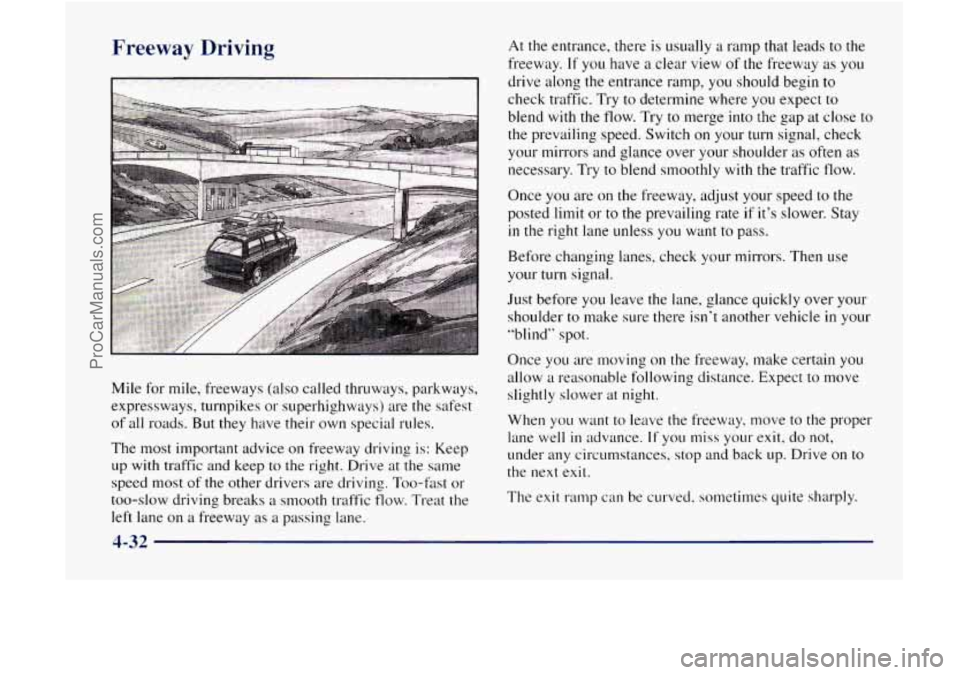
Mile for mile, freeways (also called thruways, parkways,
expressways, turnpikes or superhighways) are the safest
of all roads. But they have their own special rules.
The most important advice
on freeway driving is: Keep
up with traffic and keep to the right. Drive at the same
speed most of the other drivers are driving. Too-fast
or
too-slow driving breaks a smooth traffic flow. Treat the
left lane on a freeway as a passing lane.
At the entrance, there is usually a ramp that leads to the
freeway.
If you have a clear view of the freeway as you
drive along the entrance ramp, you should begin to
check traffic. Try to determine where you expect to
blend with the flow. Try to merge into the gap at close to
the prevailing speed. Switch
on your turn signal, check
your mirrors and glance over your shoulder as often as
necessary. Try to blend smoothly
with the traffic flow.
Once you are on the freeway, adjust your speed
to the
posted limit or to the prevailing rate if it’s slower. Stay
in the right lane unless you want to pass.
Before changing lanes, check your mirrors. Then use
your turn signal.
Just before
you leave the lane, glance quickly over your
shoulder
to make sure there isn’t another vehicle in your
“blind” spot.
Once you are
moving on the freeway, make certain you
allow
a reasonable following distance. Expect to move
slightly slower at night.
When you want to leave the freeway. move to
the proper
lane well
in advance. If you miss your exit, do not,
under any circumstances, stop and back up. Drive on to
the next exit.
The exit ramp can be curved. sometimes quite sharply.
4-32
ProCarManuals.com