steering wheel GMC ENVOY 2006 Owner's Guide
[x] Cancel search | Manufacturer: GMC, Model Year: 2006, Model line: ENVOY, Model: GMC ENVOY 2006Pages: 524, PDF Size: 3.36 MB
Page 329 of 524
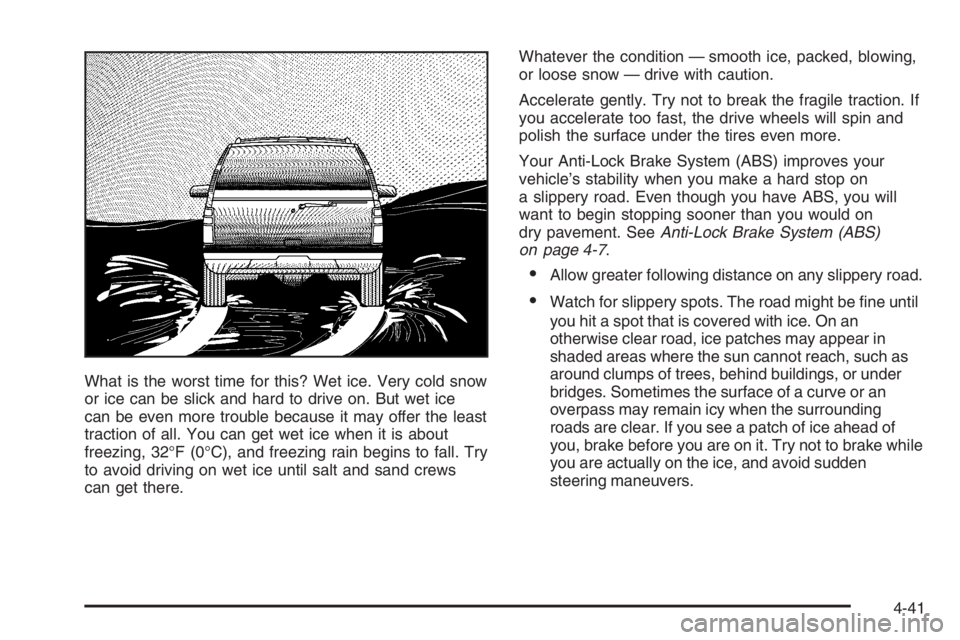
What is the worst time for this? Wet ice. Very cold snow
or ice can be slick and hard to drive on. But wet ice
can be even more trouble because it may offer the least
traction of all. You can get wet ice when it is about
freezing, 32°F (0°C), and freezing rain begins to fall. Try
to avoid driving on wet ice until salt and sand crews
can get there.Whatever the condition — smooth ice, packed, blowing,
or loose snow — drive with caution.
Accelerate gently. Try not to break the fragile traction. If
you accelerate too fast, the drive wheels will spin and
polish the surface under the tires even more.
Your Anti-Lock Brake System (ABS) improves your
vehicle’s stability when you make a hard stop on
a slippery road. Even though you have ABS, you will
want to begin stopping sooner than you would on
dry pavement. SeeAnti-Lock Brake System (ABS)
on page 4-7.
Allow greater following distance on any slippery road.
Watch for slippery spots. The road might be ne until
you hit a spot that is covered with ice. On an
otherwise clear road, ice patches may appear in
shaded areas where the sun cannot reach, such as
around clumps of trees, behind buildings, or under
bridges. Sometimes the surface of a curve or an
overpass may remain icy when the surrounding
roads are clear. If you see a patch of ice ahead of
you, brake before you are on it. Try not to brake while
you are actually on the ice, and avoid sudden
steering maneuvers.
4-41
Page 332 of 524
If Your Vehicle is Stuck in Sand,
Mud, Ice, or Snow
In order to free your vehicle when it is stuck, you will
need to spin the wheels, but you do not want to
spin your wheels too fast. The method known as rocking
can help you get out when you are stuck, but you
must use caution.
{CAUTION:
If you let your tires spin at high speed, they can
explode, and you or others could be injured.
And, the transmission or other parts of the
vehicle can overheat. That could cause an
engine compartment re or other damage.
When you are stuck, spin the wheels as little as
possible. Do not spin the wheels above 35 mph
(55 km/h) as shown on the speedometer.Notice:Spinning your wheels can destroy parts of
your vehicle as well as the tires. If you spin the
wheels too fast while shifting your transmission
back and forth, you can destroy your transmission.
For more information about using tire chains on your
vehicle, seeTire Chains on page 5-71.
Rocking Your Vehicle to Get It Out
First, turn your steering wheel left and right. That
will clear the area around your front wheels. If you have
a four-wheel-drive vehicle, shift into Four-Wheel
High. Then shift back and forth between REVERSE (R)
and a forward gear, spinning the wheels as little as
possible. Release the accelerator pedal while you shift,
and press lightly on the accelerator pedal when the
transmission is in gear. By slowly spinning your wheels
in the forward and reverse directions, you will cause
a rocking motion that may free your vehicle. If that does
not get you out after a few tries, you may need to be
towed out. If you do need to be towed out, seeTowing
Your Vehicle on page 4-50.
4-44
Page 353 of 524
Following Distance
Stay at least twice as far behind the vehicle ahead as
you would when driving your vehicle without a trailer.
This can help you avoid situations that require
heavy braking and sudden turns.
Passing
You’ll need more passing distance up ahead when
you’re towing a trailer. And, because you’re a good deal
longer, you’ll need to go much farther beyond the
passed vehicle before you can return to your lane.
Backing Up
Hold the bottom of the steering wheel with one hand.
Then, to move the trailer to the left, just move that hand
to the left. To move the trailer to the right, move your
hand to the right. Always back up slowly and, if possible,
have someone guide you.
Making Turns
Notice:Making very sharp turns while trailering
could cause the trailer to come in contact with the
vehicle. Your vehicle could be damaged. Avoid
making very sharp turns while trailering.
When you’re turning with a trailer, make wider turns than
normal. Do this so your trailer won’t strike soft shoulders,
curbs, road signs, trees or other objects. Avoid jerky or
sudden maneuvers. Signal well in advance.
Turn Signals When Towing a Trailer
The arrows on your instrument panel will ash whenever
you signal a turn or lane change. Properly hooked up,
the trailer lamps will also ash, telling other drivers
you’re about to turn, change lanes or stop.
When towing a trailer, the arrows on your instrument
panel will ash for turns even if the bulbs on the trailer
are burned out. Thus, you may think drivers behind
you are seeing your signal when they are not. It’s
important to check occasionally to be sure the trailer
bulbs are still working.
4-65
Page 357 of 524
Service............................................................5-3
Accessories and Modications..........................5-3
California Proposition 65 Warning.....................5-3
Doing Your Own Service Work.........................5-4
Adding Equipment to the Outside of
Your Vehicle..............................................5-5
Fuel................................................................5-5
Gasoline Octane............................................5-5
Gasoline Specications....................................5-5
California Fuel...............................................5-6
Additives.......................................................5-6
Fuels in Foreign Countries...............................5-7
Filling the Tank..............................................5-8
Filling a Portable Fuel Container.....................5-10
Checking Things Under the Hood....................5-10
Hood Release..............................................5-11
Engine Compartment Overview.......................5-12
Engine Oil...................................................5-16
Engine Oil Life System..................................5-20
Engine Air Cleaner/Filter................................5-21
Automatic Transmission Fluid.........................5-23
Engine Coolant.............................................5-25
Radiator Pressure Cap..................................5-28
Engine Overheating.......................................5-28
Cooling System............................................5-30
Engine Fan Noise.........................................5-35Power Steering Fluid.....................................5-36
Windshield Washer Fluid................................5-37
Brakes........................................................5-38
Battery........................................................5-41
Jump Starting...............................................5-42
Rear Axle.......................................................5-47
Four-Wheel Drive............................................5-48
Front Axle......................................................5-49
Bulb Replacement..........................................5-50
Halogen Bulbs..............................................5-50
Headlamps, Front Turn Signal, Sidemarker,
and Parking Lamps....................................5-50
Taillamps, Turn Signal, and Stoplamps............5-51
Back-Up Lamps............................................5-52
Replacement Bulbs.......................................5-52
Windshield Wiper Blade Replacement..............5-53
Tires..............................................................5-55
Tire Sidewall Labeling...................................5-56
Tire Terminology and Denitions.....................5-59
Ination - Tire Pressure.................................5-62
Tire Inspection and Rotation...........................5-63
When It Is Time for New Tires.......................5-65
Buying New Tires.........................................5-66
Different Size Tires and Wheels......................5-67
Uniform Tire Quality Grading..........................5-68
Section 5 Service and Appearance Care
5-1
Page 429 of 524
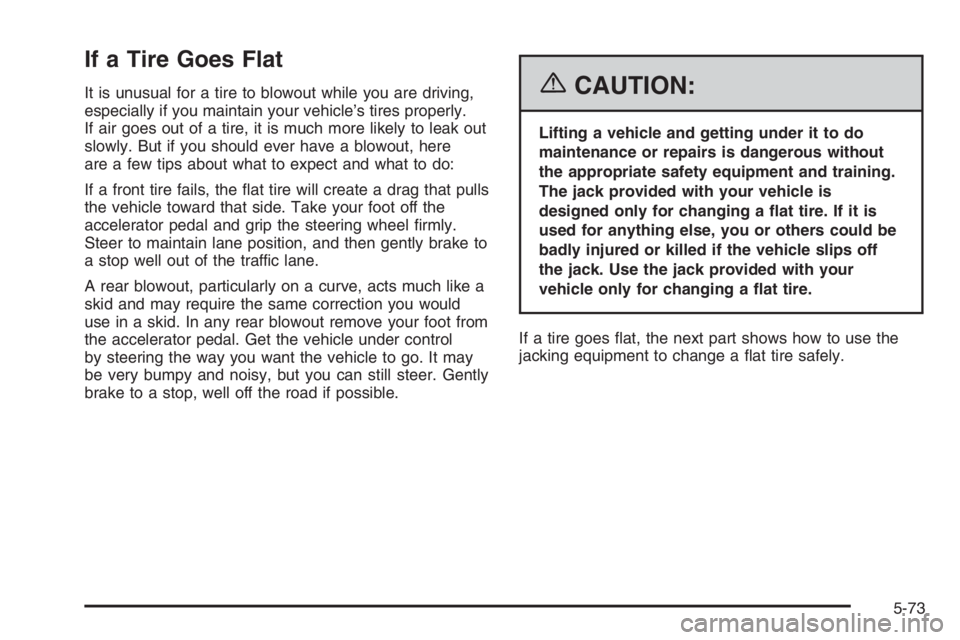
If a Tire Goes Flat
It is unusual for a tire to blowout while you are driving,
especially if you maintain your vehicle’s tires properly.
If air goes out of a tire, it is much more likely to leak out
slowly. But if you should ever have a blowout, here
are a few tips about what to expect and what to do:
If a front tire fails, the at tire will create a drag that pulls
the vehicle toward that side. Take your foot off the
accelerator pedal and grip the steering wheel rmly.
Steer to maintain lane position, and then gently brake to
a stop well out of the traffic lane.
A rear blowout, particularly on a curve, acts much like a
skid and may require the same correction you would
use in a skid. In any rear blowout remove your foot from
the accelerator pedal. Get the vehicle under control
by steering the way you want the vehicle to go. It may
be very bumpy and noisy, but you can still steer. Gently
brake to a stop, well off the road if possible.{CAUTION:
Lifting a vehicle and getting under it to do
maintenance or repairs is dangerous without
the appropriate safety equipment and training.
The jack provided with your vehicle is
designed only for changing a at tire. If it is
used for anything else, you or others could be
badly injured or killed if the vehicle slips off
the jack. Use the jack provided with your
vehicle only for changing a at tire.
If a tire goes at, the next part shows how to use the
jacking equipment to change a at tire safely.
5-73
Page 504 of 524
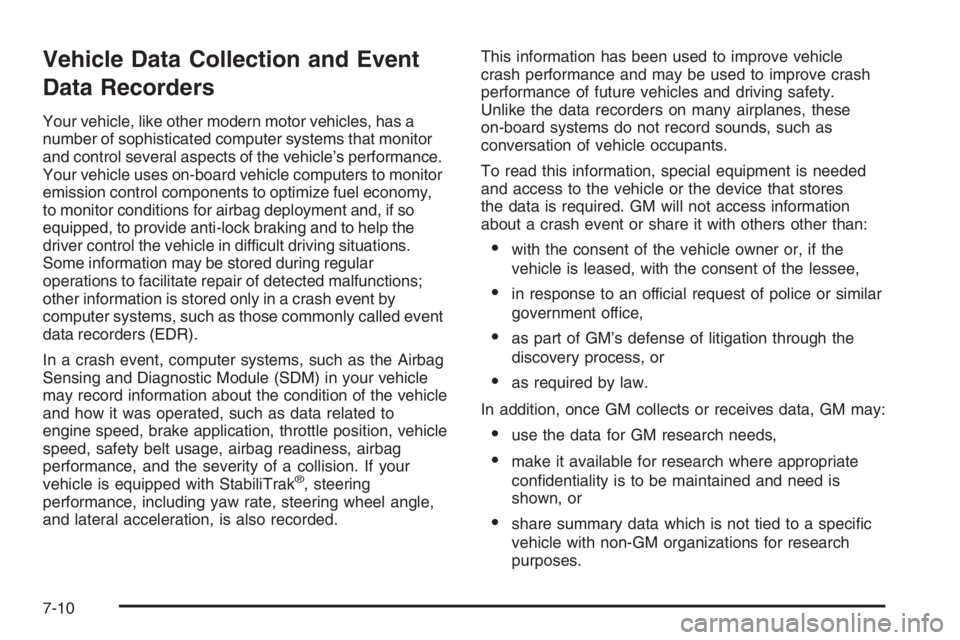
Vehicle Data Collection and Event
Data Recorders
Your vehicle, like other modern motor vehicles, has a
number of sophisticated computer systems that monitor
and control several aspects of the vehicle’s performance.
Your vehicle uses on-board vehicle computers to monitor
emission control components to optimize fuel economy,
to monitor conditions for airbag deployment and, if so
equipped, to provide anti-lock braking and to help the
driver control the vehicle in difficult driving situations.
Some information may be stored during regular
operations to facilitate repair of detected malfunctions;
other information is stored only in a crash event by
computer systems, such as those commonly called event
data recorders (EDR).
In a crash event, computer systems, such as the Airbag
Sensing and Diagnostic Module (SDM) in your vehicle
may record information about the condition of the vehicle
and how it was operated, such as data related to
engine speed, brake application, throttle position, vehicle
speed, safety belt usage, airbag readiness, airbag
performance, and the severity of a collision. If your
vehicle is equipped with StabiliTrak
®, steering
performance, including yaw rate, steering wheel angle,
and lateral acceleration, is also recorded.This information has been used to improve vehicle
crash performance and may be used to improve crash
performance of future vehicles and driving safety.
Unlike the data recorders on many airplanes, these
on-board systems do not record sounds, such as
conversation of vehicle occupants.
To read this information, special equipment is needed
and access to the vehicle or the device that stores
the data is required. GM will not access information
about a crash event or share it with others other than:
with the consent of the vehicle owner or, if the
vehicle is leased, with the consent of the lessee,
in response to an official request of police or similar
government office,
as part of GM’s defense of litigation through the
discovery process, or
as required by law.
In addition, once GM collects or receives data, GM may:
use the data for GM research needs,
make it available for research where appropriate
condentiality is to be maintained and need is
shown, or
share summary data which is not tied to a specic
vehicle with non-GM organizations for research
purposes.
7-10
Page 511 of 524

A
Accessories and Modications............................ 5-3
Accessory Inator...........................................5-71
Accessory Power Outlet(s)...............................3-19
Adding a Snow Plow or Similar Equipment.........4-50
Adding Equipment to Your Airbag-Equipped
Vehicle.......................................................1-72
Additives, Fuel................................................. 5-6
Add-On Electrical Equipment...........................5-102
Adjustable Throttle and Brake Pedal..................2-22
Air Cleaner/Filter, Engine.................................5-21
Air Conditioning......................................3-20, 3-23
Air Suspension...............................................4-55
Airbag
Passenger Status Indicator...........................3-36
Readiness Light..........................................3-35
Airbag Sensing and Diagnostic Module (SDM).......7-10
Airbag System................................................1-58
Adding Equipment to Your Airbag-Equipped
Vehicle...................................................1-72
How Does an Airbag Restrain?......................1-65
Passenger Sensing System...........................1-67
Servicing Your Airbag-Equipped Vehicle..........1-71
What Makes an Airbag Inate?......................1-65
What Will You See After an Airbag Inates?....1-66
When Should an Airbag Inate?....................1-63
Where Are the Airbags?...............................1-61
Antenna, Fixed Mast......................................3-143Antenna, XM™ Satellite Radio Antenna
System.....................................................3-143
Anti-Lock Brake System (ABS)........................... 4-7
Anti-Lock Brake, System Warning Light..............3-40
Appearance Care
Aluminum Wheels........................................5-98
Care of Safety Belts....................................5-95
Chemical Paint Spotting...............................5-99
Cleaning Exterior Lamps/Lenses....................5-96
Cleaning the Inside of Your Vehicle................5-92
Fabric/Carpet..............................................5-94
Finish Care.................................................5-96
Finish Damage............................................5-99
Instrument Panel, Vinyl, and Other
Plastic Surfaces.......................................5-95
Leather......................................................5-94
Sheet Metal Damage...................................5-99
Tires..........................................................5-98
Underbody Maintenance...............................5-99
Vehicle Care/Appearance Materials...............5-100
Washing Your Vehicle...................................5-96
Weatherstrips..............................................5-95
Windshield, Backglass, and Wiper Blades.......5-97
Ashtray(s)......................................................3-20
Audio System(s).............................................3-66
Audio Steering Wheel Controls....................3-139
Care of Your Cassette Tape Player...............3-141
Care of Your CD and DVD Player................3-142
Care of Your CDs and DVDs .......................3-142
1
Page 515 of 524

Electrical System (cont.)
Rear Underseat Fuse Block.........................5-111
Windshield Wiper Fuses.............................5-102
Electronically Controlled Air Suspension
System......................................................4-55
Engine
Air Cleaner/Filter.........................................5-21
Battery.......................................................5-41
Change Engine Oil Light...............................3-46
Check and Service Engine Soon Light............3-42
Coolant......................................................5-25
Coolant Heater............................................2-22
Coolant Temperature Gage...........................3-41
Engine Compartment Overview......................5-12
Exhaust.....................................................2-34
Fan Noise..................................................5-35
Oil .............................................................5-16
Oil Life System...........................................5-20
Overheating................................................5-28
Reduced Power Light...................................3-47
Starting......................................................2-20
Entry Lighting.................................................3-18
Event Data Recorders (EDR)............................7-10
Exit Lighting...................................................3-18
Extender, Safety Belt.......................................1-31F
Filter
Engine Air Cleaner......................................5-21
Finish Damage...............................................5-99
Fixed Mast Antenna.......................................3-143
Flashers, Hazard Warning.................................. 3-6
Flash-to-Pass................................................... 3-8
Flat Tire........................................................5-73
Flat Tire, Changing.........................................5-74
Flat Tire, Storing.............................................5-88
Fluid
Automatic Transmission................................5-23
Power Steering...........................................5-36
Windshield Washer......................................5-37
Fog Lamps ....................................................3-17
Four-Wheel Drive....................................2-27, 5-48
Front Axle......................................................5-49
Fuel............................................................... 5-5
Additives...................................................... 5-6
California Fuel.............................................. 5-6
Check Gas Cap Light...................................3-49
Filling a Portable Fuel Container....................5-10
Filling Your Tank........................................... 5-8
Fuels in Foreign Countries.............................. 5-7
Gage .........................................................3-49
Gasoline Octane........................................... 5-5
Gasoline Specications.................................. 5-5
Low Warning Light.......................................3-49
5
Page 522 of 524
Service (cont.)
Doing Your Own Work................................... 5-4
Engine Soon Light.......................................3-42
Four-Wheel-Drive Warning Light.....................3-48
Publications Ordering Information...................7-15
Servicing Your Airbag-Equipped Vehicle..............1-71
Setting the Time.............................................3-68
Sheet Metal Damage.......................................5-99
Shifting Into Park (P).......................................2-32
Shifting Out of Park (P)...................................2-33
Signals, Turn and Lane-Change.......................... 3-7
Snow Plow....................................................4-50
Spare Tire.....................................................5-92
Accessory Inator........................................5-71
Installing....................................................5-78
Removing...................................................5-75
Storing.......................................................5-88
Specications, Capacities...............................5-119
Speedometer..................................................3-33
StabiliTrak
®System.......................................... 4-9
StabiliTrak®Indicator Light................................3-41
StabiliTrak®Service Light.................................3-40
Starting Your Engine.......................................2-20
Steering........................................................4-14
Steering Wheel Controls, Audio.......................3-139
Steering Wheel, Tilt Wheel................................. 3-6
Storage Areas
Center Console Storage Area........................2-56
Convenience Net.........................................2-60
Glove Box..................................................2-56Storage Areas (cont.)
Luggage Carrier..........................................2-57
Overhead Console.......................................2-56
Rear Compartment Storage Panel/Cover.........2-58
Rear Floor Storage Lid.................................2-60
Stuck in Sand, Mud, Ice, or Snow.....................4-44
Sun Visors.....................................................2-16
Sunroof.........................................................2-62
Suspension....................................................4-55
TTachometer....................................................3-33
Taillamps
Turn Signal, and Stoplamps..........................5-51
Theft-Deterrent, Radio....................................3-139
Theft-Deterrent Systems...................................2-17
Content Theft-Deterrent................................2-17
Passlock
®...................................................2-18
Throttle, Adjustable..........................................2-22
Tilt Wheel........................................................ 3-6
Tires.............................................................5-55
Aluminum Wheels, Cleaning..........................5-98
Buying New Tires........................................5-66
Chains.......................................................5-71
Changing a Flat Tire....................................5-74
Cleaning....................................................5-98
Different Size..............................................5-67
If a Tire Goes Flat.......................................5-73
Ination - Tire Pressure................................5-62
12