warning GMC ENVOY 2007 User Guide
[x] Cancel search | Manufacturer: GMC, Model Year: 2007, Model line: ENVOY, Model: GMC ENVOY 2007Pages: 562, PDF Size: 3 MB
Page 184 of 562
Electric Power Management
This vehicle has Electric Power
Management (EPM), an advanced control
system. It estimates the battery’s temperature
and state of charge and then adjusts the voltage
for best performance and extended life of
the battery.
When the battery’s state of charge is low, the
voltage is raised slightly to quickly put the charge
back in. When the state of charge is high, the
voltage is lowered slightly to prevent overcharging.
If the vehicle has a voltmeter gage, you may
see the voltage move up or down. This is normal.
If there is a problem, an alert will be displayed.
The battery can be discharged at idle if the
electrical loads are very high. This is true for all
vehicles. This is because the generator (alternator)
may not be spinning fast enough at idle to
produce all the power that is needed for very high
electrical loads.A high electrical load occurs when several of the
following loads are on: headlamps, high beams,
fog lamps, rear window defogger, climate
control fan at high speed, heated seats, engine
cooling fans, trailer loads, and loads plugged into
accessory power outlets.
EPM works to prevent excessive discharge of the
battery. It does this by balancing the generator’s
output and the vehicle’s electrical needs. It
can increase engine idle speed to generate more
power, whenever needed. It can temporarily
reduce the power demands of some accessories.
Normally, these actions occur in steps or levels,
without being noticeable. In rare cases at the
highest levels of corrective action, this action may
be noticeable to the driver. If so, a Driver
Information Center (DIC) message might be
displayed, such as Battery Saver Active or Battery
Voltage Low. If this message is displayed, it is
recommended that the driver reduce the electrical
loads as much as possible. SeeDIC Warnings
and Messages on page 222.
184
Page 197 of 562
Warning Lights, Gages, and
Indicators
This part describes the warning lights and gages
that may be on your vehicle. The pictures will
help you locate them.
Warning lights and gages can signal that
something is wrong before it becomes serious
enough to cause an expensive repair or
replacement. Paying attention to your warning
lights and gages could also save you or others
from injury.
Warning lights come on when there may be or is
a problem with one of your vehicle’s functions.
As you will see in the details on the next few
pages, some warning lights come on briey when
you start the engine just to let you know they’re
working. If you are familiar with this section,
you should not be alarmed when this happens.Gages can indicate when there may be or is a
problem with one of your vehicle’s functions. Often
gages and warning lights work together to let you
know when there’s a problem with your vehicle.
When one of the warning lights comes on and
stays on when you are driving, or when one of the
gages shows there may be a problem, check
the section that tells you what to do about
it. Please follow this manual’s advice.
Waiting to do repairs can be costly—and even
dangerous. So please get to know your warning
lights and gages. They’re a big help.
Your vehicle may also have a Driver Information
Center (DIC) that works along with the warning
lights and gages. SeeDriver Information
Center (DIC) on page 218.
197
Page 205 of 562
Charging System Light
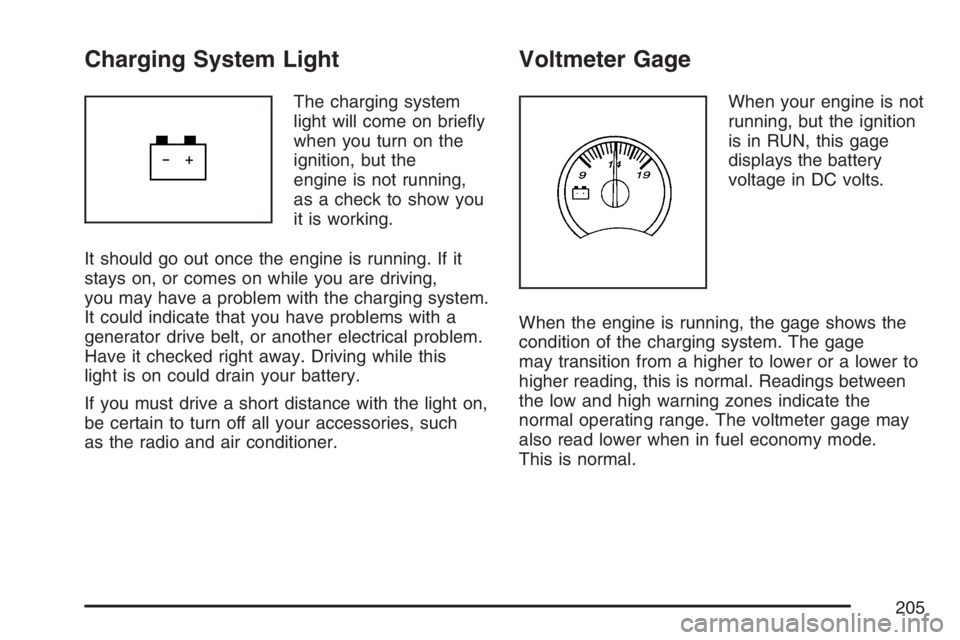
The charging system
light will come on briey
when you turn on the
ignition, but the
engine is not running,
as a check to show you
it is working.
It should go out once the engine is running. If it
stays on, or comes on while you are driving,
you may have a problem with the charging system.
It could indicate that you have problems with a
generator drive belt, or another electrical problem.
Have it checked right away. Driving while this
light is on could drain your battery.
If you must drive a short distance with the light on,
be certain to turn off all your accessories, such
as the radio and air conditioner.
Voltmeter Gage
When your engine is not
running, but the ignition
is in RUN, this gage
displays the battery
voltage in DC volts.
When the engine is running, the gage shows the
condition of the charging system. The gage
may transition from a higher to lower or a lower to
higher reading, this is normal. Readings between
the low and high warning zones indicate the
normal operating range. The voltmeter gage may
also read lower when in fuel economy mode.
This is normal.
205
Page 206 of 562
Readings in the low warning zone may occur
when a large number of electrical accessories are
operating in the vehicle and the engine is left
idling for an extended period. This condition
is normal since the charging system is not able to
provide full power at engine idle. As engine
speeds are increased, this condition should correct
itself as higher engine speeds allow the charging
system to create maximum power.
You can only drive for a short time with the
reading in either warning zone. If you must drive,
turn off all unnecessary accessories.
Readings in either warning zone indicate a
possible problem in the electrical system. Have
the vehicle serviced as soon as possible.
Brake System Warning Light
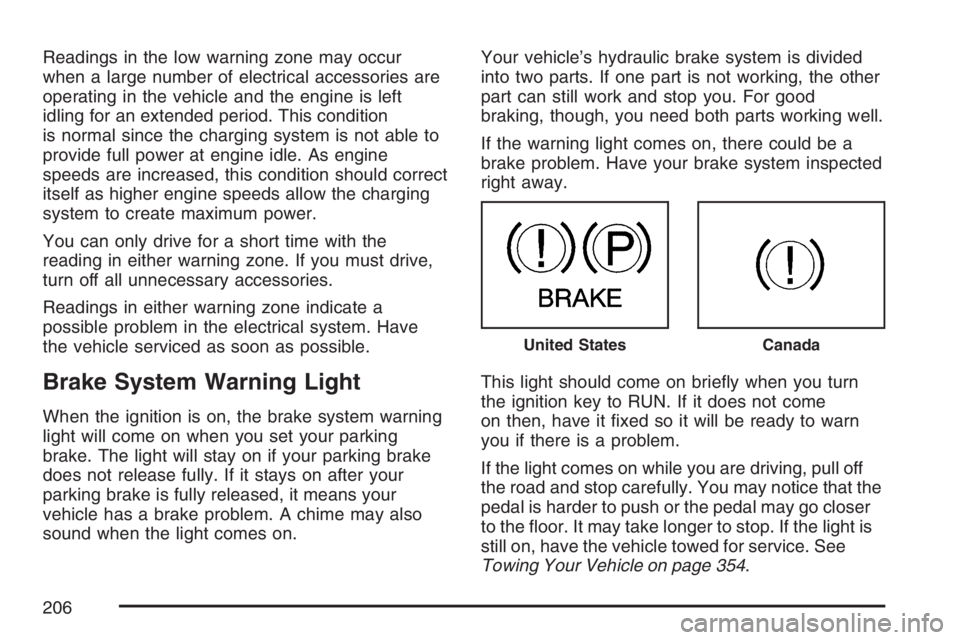
When the ignition is on, the brake system warning
light will come on when you set your parking
brake. The light will stay on if your parking brake
does not release fully. If it stays on after your
parking brake is fully released, it means your
vehicle has a brake problem. A chime may also
sound when the light comes on.Your vehicle’s hydraulic brake system is divided
into two parts. If one part is not working, the other
part can still work and stop you. For good
braking, though, you need both parts working well.
If the warning light comes on, there could be a
brake problem. Have your brake system inspected
right away.
This light should come on briey when you turn
the ignition key to RUN. If it does not come
on then, have it xed so it will be ready to warn
you if there is a problem.
If the light comes on while you are driving, pull off
the road and stop carefully. You may notice that the
pedal is harder to push or the pedal may go closer
to the oor. It may take longer to stop. If the light is
still on, have the vehicle towed for service. See
Towing Your Vehicle on page 354.
United StatesCanada
206
Page 207 of 562

{CAUTION:
Your brake system may not be working
properly if the brake system warning light
is on. Driving with the brake system
warning light on can lead to an accident.
If the light is still on after you have pulled
off the road and stopped carefully, have
the vehicle towed for service.
Anti-Lock Brake System
Warning Light
With the Anti-Lock
Brake System (ABS),
this light will come
on when you start your
engine and may
stay on for several
seconds, that is normal.
A chime may also sound when the light comes on.If the light stays on, or comes on when you are
driving, your vehicle needs service. If the regular
brake system warning light is not on, you still have
brakes, but you do not have anti-lock brakes. If the
regular brake system warning light is also on, you
do not have anti-lock brakes and there is a problem
with your regular brakes. SeeBrake System
Warning Light on page 206earlier in this section.
The ABS warning light should come on briey
when you turn the ignition key to RUN. If the light
does not come on then, have it xed so it will
be ready to warn you if there is a problem.
StabiliTrak®Service Light
This light will come on
briey when the engine
is started.
This light will come on if a problem is detected in
the StabiliTrak
®system.
For more information seeStabiliTrak
®System on
page 309.
207
Page 208 of 562

StabiliTrak®Indicator Light
This warning light
should come on briey
when the engine is
started.
During most driving conditions, this light will not
come on. If the StabiliTrak
®System is actively
controlling the stability and/or traction of the
vehicle, this light will ash. This is normal.
This light will come on if any portion of the system
has been manually turned off or a problem is
detected in the system.
If your vehicle has a Driver Information Center, a
message will appear also, seeDIC Warnings
and Messages on page 222andStabiliTrak
®
System on page 309for more information.
Engine Coolant Temperature Gage
This gage shows the engine coolant temperature.
If the gage pointer moves into the red area, it
means that the engine coolant has overheated.
If you have been operating your vehicle under
normal driving conditions, you should pull off the
road, stop your vehicle and turn off the engine
as soon as possible.
SeeEngine Overheating on page 408for more
information.
United StatesCanada
208
Page 209 of 562
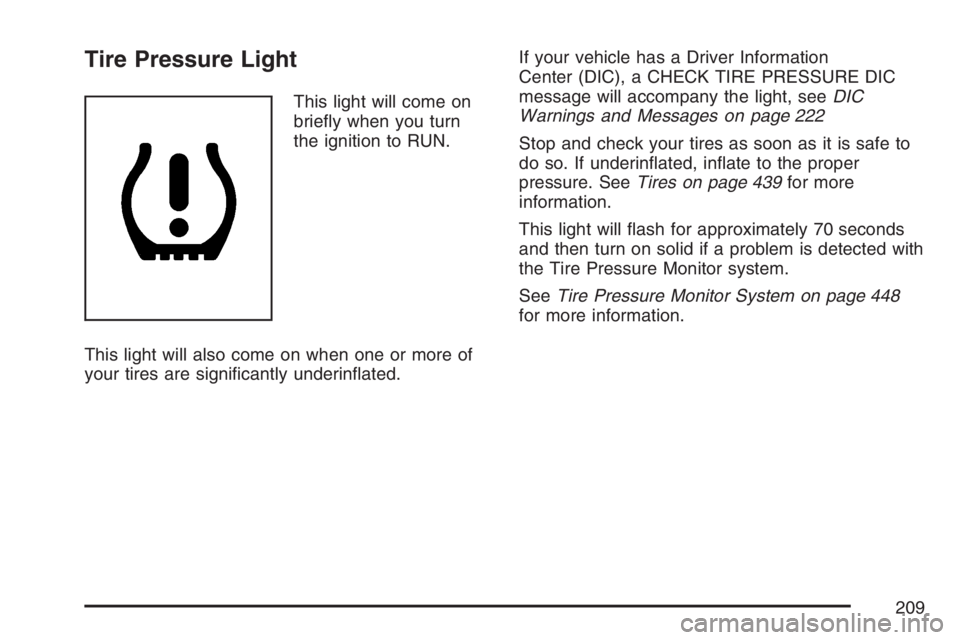
Tire Pressure Light
This light will come on
briey when you turn
the ignition to RUN.
This light will also come on when one or more of
your tires are signicantly underinated.If your vehicle has a Driver Information
Center (DIC), a CHECK TIRE PRESSURE DIC
message will accompany the light, seeDIC
Warnings and Messages on page 222
Stop and check your tires as soon as it is safe to
do so. If underinated, inate to the proper
pressure. SeeTires on page 439for more
information.
This light will ash for approximately 70 seconds
and then turn on solid if a problem is detected with
the Tire Pressure Monitor system.
SeeTire Pressure Monitor System on page 448
for more information.
209
Page 215 of 562
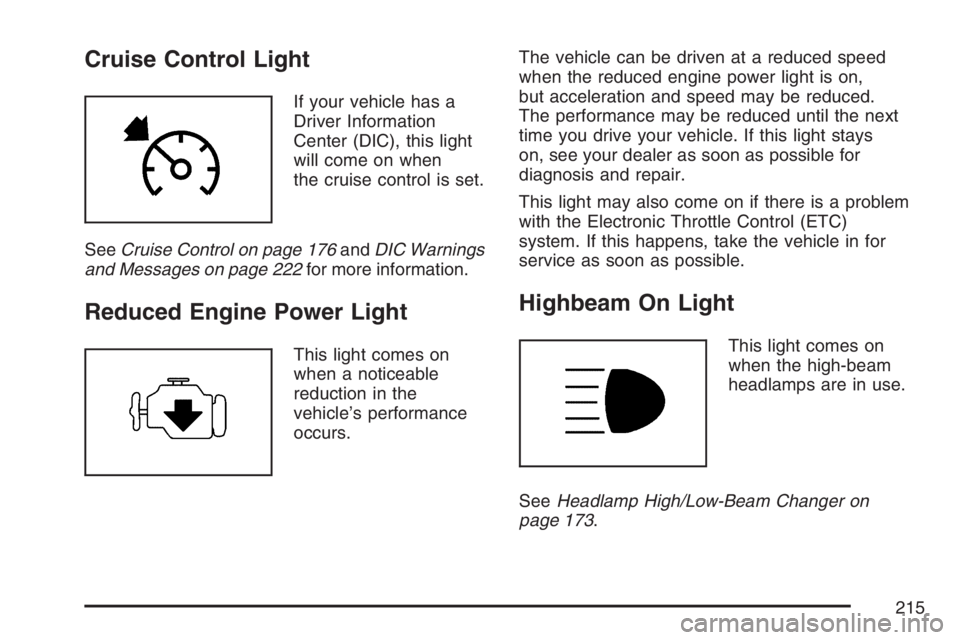
Cruise Control Light
If your vehicle has a
Driver Information
Center (DIC), this light
will come on when
the cruise control is set.
SeeCruise Control on page 176andDIC Warnings
and Messages on page 222for more information.
Reduced Engine Power Light
This light comes on
when a noticeable
reduction in the
vehicle’s performance
occurs.The vehicle can be driven at a reduced speed
when the reduced engine power light is on,
but acceleration and speed may be reduced.
The performance may be reduced until the next
time you drive your vehicle. If this light stays
on, see your dealer as soon as possible for
diagnosis and repair.
This light may also come on if there is a problem
with the Electronic Throttle Control (ETC)
system. If this happens, take the vehicle in for
service as soon as possible.
Highbeam On Light
This light comes on
when the high-beam
headlamps are in use.
SeeHeadlamp High/Low-Beam Changer on
page 173.
215
Page 216 of 562

Service Four-Wheel Drive
Warning Light
This light should come
on briey when you turn
on the ignition, as a
check to show you
it is working.
The service four-wheel drive light comes on to
indicate that there may be a problem with the drive
system and service is required. Malfunctions
can be indicated by the system before any problem
is apparent, which may prevent serious damage
to the vehicle. This system is also designed
to assist your dealer in correctly diagnosing a
malfunction.
Check Gages Warning Light
The check gages light
will come on briey
when you are starting
the engine.
If the light comes on and stays on while you are
driving, check your coolant temperature and
engine oil pressure gages to see if they are in the
warning zones.
Gate Ajar Light
If this light comes on,
the liftgate or liftglass is
not completely shut.
Close the liftgate or liftglass. Never drive with the
liftgate or liftglass even partially open.
216
Page 217 of 562

Fuel Gage
When the ignition is on, the fuel gage tells you
about how much fuel you have remaining.
Here are four things that some owners ask about.
None of these show a problem with your fuel gage:
At the gas station, the gas pump shuts off
before the gage reads full.
It takes a little more or less fuel to ll up than
the gage indicated. For example, the gage may
have indicated the tank was half full, but it
actually took a little more or less than half the
tank’s capacity to ll the tank.
The gage moves a little when you turn a corner
or speed up.
The gage doesn’t go back to empty when you
turn off the ignition.
Low Fuel Warning Light
The light next to the fuel gage will come on briey
when you are starting the engine.
This light comes on when the fuel tank is low on
fuel. To turn it off, add fuel to the fuel tank.
SeeFuel on page 382.
Check Gas Cap Light
If your vehicle has this
light, it will come on if
your gas cap is not
securely fastened.
SeeMalfunction Indicator Lamp on page 210for
more information.
United StatesCanada
217