seats GMC ENVOY 2007 Owner's Guide
[x] Cancel search | Manufacturer: GMC, Model Year: 2007, Model line: ENVOY, Model: GMC ENVOY 2007Pages: 562, PDF Size: 3 MB
Page 89 of 562
Adding Equipment to Your
Airbag-Equipped Vehicle
Q:Is there anything I might add to the front
or sides of the vehicle that could keep the
airbags from working properly?
A:Yes. If you add things that change your
vehicle’s frame, bumper system, height,
front end or side sheet metal, they may keep
the airbag system from working properly.
Also, the airbag system may not work properly
if you relocate any of the airbag sensors.
If you have any questions about this,
you should contact Customer Assistance
before you modify your vehicle. The phone
numbers and addresses for Customer
Assistance are in Step Two of the Customer
Satisfaction Procedure in this manual.
SeeCustomer Satisfaction Procedure
on page 526.
Q:Because I have a disability, I have to get
my vehicle modied. How can I nd out
whether this will affect my airbag system?
A:Changing or moving any parts of the
front seats, safety belts, the airbag sensing
and diagnostic module, steering wheel,
instrument panel, the inside review mirror,
ceiling headliner, ceiling and pillar garnish trim,
roof-mounted airbag modules, or airbag
wiring can affect the operation of the airbag
system. If you have questions, call Customer
Assistance. The phone numbers and
addresses for Customer Assistance are
in Step Two of the Customer Satisfaction
Procedure in this manual. SeeCustomer
Satisfaction Procedure on page 526.
89
Page 126 of 562
Parking Brake
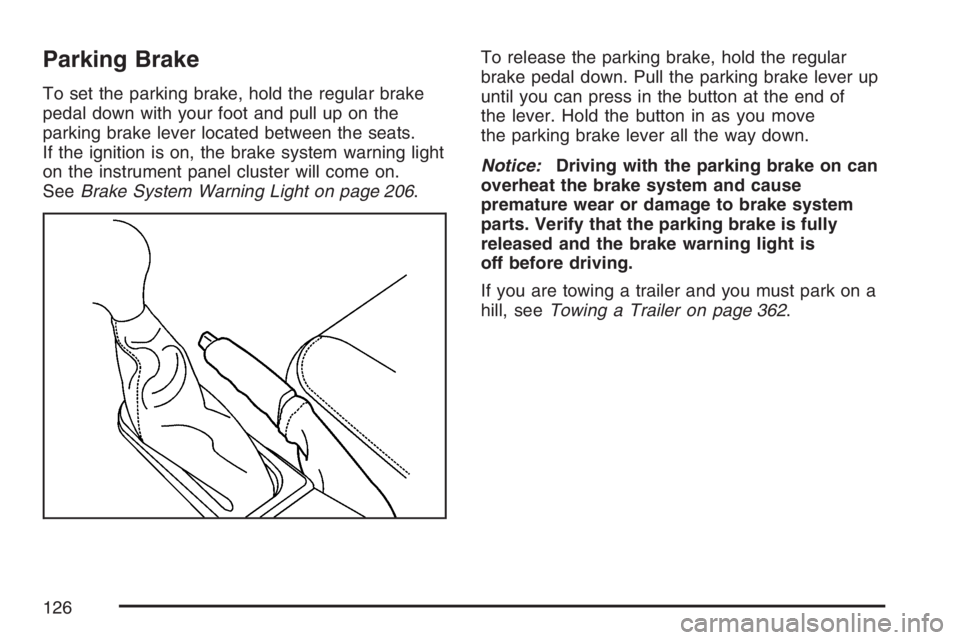
To set the parking brake, hold the regular brake
pedal down with your foot and pull up on the
parking brake lever located between the seats.
If the ignition is on, the brake system warning light
on the instrument panel cluster will come on.
SeeBrake System Warning Light on page 206.To release the parking brake, hold the regular
brake pedal down. Pull the parking brake lever up
until you can press in the button at the end of
the lever. Hold the button in as you move
the parking brake lever all the way down.
Notice:Driving with the parking brake on can
overheat the brake system and cause
premature wear or damage to brake system
parts. Verify that the parking brake is fully
released and the brake warning light is
off before driving.
If you are towing a trailer and you must park on a
hill, seeTowing a Trailer on page 362.
126
Page 184 of 562
Electric Power Management
This vehicle has Electric Power
Management (EPM), an advanced control
system. It estimates the battery’s temperature
and state of charge and then adjusts the voltage
for best performance and extended life of
the battery.
When the battery’s state of charge is low, the
voltage is raised slightly to quickly put the charge
back in. When the state of charge is high, the
voltage is lowered slightly to prevent overcharging.
If the vehicle has a voltmeter gage, you may
see the voltage move up or down. This is normal.
If there is a problem, an alert will be displayed.
The battery can be discharged at idle if the
electrical loads are very high. This is true for all
vehicles. This is because the generator (alternator)
may not be spinning fast enough at idle to
produce all the power that is needed for very high
electrical loads.A high electrical load occurs when several of the
following loads are on: headlamps, high beams,
fog lamps, rear window defogger, climate
control fan at high speed, heated seats, engine
cooling fans, trailer loads, and loads plugged into
accessory power outlets.
EPM works to prevent excessive discharge of the
battery. It does this by balancing the generator’s
output and the vehicle’s electrical needs. It
can increase engine idle speed to generate more
power, whenever needed. It can temporarily
reduce the power demands of some accessories.
Normally, these actions occur in steps or levels,
without being noticeable. In rare cases at the
highest levels of corrective action, this action may
be noticeable to the driver. If so, a Driver
Information Center (DIC) message might be
displayed, such as Battery Saver Active or Battery
Voltage Low. If this message is displayed, it is
recommended that the driver reduce the electrical
loads as much as possible. SeeDIC Warnings
and Messages on page 222.
184
Page 194 of 562
Rear Window Defogger
If your vehicle has the rear window defogger a
warming grid is used to remove fog from the
rear window.
<(Rear):Press this button to turn the rear
window defogger on or off.
An indicator light in the button will come on
to let you know that the rear window defogger
is activated.
The rear window defogger will turn off
approximately 10 minutes after the button is
pressed. If you need additional warming time,
press the button again.
If your vehicle has heated mirrors, they will come
on when this button is pressed.
Notice:Do not use a razor blade or sharp
object to clear the inside rear window. Do not
adhere anything to the defogger grid lines
in the rear glass. These actions may damage
the rear defogger. Repairs would not be
covered by your warranty.
Outlet Adjustment
Use the air outlets located in the center and on the
side of the instrument panel to direct the airow.
Operation Tips
Keep the hood and front air inlets free of ice,
snow, or any other obstruction, such as
leaves. The heater and defroster will work
better, reducing the chance of fogging
the inside of your windows.
When you enter a vehicle in cold weather, set
the fan speed to maximum airow for a few
moments before driving. This helps clear
the intake ducts of snow and moisture, and
reduces the chance of fogging the inside
of your windows.
Keep the air path under the front seats clear
of objects. This helps air to circulate
throughout your vehicle.
Adding outside equipment to the front of the
vehicle, such as hood-air deectors, may
affect the performance of the heating and air
conditioning system. Check with your
dealer before adding equipment to the outside
of your vehicle.
194
Page 354 of 562
If you put things inside your vehicle — like
suitcases, tools, packages, or anything
else — they will go as fast as the vehicle goes.
If you have to stop or turn quickly, or if there is a
crash, they will keep going.
{CAUTION:
Things you put inside your vehicle can
strike and injure people in a sudden stop
or turn, or in a crash.
Put things in the cargo area of your
vehicle. Try to spread the weight
evenly.
Never stack heavier things, like
suitcases, inside the vehicle so that
some of them are above the tops of
the seats.
Do not leave an unsecured child
restraint in your vehicle.
When you carry something inside the
vehicle, secure it whenever you can.
Do not leave a seat folded down
unless you need to.There is also important loading information for
off-road driving in this manual. See “Loading Your
Vehicle for Off-Road Driving” underOff-Road
Driving on page 319.
Adding a Snow Plow or Similar
Equipment
Your vehicle was neither designed nor intended
for a snow plow.
Notice:Adding a snow plow or similar
equipment to your vehicle can damage it, and
the repairs would not be covered by warranty.
Do not install a snow plow or similar
equipment on your vehicle.
Towing
Towing Your Vehicle
Consult your dealer or a professional towing
service if you need to have your disabled vehicle
towed. SeeRoadside Assistance Program on
page 532.
354
Page 444 of 562
Tire Terminology and Denitions
Air Pressure:The amount of air inside the tire
pressing outward on each square inch of the
tire. Air pressure is expressed in pounds
per square inch (psi) or kilopascal (kPa).
Accessory Weight:This means the combined
weight of optional accessories. Some examples of
optional accessories are, automatic transmission/
transaxle, power steering, power brakes, power
windows, power seats, and air conditioning.
Aspect Ratio:The relationship of a tire’s height
to its width.
Belt:A rubber coated layer of cords that is
located between the plies and the tread. Cords
may be made from steel or other reinforcing
materials.
Bead:The tire bead contains steel wires wrapped
by steel cords that hold the tire onto the rim.
Bias Ply Tire:A pneumatic tire in which the plies
are laid at alternate angles less than 90 degrees
to the centerline of the tread.Cold Tire Pressure:The amount of air pressure
in a tire, measured in pounds per square inch
(psi) or kilopascals (kPa) before a tire has built up
heat from driving. SeeInation - Tire Pressure
on page 447.
Curb Weight:This means the weight of a motor
vehicle with standard and optional equipment
including the maximum capacity of fuel, oil, and
coolant, but without passengers and cargo.
DOT Markings:A code molded into the sidewall
of a tire signifying that the tire is in compliance
with the U.S. Department of Transportation (DOT)
motor vehicle safety standards. The DOT code
includes the Tire Identication Number (TIN),
an alphanumeric designator which can also identify
the tire manufacturer, production plant, brand,
and date of production.
GVWR:Gross Vehicle Weight Rating. See
Loading Your Vehicle on page 349.
GAWR FRT:Gross Axle Weight Rating for the
front axle. SeeLoading Your Vehicle on page 349.
GAWR RR:Gross Axle Weight Rating for the
rear axle. SeeLoading Your Vehicle on page 349.
444
Page 500 of 562
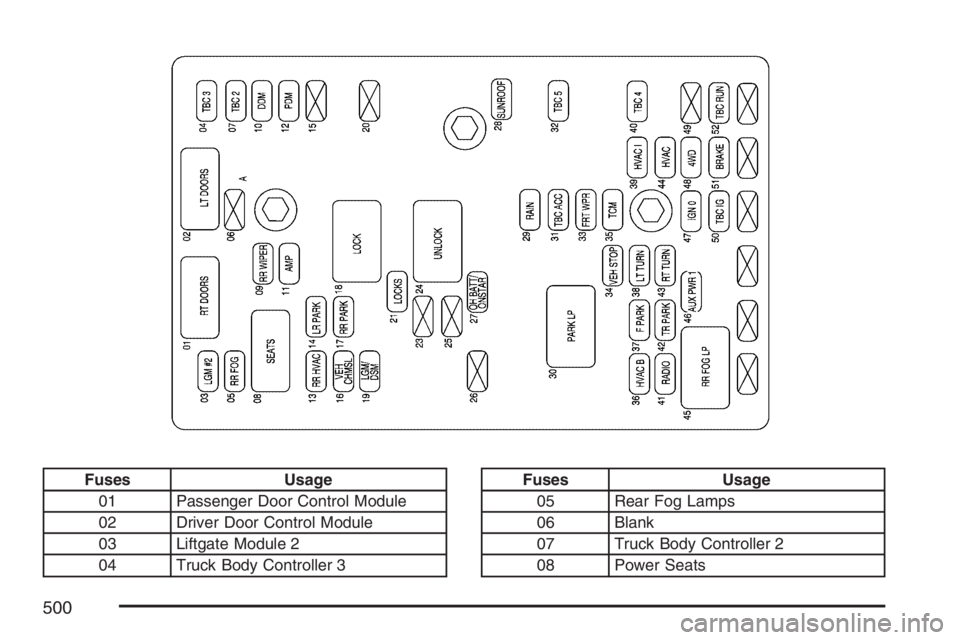
Fuses Usage
01 Passenger Door Control Module
02 Driver Door Control Module
03 Liftgate Module 2
04 Truck Body Controller 3Fuses Usage
05 Rear Fog Lamps
06 Blank
07 Truck Body Controller 2
08 Power Seats
500
Page 518 of 562

Usage Fluid/Lubricant
Front and
Rear AxleSAE 75W-90 Synthetic
Axle Lubricant
(GM Part No. U.S. 12378261,
in Canada 10953455) meeting
GM Specication 9986115.
Transfer CaseAUTO-TRAK II Fluid
(GM Part No. U.S. 12378508,
in Canada 10953626).
Rear Driveline
Center Spline
and Universal
JointsChassis Lubricant
(GM Part No. U.S. 12377985, in
Canada 88901242) or lubricant
meeting requirements of NLGI #2,
Category LB or GC-LB.
Constant
Velocity
Universal JointChassis Lubricant
(GM Part No. U.S. 12377985, in
Canada 88901242) or lubricant
meeting requirements of NLGI #2,
Category LB or GC-LB.
Hood Latch
Assembly,
Secondary
Latch, Pivots,
Spring
Anchor, and
Release PawlLubriplate Lubricant Aerosol
(GM Part No. U.S. 12346293,
in Canada 992723) or lubricant
meeting requirements of NLGI #2,
Category LB or GC-LB.Usage Fluid/Lubricant
Hood and Door
Hinges, Body
Door Hinge
Pins, Liftgate
Hinge and
Linkage,
Folding Seats,
and Fuel
Door HingeMulti-Purpose Lubricant, Superlube
(GM Part No. U.S. 12346241,
in Canada 10953474).
Outer Tailgate
Handle Pivot
Points and
HingesMulti-Purpose Lubricant, Superlube
(GM Part No. U.S. 12346241,
in Canada 10953474).
Weatherstrip
ConditioningWeatherstrip Lubricant
(GM Part No. U.S. 3634770,
in Canada 10953518) or
Dielectric Silicone Grease
(GM Part No. U.S. 12345579,
in Canada 992887).
Weatherstrip
SqueaksSynthetic Grease with
Teon, Superlube
(GM Part No. U.S. 12371287,
in Canada 10953437).
518
Page 553 of 562

G
Gage
Check Gages Warning Light..................... 216
Engine Coolant Temperature.................... 208
Fuel......................................................... 217
Oil Pressure............................................. 213
Speedometer........................................... 199
Tachometer.............................................. 199
Voltmeter Gage........................................ 205
Garage Door Opener..........................149, 150
Gasoline
Octane..................................................... 382
Specications........................................... 383
Gate Ajar Light............................................ 216
Glove Box................................................... 160
GM Mobility Reimbursement Program.......... 531
H
Hazard Warning Flashers............................ 170
Head Restraints............................................ 17
Headlamps.........................................179, 431
Automatic Headlamp System.................... 181
Bulb Replacement.................................... 430
Daytime Running Lamps.......................... 180Headlamps (cont.)
Electrical System..................................... 492
Flash-to-Pass........................................... 173
Front Turn Signal, Sidemarker and
Parking Lamps..................................... 432
Halogen Bulbs......................................... 430
High/Low Beam Changer......................... 173
On Reminder........................................... 180
Washer.................................................... 175
Heated Seats................................................ 11
Heater......................................................... 186
Heater......................................................... 189
Highbeam On Light..................................... 215
Highway Hypnosis....................................... 341
Hill and Mountain Roads............................. 342
Hood
Checking Things Under............................ 388
Release................................................... 388
Horn............................................................ 170
How to Use This Manual ................................ 4
How to Wear Safety Belts Properly............... 26
553
Page 555 of 562

Light (cont.)
Service Four-Wheel-Drive
Warning Light....................................... 216
StabiliTrak
®Indicator................................ 208
StabiliTrak®Service.................................. 207
Tire Pressure........................................... 209
Lighting
Entry........................................................ 183
Exit.......................................................... 183
Loading Your Vehicle................................... 349
Locking Rear Axle....................................... 309
Lockout Protection....................................... 105
Locks
Delayed Locking...................................... 102
Door........................................................ 100
Lockout Protection................................... 105
Power Door............................................. 101
Programmable Automatic Door Locks....... 102
Rear Door Security Locks........................ 105
Loss of Control........................................... 318
Low Fuel Warning Light............................... 217
Luggage Carrier.......................................... 161
Lumbar
Manual Controls......................................... 10
Power Controls.......................................... 10
M
Maintenance Schedule
Additional Required Services.................... 510
At Each Fuel Fill...................................... 513
At Least Once a Month............................ 514
At Least Once a Year .............................. 514
Introduction.............................................. 504
Maintenance Footnotes............................ 511
Maintenance Record................................ 521
Maintenance Requirements...................... 504
Normal Maintenance
Replacement Parts............................... 519
Owner Checks and Services.................... 513
Recommended Fluids and Lubricants....... 517
Scheduled Maintenance........................... 507
Using....................................................... 505
Your Vehicle and the Environment............ 505
Malfunction Indicator Light........................... 210
Manual Lumbar Controls............................... 10
Manual Seats.................................................. 8
Memory Seat, Mirrors, and Pedals................ 12
Message
DIC Warnings and Messages................... 222
555