automatic transmission GMC ENVOY 2009 Owner's Manual
[x] Cancel search | Manufacturer: GMC, Model Year: 2009, Model line: ENVOY, Model: GMC ENVOY 2009Pages: 474, PDF Size: 2.56 MB
Page 77 of 474

Keys...............................................................2-3
Remote Keyless Entry (RKE) System................2-4
Remote Keyless Entry (RKE) System
Operation...................................................2-5
Doors and Locks.............................................2-7
Door Locks....................................................2-7
Power Door Locks..........................................2-8
Delayed Locking.............................................2-8
Programmable Automatic Door Locks................2-9
Rear Door Security Locks..............................2-11
Lockout Protection........................................2-11
Liftgate/Liftglass............................................2-12
Windows........................................................2-13
Power Windows............................................2-14
Sun Visors...................................................2-15
Theft-Deterrent Systems..................................2-16
Content Theft-Deterrent.................................2-16
Passlock
®(U.S. Only)...................................2-17
PASS-Key®III+ Electronic Immobilizer.............2-18
PASS-Key®III+ Electronic Immobilizer
Operation (Canada Only)............................2-18Starting and Operating Your Vehicle................2-20
New Vehicle Break-In....................................2-20
Ignition Positions..........................................2-21
Retained Accessory Power (RAP)...................2-22
Starting the Engine.......................................2-22
Adjustable Throttle and Brake Pedal................2-23
Engine Coolant Heater..................................2-24
Active Fuel Management™.............................2-25
Automatic Transmission Operation...................2-25
Four-Wheel Drive..........................................2-28
Parking Brake..............................................2-33
Shifting Into Park..........................................2-34
Shifting Out of Park......................................2-36
Parking Over Things That Burn.......................2-36
Engine Exhaust............................................2-37
Running the Vehicle While Parked..................2-38
Mirrors...........................................................2-39
Manual Rearview Mirror.................................2-39
Automatic Dimming Rearview Mirror................2-39
Compass.....................................................2-40
Outside Manual Mirrors..................................2-41
Outside Power Mirrors...................................2-42
Outside Convex Mirror...................................2-42
Outside Heated Mirrors..................................2-42
Section 2 Features and Controls
2-1
Page 85 of 474
Programming Delayed Locking
To turn the delayed locking feature on or off, do the
following:
1. Press and hold the power door lock switch on the
driver’s door in the lock position.
2. Press the remote keyless entry transmitter unlock
button twice.
If the delayed locking feature was on, it will now be off.
If the feature was off, it will now be on.
Programmable Automatic Door
Locks
Your vehicle is equipped with an automatic lock/unlock
feature which enables you to program your vehicle’s
power door locks. You can program this feature through
the Driver Information Center (DIC), or by the following
method. SeeDIC Vehicle Customization on page 3-56.
Programmable Locking Feature
Following are the two locking modes that can be
programmed:
Mode 1:All doors lock when the transmission is shifted
out of (P) Park.
Mode 2:All doors lock when the vehicle speed is
greater than 8 mph (13 km/h).The automatic door locks were pre-programmed at the
factory to lock all the doors when the transmission
is shifted into gear. The following instructions detail how
to program your door locks differently than the factory
setting. Choose one of the two programming options
listed previously before entering the program mode.
To enter the program mode, do the following:
1. Begin with the ignition off. Then pull the turn
signal/multifunction lever toward you and hold
it there while you perform the next step.
2. Turn the key to ON/RUN and LOCK/OFF twice.
Then, with the key in LOCK/OFF, release the
turn signal/multifunction lever. Once you do this,
you will hear the lock switch lock and unlock,
the horn will chirp twice, and a 30-second program
timer will begin.
3. You are now ready to program the automatic door
locks. Select one of the two programming options
listed previously, and press the lock side of the
power door lock switch to cycle through the lock
options. You will have 30 seconds to begin
programming. If you exceed the 30-second limit,
the locks will automatically lock and unlock and the
horn will chirp twice to indicate that you have left
the program mode. If this occurs, repeat the
procedure beginning with Step 1 to re-enter the
programming mode.
2-9
Page 86 of 474
You can exit the program mode any time by turning the
ignition to ON/RUN. The locks will automatically lock
and unlock and the horn will chirp twice to indicate that
you are leaving the program mode. If the lock/unlock
switches are not pressed while in the programming
mode, the current auto lock/unlock setting will not be
modied.
See your dealer for more information.
Programmable Unlocking Feature
The following is the list of available programming
options:
Mode 1:Driver’s door unlocks when the transmission is
shifted into (P) Park.
Mode 2:All doors unlock when the transmission is
shifted into (P) Park.
Mode 3:All doors unlock when the key is removed
from the ignition.
Mode 4:No automatic door unlock.
The automatic door locks were pre-programmed at the
factory to unlock all doors once the transmission is
shifted to (P) Park. The following instructions detail how
to program your door locks differently than the factory
setting. Choose one of the four programming options
listed previously before entering the program mode.To enter the program mode you need to do the following:
1. Begin with the ignition off. Then pull the turn signal/
multifunction lever toward you and hold it there while
you perform the next step.
2. Turn the key to ON/RUN and LOCK/OFF twice.
Then, with the key in LOCK/OFF, release the turn
signal/multifunction lever. Once you do this, you will
hear the lock switch lock and unlock, the horn will
chirp twice, and a 30-second program timer will
begin.
3. You are now ready to program the automatic door
locks. Select one of the four programming options
listed above, and press the unlock side of the power
door lock switch to cycle through the unlocking
options. You will have 30 seconds to begin
programming. If you exceed the 30-second limit,
the locks will automatically lock and unlock and the
horn will chirp twice to indicate that you have left
the program mode. If this occurs, repeat the
procedure beginning with Step 1 to re-enter the
programming mode.
You can exit the program mode any time by turning the
ignition to ON/RUN. The locks will automatically lock and
unlock and the horn will chirp twice to indicate that you
are leaving the program mode. If the lock/unlock switches
are not pressed while in the programming mode, the
current auto lock/unlock setting will not be modied.
See your dealer for more information.
2-10
Page 101 of 474

Active Fuel Management™
The vehicle’s V8 engine may have Active Fuel
Management™. This system allows the engine to
operate on either all or half of its cylinders, depending
on driving conditions.
When less power is required, such as cruising at a
constant vehicle speed, the system will operate in the
half cylinder mode, allowing the vehicle to achieve better
fuel economy. When greater power is required, such
as accelerating from a stop, passing, or merging onto a
freeway, the system will maintain full-cylinder operation.
Automatic Transmission Operation
There are several different
positions for the gear shift
lever.
2-25
Page 102 of 474

P (Park):This position locks the rear wheels. It is the
best position to use when you start the engine because
the vehicle cannot move easily.
{CAUTION:
It is dangerous to get out of the vehicle if the shift
lever is not fully in P (Park) with the parking brake
rmly set. The vehicle can roll.
Do not leave the vehicle when the engine is
running unless you have to. If you have left the
engine running, the vehicle can move suddenly.
You or others could be injured. To be sure the
vehicle will not move, even when you are on fairly
level ground, always set the parking brake and
move the shift lever to P (Park). SeeShifting Into
Park on page 2-34. If you are pulling a trailer, see
Towing a Trailer on page 4-46.
{CAUTION:
If you have four-wheel drive, the vehicle will be free
to roll — even if the shift lever is in P (Park) — if the
transfer case is in Neutral. So, be sure the transfer
case is in a drive gear — not in Neutral. See
Four-Wheel Drive on page 2-28. SeeShifting Into
Park on page 2-34.
Make sure the shift lever is fully in P (Park) before
starting the engine. The vehicle has an automatic
transmission shift lock control system. You have to fully
apply the brake pedal, then press the shift lever
button before you can shift from P (Park) when the
ignition key is in ON/RUN. If you cannot shift out
of P (Park), ease pressure on the shift lever and push
the shift lever all the way into P (Park) as you maintain
brake application. Then press the shift lever button
and move the shift lever into another gear. SeeShifting
Out of Park on page 2-36.
2-26
Page 106 of 474

4n(Four-Wheel Low):This setting also engages the
front axle and delivers extra torque. It sends maximum
power to all four wheels. You might choose this setting if
you are driving off-road in deep sand, deep mud, and
climbing or descending steep hills.
{CAUTION:
Shifting the transfer case to Neutral can cause the
vehicle to roll even if the transmission is in
P (Park). You or someone else could be seriously
injured. Be sure to set the parking brake before
placing the transfer case in Neutral. SeeParking
Brake on page 2-33.
Neutral:Shift the vehicle’s transfer case to Neutral only
when towing the vehicle. SeeRecreational Vehicle
Towing on page 4-38for more information.An indicator light in the knob will show you which
position the transfer case is in. The indicator lights will
come on briey when you turn on the ignition and
one will stay on. If the lights do not come on, you should
take the vehicle to your dealer/retailer for service. An
indicator light will ash while shifting the transfer case. It
will stay on when the shift is complete. If the transfer
case cannot make a requested shift, it will return to the
last chosen setting.
If the service Four-Wheel Drive Warning Light on the
instrument panel cluster stays on, you should take
the vehicle to your dealer/retailer for service. See
Service Four-Wheel Drive Warning Light on page 3-44
for further information.
Shifting Into Four-Wheel High or Automatic
Four-Wheel Drive
Turn the knob to Four-Wheel High or Automatic
Four-Wheel Drive. This can be done at any speed
unless you are shifting out of Four-Wheel Low. The
indicator light will ash while shifting. It will remain on
when the shift is complete.
2-30
Page 114 of 474
Running the Vehicle While Parked
It is better not to park with the engine running. But if you
ever have to, here are some things to know.
{CAUTION:
Idling a vehicle in an enclosed area with poor
ventilation is dangerous. Engine exhaust may
enter the vehicle. Engine exhaust contains Carbon
Monoxide (CO) which cannot be seen or smelled.
It can cause unconsciousness and even death.
Never run the engine in an enclosed area that has
no fresh air ventilation. For more information, see
Engine Exhaust on page 2-37.
{CAUTION:
It can be dangerous to get out of the vehicle if the
automatic transmission shift lever is not fully in
P (Park) with the parking brake rmly set. The
CAUTION: (Continued)
CAUTION: (Continued)
vehicle can roll. Do not leave the vehicle when the
engine is running unless you have to. If you have
left the engine running, the vehicle can move
suddenly. You or others could be injured. To be
sure the vehicle will not move, even when you are
on fairly level ground, always set the parking
brake and move the shift lever to P (Park).
{CAUTION:
If the vehicle has four-wheel drive, it will be free to
roll — even if the shift lever is in P (Park) — if the
transfer case is in N (Neutral). So be sure the
transfer case is in a drive gear — not in N (Neutral).
SeeFour-Wheel Drive on page 2-28.
Follow the proper steps to be sure the vehicle will not
move. SeeShifting Into Park on page 2-34.
If pulling a trailer, seeTowing a Trailer on page 4-46.
2-38
Page 145 of 474
Ending Cruise Control
There are three ways to turn off the cruise control:
Step lightly on the brake pedal.
Move the cruise switch to9.
Shift the transmission to N (Neutral).
Erasing Speed Memory
The cruise control set speed memory is erased when
the cruise control or the ignition is turned off.
Headlamps
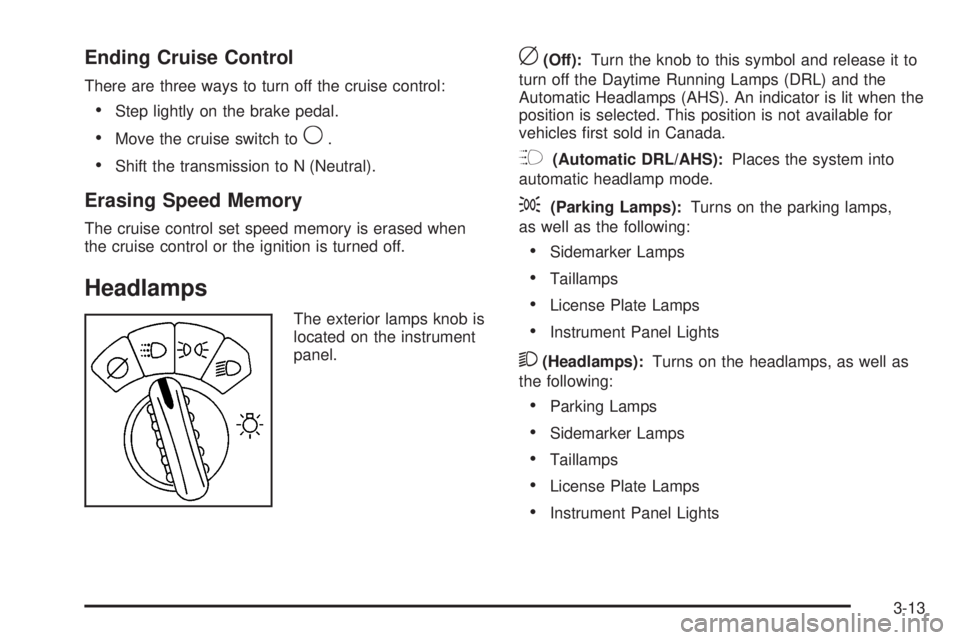
The exterior lamps knob is
located on the instrument
panel.
c(Off):Turn the knob to this symbol and release it to
turn off the Daytime Running Lamps (DRL) and the
Automatic Headlamps (AHS). An indicator is lit when the
position is selected. This position is not available for
vehicles rst sold in Canada.
?(Automatic DRL/AHS):Places the system into
automatic headlamp mode.
;(Parking Lamps):Turns on the parking lamps,
as well as the following:
Sidemarker Lamps
Taillamps
License Plate Lamps
Instrument Panel Lights
2(Headlamps):Turns on the headlamps, as well as
the following:
Parking Lamps
Sidemarker Lamps
Taillamps
License Plate Lamps
Instrument Panel Lights
3-13
Page 146 of 474

Headlamps on Reminder
A reminder tone sounds when the headlamps or
parking lamps are manually turned on, if the driver’s
door is open and the ignition is in LOCK/OFF or
ACC/ACCESSORY. To turn the tone off, turn the knob
all the way counterclockwise.
In the automatic mode, the headlamps turn off once the
ignition key is in LOCK/OFF.
Daytime Running Lamps (DRL)
Daytime Running Lamps (DRL) can make it easier for
others to see the front of your vehicle during the day.
Fully functional DRL are required on all vehicles
rst sold in Canada.
The DRL system makes the headlamps come on at
reduced brightness when the following conditions
are met:
The ignition is on.
The exterior lamps knob is in automatic
headlamp mode.
The light sensor detects daytime light.
The transmission is not in P (Park).When the DRL are on, only the headlamps will be on.
The taillamps, sidemarker, instrument panel lights
and other lamps will not be on.
When it begins to get dark, the headlamps automatically
switch from DRL to the regular headlamps.
Automatic Headlamp System
When it is dark enough outside, the Automatic
Headlamp System turns on the headlamps when
the vehicle is started and after the transmission
has been shifted out of the P (Park) position.
The headlamps, taillamps, sidemarker, and parking
lamps will come on. The instrument panel lights
and radio lights will also turn on at normal brightness.
Once on, the system remains on during these conditions
even if the vehicle is shifted back into P (Park).
The vehicle has a light sensor on the top of the
instrument panel. Do not cover the sensor or the system
may come on whenever the ignition is on and the
vehicle is shifted out of the P (Park) position.
The system could also turn on the lamps when driving
through a parking garage, heavy overcast weather
or a tunnel. This is normal.
3-14
Page 147 of 474

There is a delay in the transition between the daytime
and nighttime operation of the Daytime Running
Lamps (DRL) and the automatic headlamp systems,
so that driving under bridges or bright overhead street
lights does not affect the system. The DRL and
automatic headlamp system are only affected when the
light sensor sees a change in lighting lasting longer
than the delay.
If the vehicle is started in a dark garage, the automatic
headlamp system comes on after the transmission
is shifted out of P (Park). Once the vehicle leaves the
garage, it takes about one minute for the automatic
headlamp system to change to DRL if it is light outside.
During that delay, the instrument panel cluster might
not be as bright as usual. Make sure the instrument
panel brightness control is in the full bright position.
If the vehicle is running and the automatic headlamp
system is already on, it can be turned off by turning and
releasing the headlamp control at the off position.
The automatic headlamp system stays off until you turn
and release the headlamp control at the off position
again. SeeHeadlamps on page 3-13.Fog Lamps
The fog lamp button is located on the instrument panel
to the right of the exterior lamps knob. Use the fog
lamps for better vision in foggy or misty conditions.
The ignition must be in ON/RUN for the fog lamps
to work.
#:Press to turn the fog lamps on or off. An indicator
light turns on near the button while the fog lamps
are on. Fog lamps turn off whenever the high-beam
headlamps are on.
Some localities have laws that require the headlamps
to be on along with the fog lamps.
3-15