start GMC ENVOY DENALI 2005 Owners Manual
[x] Cancel search | Manufacturer: GMC, Model Year: 2005, Model line: ENVOY DENALI, Model: GMC ENVOY DENALI 2005Pages: 502, PDF Size: 2.66 MB
Page 1 of 502
Seats and Restraint Systems........................... 1-1
Front Seats
............................................... 1-2
Rear Seats
............................................... 1-5
Safety Belts
.............................................. 1-8
Child Restraints
.......................................1-26
Airbag System
.........................................1-48
Restraint System Check
............................1-64
Features and Controls..................................... 2-1
Keys
........................................................ 2-3
Doors and Locks
....................................... 2-8
Windows
.................................................2-14
Theft-Deterrent Systems
............................2-16
Starting and Operating Your Vehicle
...........2-18
Mirrors
....................................................2-36
OnStar
®System
......................................2-47
HomeLink®Transmitter
.............................2-49
Storage Areas
.........................................2-54
Sunroof
..................................................2-60
Vehicle Personalization
.............................2-60
Instrument Panel............................................. 3-1
Instrument Panel Overview
.......................... 3-4
Climate Controls
......................................3-21
Warning Lights, Gages, and Indicators
........3-32
Driver Information Center (DIC)
..................3-51
Audio System(s)
.......................................3-65Driving Your Vehicle....................................... 4-1
Your Driving, the Road, and Your Vehicle
..... 4-2
Towing
...................................................4-51
Service and Appearance Care.......................... 5-1
Service
..................................................... 5-3
Fuel
......................................................... 5-5
Checking Things Under the Hood
...............5-10
Rear Axle
...............................................5-47
Four-Wheel Drive
.....................................5-48
Front Axle
...............................................5-48
Bulb Replacement
....................................5-49
Windshield Wiper Blade Replacement
.........5-52
Tires
......................................................5-54
Appearance Care
.....................................5-86
Vehicle Identication
.................................5-95
Electrical System
......................................5-96
Capacities and Specications
...................5-113
Maintenance Schedule..................................... 6-1
Maintenance Schedule
................................ 6-2
Customer Assistance and Information.............. 7-1
Customer Assistance and Information
........... 7-2
Reporting Safety Defects
...........................7-12
Index................................................................ 1
2005 GMC Envoy/Envoy XL/Envoy Denali Owner ManualM
Page 19 of 502
Questions and Answers About
Safety Belts
Q:Will I be trapped in the vehicle after an accident
if I am wearing a safety belt?
A:Youcouldbe — whether you are wearing a safety
belt or not. But you can unbuckle a safety belt,
even if you are upside down. And your chance of
being conscious during and after an accident,
so youcanunbuckle and get out, ismuchgreater if
you are belted.
Q:If my vehicle has airbags, why should I have to
wear safety belts?
A:Airbags are in many vehicles today and will be in
most of them in the future. But they are
supplemental systems only; so they workwith
safety belts — not instead of them. Every airbag
system ever offered for sale has required the use of
safety belts. Even if you are in a vehicle that has
airbags, you still have to buckle up to get the most
protection. That is true not only in frontal collisions,
but especially in side and other collisions.
Q:If I am a good driver, and I never drive far from
home, why should I wear safety belts?
A:You may be an excellent driver, but if you are in an
accident — even one that is not your fault — you
and your passengers can be hurt. Being a good
driver does not protect you from things beyond your
control, such as bad drivers.
Most accidents occur within 25 miles (40 km) of
home. And the greatest number of serious injuries
and deaths occur at speeds of less than
40 mph (65 km/h).
Safety belts are for everyone.
How to Wear Safety Belts Properly
This part is only for people of adult size.
Be aware that there are special things to know about
safety belts and children. And there are different
rules for smaller children and babies. If a child will be
riding in your vehicle, seeOlder Children on page 1-26
orInfants and Young Children on page 1-29. Follow
those rules for everyone’s protection.
First, you will want to know which restraint systems your
vehicle has.
We will start with the driver position.
1-13
Page 27 of 502
Right Front Passenger Position
To learn how to wear the right front passenger’s safety
belt properly, seeDriver Position on page 1-14.
The right front passenger’s safety belt works the same
way as the driver’s safety belt — except for one
thing. If you ever pull the shoulder portion of the belt out
all the way, you will engage the child restraint locking
feature. If this happens, just let the belt go back all
the way and start again.
Rear Seat Passengers
It is very important for rear seat passengers to buckle
up! Accident statistics show that unbelted people in
the rear seat are hurt more often in crashes than those
who are wearing safety belts.
Rear passengers who are not safety belted can be
thrown out of the vehicle in a crash. And they can strike
others in the vehicle who are wearing safety belts.
Lap-Shoulder Belt
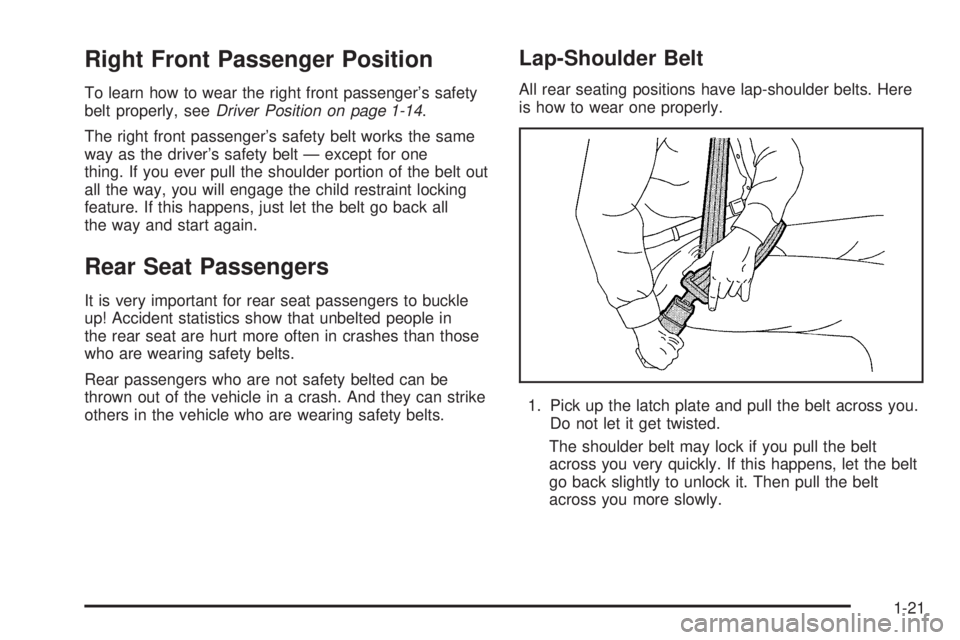
All rear seating positions have lap-shoulder belts. Here
is how to wear one properly.
1. Pick up the latch plate and pull the belt across you.
Do not let it get twisted.
The shoulder belt may lock if you pull the belt
across you very quickly. If this happens, let the belt
go back slightly to unlock it. Then pull the belt
across you more slowly.
1-21
Page 28 of 502
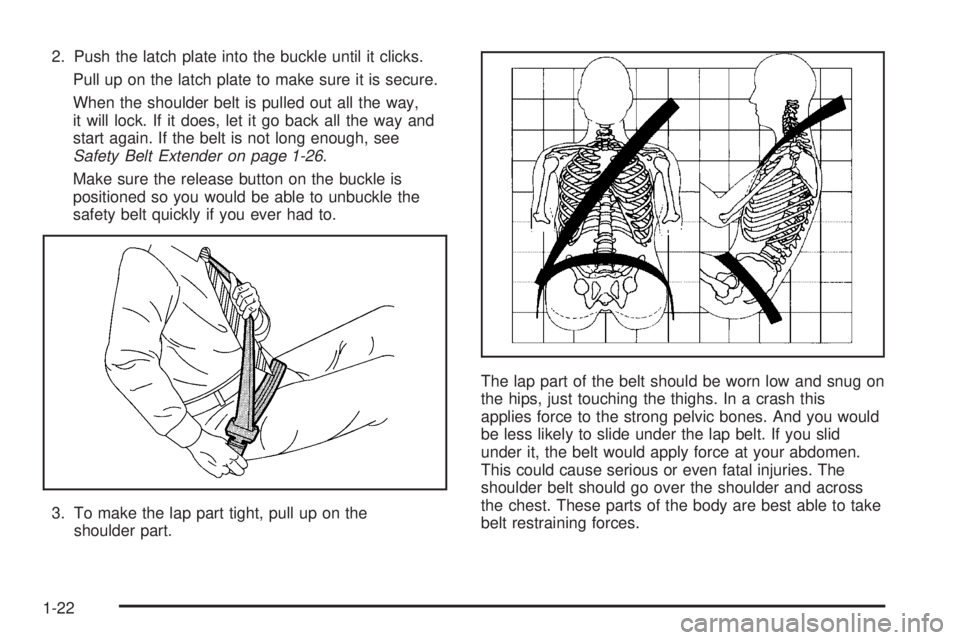
2. Push the latch plate into the buckle until it clicks.
Pull up on the latch plate to make sure it is secure.
When the shoulder belt is pulled out all the way,
it will lock. If it does, let it go back all the way and
start again. If the belt is not long enough, see
Safety Belt Extender on page 1-26.
Make sure the release button on the buckle is
positioned so you would be able to unbuckle the
safety belt quickly if you ever had to.
3. To make the lap part tight, pull up on the
shoulder part.The lap part of the belt should be worn low and snug on
the hips, just touching the thighs. In a crash this
applies force to the strong pelvic bones. And you would
be less likely to slide under the lap belt. If you slid
under it, the belt would apply force at your abdomen.
This could cause serious or even fatal injuries. The
shoulder belt should go over the shoulder and across
the chest. These parts of the body are best able to take
belt restraining forces.
1-22
Page 50 of 502
If your child restraint is equipped with the LATCH
system, seeLower Anchorages and Top Tethers for
Children (LATCH System) on page 1-38.
There is no top strap anchor at the right front seating
position. Do not secure a child seat in this position if a
national or local law requires that the top strap be
anchored or if the instructions that come with the child
restraint say that the top strap must be anchored. See
Top Strap on page 1-35if your child restraint has one.
You will be using the lap-shoulder belt to secure the
child restraint in this position. Be sure to follow
the instructions that came with the child restraint.
Secure the child in the child restraint when and as the
instructions say.1. Your vehicle has a right front passenger’s frontal
airbag. SeePassenger Sensing System on
page 1-58. General Motors recommends that
rear-facing child restraints be secured in a rear seat,
even if the airbag is off. If your child restraint is
forward-facing, move the seat as far back as it will
go before securing the child restraint in this
seat. SeePower Seats on page 1-2.
When the passenger sensing system has turned off
the right front passenger’s frontal airbag, the off
indicator in the passenger airbag status indicator
should light and stay lit when you turn the ignition to
RUN or START. SeePassenger Airbag Status
Indicator on page 3-37.
2. Put the child restraint on the seat.
3. Pick up the latch plate, and run the lap and shoulder
portions of the vehicle’s safety belt through or
around the restraint. The child restraint instructions
will show you how.
1-44
Page 53 of 502
7. Push and pull the child restraint in different
directions to be sure it is secure.
8. If the airbag is off, the off indicator in the inside
rearview mirror will be lit and stay lit when the
key is turned to RUN or START.
If a child restraint has been installed and the on
indicator is lit, turn the vehicle off. Remove the child
restraint from the vehicle and reinstall the child restraint.
If after reinstalling the child restraint and restarting
the vehicle, the on indicator is still lit, check to make
sure that the vehicle’s seatback is not pressing the child
restraint into the seat cushion. If this happens, slightlyrecline the vehicle’s seatback and adjust the seat
cushion if possible. Also make sure the child restraint is
not trapped under the vehicle head restraint. If this
happens, adjust the head restraint.
If the on indicator is still lit, secure the child in the child
restraint in a rear seat position in the vehicle and
check with your dealer.
To remove the child restraint, just unbuckle the vehicle’s
safety belt and let it go back all the way. The safety
belt will move freely again and be ready to work for an
adult or larger child passenger.
1-47
Page 64 of 502
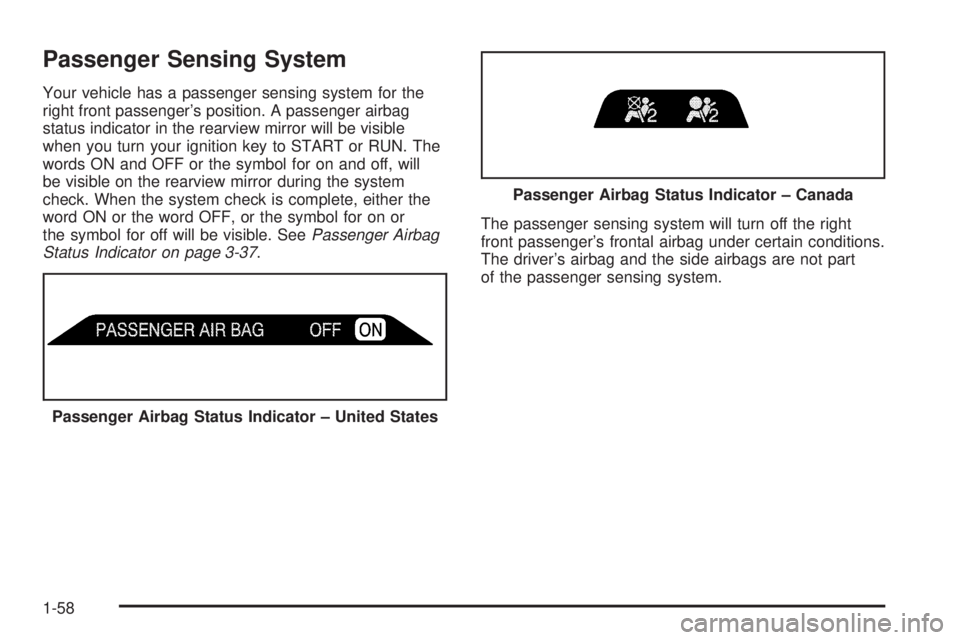
Passenger Sensing System
Your vehicle has a passenger sensing system for the
right front passenger’s position. A passenger airbag
status indicator in the rearview mirror will be visible
when you turn your ignition key to START or RUN. The
words ON and OFF or the symbol for on and off, will
be visible on the rearview mirror during the system
check. When the system check is complete, either the
word ON or the word OFF, or the symbol for on or
the symbol for off will be visible. SeePassenger Airbag
Status Indicator on page 3-37.The passenger sensing system will turn off the right
front passenger’s frontal airbag under certain conditions.
The driver’s airbag and the side airbags are not part
of the passenger sensing system.
Passenger Airbag Status Indicator – United States
Passenger Airbag Status Indicator – Canada
1-58
Page 66 of 502
the system determines that a small child is present
in a booster seat
a right front passenger takes his/her weight off of
the seat for a period of time
the right front passenger seat is occupied by a
smaller person, such as a child who has outgrown
child restraints
or if there is a critical problem with the airbag
system or the passenger sensing system.
When the passenger sensing system has turned off the
passenger’s frontal airbag, the off indicator in the
rearview mirror will light and stay lit to remind you that
the airbag is off.
If a child restraint has been installed and the on
indicator is lit, turn the vehicle off. Remove the child
restraint from the vehicle and reinstall the child restraint
following the child restraint manufacturer’s directions
and refer toSecuring a Child Restraint in the Right Front
Seat Position on page 1-43.If after reinstalling the child restraint and restarting the
vehicle, the on indicator is still lit, check to make
sure that the vehicle’s seatback is not pressing the child
restraint into the seat cushion. If this happens, slightly
recline the vehicle’s seatback and adjust the seat
cushion if possible. Also make sure the child restraint is
not trapped under the vehicle head restraint. If this
happens, adjust the head restraint.
If the on indicator is still lit, secure the child in the child
restraint in a rear seat position in the vehicle and
check with your dealer.
The passenger sensing system is designed to enable
(may inate) the right front passenger’s frontal
airbag anytime the system senses that a person of adult
size is sitting properly in the right front passenger’s
seat. When the passenger sensing system has allowed
the airbag to be enabled, the on indicator will light
and stay lit to remind you that the airbag is active.
For some children who have outgrown child restraints
and for very small adults, the passenger sensing system
may or may not turn off the right front passenger’s
frontal airbag, depending upon the person’s seating
posture and body build. Everyone in your vehicle who
has outgrown child restraints should wear a safety
belt properly — whether or not there is an airbag for
that person.
1-60
Page 67 of 502
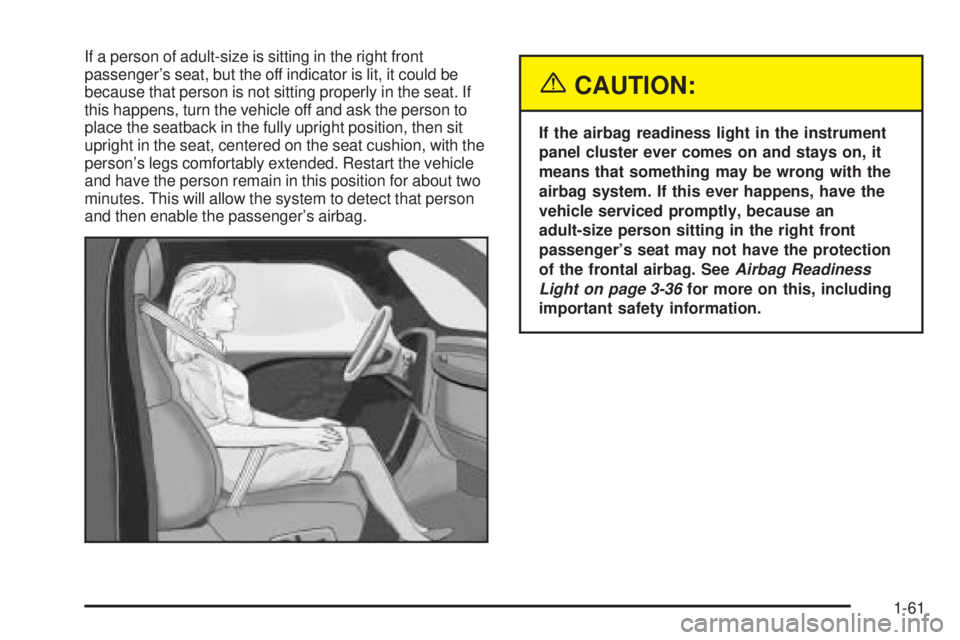
If a person of adult-size is sitting in the right front
passenger’s seat, but the off indicator is lit, it could be
because that person is not sitting properly in the seat. If
this happens, turn the vehicle off and ask the person to
place the seatback in the fully upright position, then sit
upright in the seat, centered on the seat cushion, with the
person’s legs comfortably extended. Restart the vehicle
and have the person remain in this position for about two
minutes. This will allow the system to detect that person
and then enable the passenger’s airbag.
{CAUTION:
If the airbag readiness light in the instrument
panel cluster ever comes on and stays on, it
means that something may be wrong with the
airbag system. If this ever happens, have the
vehicle serviced promptly, because an
adult-size person sitting in the right front
passenger’s seat may not have the protection
of the frontal airbag. SeeAirbag Readiness
Light on page 3-36for more on this, including
important safety information.
1-61
Page 71 of 502
If belts are cut or damaged, replace them. Collision
damage also may mean you will need to have LATCH
system, safety belt or seat parts repaired or replaced.
New parts and repairs may be necessary even if the belt
or LATCH system was not being used at the time of
the collision.
If an airbag inates, you will need to replace airbag
system parts. See the part on the airbag system earlier
in this section.
If the airbags inate you will also need to replace the
driver and front passenger’s safety belt retractor
assembly. Be sure to do so. Then the new retractor
assembly will be there to help protect you in a collision.After a crash you may need to replace the driver and
front passenger’s safety belt retractor assemblies, even
if the airbags have not deployed. The driver and
front passenger’s safety belt retractor assemblies
contain the safety belt pretensioners. Have your safety
belt pretensioners checked if your vehicle has been
in a collision, or if your airbag readiness light stays on
after you start your vehicle or while you are driving. See
Airbag Readiness Light on page 3-36.
1-65