lock GMC ENVOY DENALI 2007 Owners Manual
[x] Cancel search | Manufacturer: GMC, Model Year: 2007, Model line: ENVOY DENALI, Model: GMC ENVOY DENALI 2007Pages: 562, PDF Size: 2.87 MB
Page 437 of 562
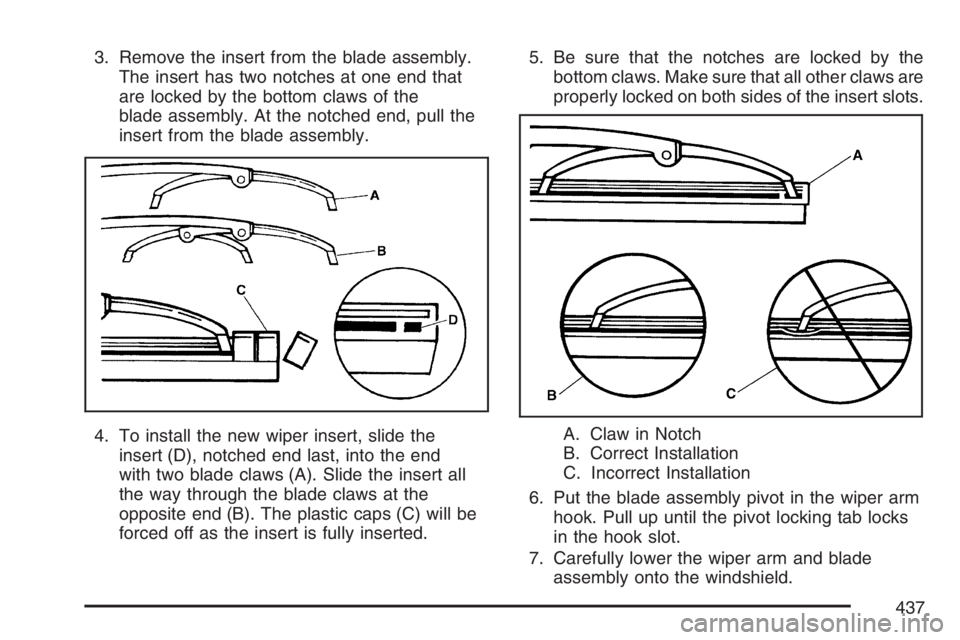
3. Remove the insert from the blade assembly.
The insert has two notches at one end that
are locked by the bottom claws of the
blade assembly. At the notched end, pull the
insert from the blade assembly.
4. To install the new wiper insert, slide the
insert (D), notched end last, into the end
with two blade claws (A). Slide the insert all
the way through the blade claws at the
opposite end (B). The plastic caps (C) will be
forced off as the insert is fully inserted.5. Be sure that the notches are locked by the
bottom claws. Make sure that all other claws are
properly locked on both sides of the insert slots.
A. Claw in Notch
B. Correct Installation
C. Incorrect Installation
6. Put the blade assembly pivot in the wiper arm
hook. Pull up until the pivot locking tab locks
in the hook slot.
7. Carefully lower the wiper arm and blade
assembly onto the windshield.
437
Page 438 of 562
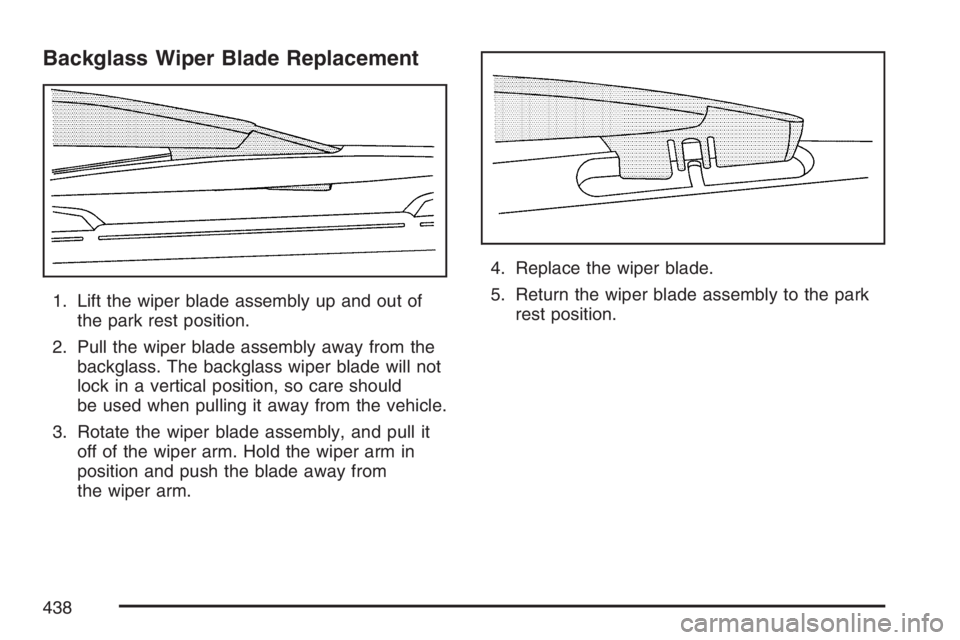
Backglass Wiper Blade Replacement
1. Lift the wiper blade assembly up and out of
the park rest position.
2. Pull the wiper blade assembly away from the
backglass. The backglass wiper blade will not
lock in a vertical position, so care should
be used when pulling it away from the vehicle.
3. Rotate the wiper blade assembly, and pull it
off of the wiper arm. Hold the wiper arm in
position and push the blade away from
the wiper arm.4. Replace the wiper blade.
5. Return the wiper blade assembly to the park
rest position.
438
Page 452 of 562
5. Remove the valve cap from the valve cap stem.
Activate the TPMS sensor by increasing or
decreasing the tire’s air pressure for
10 seconds, then stop and listen for a single
horn chirp. The single horn chirp should sound
within 15 seconds, conrming that the sensor
identication code has been matched to this
tire and wheel position. If you do not hear the
conrming single horn chirp, you will need to
start over with step number one. To let
air-pressure out of a tire you can use the
pointed end of the valve cap, a pencil-style air
pressure gage, or a key.
6. Proceed to the passenger’s side front tire,
and repeat the procedure in Step 5.
7. Proceed to the passenger’s side rear tire,
and repeat the procedure in Step 5.
8. Proceed to the driver’s side rear tire, and
repeat the procedure in Step 5.9. After hearing the conrming horn chirp for
the driver’s side rear tire, check to see if
the TPMS warning light is still ashing. If yes,
turn the ignition switch to LOCK to exit the
sensor matching process. If the TPMS warning
light is not ashing, the ve minute time
limit has passed and you will need to start
the process over beginning with Step 1.
10. Set all four tires to the recommended air
pressure level as indicated on the Tire
and Loading Information label.
11. Put the valve caps back on the valve stems
The spare tire does not have a TPMS sensor.
If you replace one of the road tires with the spare,
the SERVICE TIRE MONITOR message will be
displayed on the DIC screen. This message should
go off once you re-install the road tire containing
the TPMS sensor.
452
Page 457 of 562
Your vehicle’s original equipment tires are listed
on the Tire and Loading Information Label.
This label is attached to the vehicle’s center pillar
(B-pillar). SeeLoading Your Vehicle on page 349,
for more information about the Tire and Loading
Information Label.
Different Size Tires and Wheels
If you add wheels or tires that are a different
size than your original equipment wheels and
tires, this may affect the way your vehicle
performs, including its braking, ride and handling
characteristics, stability, and resistance to
rollover. Additionally, if your vehicle has electronic
systems such as, anti-lock brakes, traction
control, and electronic stability control, the
performance of these systems can be affected.
{CAUTION:
If you add different sized wheels, your
vehicle may not provide an acceptable
level of performance and safety if tires
not recommended for those wheels are
selected. You may increase the chance
that you will crash and suffer serious
injury. Only use GM specic wheel and
tire systems developed for your vehicle,
and have them properly installed by a
GM certied technician.
SeeBuying New Tires on page 455and
Accessories and Modications on page 380
for additional information.
457
Page 463 of 562
4. Press and release the switch to turn the air
inator on. The indicator light will remain on
when the inator is running.
The system has an internal clock to prevent
the system from overheating. The system
will allow about ve minutes of running time,
then the compressor will stop. The indicator
light will then begin to ash. When the indicator
is off, the inator can be started again by
pressing the switch. If the compressor is still
hot, it may only run for a short time before
shutting off again.
5. Press and release the switch to turn the
inator off.Place the inator kit tools in the pouch and store it
in its proper location. Remove the inator hose
from the outlet during loading and unloading. Load
leveling will not function with the inator hose
attached to the inator outlet. SeeElectronically
Controlled Air Suspension System on page 360for
more information.
To reinstall the cover, line up the tabs at the back
of the cover, put it in place and latch the tabs.
A continuous ashing indicator light may also
indicate a malfunction in the air suspension
system. SeeElectronically Controlled Air
Suspension System on page 360for more
information.
463
Page 465 of 562
Changing a Flat Tire
If a tire goes at, avoid further tire and wheel
damage by driving slowly to a level place.
Turn on your hazard warning ashers. See
Hazard Warning Flashers on page 170for more
information.
{CAUTION:
Changing a tire can be dangerous. The
vehicle can slip off the jack and roll over
or fall on you or other people. You and
they could be badly injured or even killed.
Find a level place to change your tire.
To help prevent the vehicle from moving:
1. Set the parking brake rmly.
2. Put the shift lever in PARK (P).
CAUTION: (Continued)
CAUTION: (Continued)
3. If you have a four-wheel-drive vehicle,
be sure the transfer case is in a drive
gear — not in NEUTRAL.
4. Turn off the engine and do not restart
while the vehicle is raised.
5. Do not allow passengers to remain in
the vehicle.
6. Put the wheel blocks at the front and
rear of the tire farthest away from
the one being changed. That would
be the tire on the other side, at the
opposite end of the vehicle.
465
Page 466 of 562
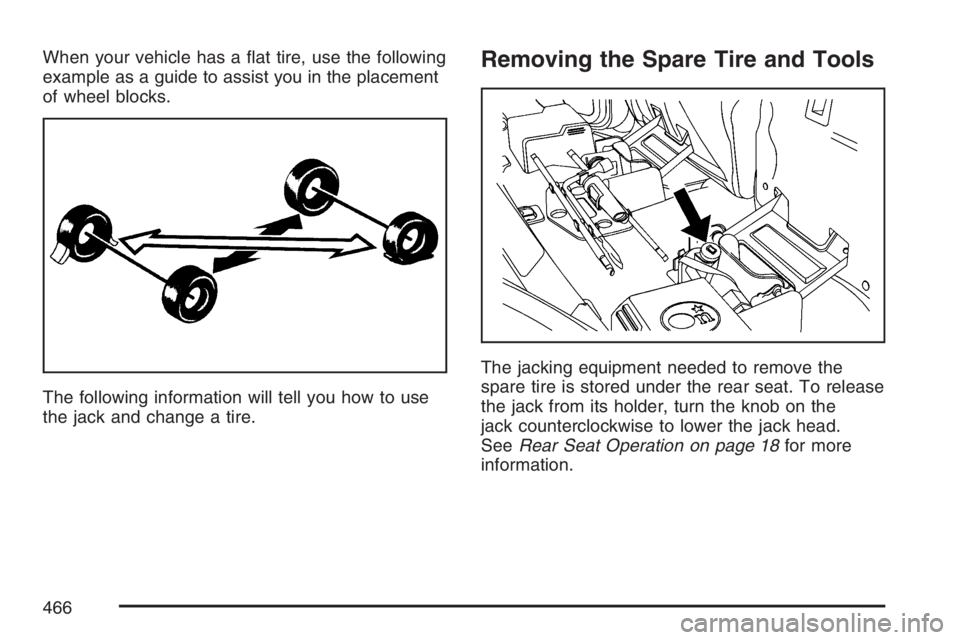
When your vehicle has a at tire, use the following
example as a guide to assist you in the placement
of wheel blocks.
The following information will tell you how to use
the jack and change a tire.Removing the Spare Tire and Tools
The jacking equipment needed to remove the
spare tire is stored under the rear seat. To release
the jack from its holder, turn the knob on the
jack counterclockwise to lower the jack head.
SeeRear Seat Operation on page 18for more
information.
466
Page 467 of 562
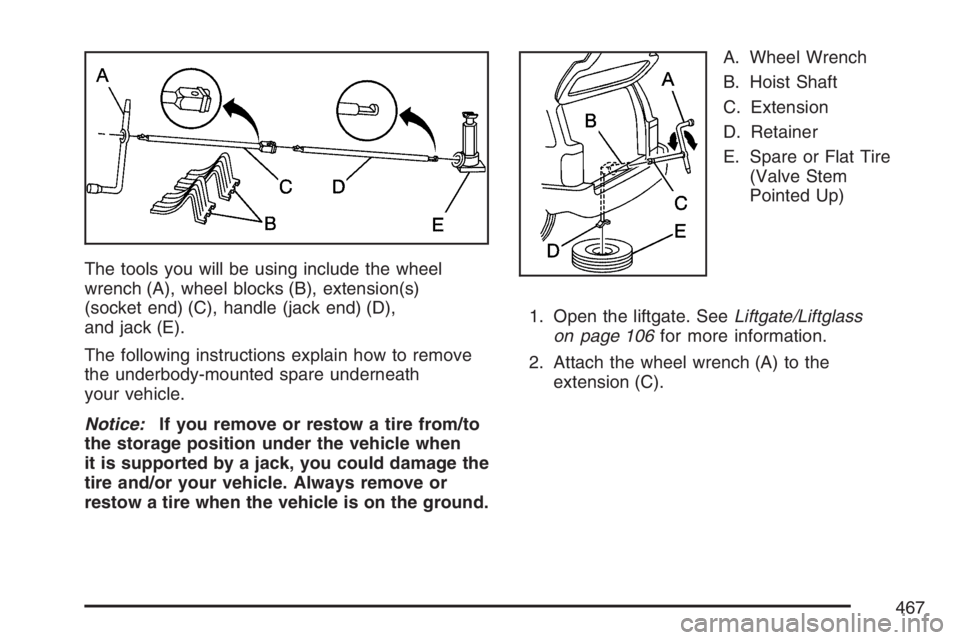
The tools you will be using include the wheel
wrench (A), wheel blocks (B), extension(s)
(socket end) (C), handle (jack end) (D),
and jack (E).
The following instructions explain how to remove
the underbody-mounted spare underneath
your vehicle.
Notice:If you remove or restow a tire from/to
the storage position under the vehicle when
it is supported by a jack, you could damage the
tire and/or your vehicle. Always remove or
restow a tire when the vehicle is on the ground.A. Wheel Wrench
B. Hoist Shaft
C. Extension
D. Retainer
E. Spare or Flat Tire
(Valve Stem
Pointed Up)
1. Open the liftgate. SeeLiftgate/Liftglass
on page 106for more information.
2. Attach the wheel wrench (A) to the
extension (C).
467
Page 468 of 562
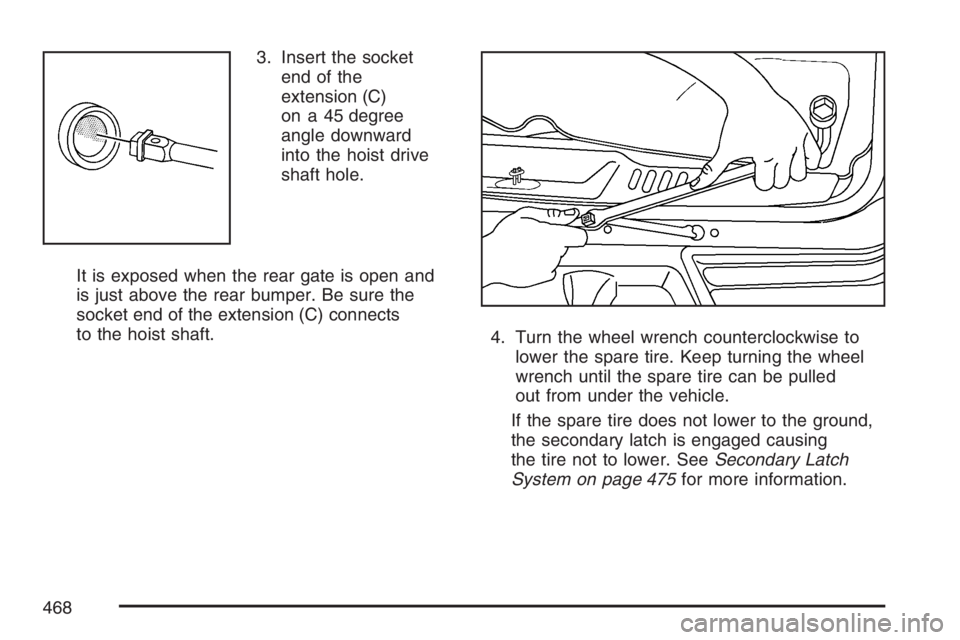
3. Insert the socket
end of the
extension (C)
on a 45 degree
angle downward
into the hoist drive
shaft hole.
It is exposed when the rear gate is open and
is just above the rear bumper. Be sure the
socket end of the extension (C) connects
to the hoist shaft.
4. Turn the wheel wrench counterclockwise to
lower the spare tire. Keep turning the wheel
wrench until the spare tire can be pulled
out from under the vehicle.
If the spare tire does not lower to the ground,
the secondary latch is engaged causing
the tire not to lower. SeeSecondary Latch
System on page 475for more information.
468
Page 470 of 562
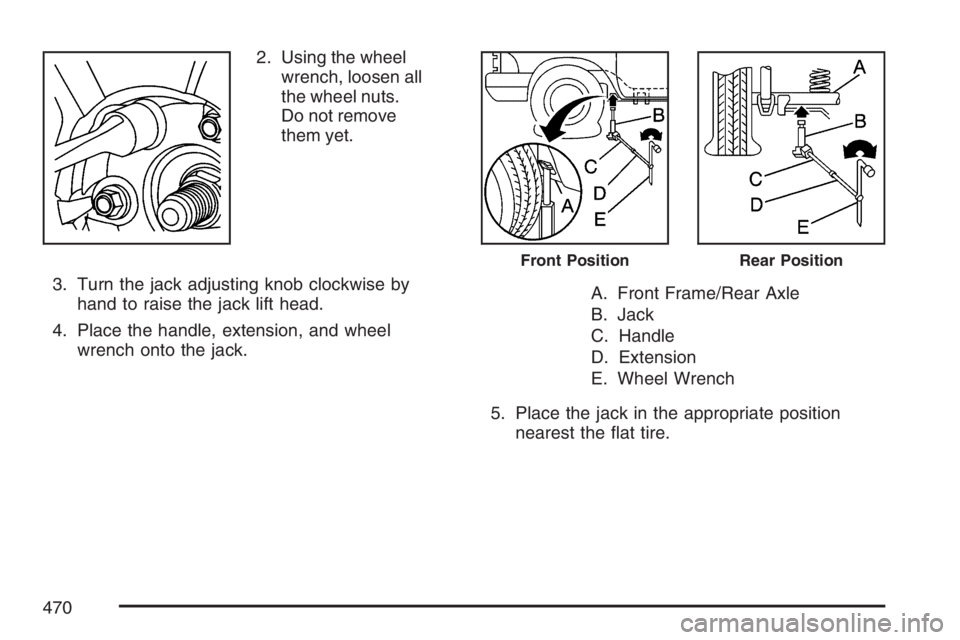
2. Using the wheel
wrench, loosen all
the wheel nuts.
Do not remove
them yet.
3. Turn the jack adjusting knob clockwise by
hand to raise the jack lift head.
4. Place the handle, extension, and wheel
wrench onto the jack.A. Front Frame/Rear Axle
B. Jack
C. Handle
D. Extension
E. Wheel Wrench
5. Place the jack in the appropriate position
nearest the at tire.
Front PositionRear Position
470