automatic transmission GMC ENVOY DENALI 2007 User Guide
[x] Cancel search | Manufacturer: GMC, Model Year: 2007, Model line: ENVOY DENALI, Model: GMC ENVOY DENALI 2007Pages: 562, PDF Size: 2.87 MB
Page 310 of 562
For more information on the stability messages,
seeDIC Warnings and Messages on page 222.
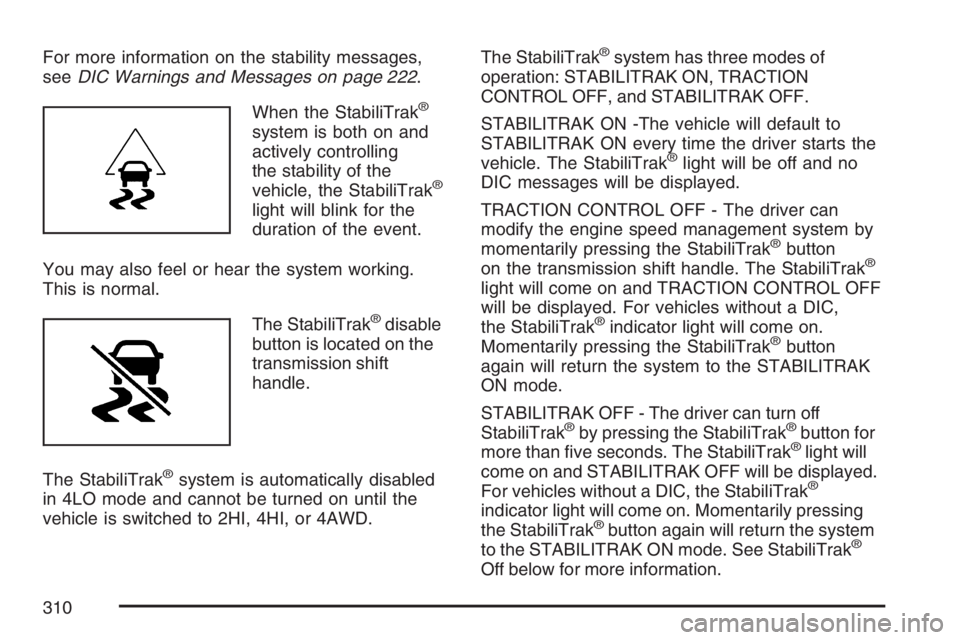
When the StabiliTrak
®
system is both on and
actively controlling
the stability of the
vehicle, the StabiliTrak
®
light will blink for the
duration of the event.
You may also feel or hear the system working.
This is normal.
The StabiliTrak
®disable
button is located on the
transmission shift
handle.
The StabiliTrak
®system is automatically disabled
in 4LO mode and cannot be turned on until the
vehicle is switched to 2HI, 4HI, or 4AWD.The StabiliTrak
®system has three modes of
operation: STABILITRAK ON, TRACTION
CONTROL OFF, and STABILITRAK OFF.
STABILITRAK ON -The vehicle will default to
STABILITRAK ON every time the driver starts the
vehicle. The StabiliTrak
®light will be off and no
DIC messages will be displayed.
TRACTION CONTROL OFF - The driver can
modify the engine speed management system by
momentarily pressing the StabiliTrak
®button
on the transmission shift handle. The StabiliTrak®
light will come on and TRACTION CONTROL OFF
will be displayed. For vehicles without a DIC,
the StabiliTrak
®indicator light will come on.
Momentarily pressing the StabiliTrak®button
again will return the system to the STABILITRAK
ON mode.
STABILITRAK OFF - The driver can turn off
StabiliTrak
®by pressing the StabiliTrak®button for
more than ve seconds. The StabiliTrak®light will
come on and STABILITRAK OFF will be displayed.
For vehicles without a DIC, the StabiliTrak
®
indicator light will come on. Momentarily pressing
the StabiliTrak®button again will return the system
to the STABILITRAK ON mode. See StabiliTrak®
Off below for more information.
310
Page 313 of 562
Notice:If the StabiliTrak®light comes on
due to heavy braking and/or because the
traction control system has been continuously
active, do not allow the wheel(s) of one axle to
spin excessively. If you do, you may be causing
damage to the transfer case. This could lead to
costly repairs not covered by your warranty.
Notice:If you allow the wheel(s) of one axle
to spin excessively while the StabiliTrak
®,
ABS and brake warning lights and the
SERVICE STABILITRAK message are
displayed, you could damage the transfer
case. The repairs would not be covered by your
warranty. Reduce engine power and do not
spin the wheel(s) excessively while these lights
and this message are displayed.
StabiliTrak
®may activate on dry or rough roads or
under conditions such as heavy acceleration
while turning or abrupt upshifts/downshifts of the
transmission. When this happens, you may
notice a reduction in acceleration, or may hear a
noise or vibration. This is normal.If your vehicle is in cruise control when the system
activates, the StabiliTrak
®light will blink, and
the cruise control will automatically disengage.
When road conditions allow, you may re-engage
the cruise control. SeeCruise Control on
page 176.
StabiliTrak
®will turn off automatically if a problem
is detected in the system. The StabiliTrak®
light will come on and SERVICE STABILITRAK
will be displayed on the DIC. For vehicles without a
DIC, the StabiliTrak
®light and the StabiliTrak®
service light will both come on. If the SERVICE
STABILITRAK message (or StabiliTrak®service
light) does not clear itself after restarting the
vehicle, you should see your dealer for service.
Adding non-GM accessories can affect your
vehicle’s performance. SeeAccessories and
Modications on page 380for more information.
313
Page 358 of 562
Dolly Towing
Front Towing
(Front Wheels Off the Ground)
Two-Wheel-Drive Vehicles
Notice:If you tow a two-wheel-drive vehicle
with the rear wheels on the ground, the
transmission could be damaged. The repairs
would not be covered by your warranty.
Never tow your vehicle with the rear wheels on
the ground.
Four-Wheel-Drive Vehicles
Four-wheel-drive vehicles can be dolly towed with
the rear wheels on the ground.
Use the following procedure to tow your vehicle:
1. Drive the vehicle onto the tow dolly.
2. Shift the automatic transmission to PARK (P).
3. Turn the engine off, but leave the ignition on.
4. Firmly set the parking brake.
5. Securely attach the vehicle being towed to
the dolly.
{CAUTION:
Shifting a four-wheel-drive vehicle’s
transfer case into NEUTRAL can cause
your vehicle to roll even if the transmission
is in PARK (P). You or others could be
injured. Make sure the parking brake is
rmly set before you shift the transfer case
to NEUTRAL.
6. Shift the transfer case to NEUTRAL (N).
SeeFour-Wheel Drive on page 122for
the proper procedure to select the
NEUTRAL (N) position for your vehicle.
7. Release the parking brake only after the
vehicle being towed is rmly attached to
the towing vehicle.
8. Turn the ignition off.
After towing, see “Shifting Out of Neutral”
underFour-Wheel Drive on page 122.
358
Page 372 of 562
Turn Signals When Towing a Trailer
The arrows on your instrument panel will
ash whenever you signal a turn or lane change.
Properly hooked up, the trailer lamps will also
ash, telling other drivers you’re about to
turn, change lanes or stop.
When towing a trailer, the arrows on your
instrument panel will ash for turns even if the
bulbs on the trailer are burned out. Thus, you may
think drivers behind you are seeing your signal
when they are not. It’s important to check
occasionally to be sure the trailer bulbs are
still working.
Driving On Grades
Reduce speed and shift to a lower gearbefore
you start down a long or steep downgrade. If you
don’t shift down, you might have to use your
brakes so much that they would get hot and no
longer work well.
You can tow in DRIVE (D). You may want to shift
the transmission to THIRD (3) or a lower gear,
under heavy loads or hilly conditions.
When towing at high altitude on steep uphill
grades, consider the following: Engine coolant will
boil at a lower temperature than at normal
altitudes. If you turn your engine off immediately
after towing at high altitude on steep uphill grades,
your vehicle may show signs similar to engine
overheating. To avoid this, let the engine run while
parked (preferably on level ground) with the
automatic transmission in PARK (P) for a few
minutes before turning the engine off. If you do get
the overheat warning, seeEngine Overheating
on page 408.
372
Page 374 of 562
When You Are Ready to Leave After
Parking on a Hill
1. Apply your regular brakes and hold the pedal
down while you:
start your engine,
shift into a gear, and
release the parking brake.
2. Let up on the brake pedal.
3. Drive slowly until the trailer is clear of the
chocks.
4. Stop and have someone pick up and store
the chocks.
Maintenance When Trailer Towing
Your vehicle will need service more often when
you’re pulling a trailer. See the Maintenance
Schedule for more on this. Things that are
especially important in trailer operation are
automatic transmission uid (don’t overll), engine
oil, axle lubricant, belt(s), cooling system and
brake system. Each of these is covered in
this manual, and the Index will help you nd them
quickly. If you’re trailering, it’s a good idea to
review these sections before you start your trip.
Check periodically to see that all hitch nuts
and bolts are tight.
374
Page 377 of 562
Service........................................................ 380
Accessories and Modications................... 380
California Proposition 65 Warning.............. 381
Doing Your Own Service Work.................. 381
Adding Equipment to the Outside of
Your Vehicle.......................................... 382
Fuel............................................................. 382
Gasoline Octane........................................ 382
Gasoline Specications.............................. 383
California Fuel........................................... 383
Additives................................................... 383
Fuels in Foreign Countries........................ 384
Filling the Tank......................................... 385
Filling a Portable Fuel Container............... 387
Checking Things Under the Hood.............. 388
Hood Release........................................... 388
Engine Compartment Overview.................. 390
Engine Oil................................................. 394
Engine Oil Life System.............................. 398
Engine Air Cleaner/Filter............................ 400
Automatic Transmission Fluid.................... 401
Engine Coolant.......................................... 405Radiator Pressure Cap.............................. 408
Engine Overheating................................... 408
Cooling System......................................... 411
Engine Fan Noise..................................... 416
Power Steering Fluid ................................. 417
Windshield Washer Fluid........................... 418
Brakes...................................................... 419
Battery...................................................... 422
Jump Starting............................................ 423
Rear Axle.................................................... 428
Four-Wheel Drive........................................ 428
Front Axle................................................... 429
Bulb Replacement....................................... 430
Halogen Bulbs........................................... 430
Headlamps................................................ 431
Front Turn Signal, Sidemarker and
Parking Lamps....................................... 432
Taillamps, Turn Signal, and Stoplamps...... 432
Back-Up Lamps......................................... 434
License Plate Lamp................................... 435
Replacement Bulbs................................... 435
Section 5 Service and Appearance Care
377
Page 391 of 562
A. Engine Air Cleaner/Filter. SeeEngine Air
Cleaner/Filter on page 400.
B. Engine Coolant Recovery Tank. SeeCooling
System on page 411.
C. Windshield Washer Fluid Reservoir. See
“Adding Washer Fluid” underWindshield
Washer Fluid on page 418.
D. Power Steering Fluid Reservoir. SeePower
Steering Fluid on page 417.
E. Automatic Transmission Fluid Dipstick (Out of
View). See “Checking the Fluid Level” under
Automatic Transmission Fluid on page 401.
F. Engine Oil Dipstick. See “Checking Engine Oil”
underEngine Oil on page 394.G. Radiator Pressure Cap. SeeRadiator Pressure
Cap on page 408.
H. Engine Oil Fill Cap. See “When to Add Engine
Oil” underEngine Oil on page 394.
I. Remote Negative (−) Terminal (Marked GND).
SeeJump Starting on page 423.
J. Brake Master Cylinder Reservoir. See “Brake
Fluid” underBrakes on page 419.
K. Battery. SeeBattery on page 422.
L. Engine Compartment Fuse Block. SeeEngine
Compartment Fuse Block on page 493.
391
Page 393 of 562
A. Engine Coolant Recovery Tank. SeeCooling
System on page 411.
B. Engine Air Cleaner/Filter. SeeEngine Air
Cleaner/Filter on page 400.
C. Windshield Washer Fluid Reservoir. See
“Adding Washer Fluid” underWindshield
Washer Fluid on page 418.
D. Engine Oil Dipstick. See “Checking Engine Oil”
underEngine Oil on page 394.
E. Automatic Transmission Fluid Dipstick. See
“Checking the Fluid Level” underAutomatic
Transmission Fluid on page 401.
F. Engine Oil Fill Cap. See “When to Add Engine
Oil” underEngine Oil on page 394.G. Radiator Pressure Cap. SeeRadiator Pressure
Cap on page 408.
H. Remote Negative (−) Terminal (Marked GND).
SeeJump Starting on page 423.
I. Power Steering Fluid Reservoir. SeePower
Steering Fluid on page 417.
J. Brake Master Cylinder Reservoir. See “Brake
Fluid” underBrakes on page 419.
K. Engine Compartment Fuse Block. SeeEngine
Compartment Fuse Block on page 493.
L. Battery. SeeBattery on page 422.
393
Page 401 of 562
{CAUTION:
Operating the engine with the air
cleaner/lter off can cause you or others
to be burned. The air cleaner not only
cleans the air; it helps to stop ames if
the engine backres. If it is not there and
the engine backres, you could be
burned. Do not drive with it off, and be
careful working on the engine with the air
cleaner/lter off.
Notice:If the air cleaner/lter is off, a backre
can cause a damaging engine re. And, dirt
can easily get into your engine, which will
damage it. Always have the air cleaner/lter in
place when you are driving.
Automatic Transmission Fluid
When to Check and Change Automatic
Transmission Fluid
A good time to check your automatic transmission
uid level is when the engine oil is changed.
Change the uid and lter at the intervals listed in
Additional Required Services on page 510, and
be sure to use the transmission uid listed in
Recommended Fluids and Lubricants on page 517.
401
Page 402 of 562
How to Check Automatic Transmission
Fluid
Because this operation can be a little difficult, you
may choose to have this done at the dealership
service department.
If you do it yourself, be sure to follow all the
instructions here, or you could get a false reading
on the dipstick.
Notice:Too much or too little uid can
damage your transmission. Too much can
mean that some of the uid could come out
and fall on hot engine parts or exhaust system
parts, starting a re. Too little uid could
cause the transmission to overheat. Be sure to
get an accurate reading if you check your
transmission uid.
Wait at least 30 minutes before checking the
transmission uid level if you have been driving:
When outside temperatures are above
90°F (32°C).
At high speed for quite a while.
In heavy traffic — especially in hot weather.
While pulling a trailer.To get the right reading, the uid should be at
normal operating temperature, which is 180°F to
200°F (82°C to 93°C).
Get the vehicle warmed up by driving about
15 miles (24 km) when outside temperatures are
above 50°F (10°C). If it is colder than 50°F (10°C),
drive the vehicle in THIRD (3) until the engine
temperature gage moves and then remains steady
for 10 minutes.
A cold uid check can be made after the vehicle
has been sitting for eight hours or more with
the engine off, but this is used only as a reference.
Let the engine run at idle for ve minutes if
outside temperatures are 50°F (10°C) or more. If it
is colder than 50°F (10°C), you may have to idle
the engine longer. Should the uid level be
low during this cold check, you must check the
uid hot before adding uid. Checking the uid hot
will give you a more accurate reading of the
uid level.
402