stop GMC ENVOY DENALI 2007 Owners Manual
[x] Cancel search | Manufacturer: GMC, Model Year: 2007, Model line: ENVOY DENALI, Model: GMC ENVOY DENALI 2007Pages: 562, PDF Size: 2.87 MB
Page 13 of 562
See “Seat Recall” underDIC Vehicle
Customization on page 229for more information.
To stop recall movement of the memory seat
feature at any time, press one of the memory
buttons or power seat controls.
Easy Exit Seat
The control for the easy exit seat function is
located on the driver’s door below the memory
buttons 1 and 2. The easy exit seat button is used
to program and recall the desired driver’s seat
position when exiting or entering the vehicle. The
mirrors, power lumbar, recline, and adjustable
pedals, if equipped, positions will not be stored or
recalled when using the easy exit seat function.
The seat position can be saved for up to
two drivers.
To store the easy exit seat position, do the
following:
1. Press and release the 1 or 2 button of the
memory control for less than three seconds.
The seat will move to the stored memory
position.
2. Adjust the seat to the desired exit position.3. Press and hold the easy exit seat button for
more than three seconds. A double chime will
sound to let you know that the position has
been stored for the selected button 1 or 2.
To repeat the procedure for a second driver,
follow the preceding steps, but press the other
numbered memory control button.
To recall the easy exit seat position, do one of the
following:
Press the easy exit seat button on the
memory control while the vehicle is in
PARK (P). The seat will move to the stored
exit position.
Or, if the easy exit seat feature is activated in
the Driver Information Center (DIC), removing
the key from the ignition will move the seat
to the exit position. See “Easy Exit Seat” under
DIC Vehicle Customization on page 229for
more information on activating this feature in
the DIC.
If an easy exit seat position has not been stored,
the default position is all the way rearward.
13
Page 14 of 562
Reclining Seatbacks
Manual Reclining Seatbacks
{CAUTION:
You can lose control of the vehicle if
you try to adjust a manual driver’s seat
while the vehicle is moving. The sudden
movement could startle and confuse you,
or make you push a pedal when you do
not want to. Adjust the driver’s seat only
when the vehicle is not moving.
{CAUTION:
If the seatback is not locked, it could
move forward in a sudden stop or crash.
That could cause injury to the person
sitting there. Always push and pull on
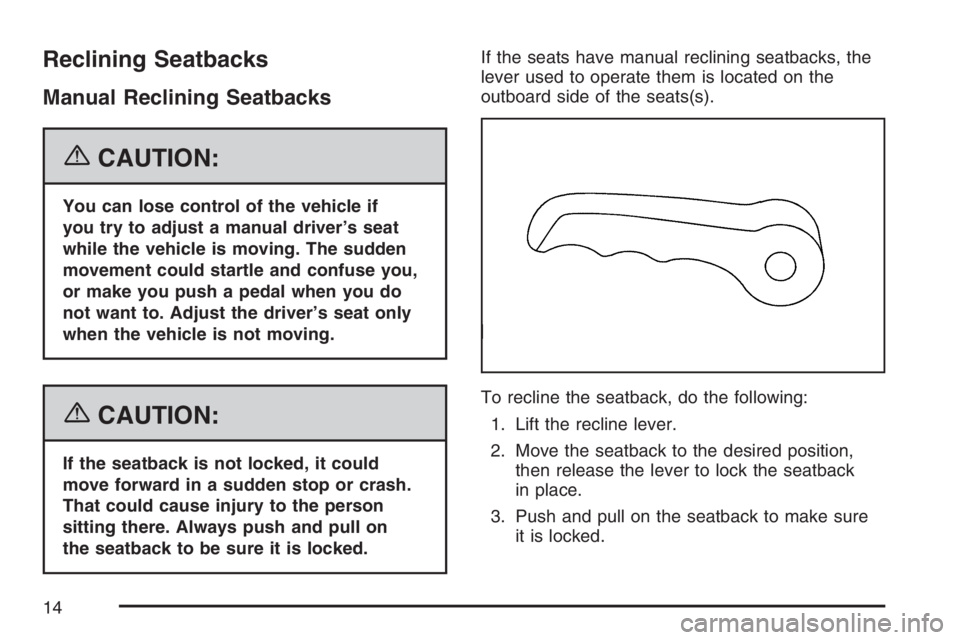
the seatback to be sure it is locked.If the seats have manual reclining seatbacks, the
lever used to operate them is located on the
outboard side of the seats(s).
To recline the seatback, do the following:
1. Lift the recline lever.
2. Move the seatback to the desired position,
then release the lever to lock the seatback
in place.
3. Push and pull on the seatback to make sure
it is locked.
14
Page 19 of 562
To return the seat(s) to the original position, do
the following:
{CAUTION:
If the seatback is not locked, it could
move forward in a sudden stop or crash.
That could cause injury to the person
sitting there. Always push and pull on the
seatback to be sure it is locked.
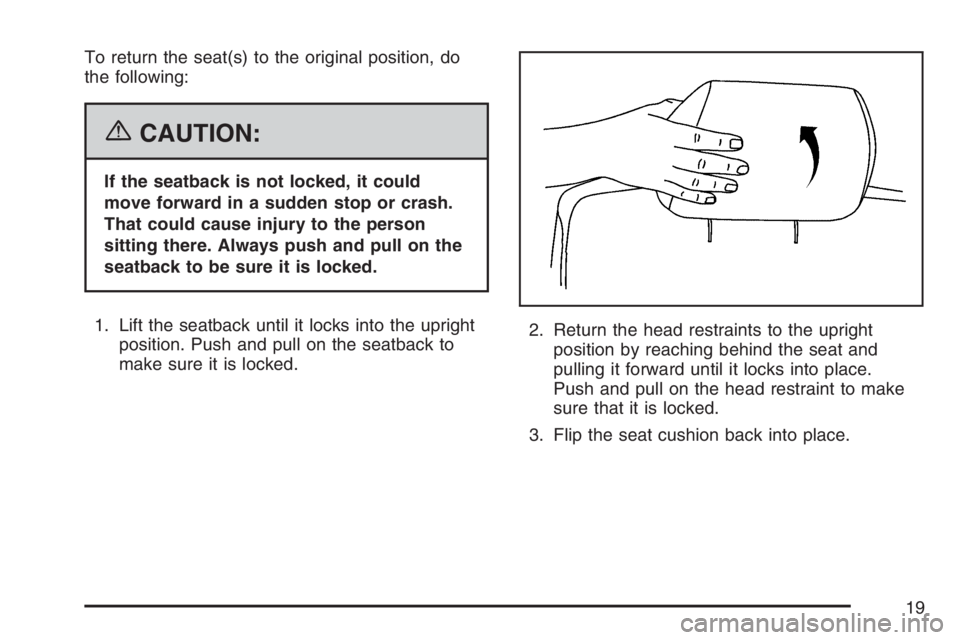
1. Lift the seatback until it locks into the upright
position. Push and pull on the seatback to
make sure it is locked.2. Return the head restraints to the upright
position by reaching behind the seat and
pulling it forward until it locks into place.
Push and pull on the head restraint to make
sure that it is locked.
3. Flip the seat cushion back into place.
19
Page 23 of 562
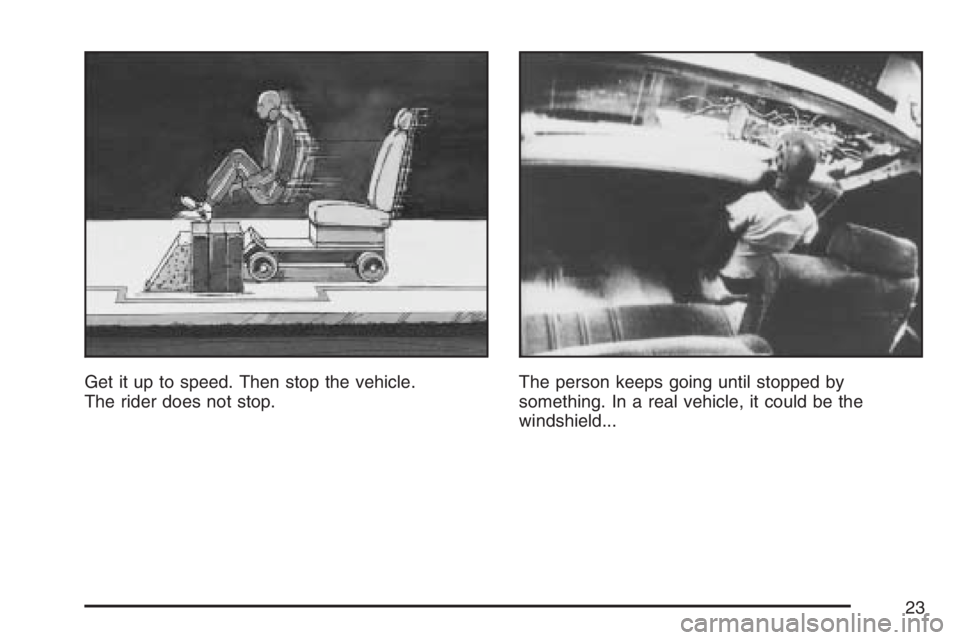
Get it up to speed. Then stop the vehicle.
The rider does not stop.The person keeps going until stopped by
something. In a real vehicle, it could be the
windshield...
23
Page 24 of 562
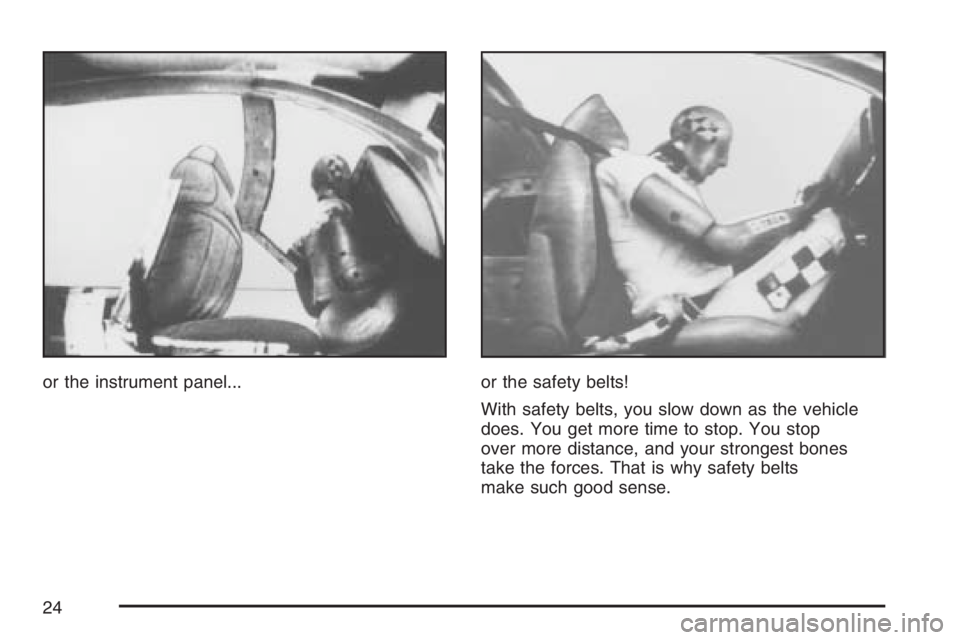
or the instrument panel... or the safety belts!
With safety belts, you slow down as the vehicle
does. You get more time to stop. You stop
over more distance, and your strongest bones
take the forces. That is why safety belts
make such good sense.
24
Page 28 of 562
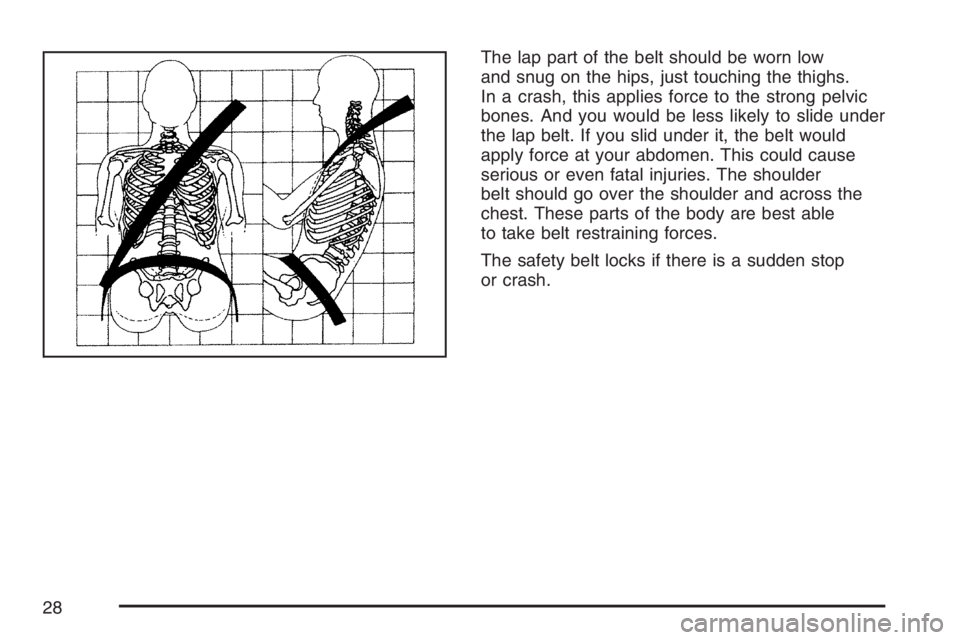
The lap part of the belt should be worn low
and snug on the hips, just touching the thighs.
In a crash, this applies force to the strong pelvic
bones. And you would be less likely to slide under
the lap belt. If you slid under it, the belt would
apply force at your abdomen. This could cause
serious or even fatal injuries. The shoulder
belt should go over the shoulder and across the
chest. These parts of the body are best able
to take belt restraining forces.
The safety belt locks if there is a sudden stop
or crash.
28
Page 37 of 562
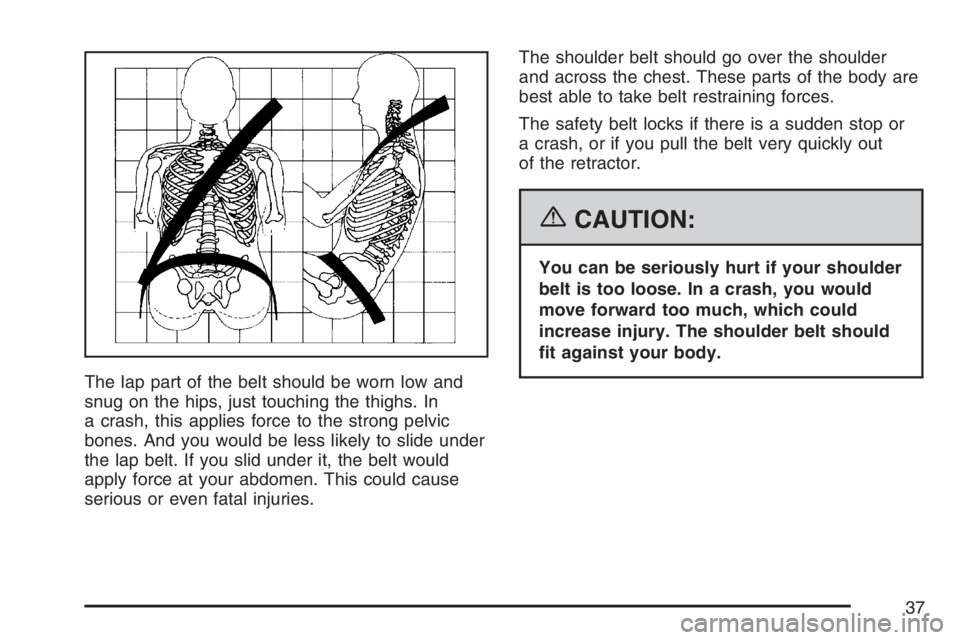
The lap part of the belt should be worn low and
snug on the hips, just touching the thighs. In
a crash, this applies force to the strong pelvic
bones. And you would be less likely to slide under
the lap belt. If you slid under it, the belt would
apply force at your abdomen. This could cause
serious or even fatal injuries.The shoulder belt should go over the shoulder
and across the chest. These parts of the body are
best able to take belt restraining forces.
The safety belt locks if there is a sudden stop or
a crash, or if you pull the belt very quickly out
of the retractor.
{CAUTION:
You can be seriously hurt if your shoulder
belt is too loose. In a crash, you would
move forward too much, which could
increase injury. The shoulder belt should
t against your body.
37
Page 52 of 562
Securing an Add-on Child Restraint in
the Vehicle
{CAUTION:
A child can be seriously injured or killed
in a crash if the child restraint is not
properly secured in the vehicle. Make sure
the child restraint is properly installed in
the vehicle using the vehicle’s safety
belt or LATCH system, following the
instructions that came with that restraint,
and also the instructions in this manual.
To help reduce the chance of injury, the child
restraint must be secured in the vehicle.
Child restraint systems must be secured in vehicle
seats by lap belts or the lap belt portion of a
lap-shoulder belt, or by the LATCH system.SeeLower Anchors and Tethers for Children
(LATCH) on page 56for more information. A
child can be endangered in a crash if the child
restraint is not properly secured in the vehicle.
When securing an add-on child restraint, refer to
the instructions that come with the restraint
which may be on the restraint itself or in a booklet,
or both, and to this manual. The child restraint
instructions are important, so if they are not
available, obtain a replacement copy from the
manufacturer.
Keep in mind that an unsecured child restraint can
move around in a collision or sudden stop and
injure people in the vehicle. Be sure to properly
secure any child restraint in your vehicle — even
when no child is in it.
52
Page 56 of 562
Keep in mind that an unsecured child restraint can
move around in a collision or sudden stop and
injure people in the vehicle. Be sure to properly
secure any child restraint in your vehicle — even
when no child is in it.
Lower Anchors and Tethers for
Children (LATCH)
The LATCH system holds a child restraint during
driving or in a crash. This system is designed
to make installation of a child restraint easier. The
LATCH system uses anchors in the vehicle and
attachments on the child restraint that are made for
use with the LATCH system
Make sure that a LATCH-compatible child restraint
is properly installed using the anchors, or use
the vehicle’s safety belts to secure the restraint,
following the instructions that came with that
restraint, and also the instructions in this manual.When installing a child restraint with a top tether,
you must also use either the lower anchors or
the safety belts to properly secure the child
restraint. A child restraint must never be installed
using only the top tether and anchor.
In order to use the LATCH system in your vehicle,
you need a child restraint that has LATCH
attachments. The child restraint manufacturer will
provide you with instructions on how to use
the child restraint and its attachments. The
following explains how to attach a child restraint
with these attachments in your vehicle.
Not all vehicle seating positions or child restraints
have lower anchors and attachments or top
tether anchors and attachments.
56
Page 80 of 562
How Does an Airbag Restrain?
In moderate to severe frontal or near frontal
collisions, even belted occupants can contact
the steering wheel or the instrument panel.
In moderate to severe side collisions, even belted
occupants can contact the inside of the vehicle.
Airbags supplement the protection provided
by safety belts. Airbags distribute the force of the
impact more evenly over the occupant’s upper
body, stopping the occupant more gradually.
But the frontal airbags would not help you in
many types of collisions, including rollovers, rear
impacts, and many side impacts, primarily because
an occupant’s motion is not toward the airbag.
Roof-mounted rollover airbags would not help
you in many types of collisions, including many
frontal or near frontal collisions, and rear impacts.
Airbags should never be regarded as anything
more than a supplement to safety belts, and
then only in moderate to severe frontal or
near-frontal collisions for the driver’s and right
front passenger’s frontal airbags, and only
in moderate to severe side collisions or rollovers
for vehicles with roof-mounted rollover airbags.
What Will You See After an Airbag
Inates?
After a frontal airbag inates, it quickly deates, so
quickly that some people may not even realize
an airbag inated. Roof-mounted rollover airbags
may still be at least partially inated minutes
after the vehicle comes to rest. Some components
of the airbag module — the steering wheel hub
for the driver’s airbag, the instrument panel for
the right front passenger’s airbag, and the
area along the ceiling of the vehicle near the side
windows for vehicles with roof–mounted side
impact airbags — may be hot for a short time.
The parts of the airbag that come into contact
with you may be warm, but not too hot to touch.
There may be some smoke and dust coming from
the vents in the deated airbags. Airbag ination
does not prevent the driver from seeing out of
the windshield or being able to steer the vehicle,
nor does it prevent people from leaving the vehicle.
80