washer GMC ENVOY DENALI 2007 Owners Manual
[x] Cancel search | Manufacturer: GMC, Model Year: 2007, Model line: ENVOY DENALI, Model: GMC ENVOY DENALI 2007Pages: 562, PDF Size: 2.87 MB
Page 165 of 562
Instrument Panel Overview........................ 168
Hazard Warning Flashers.......................... 170
Other Warning Devices............................. 170
Horn.......................................................... 170
Tilt Wheel.................................................. 171
Turn Signal/Multifunction Lever.................. 171
Turn and Lane-Change Signals................. 172
Headlamp High/Low-Beam Changer.......... 173
Flash-to-Pass............................................ 173
Windshield Wipers..................................... 173
Windshield Washer.................................... 174
Rear Window Wiper/Washer...................... 174
Headlamp Washer..................................... 175
Cruise Control........................................... 176
Headlamps................................................ 179
Headlamps on Reminder........................... 180
Daytime Running Lamps (DRL)................. 180
Automatic Headlamp System..................... 181
Fog Lamps................................................ 182
Instrument Panel Brightness...................... 182
Dome Lamps............................................. 182
Dome Lamp Override................................ 183
Entry Lighting............................................ 183
Exit Lighting.............................................. 183Reading Lamps......................................... 183
Electric Power Management...................... 184
Battery Run-Down Protection..................... 185
Accessory Power Outlet(s)........................ 185
Ashtray(s) and Cigarette Lighter................ 186
Climate Controls......................................... 186
Dual Climate Control System..................... 186
Dual Automatic Climate Control System.... 189
Outlet Adjustment...................................... 194
Rear Climate Control System.................... 195
Warning Lights, Gages, and Indicators..... 197
Instrument Panel Cluster........................... 198
Speedometer and Odometer...................... 199
Trip Odometer........................................... 199
Tachometer............................................... 199
Safety Belt Reminder Light........................ 200
Passenger Safety Belt Reminder Light....... 200
Airbag Readiness Light............................. 201
Passenger Airbag Status Indicator............. 202
Charging System Light.............................. 205
Voltmeter Gage......................................... 205
Brake System Warning Light..................... 206
Anti-Lock Brake System Warning Light...... 207
Section 3 Instrument Panel
165
Page 169 of 562
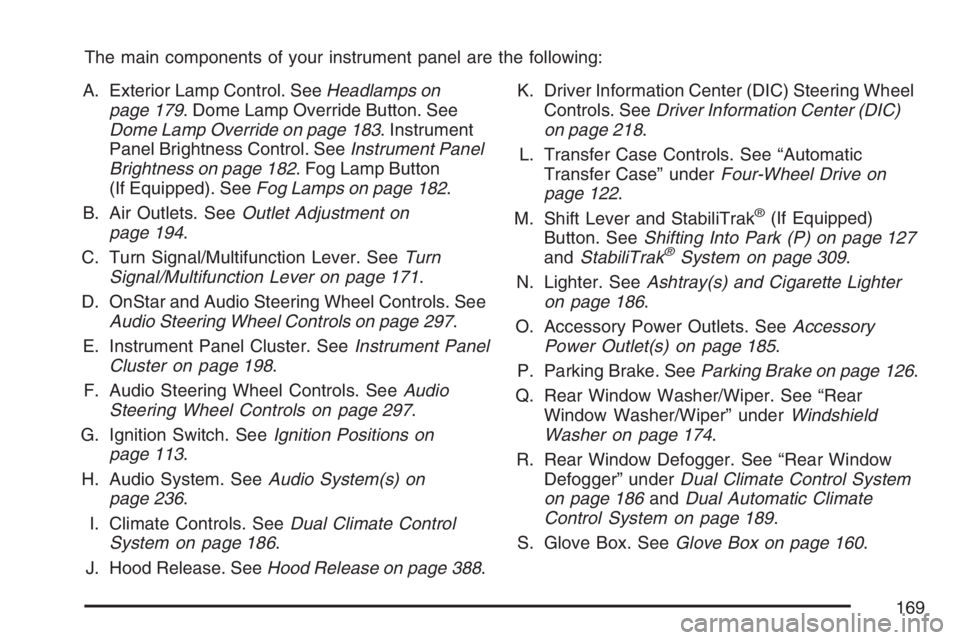
The main components of your instrument panel are the following:
A. Exterior Lamp Control. SeeHeadlamps on
page 179. Dome Lamp Override Button. See
Dome Lamp Override on page 183. Instrument
Panel Brightness Control. SeeInstrument Panel
Brightness on page 182. Fog Lamp Button
(If Equipped). SeeFog Lamps on page 182.
B. Air Outlets. SeeOutlet Adjustment on
page 194.
C. Turn Signal/Multifunction Lever. SeeTurn
Signal/Multifunction Lever on page 171.
D. OnStar and Audio Steering Wheel Controls. See
Audio Steering Wheel Controls on page 297.
E. Instrument Panel Cluster. SeeInstrument Panel
Cluster on page 198.
F. Audio Steering Wheel Controls. SeeAudio
Steering Wheel Controls on page 297.
G. Ignition Switch. SeeIgnition Positions on
page 113.
H. Audio System. SeeAudio System(s) on
page 236.
I. Climate Controls. SeeDual Climate Control
System on page 186.
J. Hood Release. SeeHood Release on page 388.K. Driver Information Center (DIC) Steering Wheel
Controls. SeeDriver Information Center (DIC)
on page 218.
L. Transfer Case Controls. See “Automatic
Transfer Case” underFour-Wheel Drive on
page 122.
M. Shift Lever and StabiliTrak
®(If Equipped)
Button. SeeShifting Into Park (P) on page 127
andStabiliTrak
®System on page 309.
N. Lighter. SeeAshtray(s) and Cigarette Lighter
on page 186.
O. Accessory Power Outlets. SeeAccessory
Power Outlet(s) on page 185.
P. Parking Brake. SeeParking Brake on page 126.
Q. Rear Window Washer/Wiper. See “Rear
Window Washer/Wiper” underWindshield
Washer on page 174.
R. Rear Window Defogger. See “Rear Window
Defogger” underDual Climate Control System
on page 186andDual Automatic Climate
Control System on page 189.
S. Glove Box. SeeGlove Box on page 160.
169
Page 171 of 562
Tilt Wheel
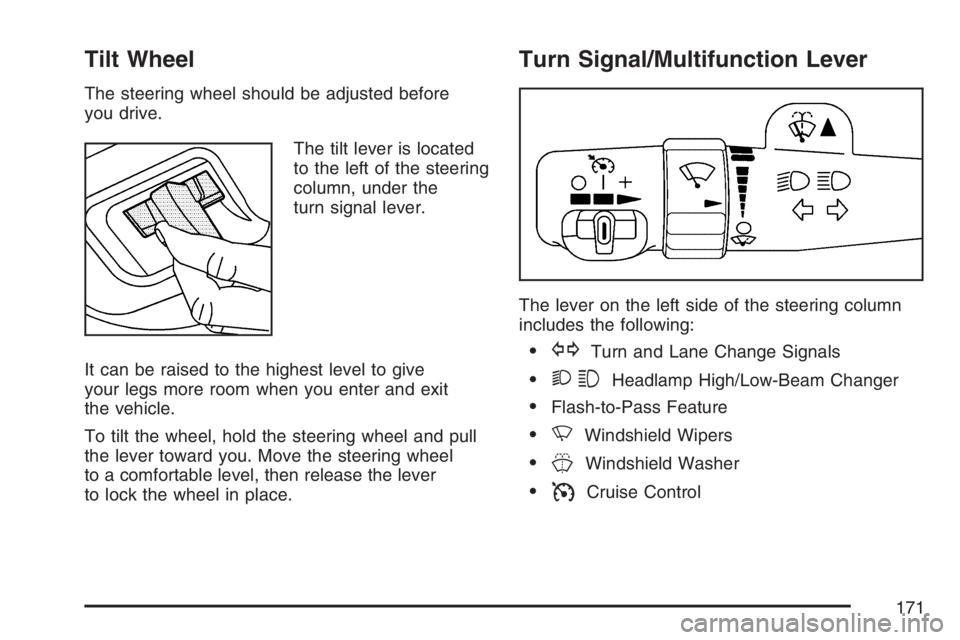
The steering wheel should be adjusted before
you drive.
The tilt lever is located
to the left of the steering
column, under the
turn signal lever.
It can be raised to the highest level to give
your legs more room when you enter and exit
the vehicle.
To tilt the wheel, hold the steering wheel and pull
the lever toward you. Move the steering wheel
to a comfortable level, then release the lever
to lock the wheel in place.
Turn Signal/Multifunction Lever
The lever on the left side of the steering column
includes the following:
GTurn and Lane Change Signals
23Headlamp High/Low-Beam Changer
Flash-to-Pass Feature
NWindshield Wipers
JWindshield Washer
ICruise Control
171
Page 174 of 562
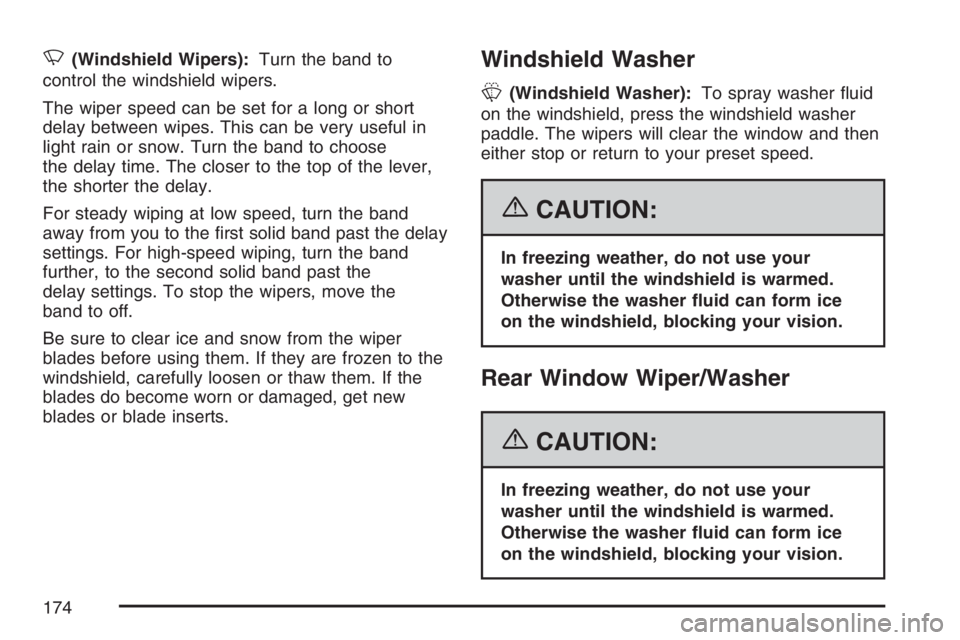
N(Windshield Wipers):Turn the band to
control the windshield wipers.
The wiper speed can be set for a long or short
delay between wipes. This can be very useful in
light rain or snow. Turn the band to choose
the delay time. The closer to the top of the lever,
the shorter the delay.
For steady wiping at low speed, turn the band
away from you to the rst solid band past the delay
settings. For high-speed wiping, turn the band
further, to the second solid band past the
delay settings. To stop the wipers, move the
band to off.
Be sure to clear ice and snow from the wiper
blades before using them. If they are frozen to the
windshield, carefully loosen or thaw them. If the
blades do become worn or damaged, get new
blades or blade inserts.Windshield Washer
L(Windshield Washer):To spray washer uid
on the windshield, press the windshield washer
paddle. The wipers will clear the window and then
either stop or return to your preset speed.
{CAUTION:
In freezing weather, do not use your
washer until the windshield is warmed.
Otherwise the washer uid can form ice
on the windshield, blocking your vision.
Rear Window Wiper/Washer
{CAUTION:
In freezing weather, do not use your
washer until the windshield is warmed.
Otherwise the washer uid can form ice
on the windshield, blocking your vision.
174
Page 175 of 562
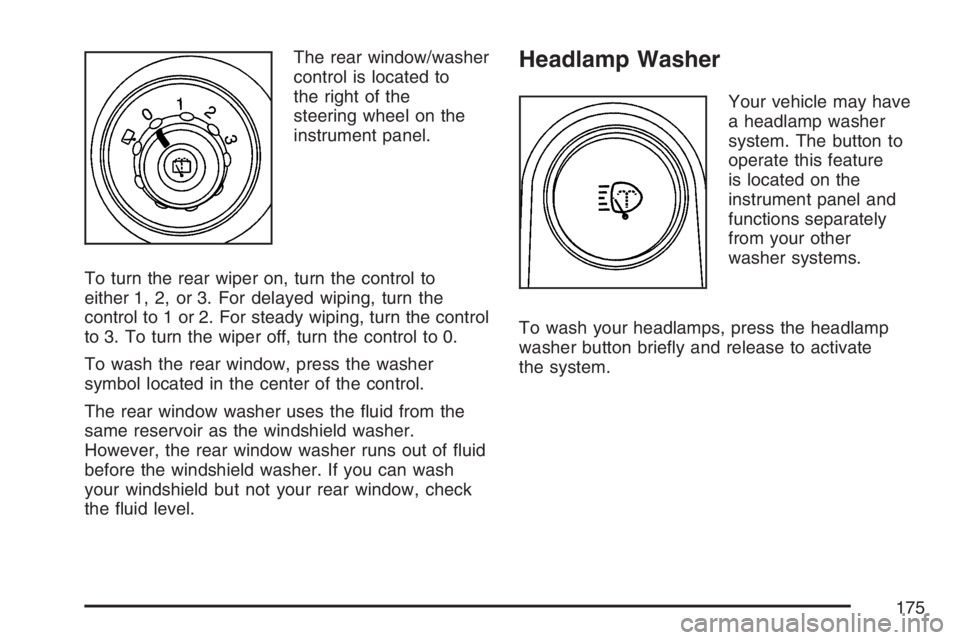
The rear window/washer
control is located to
the right of the
steering wheel on the
instrument panel.
To turn the rear wiper on, turn the control to
either 1, 2, or 3. For delayed wiping, turn the
control to 1 or 2. For steady wiping, turn the control
to 3. To turn the wiper off, turn the control to 0.
To wash the rear window, press the washer
symbol located in the center of the control.
The rear window washer uses the uid from the
same reservoir as the windshield washer.
However, the rear window washer runs out of uid
before the windshield washer. If you can wash
your windshield but not your rear window, check
the uid level.Headlamp Washer
Your vehicle may have
a headlamp washer
system. The button to
operate this feature
is located on the
instrument panel and
functions separately
from your other
washer systems.
To wash your headlamps, press the headlamp
washer button briey and release to activate
the system.
175
Page 223 of 562

If this message appears on the DIC, stop as soon
as you can. Have the tire pressures checked
and set to those shown on the Tire Loading
Information Label. SeeTires on page 439,Loading
Your Vehicle on page 349, andInation - Tire
Pressure on page 447. If the tire pressure is low,
the low tire pressure warning light comes on.
SeeTire Pressure Light on page 209.
CHECK WASHER FLUID
This message displays if the washer uid level is
low. Adding washer uid to the windshield
washer uid reservoir clears this message. See
Windshield Washer Fluid on page 418. This
message clears itself after 10 seconds, or you can
press any of the DIC buttons, or the trip stem,
to acknowledge this message and clear it from the
DIC display.
CURB VIEW ACTIVATED
This message displays when the passenger
outside rearview mirror moves into the curb view
position. SeeOutside Curb View Assist Mirror
on page 144for more information.
DRIVER DOOR AJAR
This message displays and a chime sounds if the
driver’s door is not fully closed. Stop and turn
off the vehicle, check the door for obstructions, and
close the door again. Check to see if the
message still appears on the DIC. Press any of
the DIC buttons, or the trip stem, to acknowledge
this message and clear it from the DIC display.
223
Page 336 of 562

The heavier the rain, the harder it is to see. Even if
your windshield wiper blades are in good shape, a
heavy rain can make it harder to see road signs and
traffic signals, pavement markings, the edge of the
road, and even people walking.
It is wise to keep your wiping equipment in good
shape and keep your windshield washer uid
reservoir lled with washer uid. Replace your
windshield wiper inserts when they show signs of
streaking or missing areas on the windshield, or
when strips of rubber start to separate from the
inserts.
{CAUTION:
Wet brakes can cause accidents. They may
not work as well in a quick stop and may
cause pulling to one side. You could lose
control of the vehicle.
After driving through a large puddle of
water or a car wash, apply your brake pedal
lightly until your brakes work normally.Driving too fast through large water puddles or
even going through some car washes can cause
problems, too. The water may affect your brakes.
Try to avoid puddles. But if you cannot, try to slow
down before you hit them.
Hydroplaning
Hydroplaning is dangerous. So much water can
build up under your tires that they can actually ride
on the water. This can happen if the road is wet
enough and you are going fast enough. When your
vehicle is hydroplaning, it has little or no contact
with the road.
Hydroplaning does not happen often. But it can
if your tires do not have much tread or if the
pressure in one or more is low. It can happen if a
lot of water is standing on the road. If you can
see reections from trees, telephone poles,
or other vehicles, and raindrops dimple the water’s
surface, there could be hydroplaning.
Hydroplaning usually happens at higher speeds.
There just is not a hard and fast rule about
hydroplaning. The best advice is to slow down
when it is raining.
336
Page 341 of 562
Here are some things you can check before a trip:
Windshield Washer Fluid:Is the reservoir
full? Are all windows clean inside and outside?
Wiper Blades:Are they in good shape?
Fuel, Engine Oil, Other Fluids:Have you
checked all levels?
Lamps:Are they all working? Are the lenses
clean?
Tires:They are vitally important to a safe,
trouble-free trip. Is the tread good enough
for long-distance driving? Are the tires
all inated to the recommended pressure?
Weather Forecasts:What is the weather
outlook along your route? Should you
delay your trip a short time to avoid a major
storm system?
Maps:Do you have up-to-date maps?
Highway Hypnosis
Is there actually such a condition as highway
hypnosis? Or is it just plain falling asleep at the
wheel? Call it highway hypnosis, lack of
awareness, or whatever.
There is something about an easy stretch of road
with the same scenery, along with the hum of the
tires on the road, the drone of the engine, and the
rush of the wind against the vehicle that can make
you sleepy. Do not let it happen to you! If it does,
your vehicle can leave the road in less than a
second, and you could crash and be injured.
What can you do about highway hypnosis?
First, be aware that it can happen.
Then here are some tips:
Make sure your vehicle is well ventilated, with
a comfortably cool interior.
Keep your eyes moving. Scan the road ahead
and to the sides. Check your mirrors and your
instruments frequently.
If you get sleepy, pull off the road into a rest,
service, or parking area and take a nap, get
some exercise, or both. For safety, treat
drowsiness on the highway as an emergency.
341
Page 344 of 562
Winter Driving
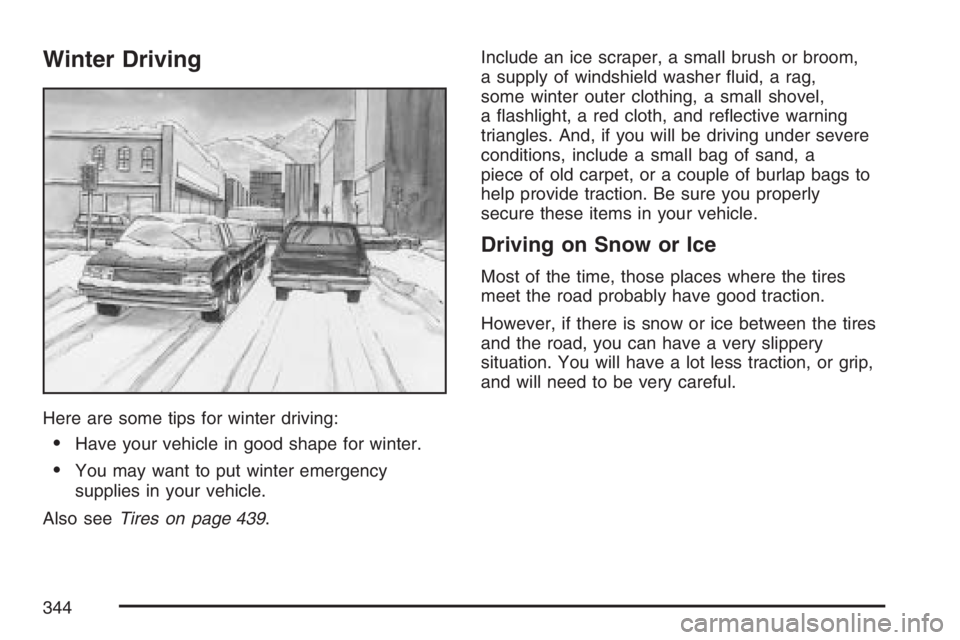
Here are some tips for winter driving:
Have your vehicle in good shape for winter.
You may want to put winter emergency
supplies in your vehicle.
Also seeTires on page 439.Include an ice scraper, a small brush or broom,
a supply of windshield washer uid, a rag,
some winter outer clothing, a small shovel,
a ashlight, a red cloth, and reective warning
triangles. And, if you will be driving under severe
conditions, include a small bag of sand, a
piece of old carpet, or a couple of burlap bags to
help provide traction. Be sure you properly
secure these items in your vehicle.
Driving on Snow or Ice
Most of the time, those places where the tires
meet the road probably have good traction.
However, if there is snow or ice between the tires
and the road, you can have a very slippery
situation. You will have a lot less traction, or grip,
and will need to be very careful.
344
Page 377 of 562
Service........................................................ 380
Accessories and Modications................... 380
California Proposition 65 Warning.............. 381
Doing Your Own Service Work.................. 381
Adding Equipment to the Outside of
Your Vehicle.......................................... 382
Fuel............................................................. 382
Gasoline Octane........................................ 382
Gasoline Specications.............................. 383
California Fuel........................................... 383
Additives................................................... 383
Fuels in Foreign Countries........................ 384
Filling the Tank......................................... 385
Filling a Portable Fuel Container............... 387
Checking Things Under the Hood.............. 388
Hood Release........................................... 388
Engine Compartment Overview.................. 390
Engine Oil................................................. 394
Engine Oil Life System.............................. 398
Engine Air Cleaner/Filter............................ 400
Automatic Transmission Fluid.................... 401
Engine Coolant.......................................... 405Radiator Pressure Cap.............................. 408
Engine Overheating................................... 408
Cooling System......................................... 411
Engine Fan Noise..................................... 416
Power Steering Fluid ................................. 417
Windshield Washer Fluid........................... 418
Brakes...................................................... 419
Battery...................................................... 422
Jump Starting............................................ 423
Rear Axle.................................................... 428
Four-Wheel Drive........................................ 428
Front Axle................................................... 429
Bulb Replacement....................................... 430
Halogen Bulbs........................................... 430
Headlamps................................................ 431
Front Turn Signal, Sidemarker and
Parking Lamps....................................... 432
Taillamps, Turn Signal, and Stoplamps...... 432
Back-Up Lamps......................................... 434
License Plate Lamp................................... 435
Replacement Bulbs................................... 435
Section 5 Service and Appearance Care
377