parking GMC ENVOY DENALI 2009 Owners Manual
[x] Cancel search | Manufacturer: GMC, Model Year: 2009, Model line: ENVOY DENALI, Model: GMC ENVOY DENALI 2009Pages: 474, PDF Size: 2.54 MB
Page 77 of 474
Keys...............................................................2-3
Remote Keyless Entry (RKE) System................2-4
Remote Keyless Entry (RKE) System
Operation...................................................2-5
Doors and Locks.............................................2-7
Door Locks....................................................2-7
Power Door Locks..........................................2-8
Delayed Locking.............................................2-8
Programmable Automatic Door Locks................2-9
Rear Door Security Locks..............................2-11
Lockout Protection........................................2-11
Liftgate/Liftglass............................................2-12
Windows........................................................2-13
Power Windows............................................2-14
Sun Visors...................................................2-15
Theft-Deterrent Systems..................................2-16
Content Theft-Deterrent.................................2-16
Passlock
®(U.S. Only)...................................2-17
PASS-Key®III+ Electronic Immobilizer.............2-18
PASS-Key®III+ Electronic Immobilizer
Operation (Canada Only)............................2-18Starting and Operating Your Vehicle................2-20
New Vehicle Break-In....................................2-20
Ignition Positions..........................................2-21
Retained Accessory Power (RAP)...................2-22
Starting the Engine.......................................2-22
Adjustable Throttle and Brake Pedal................2-23
Engine Coolant Heater..................................2-24
Active Fuel Management™.............................2-25
Automatic Transmission Operation...................2-25
Four-Wheel Drive..........................................2-28
Parking Brake..............................................2-33
Shifting Into Park..........................................2-34
Shifting Out of Park......................................2-36
Parking Over Things That Burn.......................2-36
Engine Exhaust............................................2-37
Running the Vehicle While Parked..................2-38
Mirrors...........................................................2-39
Manual Rearview Mirror.................................2-39
Automatic Dimming Rearview Mirror................2-39
Compass.....................................................2-40
Outside Manual Mirrors..................................2-41
Outside Power Mirrors...................................2-42
Outside Convex Mirror...................................2-42
Outside Heated Mirrors..................................2-42
Section 2 Features and Controls
2-1
Page 81 of 474

Remote Keyless Entry (RKE)
System Operation
The Remote Keyless Entry (RKE) transmitter functions
work up to 30 feet (9 m) away from the vehicle.
There are other conditions which can affect the
performance of the transmitter. SeeRemote Keyless
Entry (RKE) System on page 2-4.
K(Unlock): Press once to
unlock the driver door. The
parking lamps ash and
the interior lights come on.
Press
Ka second time
within three seconds
to unlock all the doors.
To program different feedback settings through the
Driver Information Center (DIC), seeDriver Information
Center (DIC) on page 3-47.
Q(Lock):Press to lock all the doors. PressQagain
within three seconds and the horn chirps.
L(Panic):Press to sound the horn. The headlamps
and taillamps ash for up to 30 seconds. To turn it
off, press
Lagain, or wait 30 seconds, or start
the vehicle.
Programming Transmitters to the
Vehicle
Only RKE transmitters programmed to the vehicle will
work. If a transmitter is lost or stolen, a replacement can
be purchased and programmed through your
dealer/retailer. When the replacement transmitter is
programmed to the vehicle, all remaining transmitters
must also be programmed. Any lost or stolen
transmitters no longer work once the new transmitter is
programmed. Each vehicle can have up to four
transmitters programmed to it.
2-5
Page 92 of 474
Theft-Deterrent Systems
Vehicle theft is big business, especially in some cities.
This vehicle has theft-deterrent features, however,
they do not make it impossible to steal.
Content Theft-Deterrent
Your vehicle may have a content theft-deterrent alarm
system.
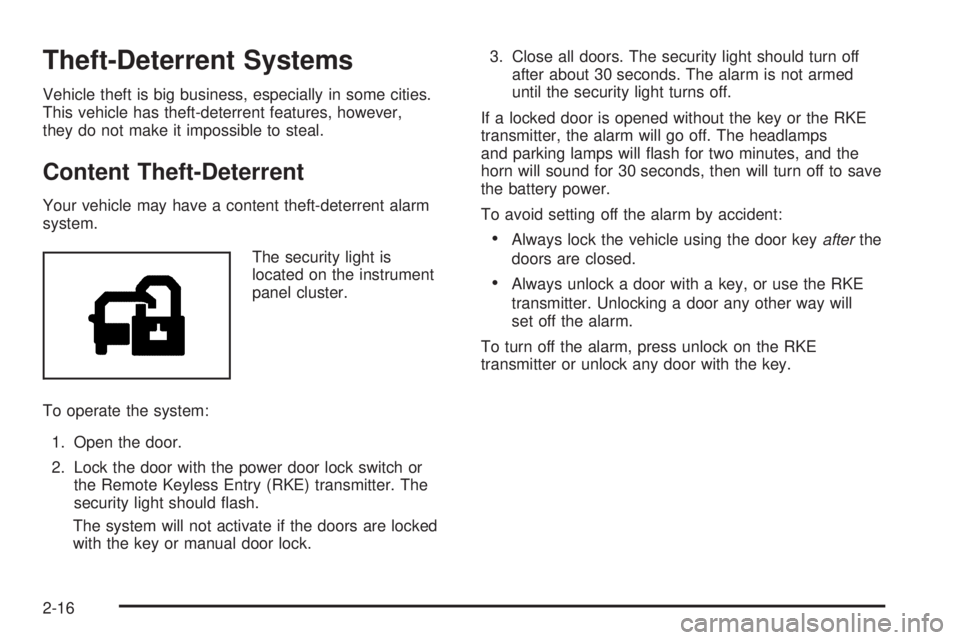
The security light is
located on the instrument
panel cluster.
To operate the system:
1. Open the door.
2. Lock the door with the power door lock switch or
the Remote Keyless Entry (RKE) transmitter. The
security light should ash.
The system will not activate if the doors are locked
with the key or manual door lock.3. Close all doors. The security light should turn off
after about 30 seconds. The alarm is not armed
until the security light turns off.
If a locked door is opened without the key or the RKE
transmitter, the alarm will go off. The headlamps
and parking lamps will ash for two minutes, and the
horn will sound for 30 seconds, then will turn off to save
the battery power.
To avoid setting off the alarm by accident:
Always lock the vehicle using the door keyafterthe
doors are closed.
Always unlock a door with a key, or use the RKE
transmitter. Unlocking a door any other way will
set off the alarm.
To turn off the alarm, press unlock on the RKE
transmitter or unlock any door with the key.
2-16
Page 100 of 474
Engine Coolant Heater
The engine coolant heater can provide easier starting
and better fuel economy during engine warm-up in cold
weather conditions at or below 0°F (−18°C). Vehicles
with an engine coolant heater should be plugged
in at least four hours before starting the vehicle. An
internal thermostat in the plug-end of the cord may exist
which will prevent engine coolant heater operation at
temperatures above 0°F (−18°C).
To Use the Engine Coolant Heater
1. Turn off the engine.
2. Open the hood and unwrap the electrical cord. The
cord is located on the driver side of the engine
compartment next to the battery box facing
the engine.
3. Plug it into a normal, grounded 110-Volt AC outlet.
{CAUTION:
Plugging the cord into an ungrounded outlet could
cause an electrical shock. Also, the wrong kind of
extension cord could overheat and cause a re.
You could be seriously injured. Plug the cord into
a properly grounded three-prong 110-volt AC
outlet. If the cord will not reach, use a heavy-duty
three-prong extension cord rated for at least
15 amps.
4. Before starting the engine, be sure to unplug and
store the cord as it was before to keep it away
from moving engine parts and prevent damage.
The length of time the heater should remain plugged in
depends on several factors. Ask a dealer/retailer in
the area where you will be parking the vehicle for the
best advice on this.
2-24
Page 102 of 474
P (Park):This position locks the rear wheels. It is the
best position to use when you start the engine because
the vehicle cannot move easily.
{CAUTION:
It is dangerous to get out of the vehicle if the shift
lever is not fully in P (Park) with the parking brake
rmly set. The vehicle can roll.
Do not leave the vehicle when the engine is
running unless you have to. If you have left the
engine running, the vehicle can move suddenly.
You or others could be injured. To be sure the
vehicle will not move, even when you are on fairly
level ground, always set the parking brake and
move the shift lever to P (Park). SeeShifting Into
Park on page 2-34. If you are pulling a trailer, see
Towing a Trailer on page 4-46.
{CAUTION:
If you have four-wheel drive, the vehicle will be free
to roll — even if the shift lever is in P (Park) — if the
transfer case is in Neutral. So, be sure the transfer
case is in a drive gear — not in Neutral. See
Four-Wheel Drive on page 2-28. SeeShifting Into
Park on page 2-34.
Make sure the shift lever is fully in P (Park) before
starting the engine. The vehicle has an automatic
transmission shift lock control system. You have to fully
apply the brake pedal, then press the shift lever
button before you can shift from P (Park) when the
ignition key is in ON/RUN. If you cannot shift out
of P (Park), ease pressure on the shift lever and push
the shift lever all the way into P (Park) as you maintain
brake application. Then press the shift lever button
and move the shift lever into another gear. SeeShifting
Out of Park on page 2-36.
2-26
Page 106 of 474
4n(Four-Wheel Low):This setting also engages the
front axle and delivers extra torque. It sends maximum
power to all four wheels. You might choose this setting if
you are driving off-road in deep sand, deep mud, and
climbing or descending steep hills.
{CAUTION:
Shifting the transfer case to Neutral can cause the
vehicle to roll even if the transmission is in
P (Park). You or someone else could be seriously
injured. Be sure to set the parking brake before
placing the transfer case in Neutral. SeeParking
Brake on page 2-33.
Neutral:Shift the vehicle’s transfer case to Neutral only
when towing the vehicle. SeeRecreational Vehicle
Towing on page 4-38for more information.An indicator light in the knob will show you which
position the transfer case is in. The indicator lights will
come on briey when you turn on the ignition and
one will stay on. If the lights do not come on, you should
take the vehicle to your dealer/retailer for service. An
indicator light will ash while shifting the transfer case. It
will stay on when the shift is complete. If the transfer
case cannot make a requested shift, it will return to the
last chosen setting.
If the service Four-Wheel Drive Warning Light on the
instrument panel cluster stays on, you should take
the vehicle to your dealer/retailer for service. See
Service Four-Wheel Drive Warning Light on page 3-44
for further information.
Shifting Into Four-Wheel High or Automatic
Four-Wheel Drive
Turn the knob to Four-Wheel High or Automatic
Four-Wheel Drive. This can be done at any speed
unless you are shifting out of Four-Wheel Low. The
indicator light will ash while shifting. It will remain on
when the shift is complete.
2-30
Page 108 of 474
Shifting into Neutral
Before shifting the transfer case to Neutral, rst make
sure the vehicle is parked so that it will not roll.
1. Set the parking brake.
2. Start the vehicle.
3. Put the transmission in N (Neutral).
4. Shift the transfer case to Two-Wheel High.
5. Turn the transfer case knob all of the way past
Four-Wheel Low and hold it there for a minimum
of 10 seconds. The Neutral indicator light will
come on.
6. With the engine running, shift the transmission to
R (Reverse) for one second, then shift the
transmission to D (Drive) for one second, to ensure
that the transfer case is in Neutral.
7. Turn the engine off, by turning the key to
ACC/ACCESSORY.
8. Place the transmission shift lever in P (Park).
9. Turn the ignition to LOCK/OFF.
Shifting Out of Neutral
To shift the transfer case out of Neutral, do the following:
1. Set the parking brake and apply the regular brake
pedal.
2. Turn the ignition to ON/RUN with the engine off.
3. Put the transmission in N (Neutral).
4. Turn the transfer case knob to the desired position
(Two-Wheel High, Four-Wheel High, or Auto
Four-Wheel Drive).
5. After the transfer case has shifted out of Neutral,
the indicator light will go out.
6. Release the parking brake.
7. Start the engine and shift the transmission to the
desired position.
2-32
Page 109 of 474
Parking Brake
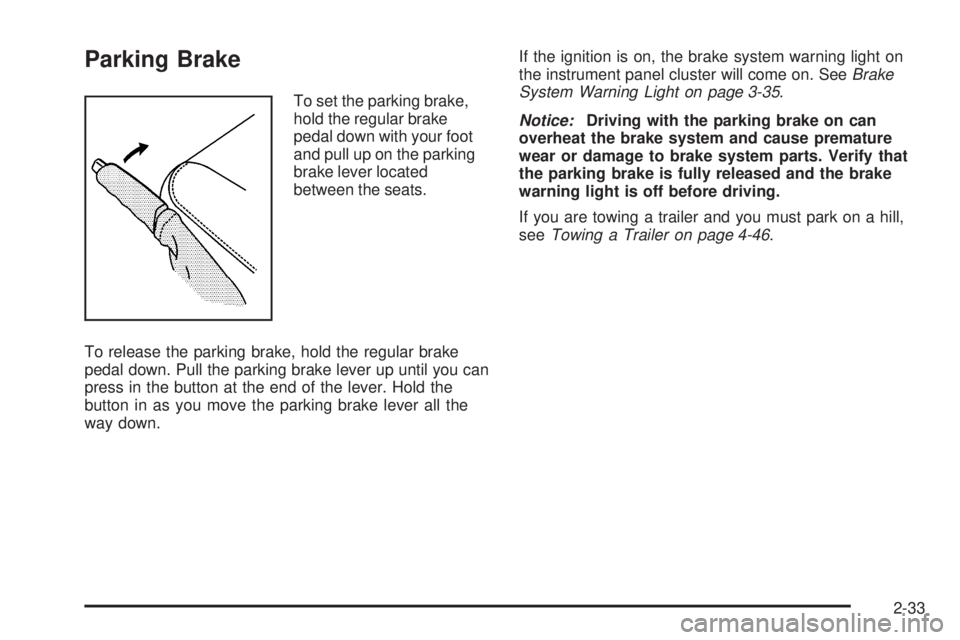
To set the parking brake,
hold the regular brake
pedal down with your foot
and pull up on the parking
brake lever located
between the seats.
To release the parking brake, hold the regular brake
pedal down. Pull the parking brake lever up until you can
press in the button at the end of the lever. Hold the
button in as you move the parking brake lever all the
way down.If the ignition is on, the brake system warning light on
the instrument panel cluster will come on. SeeBrake
System Warning Light on page 3-35.
Notice:Driving with the parking brake on can
overheat the brake system and cause premature
wear or damage to brake system parts. Verify that
the parking brake is fully released and the brake
warning light is off before driving.
If you are towing a trailer and you must park on a hill,
seeTowing a Trailer on page 4-46.
2-33
Page 110 of 474
Shifting Into Park
{CAUTION:
It can be dangerous to get out of the vehicle if the
shift lever is not fully in P (Park) with the parking
brake rmly set. The vehicle can roll. If you have
left the engine running, the vehicle can move
suddenly. You or others could be injured. To be
sure the vehicle will not move, even when you are
on fairly level ground, use the steps that follow.
With four-wheel drive, the vehicle will be free to
roll — even if the shift lever is in P (Park) — if your
transfer case is in Neutral. So, be sure the transfer
case is in a drive gear — not in Neutral. See
Four-Wheel Drive on page 2-28. Always put the
shift lever fully in P (Park) with the parking brake
rmly set. If you are pulling a trailer, seeTowing a
Trailer on page 4-46.To shift into P (Park):
1. Hold the brake pedal down with your foot and set
the parking brake.
2. Move the shift lever into P (Park) by pressing the
button on the side of the shift lever and pushing
the lever all the way toward the front of the vehicle.
3. Turn the ignition key to OFF/LOCK.
4. Remove the key and take it with you. You know the
vehicle is in P (Park) if the key can be removed
from the ignition.
2-34
Page 111 of 474
Leaving the Vehicle With the Engine
Running
{CAUTION:
It can be dangerous to leave the vehicle with the
engine running. The vehicle could move suddenly
if the shift lever is not fully in P (Park) with the
parking brake rmly set.
If you have four-wheel drive, the vehicle will be
free to roll – even if your lever is in P (Park) – if
the transfer case is in Neutral. So be sure the
transfer case is in a drive gear – not Neutral. See
Four-Wheel Drive on page 2-28.
And, if you leave the vehicle with the engine
running, it could overheat and even catch re.
You or others could be injured. Do not leave the
vehicle with the engine running unless you
have to.If you have to leave the vehicle with the engine running,
be sure the vehicle is in P (Park) and the parking
brake is rmly set before you leave it. After you have
moved the shift lever into P (Park), hold the regular
brake pedal down. Then, see if you can move the shift
lever away from P (Park) without rst pressing the
button on the console shift lever. If you can, it means
that the shift lever was not fully locked into P (Park).
Torque Lock
If you are parking on a hill and you do not shift your
transmission into P (Park) properly, the weight of
the vehicle may put too much force on the parking pawl
in the transmission. You may nd it difficult to pull the
shift lever out of P (Park). This is called “torque lock.” To
prevent torque lock, set the parking brake and then
shift into P (Park) properly before you leave the driver
seat. To nd out how, seeShifting Into Park on
page 2-34.
When you are ready to drive, move the shift lever out of
P (Park) before you release the parking brake.
If torque lock does occur, you may need to have another
vehicle push yours a little uphill to take some of the
pressure from the parking pawl in the transmission, so
you can pull the shift lever out of P (Park).
2-35