maintenance GMC JIMMY 1997 User Guide
[x] Cancel search | Manufacturer: GMC, Model Year: 1997, Model line: JIMMY, Model: GMC JIMMY 1997Pages: 410, PDF Size: 20.03 MB
Page 280 of 410

Four-wheel Drive and
All-Wheel Drive
Most lubricant checks in this section also apply to
four-wheel-drive vehicles. However, they have two
additional systems that need lubrication.
Transfer Case
When to Check Lubricant
Refer to the Maintenance Schedule to determine how
often to check the lubricant. See "Periodic Maintenance
Inspections"
in the Index.
How. to Check Lubricant
If the level is below the bottom of the filler plug hole,
you'll need to add some lubricant. Add enough lubricant
to raise the level
to the bottom of the filler plug hole.
What to Use
Refer to the Maintcnance Schedule to determine what
kind of lubricant to use. See "Recommended Fluids and
Lubricants" in the Index.
6-21
Page 281 of 410
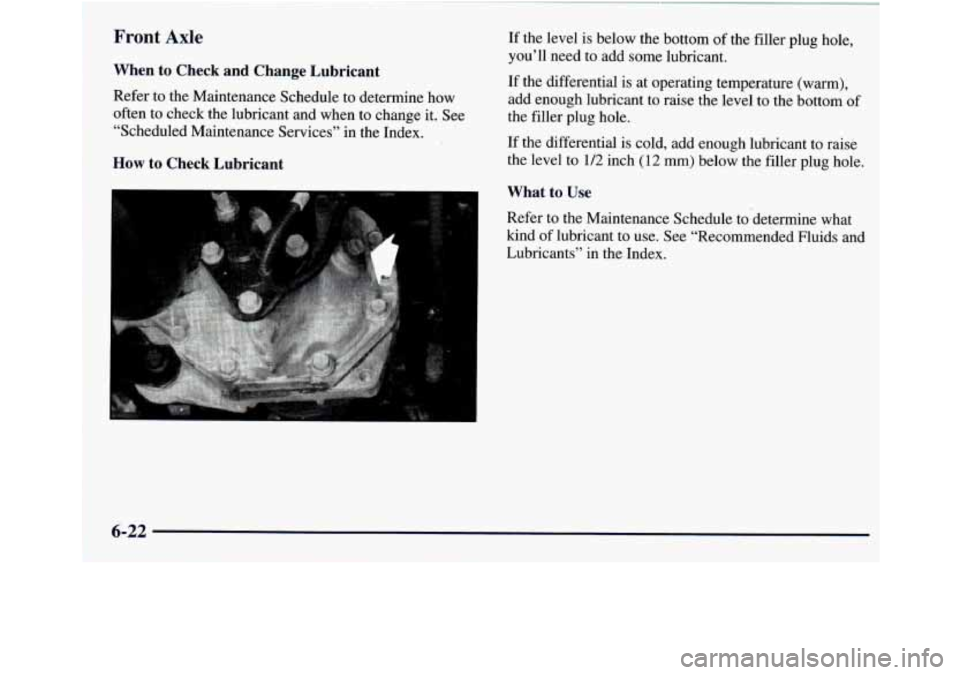
Front Axle
When to Check and Change Lubricant
Refer to the Maintenance Schedule to determine how
often to check the lubricant and when to change it. See
“Scheduled Maintenance Services” in the Index.
How to Check Lubricant
If the level is below the bottom of the filler plug hole,
you’ll need to add same lubricant.
If the differential is at operating temperature (warm),
add enough lubricant to raise the level to the bottom af
the filler plug hole.
If the differential is cold, add enough lubricant to raise
the level to 1/2 inch (12 mm) beluw the filler plug hole.
What to Use
Refer to the Maintenance Schedule to determine what
kind
of lubricant to use. See “Recommended Fluids and
Lubricants”
in the Index.
6-22
Page 288 of 410

There are only two reasons why the brake fluid level in
the reservoir might go down. The first is that the brake
fluid goes down to an acceptable level during normal
brake lining wear. When new linings are put in, the fluid
level goes back up. The other reason is that fluid is
leaking out of the brake system. If it is, you should have
your brake system fixed, since a leak means that sooner
or later your brakes won’t work well, or won’t work
at all.
So, it isn’t a good idea to “top off’ your brake fluid.
Adding brake fluid won’t correct a leak. If you add fluid
when your linings
are worn, then you’ll have too much
fluid when you get new brake linings. You should add
(or remove) brake fluid, as necessary, only when work is
done on the brake hydraulic system. Refer
to the Maintenance Schedule to determine when to
check your brake fluid. See “Periodic Maintenance
Inspections” in the Index.
Checking Brake Fluid
If you have too much brake fluid, it can spill on the
engine. The fluid
wiu burn if the engine is hot
enough.
You or others could be burned, and your
vehicle could
be damaged. Add brake fluid only
when work
is done on the brake hydraulic system.
I
You can check the brake fluid without taking off the cap.
Just look at the windows on the brake fluid reservoir. The fluid levels should be above MIN. If they aren’t,
have your brake system checked to see
if there is a leak.
After work is done on the brake hydraulic system, make
sure the levels are above
MIN and below the top of
each window.
6-29
Page 290 of 410
Brake Wear
Your vehicle has front disc brakes and rear drum brakes.
If you have the all-wheel drive option, your vehicle has
four-wheel disc brakes.
Disc brake pads have built-in wear indicators that make
a
high-pitched warning sound when the brake pads are worn
and new pads are needed.
The sound may come and go or
be heard all the time your vehicle is moving (except when
you are pushing on the brake pedal firmly).
I A CAUTION: I
The brake wear warning sound means that soon
your brakes won't
work well. That could lead to
an accident. When you hear the brake wear
warning
sound, have your vehicle serviced.
NOTICE:
Continuing to drive with worn-out brake pads
could result in costly brake repair.
Some driving conditions or climates may cause a brake
squeal when the brakes are first applied or lightly
applied. This does not mean something is wrong
with
your brakes.
Properly torqued wheel nuts are necessary to help
prevent brake pulsation. When tires are rotated, inspect
brake
pads for wear and evenly torque wheel nuts in the
proper sequence to
GM specifications.
Your rear
drum brakes don't have wear indicators,
but
if you ever hear a rear brake rubbing noise: have
the rear brake linings inspected. Also, the rear brake
drums should be removed and inspected each time the
tires are removed
for rotation or changing. When you
have the front brake pads replaced. have the rear brakes
inspected, too.
Brake linings should always be replaced as complete
axle sets.
See
"Brake System Inspection" in Section 7 of this manual
under
Part C "Periodic Maintenance Inspections."
6-31
Page 297 of 410

Front Reading Lamps
1.
2.
3.
4.
5.
6.
7.
a.
Use a coin or srnall screwdriver to 11nscrew the
center
of the overhead console lamp lens while
pressing
in on the lamp assembly.
Remove the lamp assembly from the console.
Remove the bulb assembly from the lamp assembly.
Pull the bulb straight out
of the base.
Put a new bulb into the bulb base.
Install the bulb assembly into t.he lamp assembly.
Place the lamp assembly
into the console, turning it
to latch it in place.
Install
the lens.
Vanity Mirror Lamps
4. Press the new bulb into place.
5. Slide the side tabs of the lens under the side of the
vanity assembly frame.
6. Rotate the lens downward.
7. Snap the lens into the frame.
Windshield Wiper Blade Replacement
See ”Normal Maintenance Replacement Parts” in the
Index for the proper type
of replacement blade.
NOTICE:
~~~~
Use care when removing or installing a blade
assembly. Accidental bumping can cause the
arm
to fall back and strike the windshield.
1. Insert the blade of a small screwdriver into the center I I
slot at the bottom of the lens.
2. Gently pry the screwdriver down in order to lift out
the lens.
3. Pry out the bulb.
1. To remove the old wiper blades, lift the wiper arm
until it locks into a vertical position.
6-38
Page 301 of 410
I NOTICE: (Continued) I
If your tires have too much air (overinflation),
you
can get the following:
0 Unusual wear
0 Bad handling
0 Rough ride
Needless damage from road hazards.
When to Check
Check your tires once a month or n101-e. Also. check the
tire pressure
of the spare tire.
I! you have a compact spare tire. it should be at 60 psi
(420
k Pa).
How to Check
Use a good quality pocket-type gage to check tire
pressure. You can't tell
if your tires are properly inflated
simply
by looking at thcm. Radial tires may look
properly inflated even when they're underintlatecl.
Be sure to put the valve caps back on the valve stems.
They help prevent leaks
by keeping out dirt and moisture.
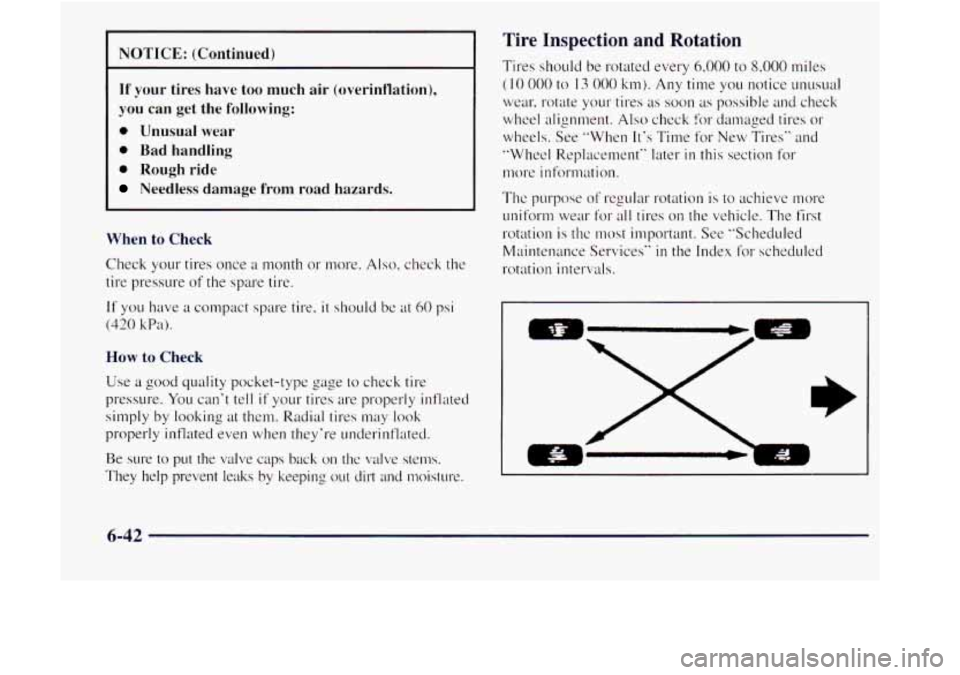
Tire Inspection and Rotation
Tires s11o111d be rotated every 6,000 to 8,000 miles
( IO 000 to 13 000 km). Any time you notice unusual
we;^. rotate your tires as soon as possible and check
wheel alignment.
Also check for damaged tires or
wheels. See "When 1t.s Time for New Tires" and
"Wheel Replacement" later
in this section for
more information.
Thc purpose
of' reg~~lar rotation is to achieve more
uniform wear
fur all tires on the vehicle. The first
rotation
is thu most important. See "Schecluled
Maintenance Services"
in the Index for scheduled
rotation intervals.
r --
6-42
Page 315 of 410

Finish Damage
Any stone chips. fractures or deep scratches in the finish
should be repaired right away. Bare
metal will corrode
quickly and may develop into
a major repair expense.
Minor chips and scratches can be repaired with touch-up
materials available from your dealer or other service
outlets. Larger areas of finish damage can
be corrected
in your dealer’s body and paint shop.
Underbody Maintenance
Chemicals used for ice and snow removal and dust conh-01
can collect on the underbody. If these xe not removed,
accelerated corrosion (rust) can oxcur
on the underbody
parts such as fuel lines, frame, floor pan and exhaust system
even though they have corrosion protection.
At least every spring, flush these materials from the
underbody
with plain water. Clean any areas where mud
and other debris
can collect. Dirt packed in closed areas
of the frame should be loosened before being flushed.
Your dealer or an underbody car washing system can do
this for you.
Chemical Paint Spotting
Some weather and atmospheric conditions can create a
chemical fallout. Airborne pollutants can fall upon and
attack painted surfaces
on your vehicle. This damage
can take two
forms: blotchy, ringlet-shaped
discolorations, and small irregular dark spots etched into
the paint surface.
Although no defect
in the paintjob causes this, CM will
repair. at no charge to the owner. the surfaces of new
vehicles damaged by this fallout condition
within
I2 months or 12,000 miles (20 000 km) of purchase.
whichever occurs
first.
6-56
Page 322 of 410
Capacities and Specifications
Engine Description ............ “VORTEC” 4300
Type .................................... V6
VINCode ................................. W
Firing Order ...................... 1-6-5-4-3-2
Horsepower
................... 190 at 4,400 rpm
Thermostat Specification ........... I95 OF (9 I “C)
Spark Plug Gap .......... 0.045 inches (0. I 14 cm)
Wheels and Tires
Wheel Nut Torque ............ 95 lb-ft ( 130 N-m)
Tire Pressure ...... See the Certification/Tire label.
See ”Loading Your
Vehicle”
in the Index.
Normal Maintenance Replacement Parts
Replacement part numbers listed in this section are
based on the latest information available at the time
of
printing, and are subject to change. If a part listed in this
manual is not the same
as the part used in your vehicle
when
it was built, or if you have any questions, please
contact your
GM truck dealer.
Thermostat
......................... 12551472
Oil Filter.. ............................. PF52
Air Cleaner Filter
...................... A 1 163C
PCV Valve
.......................... CV746C
Automatic Transmission Filter
Kit ...... 24200796
Spark Plugs
........................... 4 1-932
Fuel Filter. ............................ GF481
Front Windshield
Wiper Blade
.......... Trico (20 inchedS0.8 cm)
Backglass Wiper Blade
... Trico (14 inched35.6 cm)
6-63
Page 324 of 410
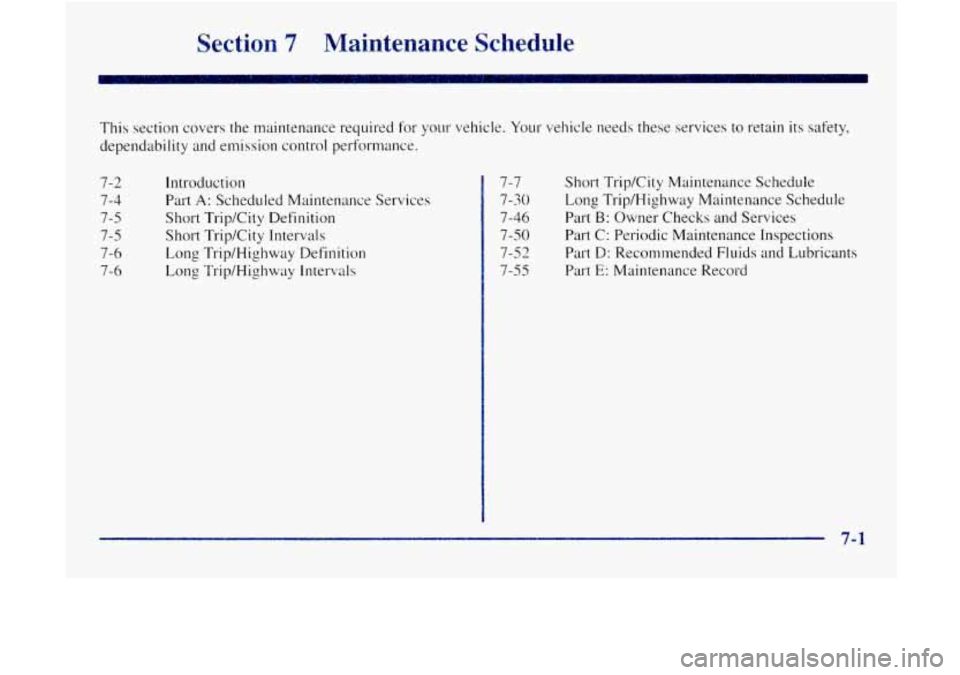
Section 7 Maintenance Schedule
This section covers the maintenance required for ~OLI~ vehicle. Your vehicle needs these services to retairl its safety,
dependability and emission control performance.
7-2
7-4
7-5 7-5
7-6
7-6
Introduction Part
A: Scheduled Maintenance Services
Short Trip/City Definition
Short Trip/City Intervals
Long Trip/Highway Definition
Long Trip/Highway Intervals 7-7
7-30
7-46
7-50
7-52
7-55 Short Trip/City Maintenance
Schedule
Long Trip/Highway Maintenance Schedule
Part
B: Owner Checks and Services
Part
C: Periodic Maintenance Inspections
Part
D: Recommended Fluids and Lubricants
Part
E: Maintenance Record
7-1
Page 325 of 410
KEEP ENGINE OIL
AT THE PROPER
LEVEL AND CHANGE AS
RECOMMENDED
Introduction
Your Vehicle and the Environment
Proper vehicle maintenance not only helps to keep your
vehicle
in good working condition, but also helps the
environment.
All recommended maintenance procedures
are important. Improper vehicle maintenance can even
affect the quality
of the air we breathe. Improper fluid
levels or the wrong tire inflation can increase the level
of emissions from your vehicle. To help protect our
environment. and to keep your vehicle
in good
condition, please maintain your vehicle properly.