power steering GMC JIMMY 1997 Owner's Manual
[x] Cancel search | Manufacturer: GMC, Model Year: 1997, Model line: JIMMY, Model: GMC JIMMY 1997Pages: 410, PDF Size: 20.03 MB
Page 72 of 410
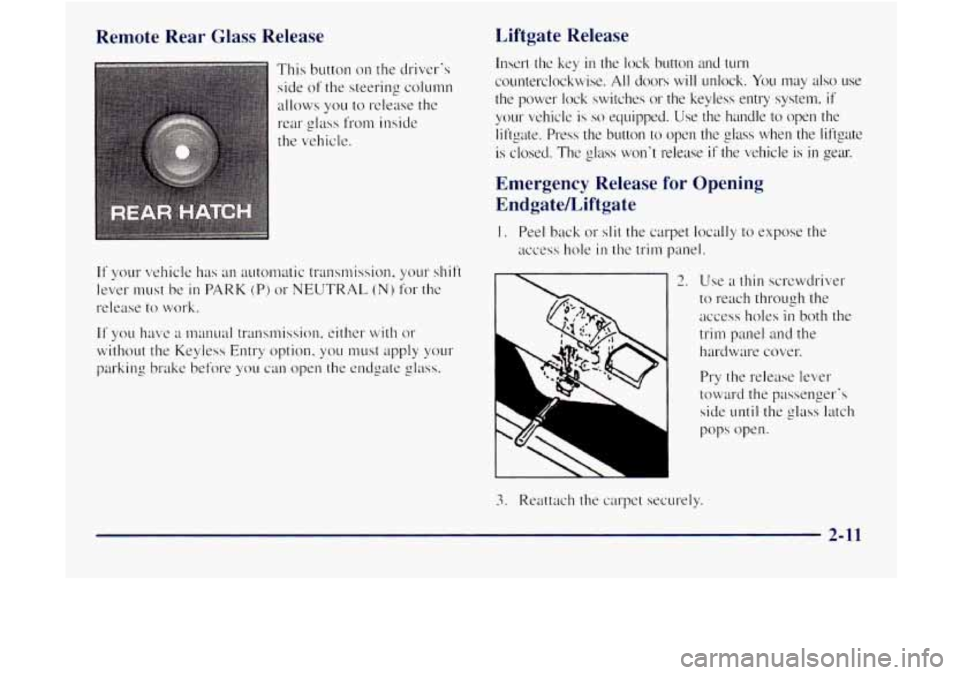
Remote Rear Glass Release
This button on the driver's
side
of the steering column
allows you to r~lease the
rear glass from inside
the vehicle
If your vehicle has an automatic transmission, your shift
lever must be
in PARK (P) or NEUTRAL (N) for the
release
to work.
Liftgate Release
Inscrl thc key in the lock button and turn
counterclockwise.
All doors will unlock. You may also use
the power lock switches
or the keyless entry system. if'
your vehicle is so equipped. Use the handle to open the
liftgate. Press the button
to open the glass Lvhen the liftgate
is closed. The
glass won't release if the vehicle is in getu.
Emergency Release for Opening
Endgatekiftgate
I. Peel back or slit the carpet locally to expose the
access hole
in the trim panel.
2. Use a thin screwdriver
to reach through the
access holes
in both the
trim panel and the
hardware cover.
Pry the release lever
toward the passenger's
side
until the glass latch
pops ope 11.
3. Reattach the carpet securely.
2-11
Page 79 of 410
Automatic Transmission Operation
Your automatic transmission may have a shift lever
located
on the console between the seats or on the
steering column.
There are several different positions for
YOLK shift lever.
If your vehicle is equipped with a column shift lever. it
features an electronic shift position indicator within the
instrument cluster. This display must be powered
anytime the
shift lever is capable of being moved out of-’
the PARK (P) position. This means that if your key is in
the OFF position, but not locked, there will be a snnall
current drain on your battery which could discharge
your battery over a period of time. If you need to leave
your key
in the ignition in the OFF position for an
extended period, it is recommended that you disconnect
the battery cable from the battery to prevent discharging
your battery.
PARK (P): This locks your rear wheels. It’s the best
position to use when
YOLI start your engine because yo~~r
vehicle can’t move easily. It
is dangerous to get out of your
vehicle if the
shift lever is not fully in
PARK (P) with the
parking brake firmly set. Your vehicle can roll.
Don’t leave your vehicle when the engine
is
running unless you have to. If you have left the
engine running, the vehicle can move suddenly.
You or others could be injured.
To be sure your
vehicle won’t move, even when you’re on fairly
level ground, always set your parking brake and
nwve the shift lever to
PARK (P).
If you have four-wheel drive, your vehicle will
be free to roll
-- even if your shift lever is
in
PARK (P) -- if your transfer case is in
NEUTRAL (N). So, be sure the transfer case is in
a drive gear, two-wheel high
(2HI) or four-wheel
high
(4HI) or four-wheel low (4LO) -- not in
NEUTRAL (N). See “Shifting Into PARK (P)” in
the Index.
If you’re pulling a trailer, see “Towing
a Trailer” in the Index.
2-18
Page 98 of 410

Lockout Switch
Four-door vehicles have a lockout feature to prevent
passengers from operating power
windows. It is located
on the driver’s door. Press LOCK to activate this feature.
Press
NORM and the windows return to normal operation.
Swing-Out Windows (2-Door Only)
If your vehicle has rear
swing-out windows, unlatch
them
at their clasps and
push out
on the glass to
open them.
When you close the window, be sure the latch catches.
Horn
TO sound the horn, press the horn symbols on the
steering wheel pad.
2-37
Page 174 of 410

Braking in Emergencies
Steering
Power Steering
If you lose power steering assist because the engine
stops or the system is not functioning. you can steer but
it will take much more effort.
Steering Tips
Driving on Curves
4-9
Page 230 of 410

When your vehicle is being towed. have the ignition key
turned to the OFF position. The steering wheel should
be cla111ped
in a straight-alwad position with a clamping
device designed for towing service. Do not use the
vehicle's steering column lock for this. The transmission
should be
in NEUTRAL (N) and the transfer case, if you
have one. should be in 2HI. The parking brake should
be released.
If your vehicle 11as a floor mounted shifter and no
electrical power, the electrical solenoid lock must be
overridden to shift from PARK (P) to NEUTRAL (N).
Follow these steps:
1. Push the base of the shift lever boot forward \%7ith
your tlwmb.
2. Lift the boot and find the white solenoid lever.
3.
4.
5.
Move the solenoid lever toward the driver's side to
unlock
it.
While holding the solenoid lever in the ~~nlock
position. press the shift lever button and shift into
NEUTRAL (N).
5-9
Page 267 of 410
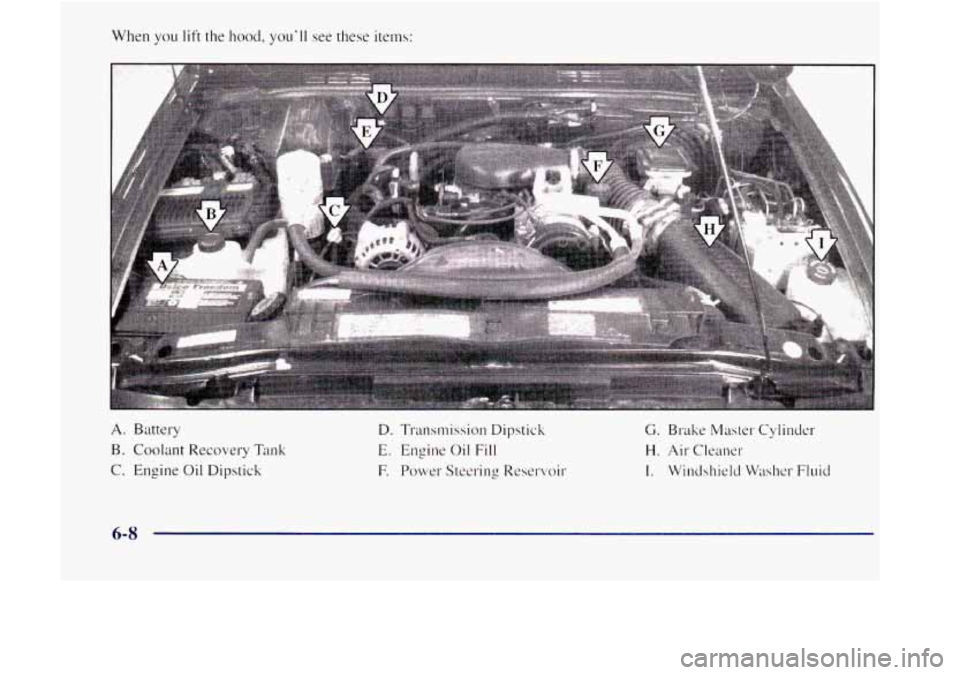
When you lift the I~ood, you'll see these items:
A. Battery
B. Coolant Re,covery
Tank
C. Engine Oil Dipstick
D. Transmission Dipstick C. Brake Master Cylinder
E. Engine Oil Fill H. Air Cleaner
E Power Steering Reservoir I. Windshield Washer Fluid
6-8
Page 286 of 410

When to Check Power Steering Fluid
It is not necessary to regularly check power steering
fluid ~rnless
you suspect there is a leak in the system or
you hear an unusual noise. A fluid loss in this system
could indicate
a problem. Have the system inspected
and repaired.
How To Check Power Steering Fluid
When the engine compartment is cool, wipe the cap and
the top of the reservoir clean, then unscrew the cap and
wipe
the dipstick with a clean rag. Replace the cap and
completely tighten
it. Then remove the cap again and
look at the fluid level on the dipstick.
The level should be between the
ADD and FULL marks.
If necessary, add only enough fluid to bring the level up
to the proper range.
What to Use
Windshield Washer Fluid
What to Use
When you need windshield washer fluid. be sure to read
the manuf‘~cturer’s instructions before ~rse.
If you will be
operating your
\:chicle in an area where the temperature
may fall below freezing,
LIS~ a fluid that has sufficient
protection against freezing.
Adding Washer Fluid
To determine what kind of fluid to use, see
“Recommended Fluids and Lubricants”
in the Index.
Always use the proper fluid. Failure to use the proper
fluid can cause leaks and damage hoses and seals.
Open
the cap labeled WASHER FLUID ONLY with the
washer symbol 011 it. Add washer tluid until the tank is full.
6-27
Page 373 of 410
Part C: Periodic Maintenance
Inspections
Listed below are inspections and services which should
be performed at least twice
a year (for instance. each
spring and fall). You should let
your GM dealer's
service department or other qualified service center
do
these jobs. Make sure any necessary repairs are
completed
at once.
Proper procedures to perform these services may be
found
in a GM service nnanual. See "Service and Owner
Publications"
in the Index.
Steering, Suspension and Front Drive Axle
Boot
and Seal Inspection
Inspect the front and rear suspension and steering
system for damaged. loose or missing parts, signs
of
wear or lack of lubrication. Inspect the power steering
lines
and hoses for proper hook-up, binding, leaks,
cracks, chafing, etc. Clean and then inspect the drive
axle boot seals for damage, tears or leakage. Replace
seals
if necessary.
Exhaust System Inspection
Inspect the complete exhaust system. Inspect the body
near the exhaust system. Look for broken, damaged,
missing or out-of-position parts
as well as open seams,
holes. loose connections
or other conditions which could
cause
a heat build-up in the floor pan or could let
exhaust fumes into the vehicle. See "Engine Exhaust"
in
the Index.
Radiator and Heater Hose Inspection
Inspect the hoses and have them replaced if they are
cracked. swollen or deteriorated. Inspect
all pipes,
fittings
and clamps; replace as needed.
Throttle Linkage Inspection
Inspect the throttle linkage for interference or binding,
and for damage or missing parts. Replace parts
as
needed. Replace any cables that have high effort or
excessi\.e wear.
Do not lubricate accelerator and cruise
control cables.
7-50
Page 375 of 410
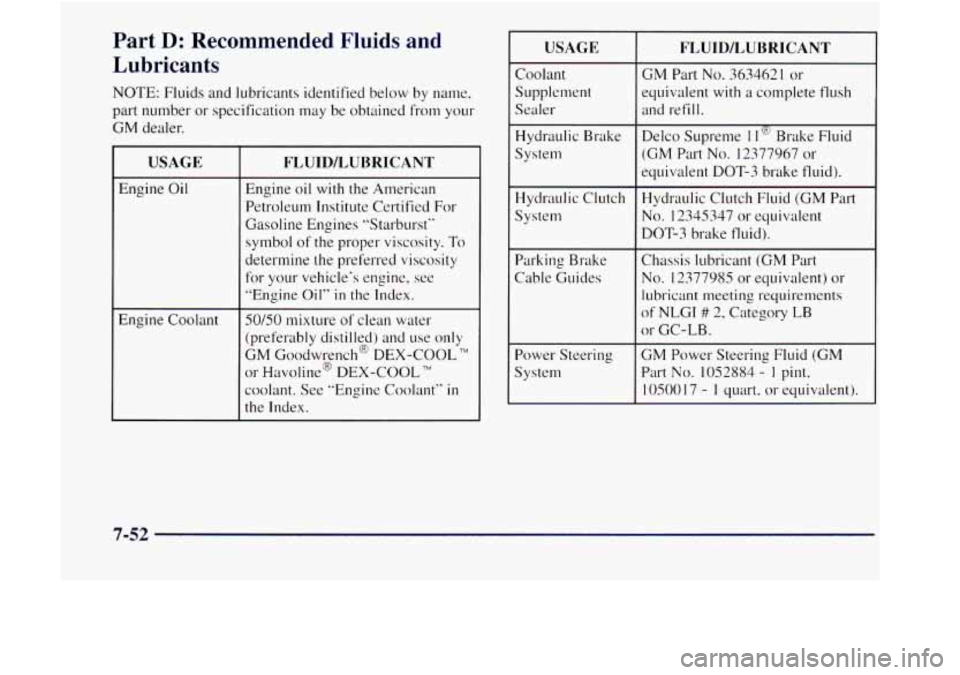
Part D: Recommended Fluids and
Lubricants
NOTE: Fluids and lubricants identified below by name.
part number or specification may be obtained from your
GM dealer.
USAGE
ine Oil
Engine Coolant
FLUIDLUBRICANT
Engine oil with the American
Petroleum Institute Certified For
Gasoline Engines "Starburst" symbol
of the proper viscosity. To
determine the preferred viscosity
for your vehicle's engine. see
"Engine Oil"
in the Index.
50/50 mixture of clean water
(preferably distilled) and
LIS~ only
GM Goodwrench@ DEX-COOL
TM
or Havoline@ DEX-COOL"
coolant. See "Engine Coolant.'
in
the Index.
USAGE
Coolant
Supplement
Sealer
Hydraulic Brake
System
Hydraulic Clutch
System
Parking Brake
Cable Guides
Power Steering
System
FI,UID/LUBRICANT
GM Part No. 3634621 or
equivalent
with a complete flush
and refill.
Delco Supreme
1 I @ Brake Fluid
(GM Part
No. 12377967 01-
equivalent DOT-3 brake fluid).
Hydraulic Clutch Fluid
(GM Part
No. 12345347 or equivalent
DOT-3 brake fluid).
Chassis lubricant (GM Part
No. 12377985 or equivalent) or
lubricant meeting requirements
of NLGI # 2,Category LB
or GC- LB .
GM Power Steering Fluid (GM
Part
No. 1052884 - 1 pint,
I0500 17 - 1 quart, or equivalent).
7-52
Page 399 of 410

Labels Certificatioflire
............................. 4-42
Fuse
....................................... 6-60
Safety Belt
.................................. 1-48
Service Parts Identification
..................... 6-58
Vehicle Identification Number
................... 6-58
Lamps
........................................ 2-45
Dome
...................................... 2-48
FrontMap
................................... 2-48
Front Reading
........................... 2-47, 2-51
Latches, Seatback
................................ 1-6
Leaving Your Vehicle
............................. 2-5
Leaving Your Vehicle with the Engine Running
....... 2-32
Air Bag Readiness
....................... 1-21, 2-73
Anti-Lock Brake System Warning
............ 2-76, 4-7
Brake System Warning
......................... 2-75
Charging System
............................. 2-73
Daytime Running Lamps Indicator
............... 2-80
Gate Ajar
................................... 2-81
Safety Belt Reminder
...................... 1-9, 2-72
Service Engine Soon
.......................... 2-77
Shift
.................................. 2-22, 2-80
Loading Your Vehicle
........................... 4-42
Locking Rear Axle
.............................. 2-23
LockoutSwitch
................................ 2-37
Interior
..................................... 2-47
OnReminder
................................ 2-4 6
Lighter
....................................... 2-61
Lights
CheckGages
................................ 2-80 Locks
......................................... 2-4
Door ........................................ 2-4
Key Lock Cylinder
Service ..................... 7-47
PowerDoor
.................................. 2-5
Rear Door Security
............................. 2-5
Steering Column Park Lock Check
............... 7-49
Loss of Control
................................ 4-13
Lubricants and Fluids
....................... 6-64, 7-52
Lubrication Service, Body
........................ 7-47
Luggagecarrier
................................ 2-59
Lumbar Controls
............................ 1-3, 1-4
Maintenance Record
........................... 7-55
Maintenance Schedule
............................ 7-1
Long Tripmighway
....................... 7-6, 7-30
Owner Checks and Services
..................... 7-46
Periodic Maintenance Inspections
................ 7-50
Recommended Fluids and Lubricants
............. 7-52
Scheduled Maintenance Services
.................. 7-4
Short TripKity
............................ 7-5, 7-7
Maintenance, Underbody
......................... 6-56
Maintenance When Trailer Towing
................. 4-54
Malfunction Indicator Lamp
...................... 2-77
Manual Front Seat
............................... 1-2
Manual Lumbar Support
.......................... 1-3
Manual Transmission Check
...................................... 7-47
Fluid
....................................... 6-18
Shifting
..................................... 2-21
Starting Your Engine
.......................... 2-16
9-6