tires GMC JIMMY 1997 Owner's Manual
[x] Cancel search | Manufacturer: GMC, Model Year: 1997, Model line: JIMMY, Model: GMC JIMMY 1997Pages: 410, PDF Size: 20.03 MB
Page 87 of 410
To shift into or out of 4LO:
1. The vehicle must be moving less than 3 mph
(4.8 km/h) with the transmission in NEUTRAL (N)
for an automatic transmission. For a manual
transmission, the clutch pedal must be engaged.
The preferred method
for shifting into or out of 4LO
is to have your vehicle moving I to 2 tnph (I .6 to
3.2 km/h).
2. Press the transfer case shift button and shift in one
continuous motion.
Don’t pause
in N SET PARK BRAKE as you shift into
or out of
4L0, or your gears could clash.
Remember that driving
in 4HI or 4LO may reduce fuel
economy. Also, driving in four-wheel drive on dry
pavement could cause your tires to wear faster and
make your transfer case harder to
shift and reduce
powertrain longevity.
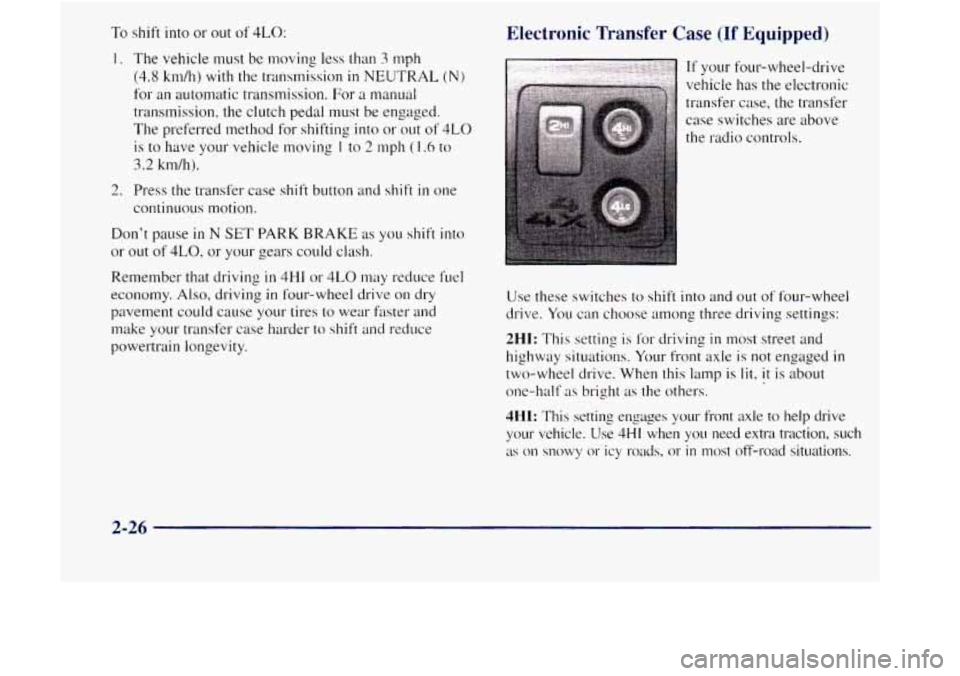
Electronic Transfer Case (If Equipped)
If your four-wheel-drive
vehicle has the electronic
transfer case, the transfer
case switches are above
the radio controls.
Use these switches to shift into and out
of four-wheel
drive.
You can choose among three driving settings:
2HI: This setting is for driving in most street and
highway situations. Your front axle is not engaged
in
two-wheel drive. When this lamp is lit, it is about
one-half
as bright as the others.
4HI: This setting engages your front axle to help drive
your vehicle. Use
4HI when you need extra traction, such
as on snowy or icy roads. 01- in most off-road situations.
2-26
Page 171 of 410

Control of a Vehicle
You have three systems that make your vehicle go where
you want
it to go. They are the brakes, the steering and
the accelerator. All three systems have to do their work
at the places where the tires meet the road.
Sometimes, as when you’re driving on snow or ice, it’s
easy to ask more
of those control systems than the tires
and road can provide. That means you can lose control
of your vehicle.
Braking
Braking action involves perception time and
reaction time.
First, you have to decide to push on the brake pedal.
That’s
perception time. Then you have to bring up your
foot and do it. That’s
reaction time.
Average reaction time is about 314 of a second. But
that’s only an average. It might be less with one driver
and as long as two or three seconds or more with
another. Age, physical condition, alertness, coordination
and eyesight all play a part.
So do alcohol, drugs and
frustration. But even in
314 of a second, a vehicle
moving at
60 mph (100 km/h) travels 66 feet (20 m).
That could be a lot of distance in an emergency,
so
keeping enough space between your vehicle and others
is important.
And, of course, actual stopping distances vary greatly
with the surface of the road (whether it’s pavement or
gravel); the condition of the road (wet, dry, icy); tire
tread; the condition of your brakes; the weight
of the
vehicle and the amount of brake force applied.
Page 175 of 410

Suppose you're steering througl1 a shxp CLII-V~. Tllen you
suddenly accelemtc.
Both control systems -- steering and
acceleration
-- have to do their work where the tires meet
the road. Adding the sudden acceleration cim ciemand too
much of those places. You can lose control.
What sho~~ld you do
if this ever happens'! Ease LIP on the
accelerator pedal. steer the vehicle the way you want it
to go, and slow down.
Speed limit signs near CLI~V~S warn that ~OLI shoulcl
adjust your speed. Of co~~rse. the posted speeds are
based
on good weather and road conditions. Under less
favorable conditions you'll want to
go slower.
If you need to reduce yo111- speed as you approach a
curve, do it before ~OLI enter the curve7 while your front
wheels are straight ahead.
Try to adjust your speed
so you can "drive" through the
curve. Maintain
a reasonable, steady speed. Wait to
accelerate
until you are out of the curve. and then
accelerate gently into the straightaway.
Steering in Emergencies
4-10
Page 178 of 410

0 Check your mirrors. glat~ce over your shoulder and
start your left lane change signal before moving out
of the right lane to pass. When you are
far enough
ahead
of the passed vehicle to see its front in yo~~r
inside mirror. acti\;ate your right lane change signal
and move
back into the right lane. (Remember that
your right outside mirror is convex. The vehicle you
just passed
may seem to be farther away f'rom you
than it really is.)
a Try not to pass more than one vehicle at a time on
two-lane roads. Reconsider before passing the
next vehicle.
Loss of Control
Let's re\:iew what driving experts say about what
happens when the three control systems
(brakes. steering
;MI accelerution) don't ha\^ enough friction where the
tires meet the road
to do what the driver has asked.
In any emergency. don't give up. Keep trying to steer a.nd
constantly seek an escape route
or area of less danger.
Skidding
4-13
Page 191 of 410
Driving in Mud, Sand, Snow or Ice
When you drive in mud, snow or sand, your wl~ecls
won't get
good traction. You ca11.t accelerate ;IS quickly,
turning
is nm-e difficult, and you'll need longer
braking distances.
It's best to use
a low gear when you're in mud -- the
deeper the mud, the lower the gear.
In really deep mud.
the idea is to keep your vehicle moving
so ~OLI don't
get stuck.
When
you drive on sand, you'll sense a change in wheel
traction. But it will depend upon how loosely p~~ked the
sand is. On loosely prncked sand (as on beaches or sand
dunes) your tires will tend
to sink into the sand. This has
a11 effect on steering. accelerating and braking. You may
want
to reduce the air pressure in your tires slightly
when driving on sand. This will ilnprove traction.
Hard packed snow and
ice offer the worst tire traction.
On these surfaces, it's very easy to lose control. On wet
ice, for example, the traction is
so poor that you will
have difficulty accelerating. And if you do get moving.
poor steering and difficult braking
can C~LIS~ you to slide
out
of colltl*ol.
Driving on frozen lakes, ponds or ws can be
dangerous. Underwat.er springs, currents under
the ice, or sudden thaws can weaken the ice. Your
vehicle could
fall through the ice and you and
your passengers could drown. Drive your vehicle
on safe surfaces
only.
Driving in Water
4-26
Page 192 of 410
If the water isn't too deep, then drive through it slowly.
At fast speeds, water splashes on your ignition system
and
your vehicle can stall. Stalling can dso occur if you
tailpipe is under water, yo~l*II never be able to start your
engine. When
you go through water. remember that
when your brakes get
wet. it nay take you longer
to stop.
2 wt your tailpipe under water. And. as long as your
Driving through rushing water can be dangerous. Deep water can sweep your vehicle downstream
and
you and your passengers could drown. If it's
only shallow water, it can still wash away the
ground from under your tires, and you could lose
traction and roll the vehicle over. Don't drive
through rushing water.
After Off-Road Driving
Relmove any brush or debris that has collected on the
underbody. chassis or 11nder the hood. These
accumulations CUI be a fire hazard.
After operation
in mud or sand. have the brake linings
cleaned and checked. These substances can C~LIS~
glazing and 1111even braking. Check the body structure.
steering. suspension. wheels, tires and exlxwst system
for damage.
Also. check the fuel lines and cooling
system for any leakage.
Your
vehicle will require more frequent service due to
off-road use. Refer to the Maintenance Schedule for
additional information.
4-27
Page 199 of 410
Once you are moving on the freeway, make certain you
allow a reasonable following distance. Expect to IIIOVC
slightly slower at night.
When you want to leave the freeway, move
to the proper
lane well
in advance. If you miss your exit, do not.
under any circumstances, stop and back up. Drive
on to
the next exit.
The exit ramp can be curved, sometimes quite sharply.
The exit speed is usually posted.
Reduce your speed according to your speedometer, not
to your sense of motion. After driving for any distance
at higher speeds, you may tend to
think you are going
slower than you actually are.
Before Leaving on a Long Trip
Make sure you're ready. Try to be well rested. If you
must start when you're not fresh
-- such as after a day's
work
-- don't plan to make too many miles that first part
of the journey. Wear comfortable clothing and shoes you
can easily drive in.
Is your vehicle ready for a long trip'! If you keep it
serviced and maintained, it's ready to go. If it needs
service, have
it done before starting out. Of course,
you'll find experienced and able service experts
in GM
dealerships all across North America. They'll be ready
and willing to help
if you need it.
Here are some things you can check before a trip:
0
0
0
0
0
0
0
Windshield Wldwr Fluid: Is the reservoir full? Are
all windows clean inside and outside?
Wiper. Blcrd~s: Are they in good shape?
F~lel, EI1girw Oil, Other Fluids: Have you checked
all levels?
LUIII~S: Are they all working'? Are the lenses clean?
Tires: They are vitally important to a safe,
trouble-free trip.
Is the tread good enough for
long-distance driving? Are the tires all inflated to the
recommended pressure?
Wecrtlwr For-cxmts: What's the weather outlook
along your route? Should you delay your trip a short
time to avoid a major storm system?
Mclps: Do you have up-to-date maps'?
4-34
Page 200 of 410

Highway Hypnosis
Is there actually such a condition as "highway hypnosis'"?
Or is
it just plain falling asleep at the wheel'? Call it
highway hypnosis, lack of awareness, or whatever.
There
is something about an easy stretch of road with
the same scenery, along with the hum of the tires on the
road, the drone of the engine. and the rush of the wind
against the vehicle that can make you sleepy. Don't let
it
happen to you! If it does, your vehicle can leave the
road
in less than cf soc-ond, and you could crash and
be injured.
What can you
do about highway
aware that
it can happen.
Then here are some tips:
0 Make sure your vehicle is we1
comfortably cool interior. 1ypmsis'?
First. be
0
0
I ventilated. with a
Keep your eyes moving. Scan the road ahead and
to the sides. Check your mirrors and your
instruments frequently.
If you get sleepy, pull off the road into a rest. service
or parking area and take
a nap, get some exercise, or
both.
For safety, treat drowsiness on the highway as
an emergency.
Hill and Mountain Roads
Driving on steep hills or nlountains is different from
driving
in flat or rolling terrain.
If you drive regularly in steep country, or if you're
planning
to visit there, here are some tips that can make
your trips safer
and more enjoyable. (See "Off-Road
Driving"
in the Index for information about driving
off-road.
)
4-35
Page 201 of 410
0
0
Keep your vehicle in good shape. Check all fluid
levels and also
the brakes, tires, cooling system and
transmission. These parts can work hard on
mountain roads.
Know
how to go down hills. The most important
thing to know is this:
let your engine do some of the
slowing down.
Shift to a lower gear when you go
down a steep or long hill.
If you don’t shift down, your brakes could get so
hot that they wouldn’t work well. You would then
have poor braking or even none going down
a
hill. You could crash. Shift down to let your
engine assist your brakes on
a steep
downhill slope.
A CAUTION: . -.
Coasting downhill in NEUTRAL (N) or with the
ignition
otf is dangerous. Your brakes will have to
do all the work
of slowing down. They could get so
hot that they wouldn’t work well. You would then
have poor braking or even none going down a hill.
You could crash. Always have your engine running
and your vehicle in gear when
you go downhill.
0 Know how to go uphill. You may want to shift down to a
lower gear. The lower gears help cool yo~~r engine and
transmission, and you can climb the hill better.
0 Stay in your own lane when driving on two-lane
roads
in hills or mountains. Don’t swing wide or cut
across the center
of the road. Drive at speeds that let
you stay
in your own lane.
0 As you go over the top of a hill, be alert. There could be
something
in your lane, like a stalled car or an accident.
You may see highway signs on nmuntains that warn of
special problems. Examples are long grades, passing or
no-passing zones. a falling rocks area or winding
roads.
Be alert to these and take appropriate action.
4-36
Page 202 of 410
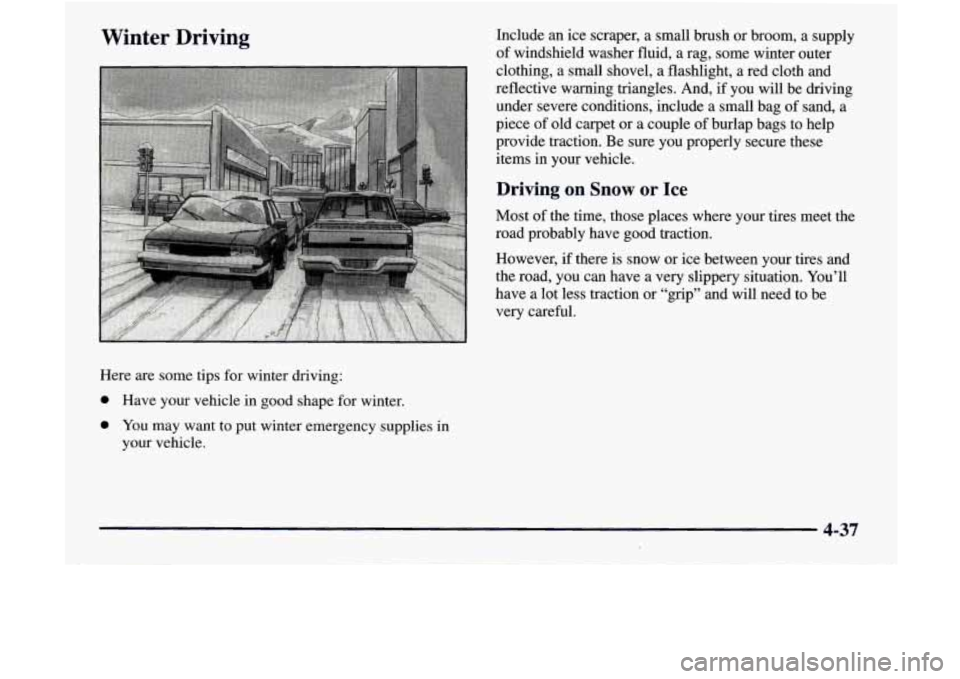
Winter Driving
Here are some tips for winter driving:
0 Have your vehicle in good shape for winter.
0 You may want to put winter emergency supplies in
your vehicle. Include an ice scraper, a small brush or broom, a supply
of windshield washer fluid,
a rag, some winter outer
clothing, a small shovel, a flashlight, a red cloth and
reflective warning triangles. And, if you will be driving
under severe conditions, include a small bag
of sand, a
piece
of old carpet or a couple of burlap bags to help
provide traction. Be sure you properly secure these
items in your vehicle.
Driving on Snow or Ice
Most of the time, those places where your tires meet the
road probably have good traction.
However, if there is snow or ice between your tires and
the road, you can have a very slippery situation. You’ll
have a lot less traction or “grip” and will need to be
very careful.
4-37