lock GMC SAFARI 2002 Repair Manual
[x] Cancel search | Manufacturer: GMC, Model Year: 2002, Model line: SAFARI, Model: GMC SAFARI 2002Pages: 400, PDF Size: 2.66 MB
Page 212 of 400

4-27
CAUTION:
Snow can trap exhaust gases under your vehicle. This
can cause deadly CO (carbon monoxide) gas to get
inside. CO could overcome you and kill you. You
can't see it or smell it, so you might not know it is in
your vehicle. Clear away snow from around the base
of your vehicle, especially any that is blocking your
exhaust pipe. And check around again from time
to time to be sure snow doesn't collect there.
Open a window just a little on the side of the
vehicle that's away from the wind. This will help
keep CO out.
Run your engine only as long as you must. This saves
fuel. When you run the engine, make it go a little faster
than just idle. That is, push the accelerator slightly. This
uses less fuel for the heat that you get and it keeps the
battery charged. You will need a well
-charged battery to
restart the vehicle, and possibly for signaling later on
with your headlamps. Let the heater run for a while.
Then, shut the engine off and close the window almost
all the way to preserve the heat. Start the engine again
and repeat this only when you feel really uncomfortable
from the cold. But do it as little as possible.Preserve the fuel as long as you can. To help keep warm,
you can get out of the vehicle and do some fairly vigorous
exercises every half hour or so until help comes.
Recreational Vehicle Towing
Recreational vehicle towing means towing your vehicle
behind another vehicle
-- such as behind a motorhome.
The two most common types of recreational vehicle towing
are known as ªdinghy towingº (towing your vehicle with
all four wheels on the ground) and ªdolly towingº (towing
your vehicle with two wheels on the ground and two wheels
up on a device known as a ªdollyº).
Your vehicle was not designed to be towed with any of
its wheels on the ground. If your vehicle must be towed,
see ªTowing Your Vehicleº in the Index.
NOTICE:
Towing an all±wheel±drive vehicle with all four
wheels on the ground, or even with only two of its
wheels on the ground, will damage drivetrain
components. Don't tow an all±wheel±drive
vehicle if any of its wheels will be on the ground.
Page 241 of 400
5-14 How to Add Coolant to the Radiator
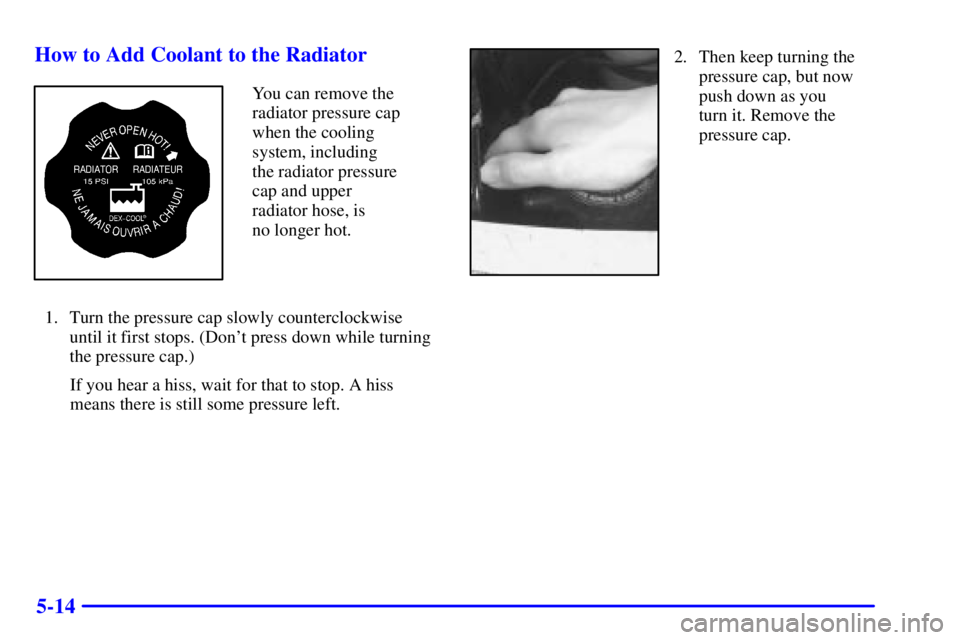
You can remove the
radiator pressure cap
when the cooling
system, including
the radiator pressure
cap and upper
radiator hose, is
no longer hot.
1. Turn the pressure cap slowly counterclockwise
until it first stops. (Don't press down while turning
the pressure cap.)
If you hear a hiss, wait for that to stop. A hiss
means there is still some pressure left.
2. Then keep turning the
pressure cap, but now
push down as you
turn it. Remove the
pressure cap.
Page 245 of 400

5-18
Changing a Flat Tire
If a tire goes flat, avoid further tire and wheel damage
by driving slowly to a level place. Turn on your hazard
warning flashers.
CAUTION:
Changing a tire can cause an injury. The vehicle
can slip off the jack and roll over you or other
people. You and they could be badly injured.
Find a level place to change your tire. To help
prevent the vehicle from moving:
1. Set the parking brake firmly.
2. Put the shift lever in PARK (P).
3. Turn off the engine.
4. Put the wheel blocks at the front and
rear of the tire farthest away from the
one being changed. That would be the
tire on the other side of the vehicle, at
the opposite end.The following steps will tell you how to use the jack and
change a tire.
Page 246 of 400

5-19 Removing the Spare Tire and Tools
The jacking equipment you'll need is stored by your
vehicle's rear doors, along the passenger's side wall.
1. Remove the jack cover by pulling it away from the
side wall and down to release the tabs securing the
top of the cover.
2. Remove the wheel blocks by turning the top nut
counterclockwise. Remove the nut and washer, then
pull the wheel blocks off the bolt.
3. Push down on the bolt and remove the hooked end
from the slot. Slide the jack toward the front of the
vehicle and lift it from the mounting. Remove the
extension and the ratchet from the pouch.
Page 248 of 400

5-21
5. Put the flat end of the extension on an angle through
the hole in the rear door frame, above the bumper.
Be sure the flat end connects into the hoist shaft.
6. Turn the ratchet counterclockwise to lower the
compact spare tire to the ground. Keep turning the
ratchet until the spare tire can be pulled out from
under the vehicle.
7. When the tire has been
lowered, tilt the retainer
plate at the end of the
cable and pull it through
the wheel opening.
8. Pull the tire out from under the vehicle.
NOTICE:
To help avoid vehicle damage, do not drive the
vehicle before the cable is restored.
Page 249 of 400
5-22
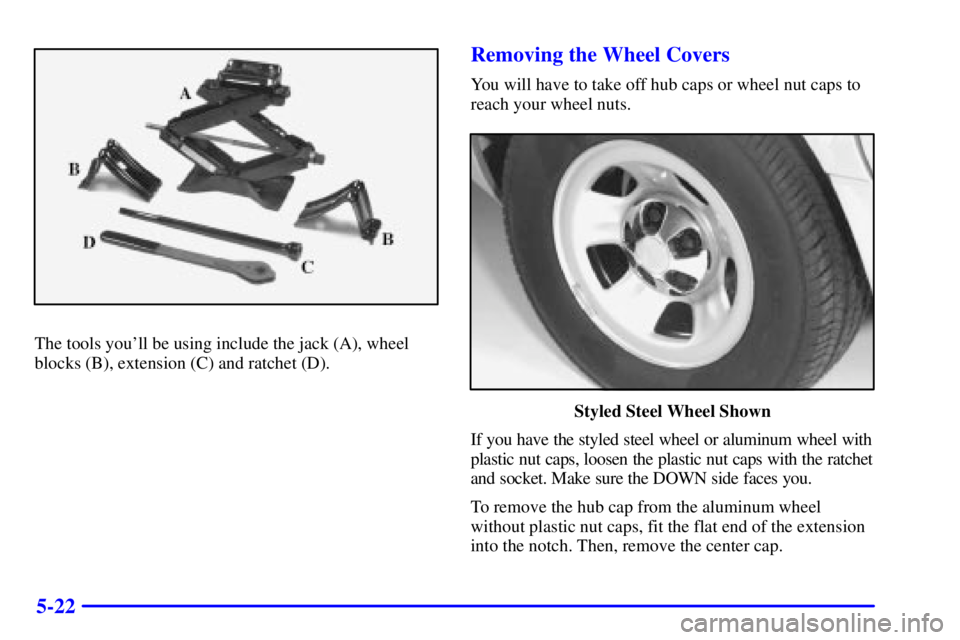
The tools you'll be using include the jack (A), wheel
blocks (B), extension (C) and ratchet (D).
Removing the Wheel Covers
You will have to take off hub caps or wheel nut caps to
reach your wheel nuts.
Styled Steel Wheel Shown
If you have the styled steel wheel or aluminum wheel with
plastic nut caps, loosen the plastic nut caps with the ratchet
and socket. Make sure the DOWN side faces you.
To remove the hub cap from the aluminum wheel
without plastic nut caps, fit the flat end of the extension
into the notch. Then, remove the center cap.
Page 250 of 400
5-23 Removing the Flat Tire and Installing the
Spare Tire
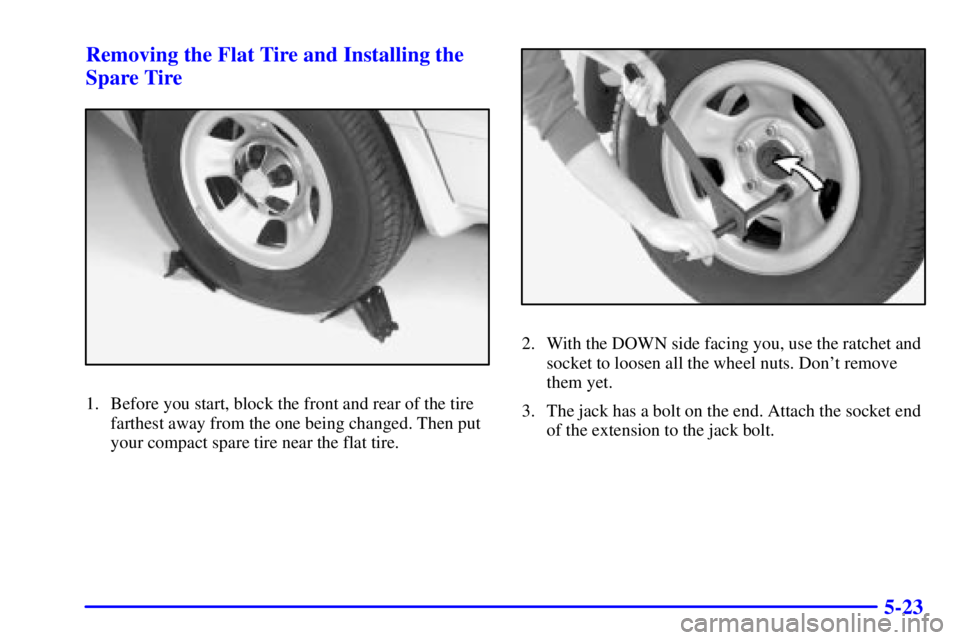
1. Before you start, block the front and rear of the tire
farthest away from the one being changed. Then put
your compact spare tire near the flat tire.
2. With the DOWN side facing you, use the ratchet and
socket to loosen all the wheel nuts. Don't remove
them yet.
3. The jack has a bolt on the end. Attach the socket end
of the extension to the jack bolt.
Page 251 of 400

5-24
4. Attach the ratchet to the extension with the UP side
facing you.
5. Turn the ratchet clockwise. That will raise the jack
lift head a little.6. Position the jack under the vehicle.
Page 254 of 400
5-27
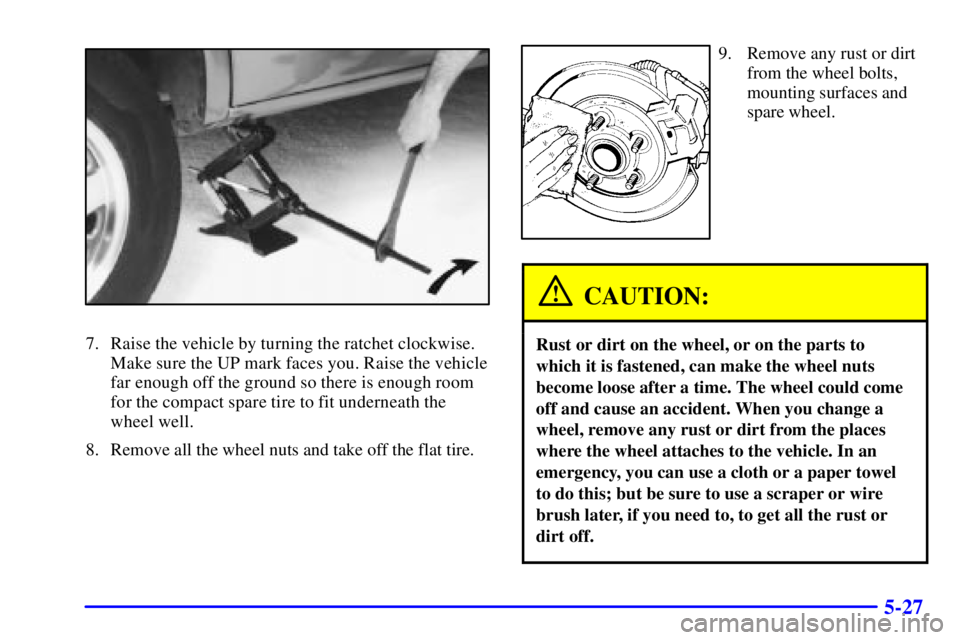
7. Raise the vehicle by turning the ratchet clockwise.
Make sure the UP mark faces you. Raise the vehicle
far enough off the ground so there is enough room
for the compact spare tire to fit underneath the
wheel well.
8. Remove all the wheel nuts and take off the flat tire.
9. Remove any rust or dirt
from the wheel bolts,
mounting surfaces and
spare wheel.
CAUTION:
Rust or dirt on the wheel, or on the parts to
which it is fastened, can make the wheel nuts
become loose after a time. The wheel could come
off and cause an accident. When you change a
wheel, remove any rust or dirt from the places
where the wheel attaches to the vehicle. In an
emergency, you can use a cloth or a paper towel
to do this; but be sure to use a scraper or wire
brush later, if you need to, to get all the rust or
dirt off.
Page 255 of 400

5-28
CAUTION:
Never use oil or grease on studs or nuts. If you
do, the nuts might come loose. Your wheel could
fall off, causing a serious accident.
10. Put on the compact spare tire. Put the nuts on by
hand. Make sure the cone
-shaped end is toward the
wheel. Tighten each nut by hand until the wheel is
held against the hub. If a nut can't be turned by
hand, use the extension and see your dealer as soon
as possible.
11. Lower the vehicle by turning the ratchet
counterclockwise. Lower the jack completely.