wheel GMC SAVANA 1996 Owner's Guide
[x] Cancel search | Manufacturer: GMC, Model Year: 1996, Model line: SAVANA, Model: GMC SAVANA 1996Pages: 372, PDF Size: 18.81 MB
Page 196 of 372
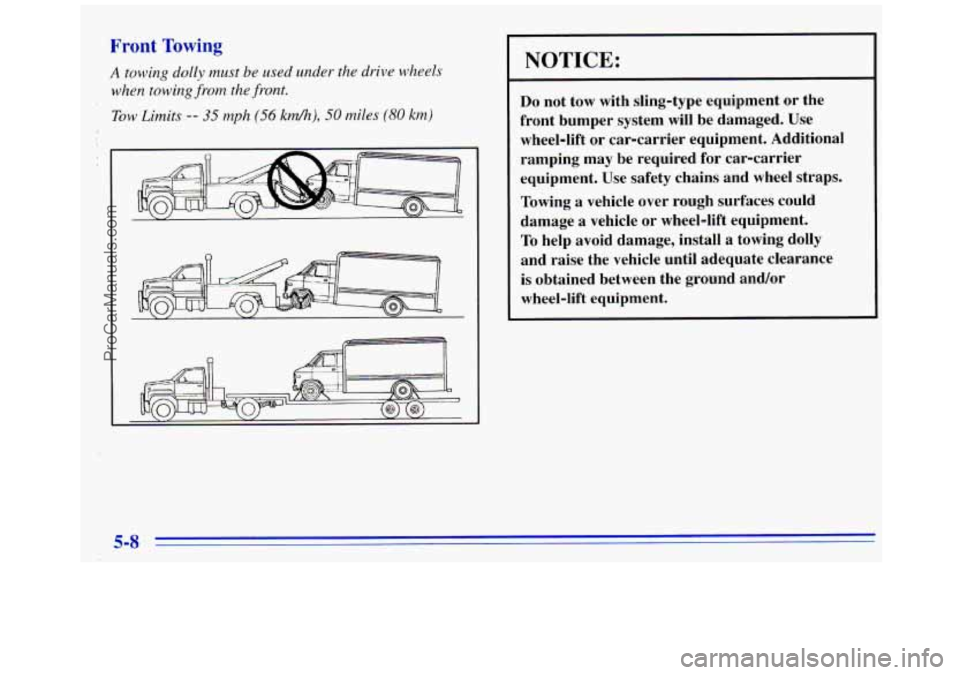
FroF Towing
A towlng dolly must be used under the drive wheels
when towing
from the front.
Tow Limits -- 35 mph (56 kh), SO miles (80 km)
NOTICE:
Do not tow with sling-type equipment or the
front bumper system will be damaged. Use
wheel-lift or car-carrier equipment. Additional
ramping may be required for car-carrier
equipment. Use safety chains and wheel straps.
Towing a vehicle over rough surfaces could
damage a vehicle or wheel-lift equipment.
To help avoid damage, install a towing dolly
and raise the vehicle until adequate clearance
is obtained between the ground and/or
wheel-lift equipment.
5-8
ProCarManuals.com
Page 197 of 372
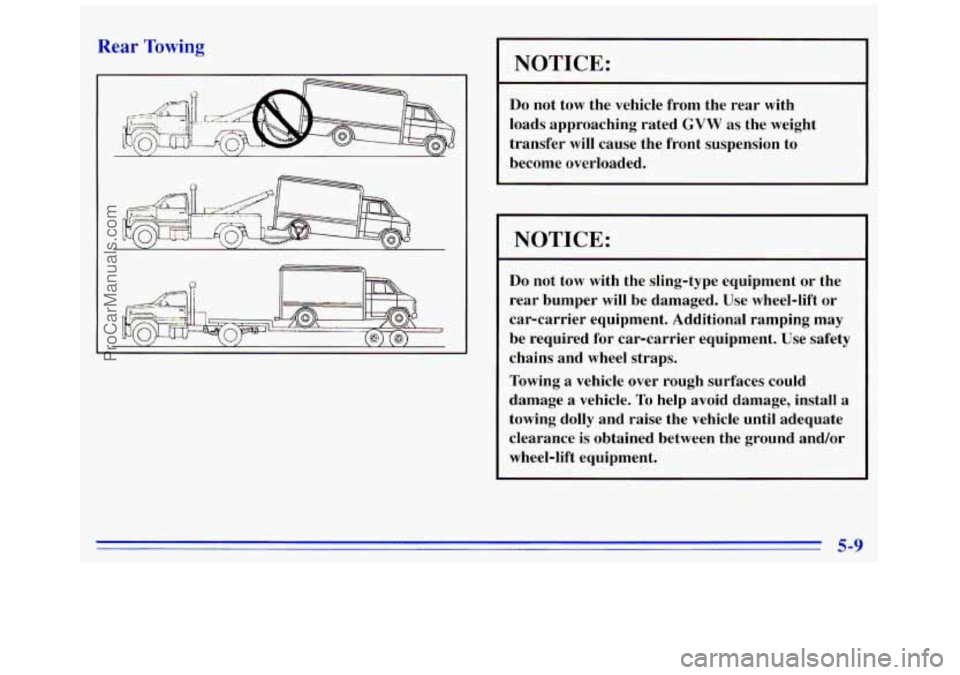
Rear Towing
NOTICE:
Do not tow the vehicle from the rear with
loads approaching rated
GVW as the weight
transfer will cause the front suspension to
become overloaded.
NOTICE:
Do not tow with the sling-type equipment or the
rear bumper will be damaged. Use wheel-lift or
car-carrier equipment. Additional ramping may
be required for car-carrier equipment. Use safety
chains and wheel straps.
Towing
a vehicle over rough surfaces could
damage a vehicle.
To help avoid damage, install a
towing dolly and raise the vehicle until adequate
clearance is obtained between the ground and/or
wheel-lift equipment.
5-9
ProCarManuals.com
Page 208 of 372
If a Tire Goes Flat
It’s unusual for a tire to “blow out” while you’re driving,
especially
if you maintain your tires properly. If air goes
out of a tire, it’s much more likely
to leak out slowly.
But
if you should ever have a “blowout,” here are a few
tips about what to expect and what to do:
If a front tire fails, the flat tire will create a drag that
pulls the vehicle toward that side. Take
your foot off the
accelerator pedal and grip the st.eering wheel firmly.
Steer to maintain lane position, and then gently brake to
a stop well out of the traffic lane.
A rear blowout, particularly on a curve, acts much like a
skid and may require the same correction you’d use in a
skid.
In any rear blowout, remove your foot from the
accelerator pedal. Get the vehicle under control
by
steering the way you want the vehicle to go. It may be
very bumpy and noisy, but you can still steer. Gently
brake to
a stop -- well off the road if possible.
If a tire goes flat, the next part shows how to use your
jacking equipment to change a
flat tire safely.
Changing a Flat Tire
If a tire goes flat, avoid further tire and wheel damage
by driving slowly to
a level place. Turn on your hazard
warning flashers.
Changing a tire can cause an injury. The vehicle
can slip off the jack and roll over you or other
people. You and they could be badly injured.
Find a level place
to change your tire. To help
prevent the vehicle from moving:
1. Set the parking brake firmly.
2. Put the shift lever in PARK (P).
3. Turn off the engine.
To be even more certain the vehicle won’t move,
you can put blocks at the front and rear of the
tire farthest away from the one being changed.
That would be the tire on the other side of the
vehicle, at the opposite end.
5-20
ProCarManuals.com
Page 212 of 372
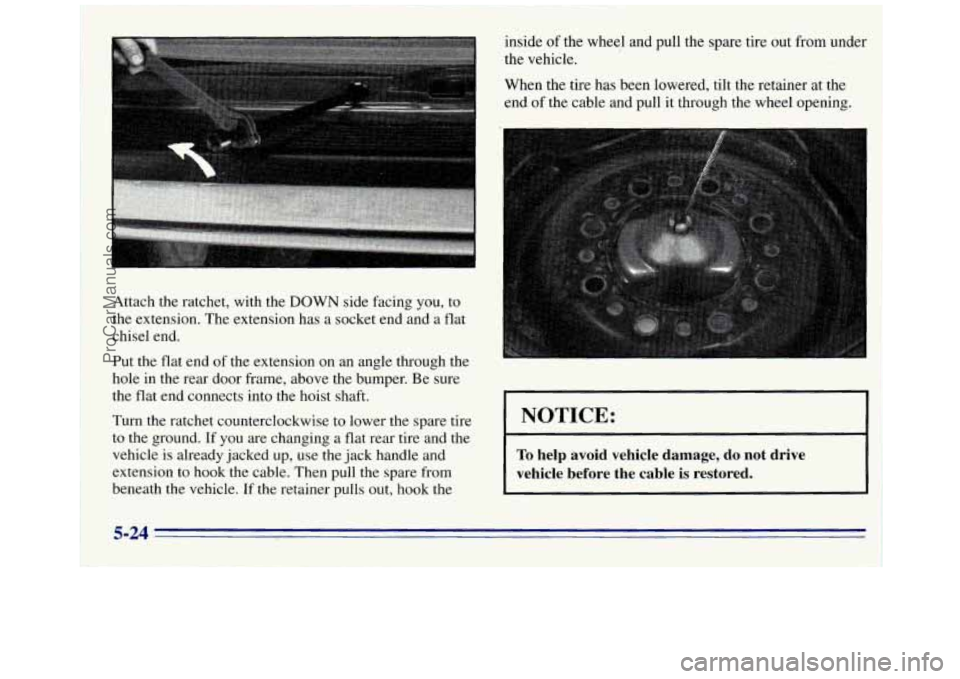
Attach the ratchet, with the DOWN side facing you, to
the extension. The extension has a socket end and a flat
chisel end.
Put the flat end of the extension on an angle through the
hole in the rear door frame, above the bumper. Be sure
the flat end connects into the hoist shaft.
Turn the ratchet counterclockwise to lower the spare tire
to the ground.
If you are changing a flat rear tire and the
vehicle is already jacked up, use the jack handle and
extension to hook the cable. Then pull the spare from
beneath the vehicle.
If the retainer pulls out, hook the inside
of the wheel and pull the
spare tire out from under
the vehicle.
When the tire has been lowered, tilt the retainer at the end
of the cable and pull it through the wheel opening.
NOTICE:
To help avoid vehicle damage, do not drive
vehicle before the cable is restored.
5-24 i
t
ProCarManuals.com
Page 214 of 372
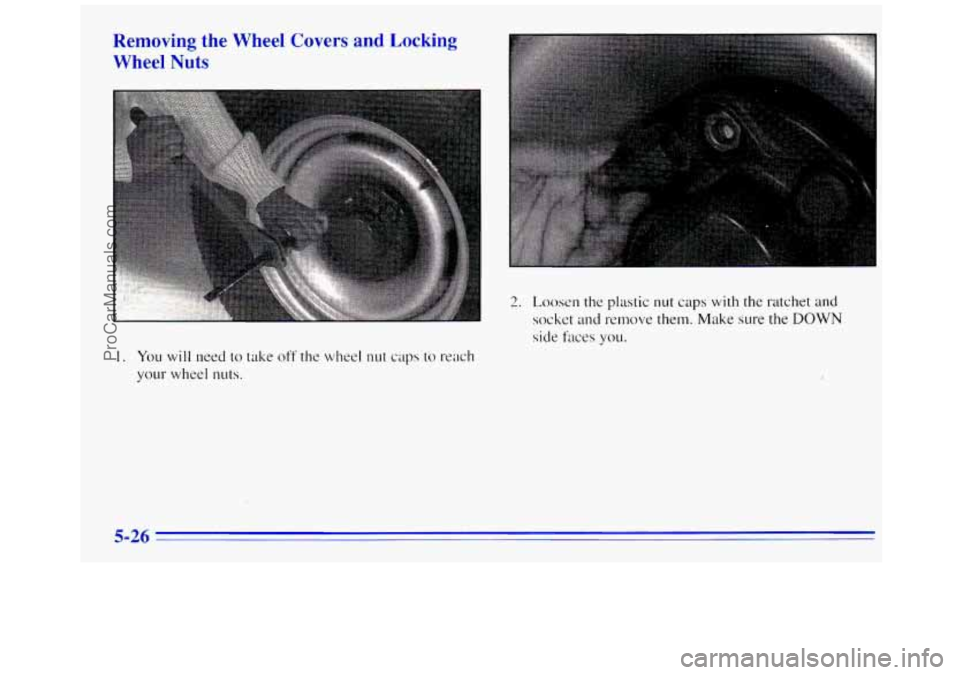
Removing the Wheel Covers and Locking
Wheel
P
I. You will need to take oft' the wheel nut caps to reach
your wheel nuts.
2. Loosen the plastic nut caps with the ratchet and
socket and remove them. Make sure the DOWN
side faces you.
5-26
ProCarManuals.com
Page 218 of 372
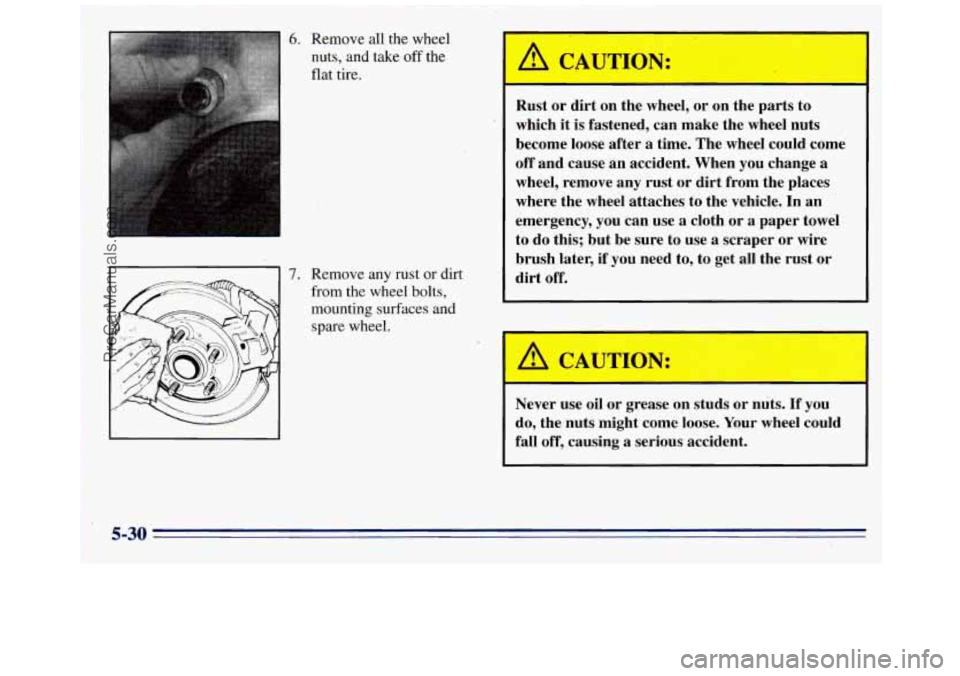
6. Remove all the wheel
nuts, and take
off the
flat tire.
7. Remove any rust or dirt
from the wheel bolts,
mounting surfaces and
spare wheel.
I
A C it 'ION:
-
Rust or dirt on the wheel, or on the parts to
which it is fastened, can make the wheel nuts
become loose after a time. The wheel could come'
off and cause an accident. When you change
a
wheel, remove any rust or dirt from the places
where the wheel attaches to the vehicle. In an
emergency, you can use
a cloth or a paper towel
to do this; but be,sure to use
a scraper or wire
brush later, if you need to, to get all the rust or
dirt off.
~~
A CAUTION:
7
Never use oil or g;,ase on studs or nuts. If you
do, the nuts might come
loose. Your wheel could
fall
off, causing a serious accident.
5-30
ProCarManuals.com
Page 219 of 372
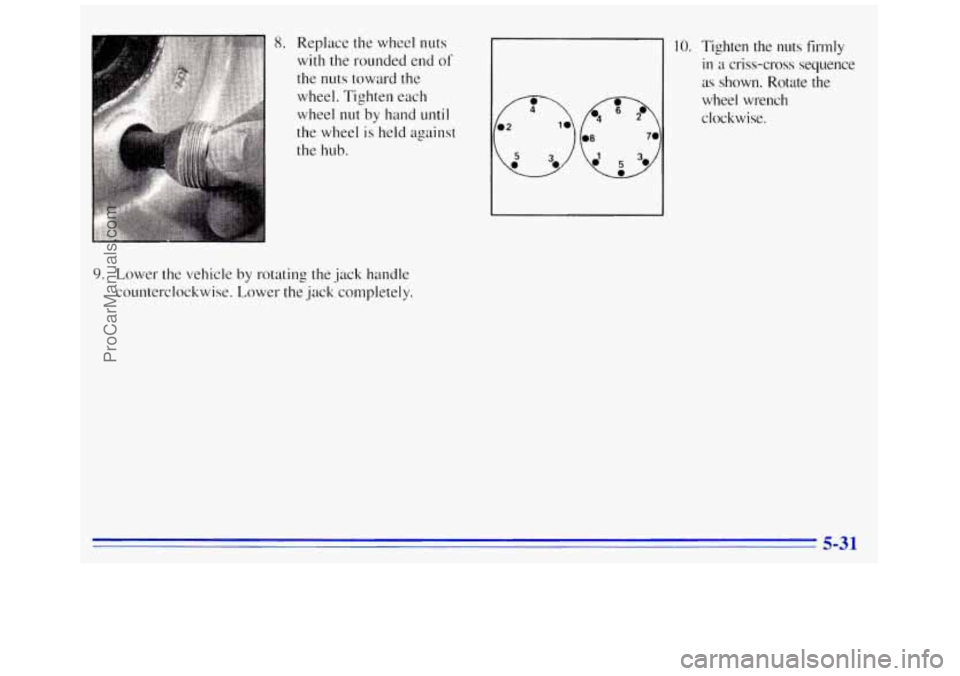
8. Replace the wheel nuts
with the rounded end of
the nuts toward the
wheel. Tighten each
wheel nut
by hand until
the wheel is held against
the hub.
9. Lower the vehicle by rotating thejack handle
counterclockwise. Lower the
jack completely.
10. Tighten the nuts firmly
in a criss-cross sequence
as shown. Rotate the
wheel wrench
clockwise.
5-31
ProCarManuals.com
Page 220 of 372
A CAUTION:
Incorrect wheel nuts or improperly tightenea
wheel nuts can cause the wheel to become loose
and even come off. This could lead to an accident.
Be sure to use the correct wheel nuts.
If you have
to replace them, be sure to get new
GM original
equipment wheel nuts.
Stop, somewhere
as soon as you can and have
the nuts tightened with a torque wrench to
122 lb-ft (165 N-m).
NOTICE:
Improperly tightened wheel nuts can lead to
brake pulsation and rotor damage.
To avoid
expensive brake repairs, evenly tighten the wheel
nuts in the proper sequence and to the proper'
torque specification.
11. Put the wheel cover back on, if you have one.
Remove any wheel blocks.'
Remember that the jack, jacking equipment and tire
must
be properly stored in their original storage
position before you begin driving again. The next
part will show you how.
5-32
ProCarManuals.com
Page 221 of 372
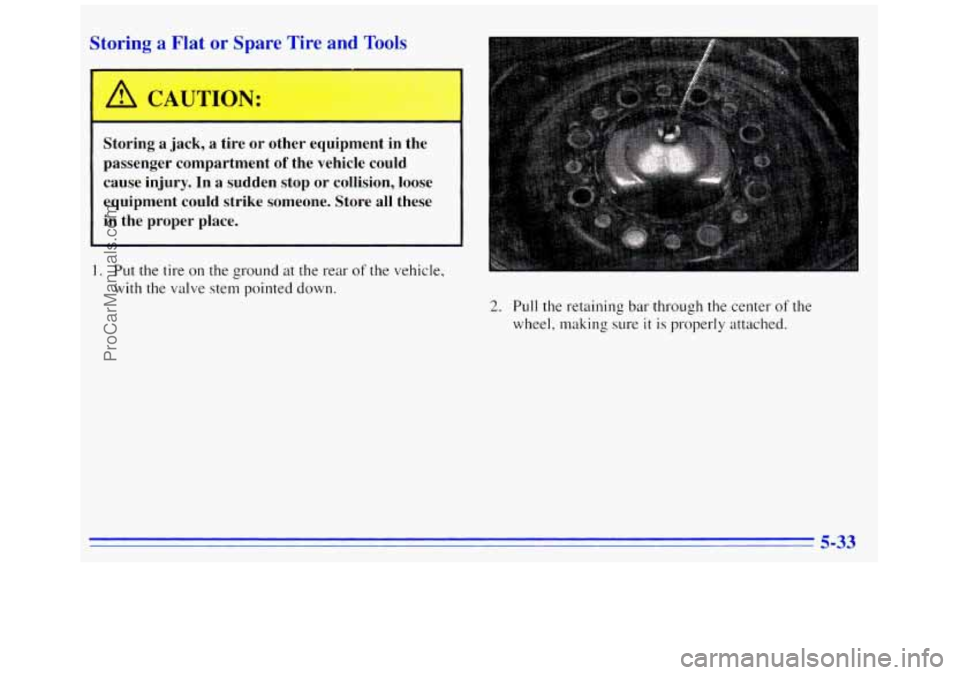
Storing a Flat or Spare Tire and Tools
Storing a jack, a tire or other equipment in the
passenger compartment
of the vehicle could
cause injury. In a sudden stop
or collision, loose
equipment could strike someone. Store all these
in the proper place.
I. Put the tire on the ground at the rear of the vehicle,
with the valve stem pointed down.
2. Pull the retaining bar through the center of the
wheel, making sure
it is properly attached.
5-33
ProCarManuals.com
Page 222 of 372
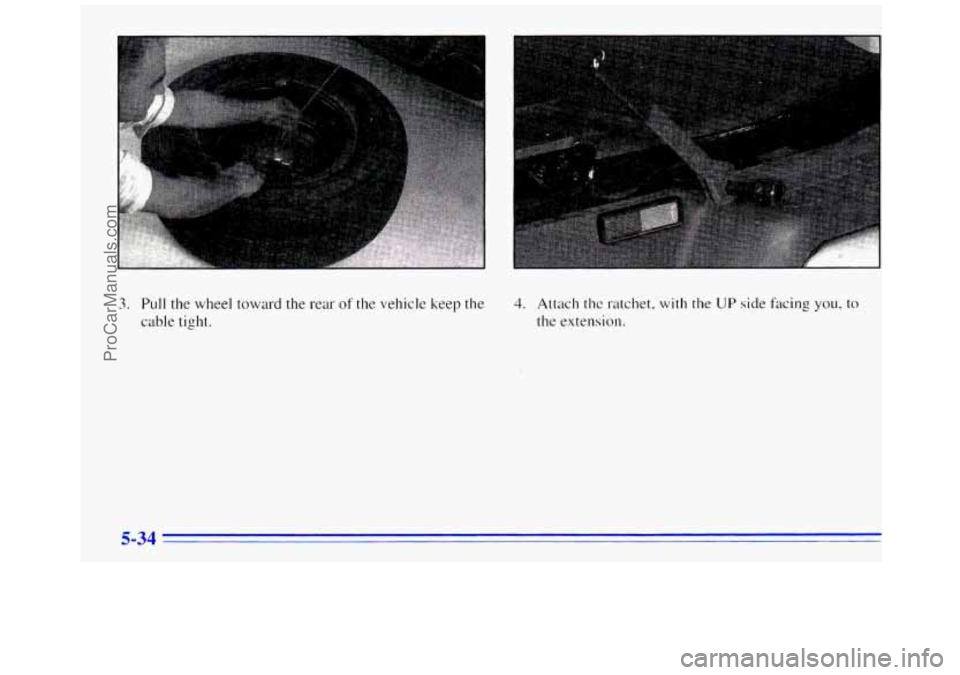
3. Pull the wheel toward the rear of the vehicle keep the
cable tight. 4. Attach the ratchet, with the UP side facing you, to
the extension.
5-34
ProCarManuals.com