belt GMC SAVANA 1996 Workshop Manual
[x] Cancel search | Manufacturer: GMC, Model Year: 1996, Model line: SAVANA, Model: GMC SAVANA 1996Pages: 372, PDF Size: 18.81 MB
Page 269 of 372
Dual Tire Operation
When the vehicle is new, or whenever a wheel, wheel
bolt or wheel
nut is replaced, check the wheel nut torque
after
100, 1,000 and 6,000 miles ( 160, 1 600 and
10 000 km) of driving. For proper torque, see “Wheel
Nut Torque”
in the Index.
The outer tire
on a dual wheel setup generally wears
faster than
the inner tire. Your tires will wear more
evenly and last longer if
you rotate the tires periodically.
If you’re going to be doing a lot of driving on
high-crown roads, you can reduce tire wear by adding
5 psi (35 kPa) to the tire pressure in the outer tires. Be
sure to return
to the recommended pressures when no
longer driving under those conditions. See “Changing a
Flat Tire” in the Index for more information.
A CAUTION:
If you operate your vehicle with a tire that is
badly underinflated, the tire can overheat. An
overheated tire can lose air suddenly
or catch
fire. You or others could be injured. Be sure all
tires (including the spare) are properly inflated.
Buying New Tires
To find out what kind and size of tires you need, look at
the Certification/Tire label.
The tires installed on your vehicle when
it was new had
a Tire Performance Criteria Specification (TPC Spec)
number
on each tire’s sidewall. When you get new tires,
get ones
with that same TPC Spec number. That way
your vehicle will continue to have tires that are designed
to give proper endurance, handling, speed rating,
traction, ride and other things during normal service
on
your vehicle. If your tires have an all-season tread
design, the TPC number will be followed by an
“MS”
(for mud and snow).
If you ever replace your tires with those not having a
TPC Spec number, make sure they are the same size,
load range, speed rating and construction type (bias,
bias-belted or radial) as your original tires.
ProCarManuals.com
Page 270 of 372
A CAUTION:
Mixing tires could cause you to lose control while
driving.
If you mix tires of different sizes or types
(radial and bias-belted tires), the vehicle may not
handle properly, and
you could have a crash.
Using tires of different sizes may also cause
damage to your vehicle. Be sure to use the same
size and type tires
on all wheels.
Uniform Tire Quality Grading
The following information relates to the system
developed by the United States National Highway
Traffic Safety Administration, which grades tires
by
treadwear, traction and temperature performance. (This
applies only to vehicles sold
in the United States.) The
grades are molded
on the sidewalls of most passenger
car tires. The Uniform Tire Quality Grading system does
not apply
to deep tread, winter-type snow tires,
space-saver or temporary use spare tires, tires with
nominal
rim diameters of 10 to 12 inches (25 to 30 cm),
or to some limited-production tires.
While the tires available on General Motors passenger
cars and light trucks may vary with respect
to these
grades, they must
also conform to Federal safety
requirements and additional General Motors Tire
Performance Criteria
(TYC) standards.
6-46
ProCarManuals.com
Page 278 of 372
Cleaning the Top of the Instrument Panel
Use only mild soap and water to clean the top surfaces
of the instrument panel. Sprays containing silicones or
waxes may cause annoying reflections
in the windshield
and even make
it difficult to see through the windshield
under certain conditions.
Care of Safety Belts
Keep belts clean and dry.
Do not bleach or dye safety belts. If you do, it
may severely weaken them. In a crash, they
might not be able
to provide adequate protection.
Clean-safety belts only with mild soap and
lukewarm water.
Glass
Glass should be cleaned often. GM Glass Cleaner
(GM Part No. 1050427) or a liquid household glass
cleaner will remove normal tobacco smoke and
dust films.
Don’t use abrasive cleaners on glass, because they may
cause scratches. Avoid placing decals
on the inside rear
window, since they may have
to be scraped off later. If
abrasive cleaners are used on the inside of the rear
window,
an electric defogger element may be damaged.
Any temporary license should not
be attached across the
defogger grid.
6-54
ProCarManuals.com
Page 294 of 372
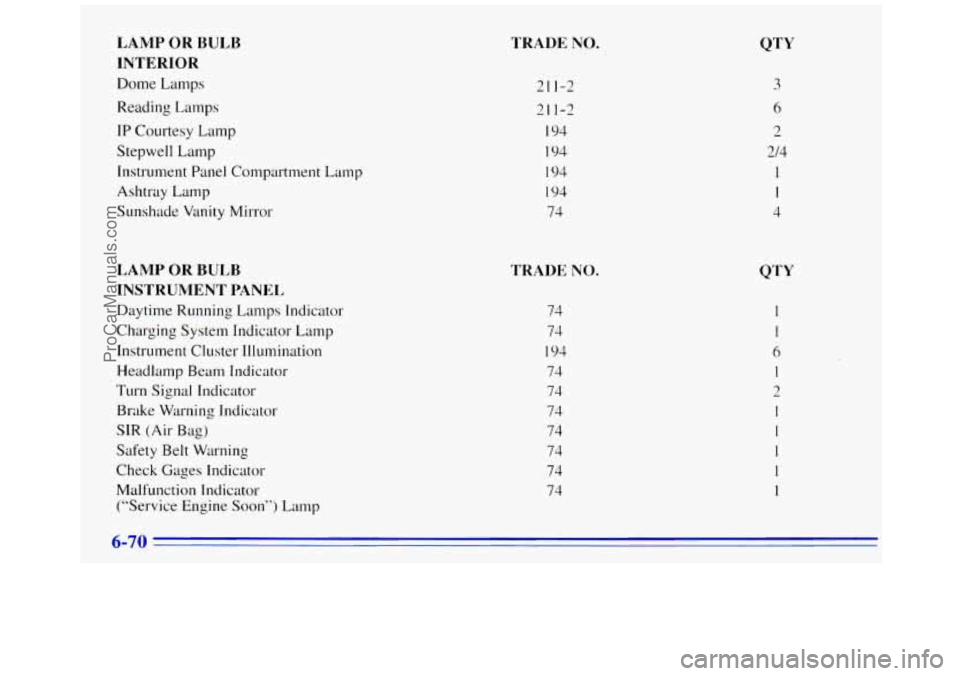
LAMP OR BULB
INTERIOR
Dome Lamps
Reading Lamps
IP Courtesy Lamp
Stepwell Lamp Instrument Panel Compartment Lamp
Ashtray Lamp
Sunshade Vanity Mirror
LAMP OR BULB
INSTRUMENT PANEL
Daytime Running Lamps Indicator
Charging System Indicator Lamp
Instrument Cluster Illumination
Headlamp Beam Indicator
Turn Signal Indicator Brake Warning Indicator
SIR (Air Bag)
Safety Belt Warning
Check Gages Indicator
Malfunction Indicator
("Service Engine Soon") Lamp
TRADE NO.
21 1-2
21 1-2
194
194
194
194 74
TRADE NO.
74
74
194 74
74
74
74
74
74
74
3
6
2
214
1
I
4
1
1
6
1
2
I
I
1
1
1
6-70
ProCarManuals.com
Page 301 of 372
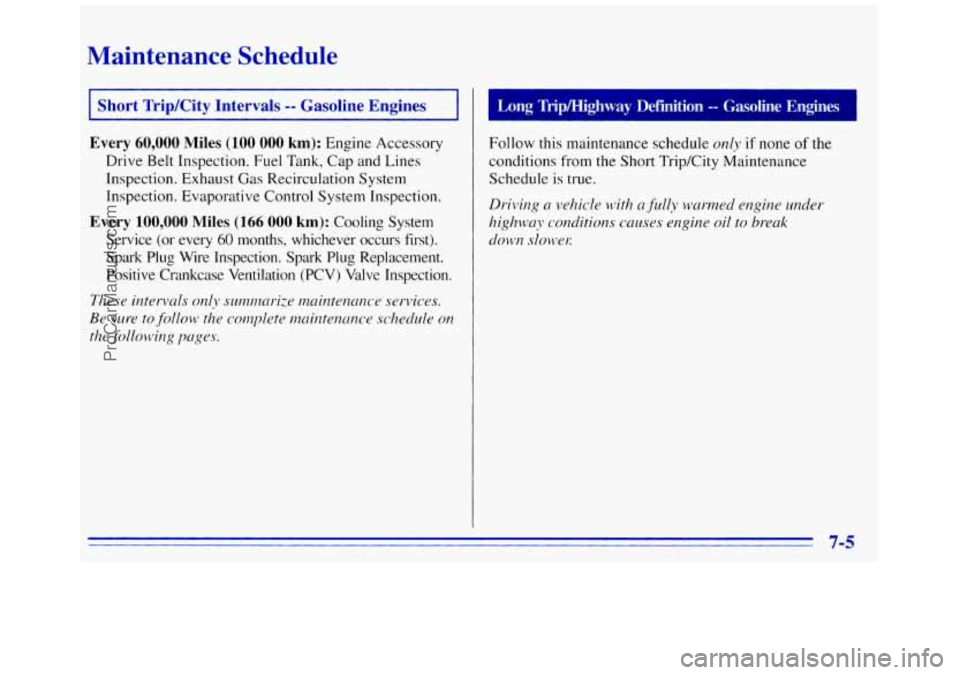
Maintenance Schedule
I Short Trip/City Intervals -- Gasoline Engines I
Every 60,000 Miles (100 000 km): Engine Accessory
Drive Belt Inspection. Fuel Tank, Cap and Lines
Inspection. Exhaust
Gas Recirculation System
Inspection. Evaporative Control System Inspection.
Every 100,000 Miles (166 000 km): Cooling System
Service
(or every 60 months, whichever occurs first).
Spark Plug Wire Inspection. Spark Plug Replacement.
Positive Crankcase Ventilation (PCV) Valve Inspection.
These intervals onlj? sumnariZe mlinterzcrnce services.
Be sure to.follow the complete nzainterzance schedule on
the jollowing pcrges.
I Long Tkip/Highway Definition -- Gasoline Engines I
Follow this maintenance schedule ordy if none of the
conditions from the Short Trip/City Maintenance
Schedule
is true.
Driviizg a vehicle with a fdly warmed engine mder
highway conditions c:a~~ses engine oil
to break
down slowe~:
7-5
ProCarManuals.com
Page 302 of 372
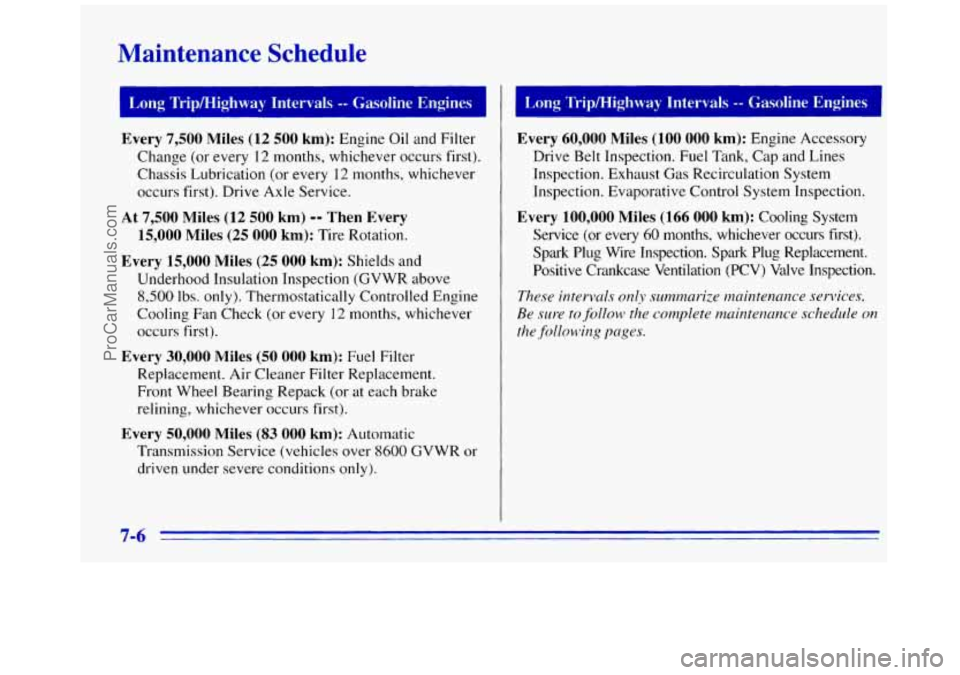
Maintenance Schedule
Every 7,500 Miles (12 500 km): Engine Oil and Filter
Change (or every 12 months, whichever occurs first).
Chassis Lubrication (or every 12 months, whichever
occurs first). Drive Axle Service.
At 7,500 Miles (12 500 km) -- Then Every
15,000 Miles
(25 000 km): Tire Rotation.
Every 15,000 Miles (25 000 km): Shields and
Underhood Insulation Inspection (GVWR above
8,500 lbs. only). Thermostatically Controlled Engine
Cooling Fan Check
(or every 12 months, whichever
occurs first).
Every 30,000 Miles (50 000 km): Fuel Filter
Replacement. Air Cleaner Filter Replacement.
Front Wheel Bearing Repack (or at each brake
relining, whichever occurs first).
Every 50,000 Miles (83 000 km): Automatic
Transmission Service (vehicles over
8600 GVWR or
driven under severe conditions only).
Every 60,000 Miles (100 000 km): Engine Accessory
Drive Belt Inspection. Fuel
Tank, Cap and Lines
Inspection. Exhaust Gas Recirculation System
Inspection. Evaporative Control System Inspection.
Every 100,000 Miles (166 000 km): Cooling System
Service (or every
60 months, whichever occurs fist).
Spark Plug Wire Inspection. Spark
Plug Replacement.
Positive Crankcase Ventilation (PCV) Valve Inspection.
These intervals only sumnarize maintenance services.
Be sure to follow the complete maintenance schedule on
the.following pnges.
7-6
ProCarManuals.com
Page 316 of 372
-
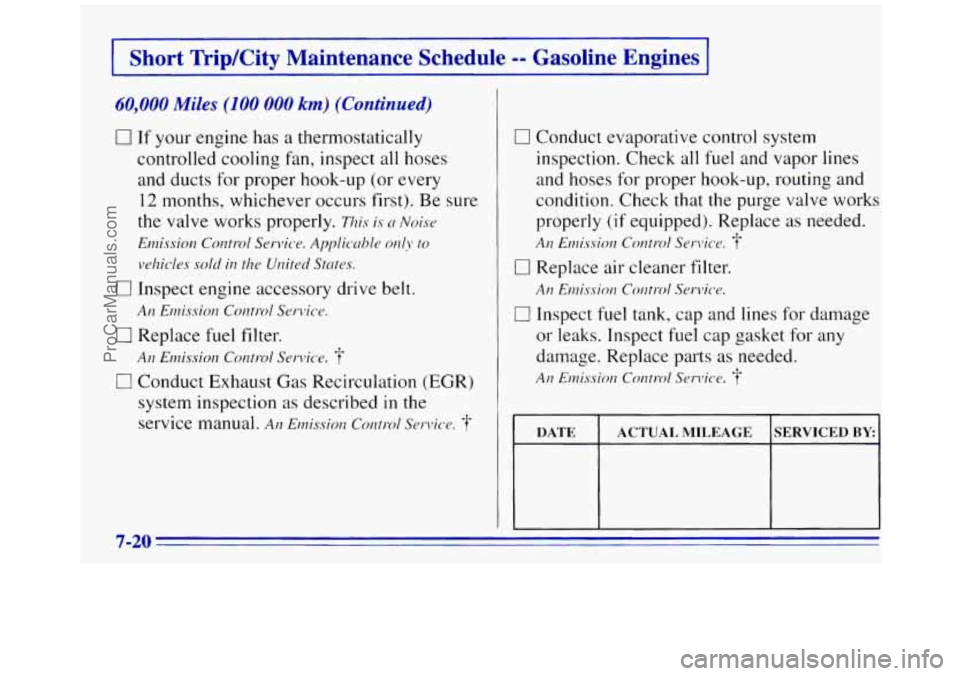
Short TripKity Maintenance Schedule -- Gasoline Engines
60,000 Miles (100 000 km) (Continued)
0 If your engine has a thermostatically
controlled cooling fan, inspect
all hoses
and ducts for proper hook-up (or every
12 months, whichever occurs first). Be sure
the valve works properly.
This is LI Noise
Emission Control Senice. Applicublp
on1~ to
vehicles
sold in the United Stcrtes.
0 Inspect engine accessory drive belt.
0 Replace fuel filter.
0 Conduct Exhaust Gas Recirculation (EGR)
system inspection
as described in the
service manual.
A11 Emissiofz Comol Service.
AI? Emissiorz Control Service.
An Emission Colafro1 Service.
0 Conduct evaporative control system
inspection. Check all fuel and vapor lines
and hoses for proper hook-up, routing and
condition. Check that the purge valve works
properly
(if equipped). Replace as needed.
An Emisxion Cor1 fro1 SL>rvico.
0 Replace air cleaner filter.
17 Inspect fuel tank, cap and lines for damage
or leaks. Inspect fuel cap gasket for any
damage. Replace parts
as needed.
An Emissinll Cof7fm1 Service'.
AH Emissior7 Coutr-ol Ser?>ic.e. 7 L
I DATE I ACTUAL MILEAGE I SERVICED BY I
ProCarManuals.com
Page 332 of 372
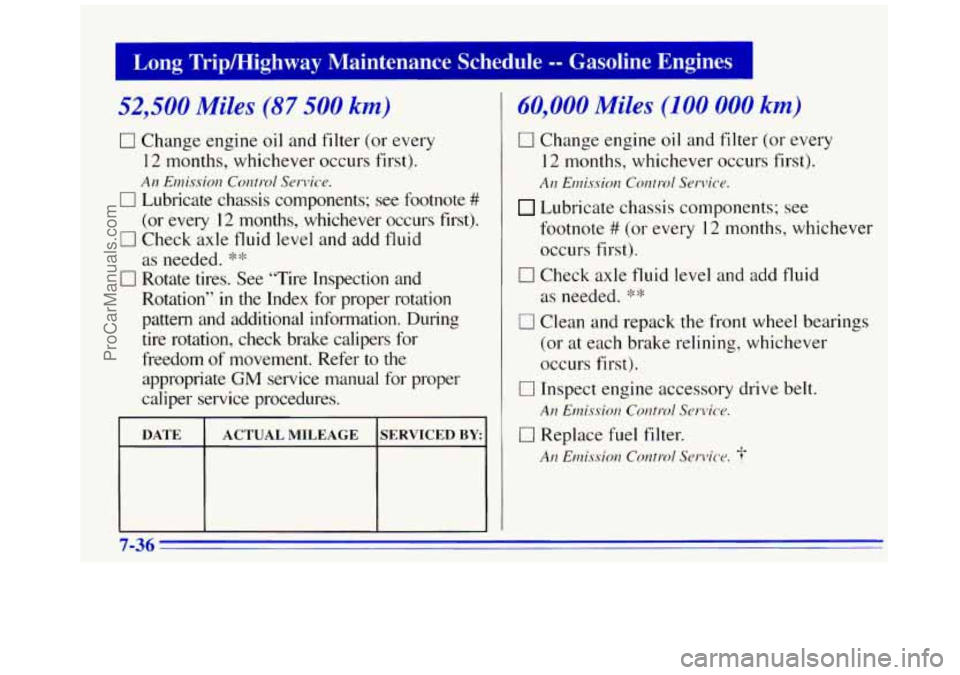
Long Tripmighway Maintenance Schedule -- Gasoline Engines I
52,500 Miles (87 500 km)
0 Change engine oil and filter (or every
12 months, whichever occurs first).
An Emission Control Service.
0 Lubricate chassis components; see footnote ##
(or every 12 months, whichever occurs first).
0 Check axle fluid level and add fluid
as needed.
‘M
I7 Rotate tires. See “Tire Inspection and
Rotation”
in the Index for proper rotation
pattern and additional information. During
tire rotation, check brake calipers for
freedom
of movement. Refer to the
appropriate
GM service manual for proper
caliper service procedures.
I DATE I ACTUALMILEAGE SERVICED BY:^
60,000 Miles (100 000 km)
0 Change engine oil and filter (or every
I2 months, whichever occurs first).
Lubricate chassis components; see
An Emissiorl Control Service.
footnote ## (or every 12 months, whichever
occurs first).
as needed.
**
(or at each brake relining, whichever
occurs first).
0 Check axle fluid level and add fluid
0 Clean and repack the front wheel bearings
0 Inspect engine accessory drive belt.
0 Replace fuel filter.
A17 Elnissiorl Co~~rol Service.
AIZ Emission Corz~ol Servicv. ?
7-36 -
ProCarManuals.com
Page 340 of 372
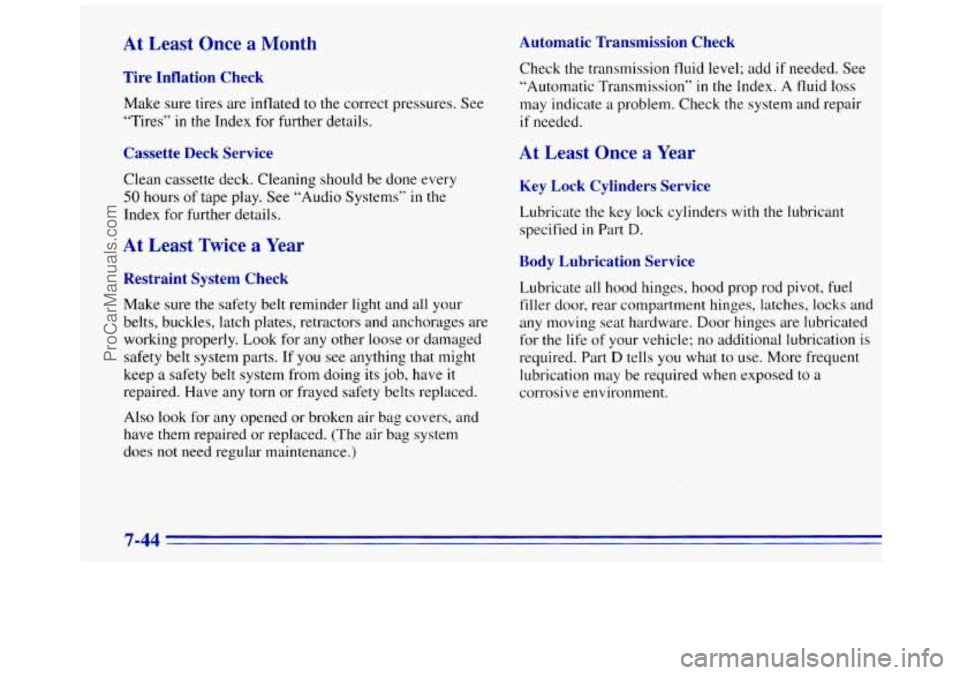
At Least Once a Month Automatic Transmission Check
Tire Inflation Check
Make sure tires are inflated to the correct pressures. See
“Tires”
in the Index for further details.
Cassettt -1eck Service
Clean cassette deck. Cleaning should be done every
50 hours of tape play. See “Audio Systems” in the
Index for further details.
At Least Twice a Year
Restraint System Check
Make sure the safety belt reminder light and all bur
belts, buckles, latch plates, retractorshnd anchoiages are
working properly.
Look for any other loose or damaged
safety belt system parts. If you see anything that might
keep
a safety belt system from doing its job, have it
repaired. Have any torn or frayed safety belts replaced.
Also look for any opened or broken air bag covers, and
have them repaired or replaced. (The air
bag system
does
not need regular maintenance.) Check
the transmission fluid level; add if needed. See
“Automatic Transmission“
in the Index. A fluid loss
may indicate a problem. Check the system and repair
if needed.
At Least Once a Year
Key Lock Cylinders Service
Lubricate the key lock cylinders with the lubricant
specified
in Part D.
Body Lubrication Service
Lubricate ail hood hinges, hood prop rod pivot, fuel
filler door, rear compartment hinges, latches,
locks and
any moving seat hardware. Door hinges are lubricated
for the
life of your vehicle; no additional lubrication is
required. Part D tells you what to use. More frequent
lubrication may be required when exposed to a
corrosive environment.
7-44
ProCarManuals.com
Page 365 of 372
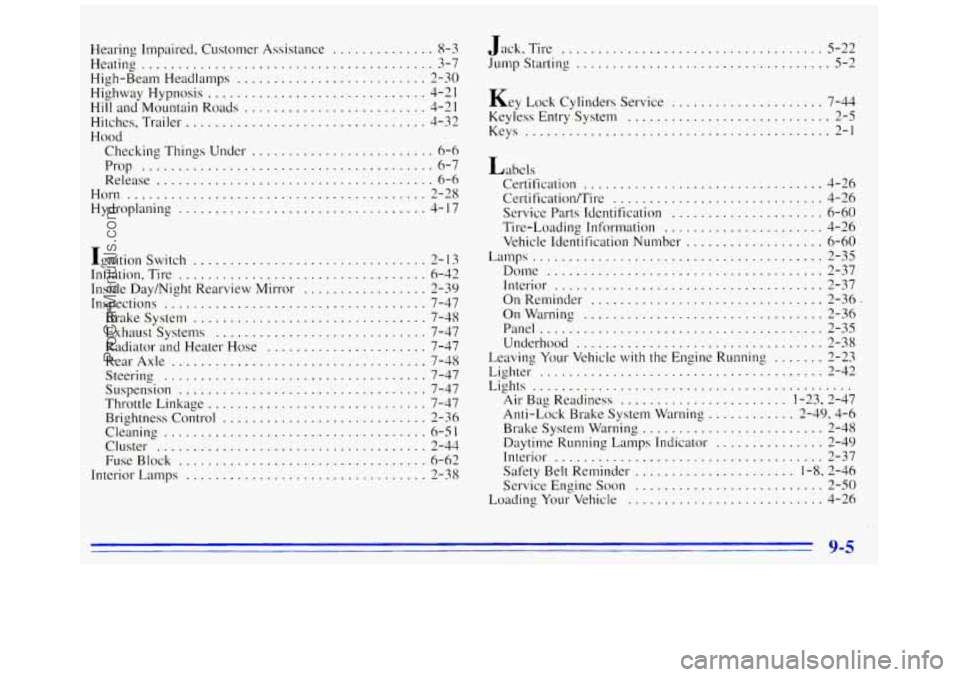
Hearing Impaired. Customer Assistance .............. 8-3
Heating ........................................ 3-7
High-Beam Headlamps
.......................... 2-30
Highway Hypnosis
.............................. 4-2 1
Hill and Mountain Roads ......................... 4-21
Hitches. Trailer
................................. 4-32
Hood
Checking Things Under
......................... 6-6
Prop
........................................ 6-7
Release
...................................... 6-6
Hydroplaning
.................................. 4- 17
Horn
......................................... 2-28
Ignition Switch
................................ 2- I3
Inflation. Tire
.................................. 6-42
Inside Day/Night Rearview Mirror
................. 2-39
Brakesystem
................................ 7-48
Exhaust Systems ............................. 7-47
Radiator and Heater
Hose ...................... 7-47
RearAxle
................................... 7-48
Steering
.................................... 7-47
Suspension
.................................. 7-47
Throttle Linkage
.............................. 7-47
Brightness Control
............................ 2-36
Cleaning
.................................... 6-51
Cluster ..................................... 2-44
FuseBlock
.................................. 6-62
Interior Lamps
................................. 2-38
Inspections
.................................... 7-47
.................................... J ack.Tire
5-22
Jump Starting ................................... 5-2
Key Lock Cylinders Service ..................... 7-44
Keyless Entry System
............................ 2-5
Keys .......................................... 2-1
Labels
Certification ................................. 4-26
CeriificatiodTire
............................. 4-26
Service Parts Identification
..................... 6-60
Tire-Loading
. Information ...................... 4-26
Vehicle Identification Number
................... 6-60
Lamps ........................................ 2-35
Dome ...................................... 2-37
Interior
..................................... 2-37
On Reminder
................................ 2-36 .
On Warning ................................. 2-36
Panel
....................................... 2-35
Underhood
.................................. 2-38
Leaving
Your Vehicle with the Engine Running ....... 2-23
Lighter
....................................... 2-42
Lights
............................................
Air Bag Readiness ....................... 1-23.2-47
Anti-Lock Brake System Warning
............ 2.49, 4.6
Brake System Warning ......................... 2-48
Daytime Running Lamps Indicator
............... 2-49
Interior
..................................... 2-37
Safety Belt Reminder
...................... 1.8. 2.46
Service Engine
Soon .......................... 2-50
Loading Your Vehicle ........................... 4-26
9-5
ProCarManuals.com