engine GMC SAVANA 1996 Manual PDF
[x] Cancel search | Manufacturer: GMC, Model Year: 1996, Model line: SAVANA, Model: GMC SAVANA 1996Pages: 372, PDF Size: 18.81 MB
Page 245 of 372
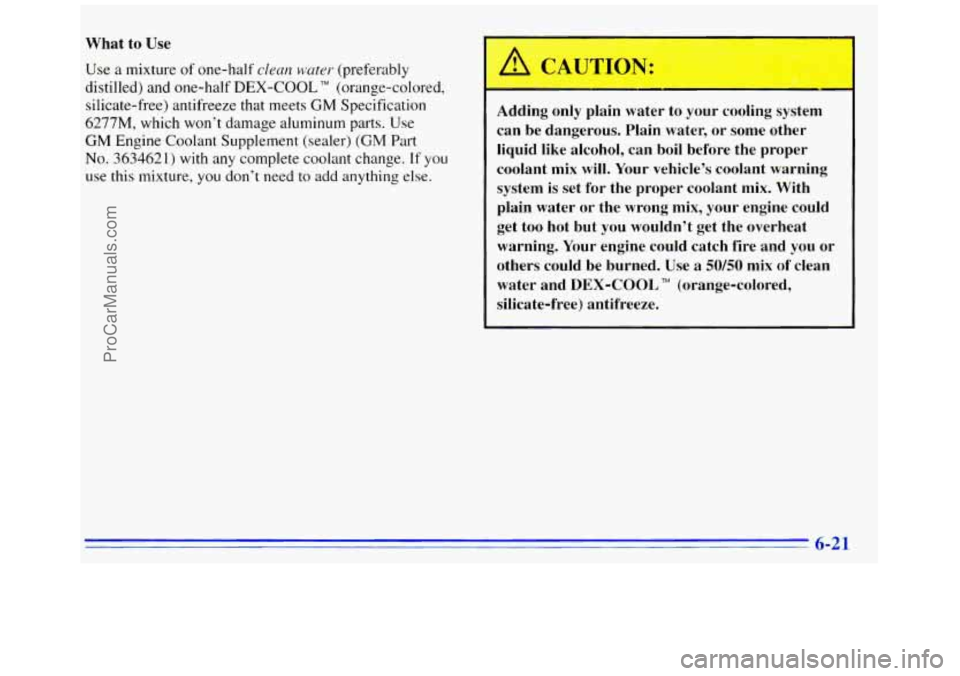
What to Use
Use a mixture of one-half clean water (preferably
distilled) and one-half
DEX-COOL TM (orange-colored,
silicate-free) antifreeze that meets
GM Specification
6277M, which won’t damage aluminum parts. Use
GM Engine Coolant Supplement (sealer) (GM Part
No. 3634621) with any complete coolant change. If you
use this mixture, you don’t need to add anything else. Adding
only plain water to your cooling system
can be dangerous. Plain water,
or some other
liquid like alcohol, can boil before the proper
coolant mix will. Your vehicle’s coolant warning
system is set for the proper coolant mix. With
plain water or the wrong mix, your engine could get too hot but you wouldn’t get the overheat
warning. Your engine could catch fire and you or
others could be burned. Use a
50/50 mix of clean
water and
DEX-COOL TM (orange-colored,
silicate-free) antifreeze.
6-21
ProCarManuals.com
Page 246 of 372
NOTICE:
~~
If you use an improper coolant mix, your engine
could overheat and be badly damaged. The
repair cost wouldn’t be covered by your
warranty.
Too much water in the mix can freeze
and crack the engine, radiator, heater core and
other parts.
If you have to add coolant more than four times a year,
have your dealer check your cooling system.
I NOTICE:
If you use the proper coolant, you don’t have to
add extra inhibitors or additives which claim to
improve the system. These can be harmful.
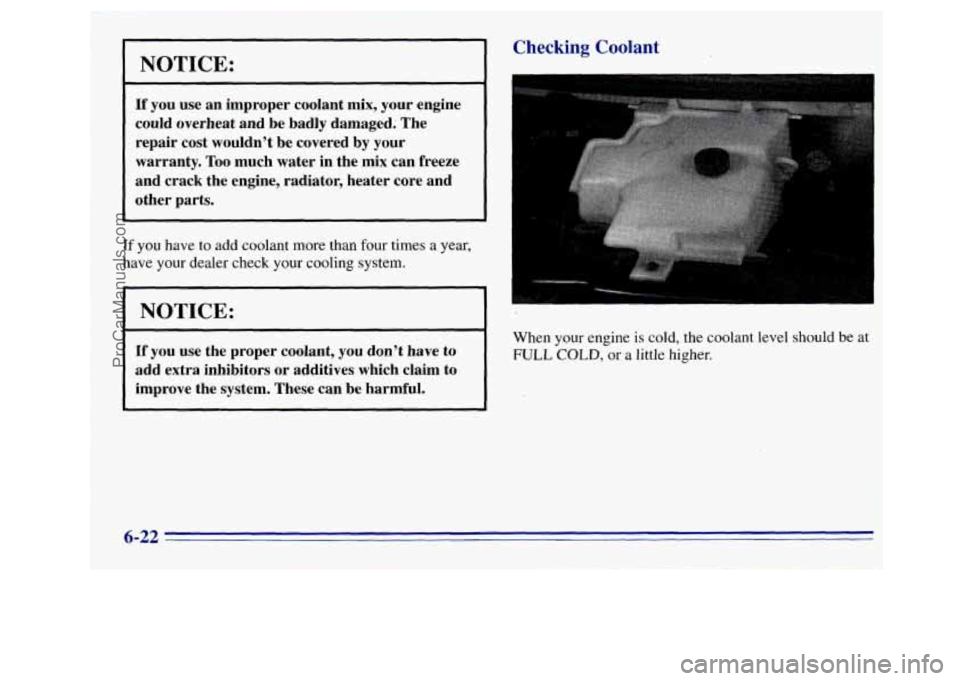
Checking Coolant
When your engine is cold, the coolant level should be at
FULL COLD, or a little higher.
6-22
k
ProCarManuals.com
Page 247 of 372
Adding Coolant
If you need more coolant, add the proper mix ut the
coolcrnt mcoveq* tmk.
A CAUTION:
Tbrning the radiator pressure cap when the
engine and radiator are hot can allow steam and scalding liquids to blow out and burn you
badly. With the coolant recovery tank, you will
almost never have to add coolant at the radiator.
Never turn the radiator pressure cap
-- even a
little
-- when the engine and radiator are hot.
Add coolant mix at the recovery tank. but be careful
not
to spill it.
A CAUTION:
You can be burned if' you spill coolant on hot
engine parts. Coolant contains ethylene glycol,
and it
will burn if the engine parts are hot
enough. Don't spill coolant on a hot engine.
Radiator Pressure Cap
The radiator pressure cap nust be tightly installed with
the arrows
on the cap lined up with the overflow tube on
the radiator filler neck.
NOTICE:
Your radiator cap is a pressure-type cap and
must be tightly installed to prevent coolant
loss
and possible engine damage from overheating. Be
sure the arrows on the cap line up with the
overflow tube on the radiator filler neck.
6-23
ProCarManuals.com
Page 248 of 372
Thermostat
Engine coolant temperature is controlled by a thermostat
in the engine cooling system. The thermoskt stops the
tlow of coolant through the radiator until the coolant
reaches
a preset temperature.
When you replace your thermostat,
an AC@ thermostat
is recommended.
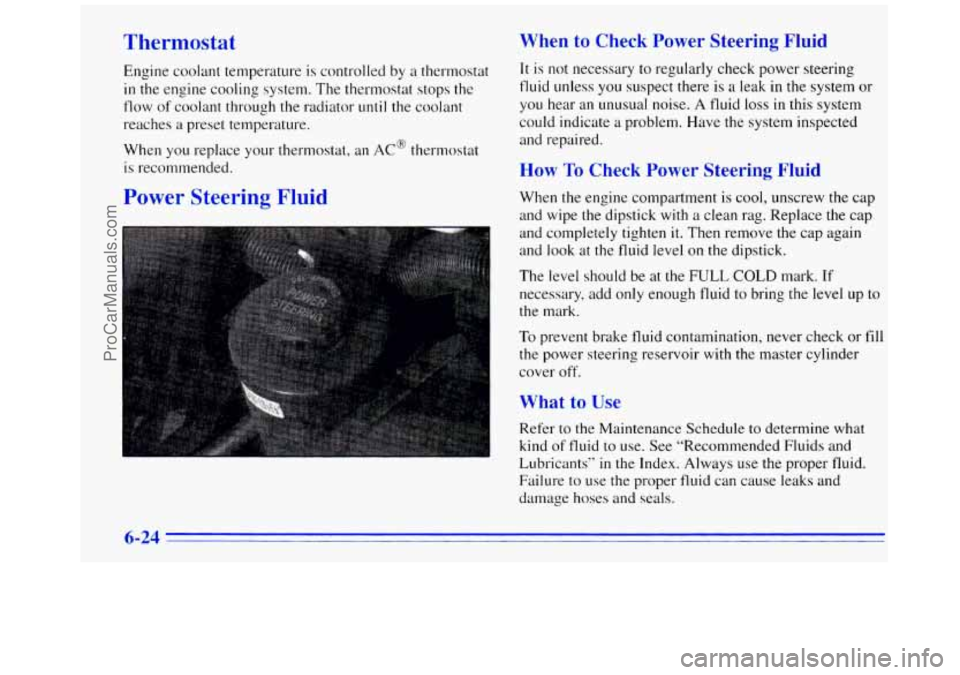
Power Steering Fluid
When to Check Power Steering Fluid
It is not necessary to regularly check power steering
tluid unless you suspect there
is a leak in the system or
you hear an unusual noise.
A fluid loss in this system
could indicate a problem. Have the system inspected
and repaired.
How To Check Power Steering Fluid
When the engine compartment is cool, unscrew the cap
and wipe the dipstick with a clean rag. Replace the cap
and completely tighten
it. Then remove the cap again
and
look at the fluid level on the dipstick.
The level should be at the FULL COLD mark. If
necessary, add only enough fluid to bring
the level up to
the mark.
To prevent brake fluid contamination, never check or
fill
the power steering reservoir with the master cylinder
cover off.
What to Use
Refer to the Maintenance Schedule to determine what
kind
of fluid to use. See “Recommended Fluids and
Lubricants”
in the Index. Always use the proper fluid.
Failure to use the proper fluid can cause leaks and
damage hoses and seals.
ProCarManuals.com
Page 250 of 372
Brakes
Brake Fluid
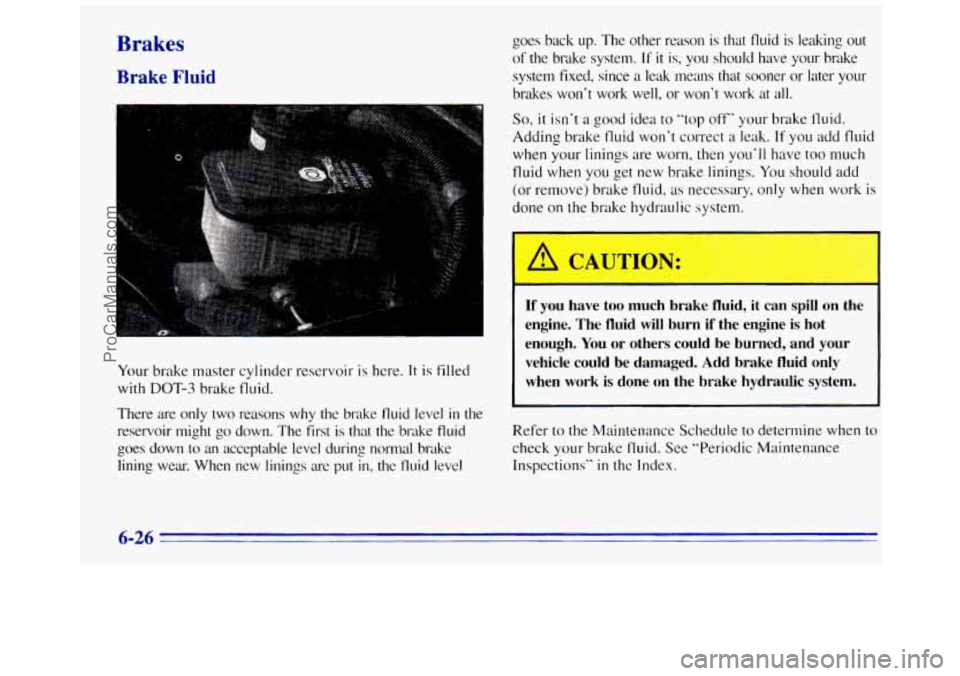
Your brake master cylinder reservoir is here. It is filled
with DOT-3 brake fluid.
There
are only two reasons why the brake fluid level in the
reservoir might
go down. The first is that the brake fluid
lining wear. When new linings are put in, thc tluid levcl
2 wes down to an acceptable level during nonnal brake
c qoes back up. The other reason is that fluid is leaking out
of the brake system. If it is, you should have your brake
system fixed, since
a leak means that sooner or later your
brakes won't work well, or
won't work at all.
So, it isn't a good idea to "top off' your brake tluid.
Adding brake fluid won't correct a leak. If you add fluid
when your linings are worn, then
you'll have too much
fluid when you get new brake linings.
You should add
(or remove) brake fluid, as necessary, only when work is
done
on the brake hydraulic system.
A CAUTION
If you have too much brake fluid, it can spill on the
engine. The fluid
will burn if the engine is hot
enough. You
or others could be burned, and your
vehicle could
be damaged. Add brake fluid only
when work
is done on the brake hydraulic system.
Refer to the Maintenance Schedule to determine when to
check your brake fluid. See "Periodic Maintenance
Inspections"
in the Index.
6-26
ProCarManuals.com
Page 252 of 372
Brake Wear
NOTICE:
Using the wrong fluid can badly damage
brake system parts. For example, just a few
drops
of mineral-based oil, such as engine
oil, in your brake system can damage brake
system parts
so badly that they’ll have to be
replaced. Don’t let someone put in the
wrong kind
of fluid.
If you spill brake fluid on your vehicle’s
painted surfaces, the paint finish can be
damaged.
Be careful not to spill brake fluid
on your vehicle. If you do, wash it off
immediately. See “Appearance Care” in
the Index.
Your vehicle has front disc brakes and rear drum brakes.
Disc brake pads have built-in wear indicators that make a
high-pitched warning sound when the brake pads are worn
and new pads are needed.
The sound may come and go or
be heard all the time
your vehicle is moving (except when
you
are pushing on the brake pedal firmly).
L
The brake wear warning sound means that
sooner or later your brakes won’t work well.
That could lead to an accident. When you hear
the brake wear warning sound, have your vehicle serviced.
I NOTICE: I
Continuing to drive with worn-out brake pads
could result
in costly brake repair.
6-28
ProCarManuals.com
Page 255 of 372
Batteries have acid that can burn you and gas
that can explode. You can be badly hurt if you
aren’t careful. See “Jump Starting” in the Index
for tips on working around a battery without
getting hurt.
Halwen Bulbs
Contact your dealer to learn how to prepare your vehicle
for longer storage periods.
Also, for your audio system, see ”Theft-Deterrent
Feature’’
in the Index.
Bulb Replacement
Before you replace any bulbs, be sure that all the lamps
are
off and the engine isn’t running. See “Replacement
Bulbs”
in the index for the proper types of bulbs to use.
A CAUTIO
Halogen bulbs have pressurized gas inside and
can burst if you drop or scratch the bulb. You or
others could be injured. Be sure to read and
follow the instructions on the bulb package.
Headlamps
You have either a sealed beam ‘headlamp system or a
composite system.
6-31
ProCarManuals.com
Page 284 of 372
Vehicle Identification Number (VIN)
B
SAMPLE4UXTM072675
ENGINEA6 f ASSEMBLY
CODE MODEL YEAR PLANT
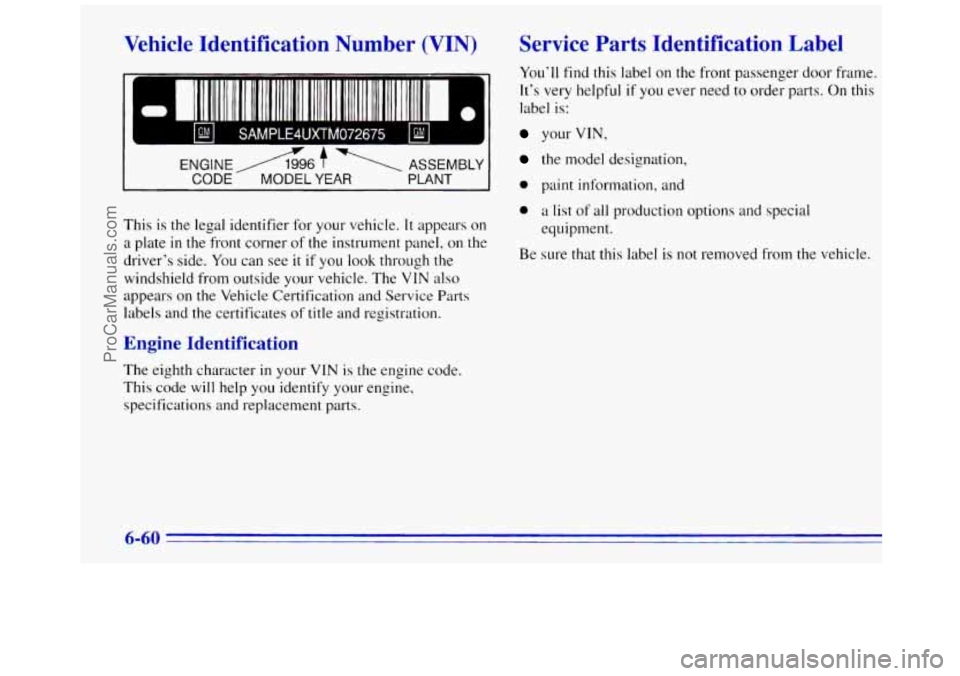
This is the legal identifier for your vehicle. It appears on
a plate
in the front corner of the instrument panel, on the
driver’s side. You can see it
if you look through the
windshield from outside your vehicle. The
VIN also
appears on the Vehicle Certification and Service Pats
labels and the certificates of title and registration.
lgine Identification
The eighth character in your VIN is the engine code.
This code will help
you identify your engine,
specifications and replacement parts.
Service Parts Identification Label
You’ll find this label on the front passenger door frame.
It’s very helpful
if you ever need to order parts. On this
label
is:
your VIN,
the model designation,
0 paint information, and
0 a list of all production options and special
equipment.
Be sure that this label is not removed from the vehicle.
6-60
ProCarManuals.com
Page 289 of 372
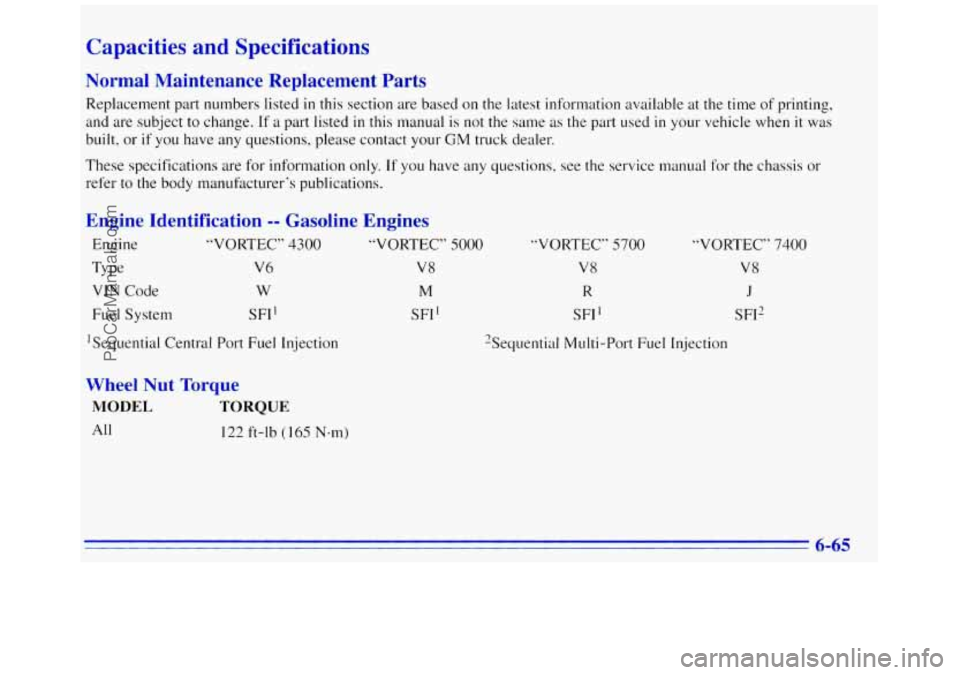
Capacities and Specifications
Normal Maintenance Replacement Parts
Replacement part numbers listed in this section are based on the latest information available at the time of printing,
and are subject
to change. If a part listed in this manual is not the same as the part used in your vehicle when it was
built, or if you have any questions, please contact your GM truck dealer.
These specifications are for information only.
If you have any questions, see the service manual for the chassis or
refer to the body manufacturer’s publications.
Engine Identification -- Gasoline Engines
Type V6 V8
Engine “VORTEC” 4300 ”VORTEC” 5000
VIN Code W M
Fuel System SFI 1 SFI 1
‘Sequential Central Port Fuel Injection
Wheel Nut Torque
MODEL TORQUE
All 122 ft-lb (165 Nem)
“VORTEC” 5700 “VORTEC” 7400
V8
V8
R J
SF1 I SFI’
? -Sequential Multi-Port Fuel Injection
ProCarManuals.com
Page 290 of 372
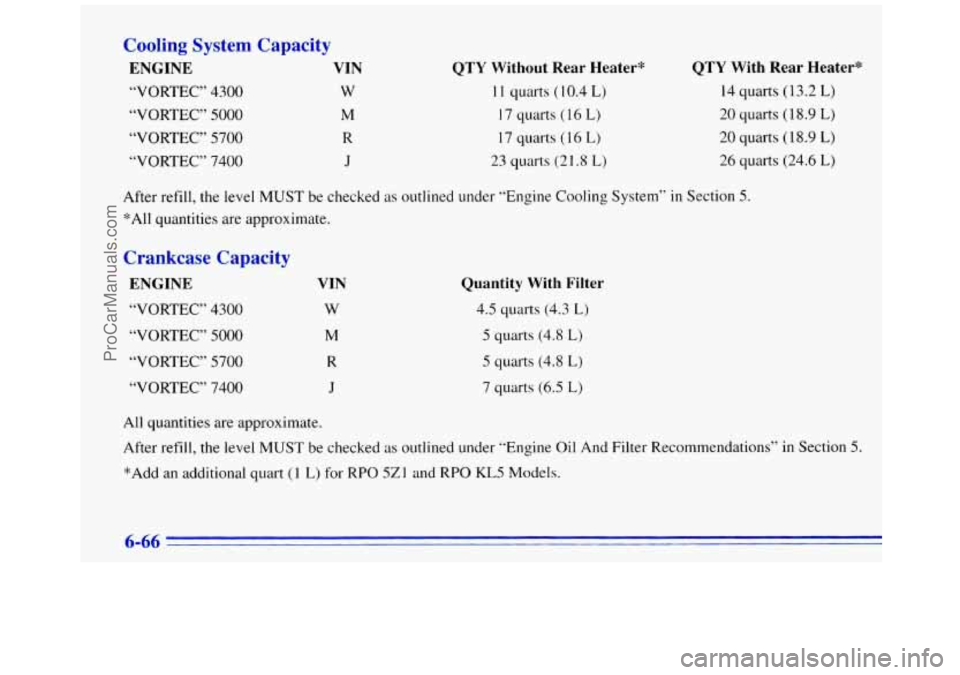
Cooling System Capacity
ENGINE VIN
“VORTEC” 4300 W
“VORTEC” SO00 M
“VORTEC” 5700 R
“VORTEC” 7400 J
QTY Without Rear Heater*
1 1 quarts ( 10.4 L)
17 quarts ( 16 L)
17 quarts (16 L)
23 quarts (2 1.8 L)
QTY With Rear Heater*
14 quarts (13.2 L)
20 quarts (18.9 L)
20 quarts (1 8.9 L)
26 quarts (24.6 L)
After refill, the level MUST be checked as outlined under “Engine Cooling System” in Section 5.
*All quantities are approximate.
Crankcase Capacity
ENGINE VIN
“VORTEC” 4300 W
“VORTEC” 5000 M
“VORTEC” 5700 R
“VORTEC” 7400 J
Quantity With Filter
4.5 quarts (4.3 L)
5 quarts (4.8 L)
5 quarts (4.8 L)
7 quarts (6.5 L)
All quantities are approximate.
After refill, the level
MUST be checked as outlined under “Engine Oil And Filter Recommendations” in Section 5.
*Add an aS;lditis.ad quart (1 L) for RPO 5ZI and RPO KL5 Models.
6-66
ProCarManuals.com