brake fluid GMC SAVANA 1996 Owners Manual
[x] Cancel search | Manufacturer: GMC, Model Year: 1996, Model line: SAVANA, Model: GMC SAVANA 1996Pages: 372, PDF Size: 18.81 MB
Page 90 of 372
Windshield Washer
At the top of the lever, there’s a paddle with the word
PUSH on it. To spray washer fluid on the windshield,
push the paddle.
Washer fluid will spray as long
as you push the paddle.
When
you let go of the paddle, the wipers will continue
to wipe for approximately two more wipe cycles and
then either stop or return to the preset speed.
Driving without washer fluid can be dangerous.
A
bad mud splash can block your vision. You could hit
another vehicle or
go off the road. Check your washer
fluid level
often.
Cruise Control (Option)
With cruise control, you can maintain a speed of about
25 mph (40 km/h) or more without keeping your foot
on
the accelerator. This can really help on long trips.
Cruise control does not work at speeds below about
25 mph (40 km/h).
When you apply your brakes, the cruise control
shuts off.
In freezing weather, don’t use your washer until
the windshield
is warmed. Otherwise the washer
fluid can form ice on the windshield, blocking
your vision.
Cruise control can be dangerous where you
can’t drive safely at a steady speed.
So,
don’t use your cruise control on winding.
roads or in heavy traffic.
slippery roads. On such roads, fast changes in tire traction can cause needless wheel
spinning, and you could lose control. Don’t
use cruise control on slippery roads.
Cruise control can be dangerous on
2-32
ProCarManuals.com
Page 170 of 372
0
0
Keep your vehicle in good shape. Check all fluid
levels and also the brakes, tires, cooling system and
transmission. These parts can work hard on
mountain roads.
Know how
to go down hills. The most important
thing to know is this: let your engine do some
of the
slowing down. Shift
to a lower gear when you go
down a steep or long hill.
A CAUTION:
If you don’t shift down, your brakes could get so
hot that they wouldn’t work well. You would then
have poor braking or even none going down a hill
You could crash. Shift down to let your engine
assist your brakes on
a steep downhill slope. Coasting
downhill in
NEUTRAL (N) or with the
ignition
off is dangerous. Your brakes will have to
do all the work
of slowing down. They could get so
hot that they wouldn’t work well. You would then
have poor braking or even none going down a hill.
You could crash. Always have your engine running
and your vehicle in gear when you go downhill.
0
0
0
0
Know how tb go uphill. You may want to shift down
to a lower gear. The lower gears help cool your engine
and transmission, and you can climb the
hill better.
Stay
in your own lane when driving on two-lane
roads
in hills or mountains. Don’t swing wide or
cut across the center of
the road. Drive at speeds
that let
YOLI stay in your own lane.
As you go over the top of a hill, be alert. There could be
something
in your lane, like a stalled car or an accident.
You may see highway signs on mountains that warn of
special problems. Examples are long grades, passing or
no-passing zones,
a falling rocks area or winding
roads. Be ale1-f to these and take appropriate action.
4-22
ProCarManuals.com
Page 185 of 372
When You Are Ready to Leave After
Parking
on a Hill
1. Apply your regular brakes and hold the pedal down
while you:
Start your engine:
Shift into a gear: and
Release the parking brake.
2. Let up on the brake pedal.
3. Drive slowly until the trailer is clear of the chocks.
4. Stop and have someone pick up and store the chocks.
Maintenance When Trailer Towing
Your vehicle will need service more often when you’re
pulling a trailer. See the Maintenance Schedule for more
on this. Things that are especially important
in trailer
operation are automatic transmission
fluid (don’t
overfill), engine oil, axle lubricant, belt, cooling system
and brake adjustment. Each
of these is covered in this
manual, and the Index will help
you find them quickly.
If you‘re trailering, it‘s a good idea to review these
sections before you start your trip.
Check periodically to see that
all hitch nuts and bolts
are tight.
Trailer Wiring Harness
The eight-wire harness, if you have one, is stored under
your vehicle along the rear frame crossmember.
It is
wrapped and bound with a plastic strap. The harness has
a 30-anlp battery feed and no connector, and you should
have a qualified electrical service person wire your
harness for you. Attach the harness
to the trailer, then
tape or strap
it to your vehicle’s frame rail. Be sure you
leave
it loose enough so the wiring doesn’t bend or
break, but not
so loose that it drags on the ground.
Store the harness
in its original place. Wrap the harness
together and tie
it neatly so it won’t be damaged.
The five-wire harness,
if you have one, is stored inside
the vehicle at the passenger side rear corner, behind the
jack. This should be wired by a qualified electrical
service person. It must be routed out
of your vehicle
between the rear door and the floor,
with enough of the
harness left on both sides
so that the trailer or the body
won’t pull
it.
Store the harness in its original place. Wrap the harness
together and tie
it neatly so it won’t be damaged.
4-37
ProCarManuals.com
Page 191 of 372
If your vehicle has more than one battery, use the
battery that is under the hood
of the vehicle -- this
will reduce the electrical resistance.
2. Get the vehicles close enough so the jumper cables
can reach, but be sure the vehicles aren’t touching
each other.
If they are, it could cause a ground
connection
you don’t want. You wouldn’t be able to
start your vehicle, and the bad grounding could
damage the electrical systems.
Set the parking brake firmly
on each vehicle. Put an
automatic transmission in PARK
(P) or a manual
transmission in NEUTRAL
(N).
3. Turn off the ignition on both vehicles. Turn off all
lamps that aren’t needed, and radios. This will avoid
sparks and help save both batteries, and could save
your radio!
NOTICE:
If you leave your radio on, it could be badly
damaged. The repairs would not be covered by
your warranty.
4. Open the hoods and locate the batteries. Find
the positive
(+) and negative (-) terminals on
each battery.
A CA
Using a match near a battery can cause battery
gas to explode. People have been hurt doing this,
and some have been blinded. Use
a flashlight if
you need more light.
Be sure the battery (or batteries) has enough
water. You don’t need to add water to the Delco
Freedom@ battery
(or batteries) installed in
every new
GM vehicle. But if a battery has filler
caps, be sure the right amount of fluid
is there. If
it is low, add water to take care of that first. If
you don’t, explosive gas could be present.
Battery fluid contains acid that can burn you.
Don’t get it on you.
If you accidentally get it in
your eyes or on your skin, flush the place with
water and get medical help immediately.
5-3
ProCarManuals.com
Page 232 of 372
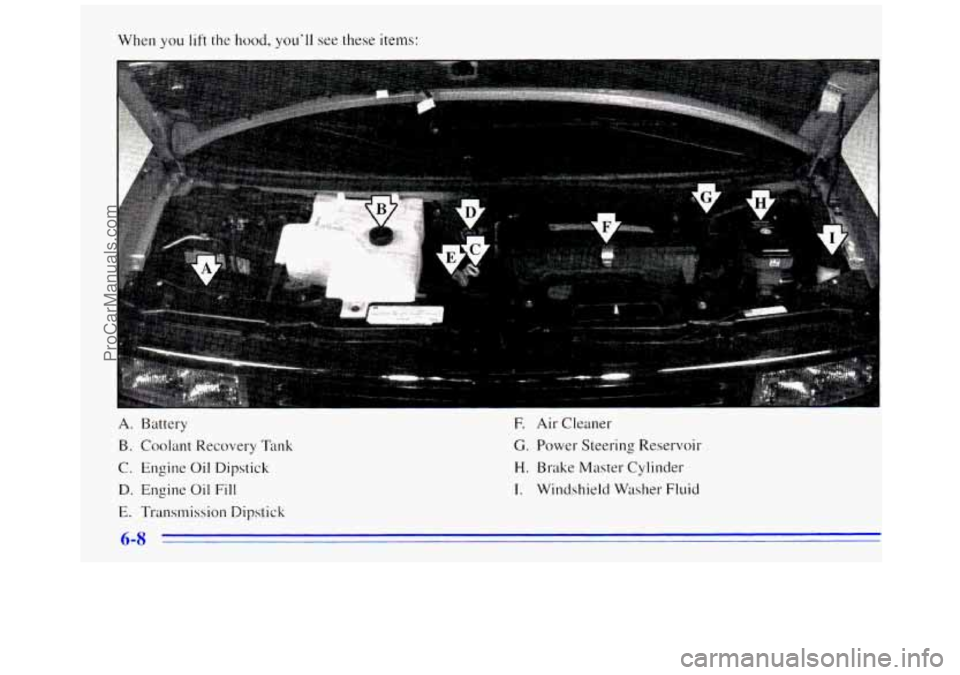
When you lift the hood, ~011’11 see these items:
A. Battery
B. Coolant Recovery Tank
C. Engine Oil Dipstick
D. Engine Oil Fill
E. Transmission Dipstick
F. Air Cleaner
G. Power Steering Reservoir
H. Brake Master Cylinder
I. Windshield Washer Fluid
ProCarManuals.com
Page 233 of 372
If your vehicle has a 7.4L engine and air conditioning,
your vehicle will have a auxiliary engine fan
in addition
to the belt driven
fdn.
If your vehicle has air conditioning, the auxiliary
engine fan under the hood can start up and
injure you even when the engine is not running.
Keep hands, clothing and tools away from any
underhood electric fan.
~ Things that burn can get on hot engine parts and
start a
fire. These include liquids like gasoline,
~ oil, coolant, brake fluid, windshield washer and
~ other fluids, and plastic or rubber. You or others
could be burned. Be careful not to drop or spill
things that
will burn onto a hot engine. Before closing
the hood, be sure
all the filler caps are
on properly.
Then
lift the hood to relieve pressure on the hood prop.
Remove the hood prop from the slot
in the hood and
return the prop to
its retainer. Then just let the hood
down and close
it firmly.
Noise Control System
The following information relates to compliance with
Federal noise emission standards for vehicles with a
Gross Vehicle Weight Rating (GVWR) of more than
10,000 lbs. (4 536 kg). The Maintenance Schedule
booklet provides information on maintaining the noise
control system to minimize degradation of the noise
emission control system during the life of your vehicle.
The noise control system warranty is given
in your
Warranty booklet.
These standards apply only
to vehicles sold in the
United States.
6-9
ProCarManuals.com
Page 241 of 372
Wait at least 30 minutes before checking the
transmission fluid level if you have been driving:
0 When outside temperatures are above 90°F (32°C).
At high speed for quite a while.
In heavy traffic -- especially in hot weather.
While pulling a trailer.
To get the right reading, the fluid should be at normal
operating temperature, which is
180°F to 200°F
(82°C to 93°C).
--- -king "ran:- ---. .ion Fluid Hot
bet the vehicle warmed up by driving about 15 miles
(24 km) when outside temperatures are above 50°F
(10°C). If it's colder than 50°F (lO"C), drive the
vehicle
in DRIVE (D) until the engine temperature
gage moves and then remains steady for
10 minutes.
Then follow the hot check procedures.
Checking Transmission Fluid Cold
A cold check is made after the vehicle has been sitting
for eight hours or more with
the engine off and is
used only
as a reference. Let the engine run at idle for
five minutes
if outside temperatures are 50°F (10°C) or
more. If it's colder than 50°F (IOOC), you may have to
idle the engine longer. Should the fluid level be low
during
a cold check, you 17zusr perform a hot check
before adding fluid. This will give you a more accurate
reading
of the fluid level.
Checking the Fluid Hot or Cold
Park your vehicle on a level place. Keep the
engine running.
With the parking brake applied, place the shift lever
in PARK (P).
With your foot on the brake pedal, move the shift
lever through each gear range, pausing for about
three seconds
in each range. Then, position the shift
lever
in PARK (P).
0 Let the engine run at idle for three minutes or more.
6-17
ProCarManuals.com
Page 248 of 372
Thermostat
Engine coolant temperature is controlled by a thermostat
in the engine cooling system. The thermoskt stops the
tlow of coolant through the radiator until the coolant
reaches
a preset temperature.
When you replace your thermostat,
an AC@ thermostat
is recommended.
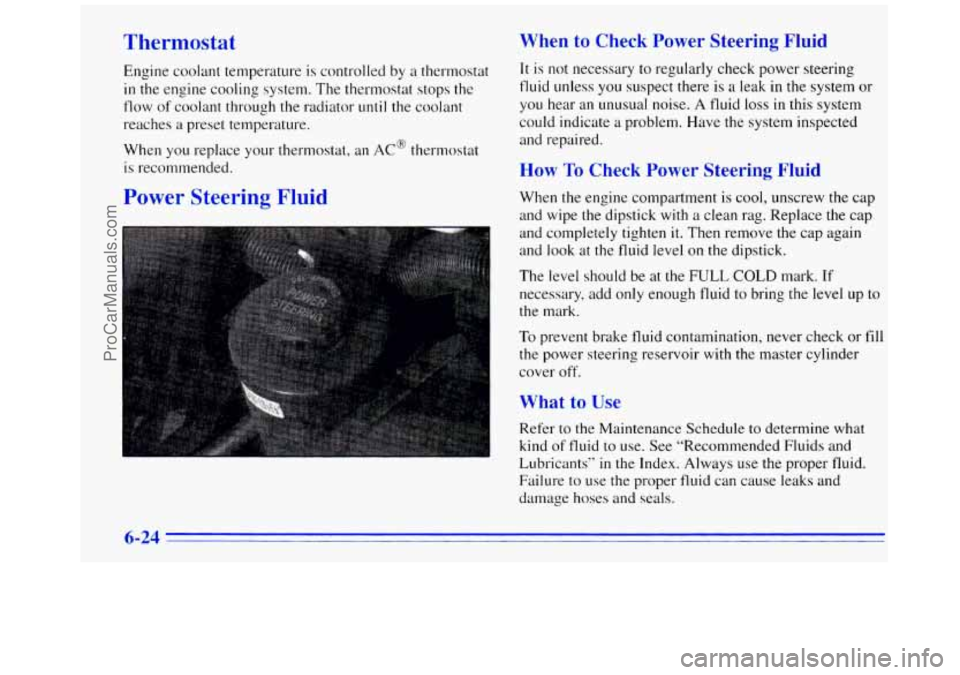
Power Steering Fluid
When to Check Power Steering Fluid
It is not necessary to regularly check power steering
tluid unless you suspect there
is a leak in the system or
you hear an unusual noise.
A fluid loss in this system
could indicate a problem. Have the system inspected
and repaired.
How To Check Power Steering Fluid
When the engine compartment is cool, unscrew the cap
and wipe the dipstick with a clean rag. Replace the cap
and completely tighten
it. Then remove the cap again
and
look at the fluid level on the dipstick.
The level should be at the FULL COLD mark. If
necessary, add only enough fluid to bring
the level up to
the mark.
To prevent brake fluid contamination, never check or
fill
the power steering reservoir with the master cylinder
cover off.
What to Use
Refer to the Maintenance Schedule to determine what
kind
of fluid to use. See “Recommended Fluids and
Lubricants”
in the Index. Always use the proper fluid.
Failure to use the proper fluid can cause leaks and
damage hoses and seals.
ProCarManuals.com
Page 250 of 372
Brakes
Brake Fluid
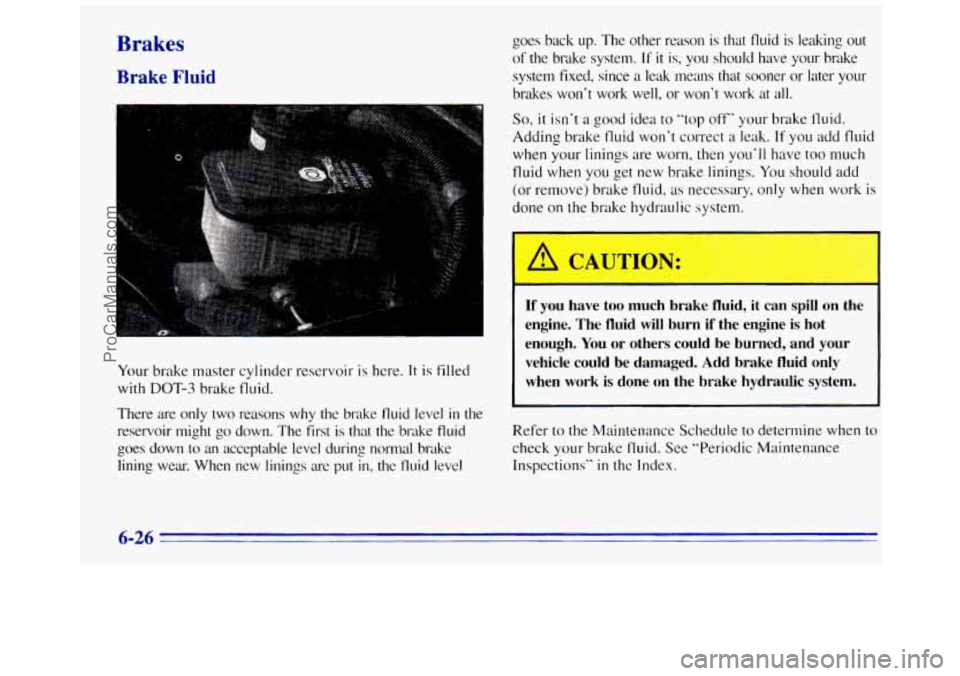
Your brake master cylinder reservoir is here. It is filled
with DOT-3 brake fluid.
There
are only two reasons why the brake fluid level in the
reservoir might
go down. The first is that the brake fluid
lining wear. When new linings are put in, thc tluid levcl
2 wes down to an acceptable level during nonnal brake
c qoes back up. The other reason is that fluid is leaking out
of the brake system. If it is, you should have your brake
system fixed, since
a leak means that sooner or later your
brakes won't work well, or
won't work at all.
So, it isn't a good idea to "top off' your brake tluid.
Adding brake fluid won't correct a leak. If you add fluid
when your linings are worn, then
you'll have too much
fluid when you get new brake linings.
You should add
(or remove) brake fluid, as necessary, only when work is
done
on the brake hydraulic system.
A CAUTION
If you have too much brake fluid, it can spill on the
engine. The fluid
will burn if the engine is hot
enough. You
or others could be burned, and your
vehicle could
be damaged. Add brake fluid only
when work
is done on the brake hydraulic system.
Refer to the Maintenance Schedule to determine when to
check your brake fluid. See "Periodic Maintenance
Inspections"
in the Index.
6-26
ProCarManuals.com
Page 251 of 372
Checking Brake Fluid
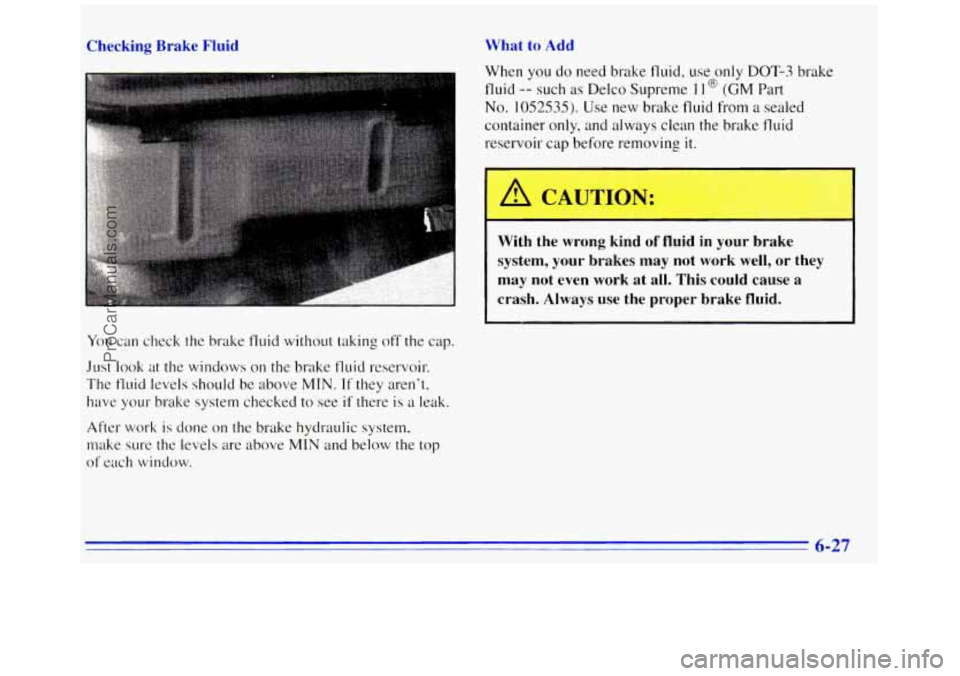
You can check the brake fluid without taking off the cap.
Just
look at the windows on the brake fluid reservoir.
The
fluid levels should be above MIN. If they aren’t,
have your brake system checked
to see if there is a leak.
After work
is done on the brake hydraulic system,
make sure the levels are above
MIN and below the top
of each window.
What to I
When you do need brake fluid, use only DOT-3 brake
fluid
-- such as Delco Supreme 11 @ (GM Part
No. 1052535). Use new brake fluid from a sealed
container only, and always clean the brake fluid
reservoir cap before removing it.
With the wrong kind of fluid in your brake
system, your brakes may not work well, or they
may not even work
at all. This could cause a
crash. Always use the proper brake fluid.
6-27
ProCarManuals.com