air condition GMC SAVANA 1997 User Guide
[x] Cancel search | Manufacturer: GMC, Model Year: 1997, Model line: SAVANA, Model: GMC SAVANA 1997Pages: 388, PDF Size: 20.17 MB
Page 132 of 388
For warmer air, turn the knob clockwise toward the red
side,
and for cooler air, turn the knob counterclockwise
toward the blue
side.
10 regulate the airflow location, adjust the center knob
on the control panel. Turn the knob counterclockwise
for floor vent airflow or clockwise for headliner
vent
airflow. Generally, the upper vents are used for air
conditioning and
the floor vents for heating. The
control knob can be set
to any blend setting.
To adjust the airflow speed, turn the fan control knob
on the left side of the control panel to the desired
blower setting.
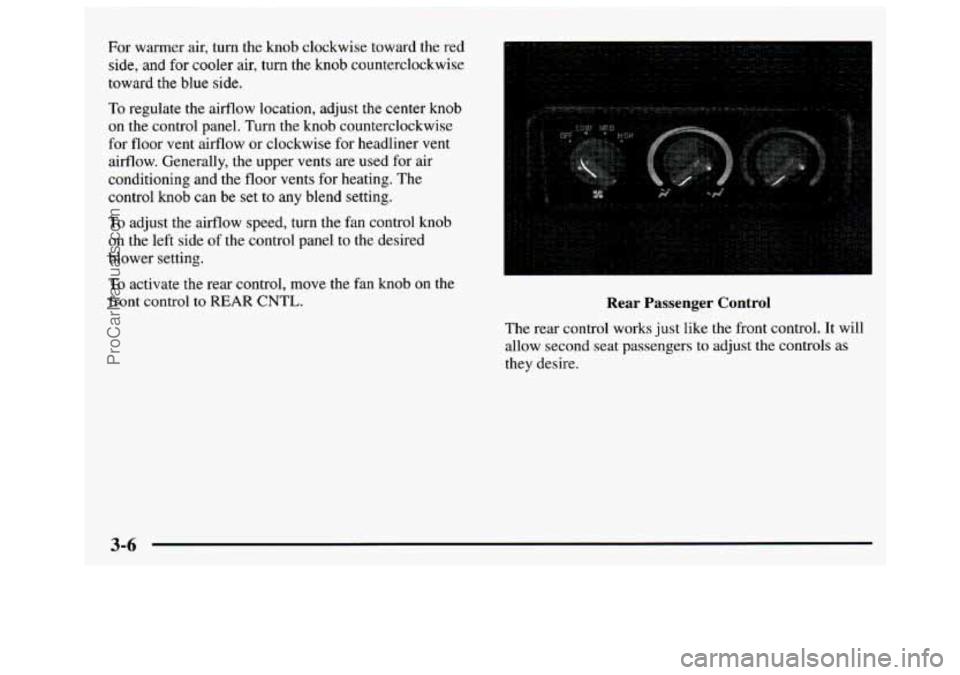
To activate the rear control, move the fan knob on the
front control to REAR CNTL. Kear rassenger Control
The rear control works just like the front control. It will
allow second seat passengers to adjust the controls as
they desire.
3-6
ProCarManuals.com
Page 133 of 388
Air Conditioning Heating
Before using your vehicle’s air conditioning, open the
windows to clear the vehicle of hot air. This reduces the
time it takes for your vehicle to cool down. Then keep
your windows closed for the air conditioner to work at
its best.
You can use
MAX A/C with the temperature knob in the
blue area, when it’s really hot outside and you need to
cool the inside air quickly.
MAX A/C lets in only a little
air from
the outside.
If you first use
MAX A/C, you can then use A/C with
the temperature knob in the blue area, as soon as the
vehicle has cooled down,
so outside air will be going
through your vehicle.
If your vehicle has rear air conditioning, setting it on
LO may enhance front A/C performance by allowing
trapped refrigerant in rear lines
to circulate.
When the air conditioning, DEFROST
or BLEND is on,
you may notice
a slight increase or decrease in engine
speed, due to compressor operation. This
is normal
because the system is designed
to cycle the compressor
on and off to keep the desired temperature. On cold
days, use
HEATER with the temperature knob
in the red area. Outside air will be brought in through
the
floor outlets. The heater works best if you keep your
windows closed while using it.
If you use the optional engine coolant heater before
starting your engine, your heating system will produce
warmer air faster to heat the passenger compartment in
cold weather. See “Engine Coolant Heater” in the Index.
Ventilation Tips
Keep the hood and front air inlet free of ice, snow,
or any other obstruction (such as leaves). The heater
and defroster will work far better, reducing the
chance of fogging the inside of your windows.
When you enter a vehicle in cold weather, turn the
blower fan to
HI for a few moments before driving
off. This helps clear the intake ducts of snow and
moisture, and reduces the chance of fogging the
inside of your windows.
3-7
ProCarManuals.com
Page 168 of 388
If your vehicle starts to slide, ease your foot off the
accelerator pedal and quickly steer the way you want the
vehicle to go. If you start steering quickly enough,
your
vehicle may straighten out. Always be ready for a
second skid if it
occurs.
Of course, traction is reduced when water, snow, ice,
gravel or other material is on the road. For safety, you’ll
want to slow down and adjust your driving to these
conditions. It is important to slow down on slippery
surfaces because stopping distance will be longer and
vehicle control more limited.
While driving on a surface with reduced traction, try
your best to avoid sudden steering, acceleration or
braking (including engine braking by shifting to a lower
gear). Any sudden changes could cause the tires to slide.
You may not realize the surface is slippery until your
vehicle is skidding. Learn to recognize warning
clues
-- such as enough water, ice or packed snow on
the road to make
a “mirrored surface’’ -- and slow
down when you have any doubt.
Remember: Any anti-lock brake system (ABS) helps
avoid only the braking skid.
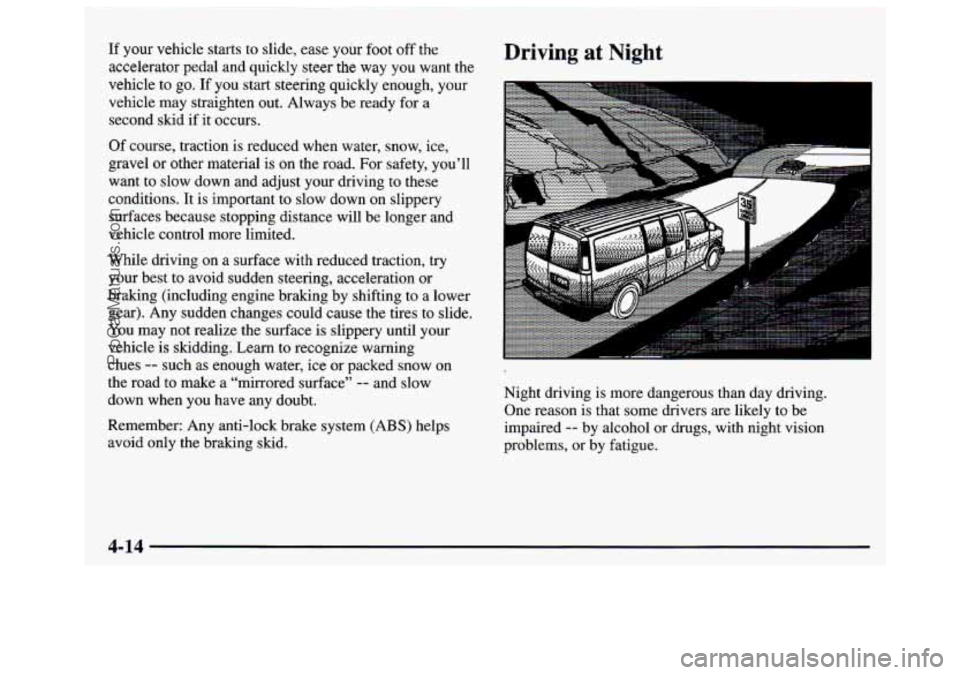
Driving at Night
Night driving is more dangerous than day driving.
One reason is that some drivers are likely to be
impaired
-- by alcohol or drugs, with night vision
problems,
or by fatigue.
4-14
ProCarManuals.com
Page 207 of 388
If No Steam Is Coming From Your Engine
If you get the overheat warning but see or hear no
steam, the problem may not be too serious. Sometimes
the engine can get a little too hot when you:
0 Climb a long hill on a hot day.
0 Stop after high-speed driving.
0 Idle for long periods in traffic.
Tow a trailer. See “Driving on Grades” in the Index.
If you get the overheat warning with no sign of steam,
try this for a minute or
so:
1. If you have an air conditioner, turn it off.
2. Turn on your heater to full hot at the highest fan
3. If you’re in a traffic jam, shift to NEUTRAL (N);
otherwise, shift to
the highest gear while
driving
-- AUTOMATIC OVERDRIVE (a)
or DRIVE (D). speed and
open the window as necessary. If you no
longer have the overheat warning, you can
drive. Just to be safe, drive slower for about 10 minutes.
If
the warning doesn’t come back on, you can
drive normally.
If the warning continues, pull over, stop, and park your
vehicle right away.
If there’s still no sign of steam, you can idle the engine
for two or three minutes while you’re parked, to push
the accelerator until the engine speed is about twice as
fast as normal idle speed. Bring the engine speed back
to normal idle speed after two or three minutes. Now
see if the warning stops. But then, if you still have the
warning,
turn ofithe engine and get everyone out of
the vehicle until it cools down.
You may decide not to lift the hood but to get service
help right away.
5-13
ProCarManuals.com
Page 216 of 388
Engine Fan Noise
Your vehicle has a clutched engine cooling fan. When the
clutch is engaged, the fan spins faster to provide more air
to cool the engine. In most everyday driving conditions,
the fan
is spinning slower and the clutch is not fully
engaged. This improves fuel economy and reduces fan
noise. Under heavy vehicle loading, trailer towing and/or
high outside temperatures, the fan speed increases as the
clutch more fully engages.
So you may hear an increase
in fan noise.
This is normal and should not be mistaken
as the transmission slipping or making extra shifts. It is
merely the cooling system functioning properly. The
fan
will slow down when additional cooling is not required
and the clutch partially disengages.
You may
also hear this fan noise when you start the engine.
It will go away as the fan clutch partially disengages.
If a Tire Goes Flat
It’s unusual for a tire to “blow out” while you’re driving,
especially if you maintain your tires properly.
If air goes
out of a tire, it’s much more likely
to leak out slowly.
But
if you should ever have a “blowout,” here are a
few tips about what to expect and what to do:
If a front tire fails, the flat tire will create a drag that
pulls the vehicle toward that side. Take your foot off the
accelerator pedal and grip the steering wheel firmly.
Steer to maintain lane position, and then gently brake to
a stop
well out of the traffic lane.
A rear blowout, particularly on a curve, acts much like
a skid and may require the same correction you’d use
in a skid. In any rear blowout, remove your foot from
the accelerator pedal. Get the vehicle under control by
steering the way you want the vehicle to go. It may be
very bumpy and noisy, but you can still steer. Gently
brake to a stop
-- well off the road if possible.
If a tire goes flat, the next part shows how to use your
jacking equipment to change a flat tire safely.
5-22
ProCarManuals.com
Page 235 of 388
Section 6 Service and Appearance Care
Here you will find information about the care of your vehicle. This section begins with service and fuel information,
and then it shows how
to check important fluid and lubricant levels. There is also technical information about your
vehicle, and a part devoted to its appearance care.
6-2
6-3
6-5
6-5
6-7
6-1 1
6-12 6-17
6-18 6-22
6-22
6-25
6-26
6-26
6-27
6-28
6-32 Service
Fuel (Gasoline Engine)
Fuels in Foreign Countries
Filling Your Tank
Checking Things Under the
Hood
Noise Control System
Engine Oil (Gasoline Engine)
Air Cleaner (Gasoline Engines)
Automatic Transmission Fluid
Rear Axle
Engine Coolant Radiator Pressure Cap
Thermostat Power Steering Fluid
Windshield Washer Fluid Brakes
Battery 6-32
6-32
6-40
6-4
1
6-49
6-50
6-54
6-55
6-55 6-55
6-56
6-57
6-5
8
6-59
6-63
6-66
6-67 Bulb
Replacement
Halogen Bulbs
Windshield Wiper Blade Replacement
Tires
Appearance Care
Cleaning the Inside of Your Vehicle
Cleaning the Outside
of Your Vehicle
Cleaning Aluminum Wheels
(If Equipped)
Cleaning Tires Sheet Metal Damage
Finish Damage
Appearance Care Materials Chart
Vehicle Identification Number (VIN)
Electrical System
Capacities and Specifications
Air Conditioning Refrigerants
Lamp and Bulb Data
ProCarManuals.com
Page 237 of 388
Adding Equipment to the Outside of
Your Vehicle
Things you might add to the outside of your vehicle can
affect the airflow around it. This may cause wind noise
and affect windshield washer performance. Check with
your GM dealer before adding equipment to the outside
of your vehicle.
Fuel (Gasoline Engine)
If your vehicle has a diesel engine, see “Diesel Fuel
Requirements and Fuel System” in the Diesel Engine
Supplement. For vehicles with gasoline engines, please
read this.
Use regular unleaded gasoline rated at 87 octane or
higher. At a minimum, it should meet specifications
ASTM D4814 in the United States and CGSB 3.5-M93
in Canada. Improved gasoline specifications have been
developed by the American Automobile Manufacturers
Association (AAMA) for better vehicle performance
and engine protection. Gasolines meeting
the AAMA
specification could provide improved driveability and
emission control system protection compared to
other gasolines. Be
sure the posted octane is
at least 87. If the octane is
less than 87, you may get a heavy knocking noise when
you drive. If it’s bad enough, it can damage your engine.
If you’re using fuel rated at 87 octane or higher and you
hear heavy knocking, your engine needs service. But
don’t worry if you hear a little pinging noise when
you’re accelerating or driving up a hill. That’s normal,
and you don’t have to buy a higher octane fuel to get rid
of pinging. It’s the heavy, constant knock that means
you have a problem.
If your vehicle is certified to meet California Emission
Standards (indicated on the underhood tune-up label),
it is designed to operate on fuels that meet California
specifications. If such fuels are not available in states
adopting California emissions standards, your vehicle
will operate satisfactorily on fuels meeting federal
specifications, but emission control system performance
may be affected. The malfunction indicator lamp on
your instrument panel may turn on and/or your vehicle
may fail a smog-check test. If this occurs, return to your
authorized GM dealer for diagnosis to determine the
cause
of failure. In the event it is determined that the
cause of the condition is the type of fuels used, repairs
may not be covered by your warranty.
6-3
ProCarManuals.com
Page 244 of 388
If your vehicle has a 7.4 liter engine and air
conditioning, your vehicle will have
a auxiliary engine
fan in addition to the belt driven fan.
b, CAUTION:
If your vehicle has air conditioning, the auxiliary
engine fan under the hood can start up and
injure you even when the engine
is not running.
Keep hands, clothing and tools away from any
underhood electric fan. Things
that burn can get on hot engine parts and
start a fire. These include liquids like gasoline,
oil, coolant, brake fluid, windshield washer and
other fluids, and plastic or rubber.
You or others
could be burned. Be careful not to drop or spill
things that will burn onto
a hot engine.
Before closing the hood, be sure all the filler caps are
on properly.
Then lift
the hood to relieve pressure on the hood prop.
Remove the hood prop from the slot in the hood and
return the prop to its retainer. Then just let the hood
down and close it firmly.
6-10
ProCarManuals.com
Page 252 of 388
Operating the engine with the air cleaner off
can cause you or others to be burned. The air
cleaner not only cleans the air, it stops flame
if
the engine backfires. If it isn’t there, and the
engine backfires,
you could be burned. Don’t
drive with
it off, and be careful working on the
engine with the air cleaner off.
NOTICE:
If the air cleaner is off, a backfire can cause a
damaging engine fire. And, dirt can easily get
into your engine, which will damage
it. Always
have the air cleaner in place when you’re driving.
~ Automatic Transmission Fluid
~ When to Check and Change
~ A good time to check your automatic transmission fluid
level is when the engine oil
is changed.
Change both the fluid and filter every
50,000 miles
(83 000 km) if the vehicle’s GVWR is over 8,600 or
if the vehicle is mainly driven under one or more of
these conditions:
In heavy city traffic where the outside temperature
regularly reaches
90°F (32°C) or higher.
In hilly or mountainous terrain.
When doing frequent trailer towing.
Uses such as found in taxi, police or delivery service.
If your vehicle’s
GVWR is not over 8,600 and you do
not use your vehicle under any of these conditions, the
fluid and filter do
not require changing.
See “Scheduled Maintenance Services” in the Index.
6-18
ProCarManuals.com
Page 279 of 388
Dual Tire Operation
When the vehicle is new, or whenever a wheel, wheel
bolt or wheel
nut is replaced, check the wheel nut torque
after
100, 1,000 and 6,000 miles (160, 1 600 and
10 000 km) of driving. For proper torque, see “Wheel
Nut Torque’’ in the Index.
The outer tire on a dual wheel setup generally wears
faster than the inner tire. Your tires will wear more
evenly and last longer if
you rotate the tires periodically.
If you’re going to be doing a lot of driving on
high-crown roads, you can reduce tire wear by adding
5 psi (35 kPa) to the tire pressure in the outer tires. Be
sure to return to the recommended pressures when no
longer driving under those conditions. See “Changing a
Flat Tire” in the Index for more information.
If you operate your vehicle with a tire that is
badly underinflated, the tire can overheat. An
overheated tire can lose air suddenly or catch
fire. You or others could be injured. Be sure all
tires (including the spare) are properly inflated.
Buying New Tires
To find out what kind and size of tires you need, look at
the Certificationmire label.
The tires installed on your vehicle when it was new had
a Tire Performance Criteria Specification (TPC Spec)
number on each tire’s sidewall. When you get new tires,
get ones with that same TPC Spec number. That way
your vehicle will continue
to have tires that are designed
to give proper endurance, handling, speed rating,
traction, ride and other things during normal service on
your vehicle. If your tires have an all-season tread
design, the TPC number will be followed by an
“MS”
(for mud and snow).
If you ever replace your tires with those not having a
TPC Spec number, make sure they are the same size,
load range, speed rating and construction type (bias,
bias-belted or radial) as your original tires.
6-45
ProCarManuals.com