key GMC SAVANA 1997 User Guide
[x] Cancel search | Manufacturer: GMC, Model Year: 1997, Model line: SAVANA, Model: GMC SAVANA 1997Pages: 388, PDF Size: 20.17 MB
Page 77 of 388
Theft Parking at Night
Vehicle theft is big business, especially in some cities.
Although your vehicle has
a number of theft-deterrent
features, we know that nothing we put on it
can make it
impossible to steal. However, there are ways
you can help.
Key in the Ignition
If you leave your vehicle with the keys inside, it’s an
easy target for joy riders or professional thieves -- so
don’t do it.
When you park your vehicle and open the driver’s door,
you’ll hear a tone reminding you to remove your key from
the ignition and take
it with you. Always do this. Your
steering wheel will be locked, and so will your ignition
and transmission. And remember to lock the doors. Park in
a lighted spot, close
all windows and lock your
vehicle. Remember
to keep your valuables out of sight.
Put them
in a storage area, or take them with you.
Parking Lots
If you park in a lot where someone will be watching
your vehicle, it’s best
to lock it up and take your keys.
But what if you have to leave your ignition key? What if
you have
to leave something valuable in your vehicle?
Put your valuables in a storage area, like your glove box.
0 Lock all the doors except the driver’s.
Then take the door key with you.
ProCarManuals.com
Page 78 of 388
New Vehicle “Break-In”
NOTICE:
Your modern vehicle doesn’t need an elaborate
“break-in.”
But it will perform better in the long
run if you follow these guidelines:
0
0
0
0
Keep your speed at 55 mph (88 km/h) or
less for the
first 500 miles (805 km).
Don’t drive at any one speed
-- fast or
slow
-- for the first 500 miles (805 km).
Don’t make full-throttle starts.
Avoid making hard
stops for the first
200 miles (322 km) or so. During this time
your new brake linings aren’t yet broken
in. Hard stops with new linings can mean
premature wear and earlier replacement.
Follow this breaking-in guideline every
time you get new brake linings.
Don’t tow
a trailer during break-in.
See “Towing a Trailer’’ in the Index for
more information.
Ignition Switch
Your key lets you turn the ignition switch to
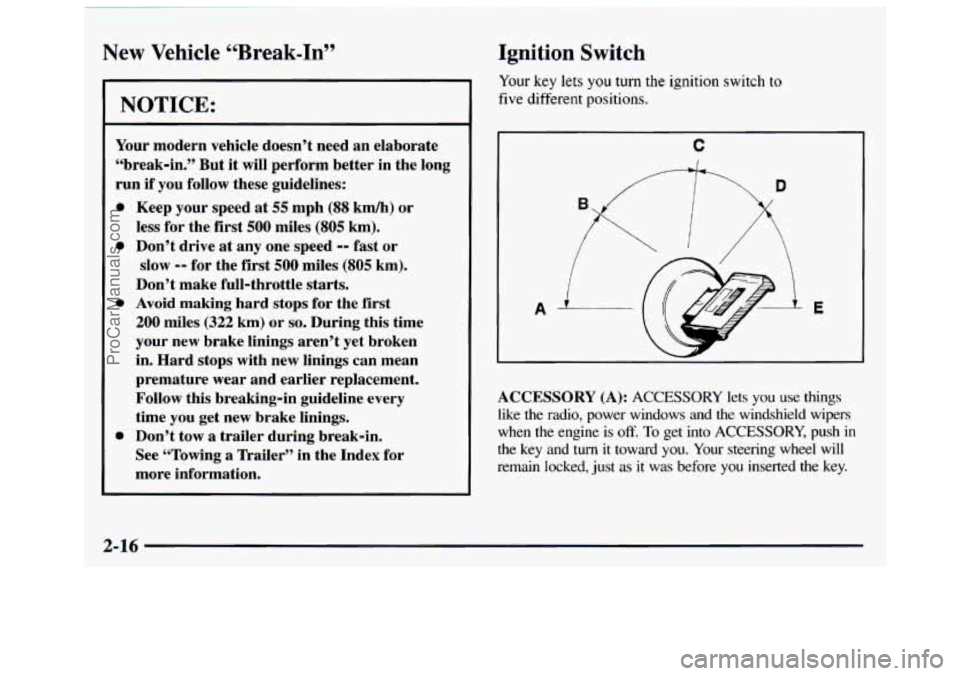
five different positions.
A E
ACCESSORY (A): ACCESSORY lets you use things
like the radio, power windows and the windshield wipers
when the engine is
off. To get into ACCESSORY, push in
the key and turn it toward
you. Your steering wheel will
remain locked, just
as it was before you inserted the key.
2-16
ProCarManuals.com
Page 79 of 388
LOCK (B): This position locks your ignition, steering
wheel and transmission. It’s a theft-deterrent feature.
You will only be able to remove your key when the
ignition is turned to
LOCK.
OFF (C): This position lets you turn off the engine but
still turn the steering wheel. It doesn’t lock the steering
wheel like
LOCK. Use OFF if you must have your
vehicle in motion while the engine is off (for example,
if your vehicle is being pushed).
RUN (D): This is the position for driving.
START (E): This starts your engine.
I NOTICE:
If your key seems stuck in LOCK and you can’t
turn it, be sure you are using the correct key;
if
so, is it all the way in? If it is, then turn the
steering wheel left and right while you turn the
key hard. But turn the key only with your hand.
Using a tool to force it could break the key or the
ignition switch.
If none of this works, then your
vehicle needs service.
Starting Your Gasoline Engine
If you have a diesel engine, see “Starting Your Diesel
Engine” in the Diesel Engine Supplement.
Move your shift lever to PARK (P)
or NEUTRAL (N).
Your engine won’t start in any other position -- that’s a
safety feature.
To restart when you’re already moving,
use NEUTRAL
(N) only.
NOTICE:
Don’t try to shift to PARK (P) if your vehicle
is moving.
If you do, you could damage the
transmission. Shift to PARK (P) only when
your vehicle is stopped.
1. Without pushing the accelerator pedal, turn your
ignition key to START. When the engine starts, let
go of the key. The idle speed will go down as your
engine gets warm.
2-17
ProCarManuals.com
Page 80 of 388
I NOTICE:
Holding your key in START for longer than
15 seconds at a time will cause your battery to be
drained much sooner. And the excessive heat can
damage your starter motor.
2. If it doesn’t start right away, hold your key in
START. If it doesn’t start in 10 seconds, push the
accelerator pedal all the way down for five more
seconds, or until it starts.
3. If your engine still won’t start (or starts but then
stops), wait
15 seconds and start over.
When the engine starts, let go of the key and the
accelerator pedal.
I
NOTICE:
Your engine is designed to work with the
electronics in your vehicle.
If you add electrical
parts or accessories, you could change the way
the engine operates. Before adding electrical
equipment, check with your dealer.
If you don’t,
your engine might not perform properly.
If you ever have to have your vehicle towed, see
the part
of this manual that tells how to do it
without damaging your vehicle. See “Towing
Your Vehicle’’ in the Index.
2-18
ProCarManuals.com
Page 82 of 388
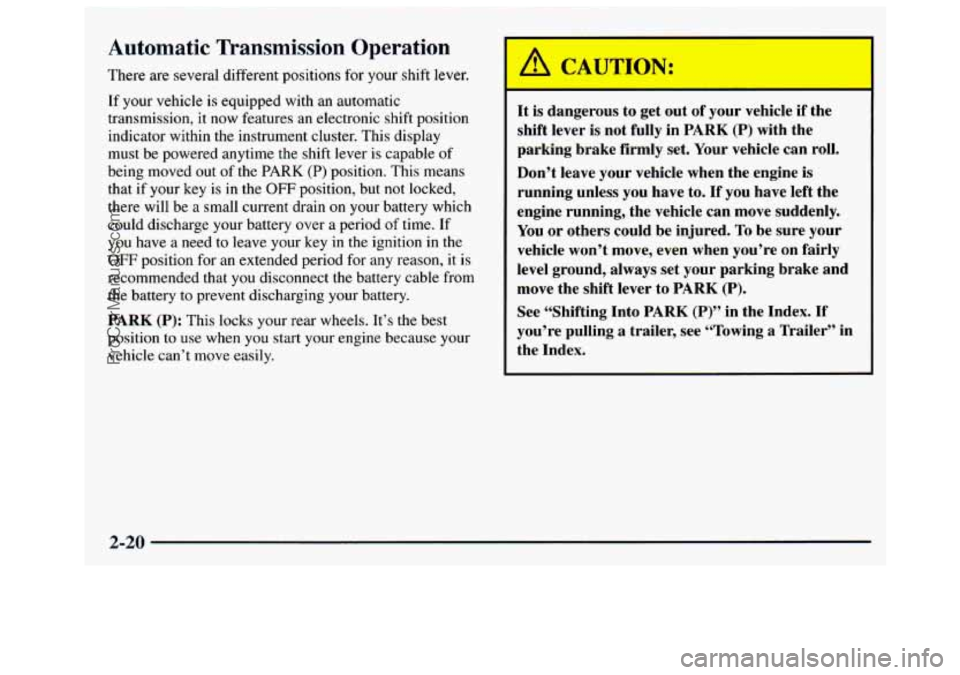
Automatic Transmission Operation
There are several different positions for your shift lever.
If your vehicle is equipped with an automatic
transmission, it now features an electronic shift position
indicator within the instrument cluster. This display
must be powered anytime the shift lever
is capable of
being moved out of the PARK (P) position. This means
that
if your key is in the OFF position, but not locked,
there will be a small current drain on your battery which
could discharge your battery over
a period of time. If
you have a need to leave your key in the ignition in the
OFF position for an extended period for any reason, it is
recommended that you disconnect the battery cable from
the battery to prevent discharging your battery.
PARK (P): This locks your rear wheels. It’s the best
position to
use when you start your engine because your
vehicle can’t move easily.
It is dangerous to get out of your vehicle if the
shift lever
is not fully in PARK (P) with the
parking brake firmly set. Your vehicle can roll.
Don’t leave your vehicle when the engine
is
running unless you have to. If you have left the
engine running, the vehicle can move suddenly.
You or others could be injured. To be sure your
vehicle won’t move, even when you’re on fairly
level ground, always set your parking brake and
move the shift lever to
PARK (P).
See “Shifting Into PARK (P)” in the Index. If
you’re pulling
a trailer, see “Towing a Trailer” in
the Index.
2-20
ProCarManuals.com
Page 87 of 388
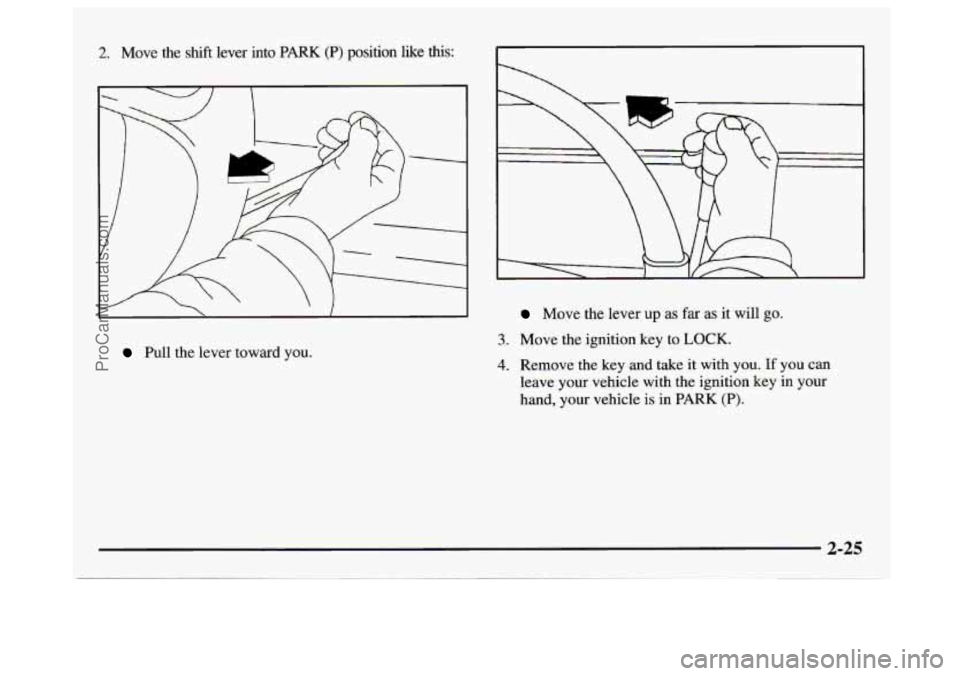
2. Move the shift lever into PARK (P) position like this:
Pull the lever toward you.
Move the lever up as far as it will go.
3. Move the ignition key to LOCK.
4. Remove the key and take it with you. If you can
leave your vehicle with
the ignition key in your
hand, your vehicle is in PARK (P).
2-25
ProCarManuals.com
Page 89 of 388
Shifting Out of PARK (P)
Your vehicle has a brake-transmission shift interlock
system. You have to fully apply your regular brakes
before you can shift from PARK (P) when the ignition
is in RUN. See “Automatic Transmission” in the Index.
If you cannot shift out of PARK (P), ease pressure on
the shift lever and push the shift lever all the way up
into PARK
(P) as you maintain brake application.
Then, move the shift lever into the gear you want.
If you ever hold the brake pedal down but still can’t
shift out of
PARK (P), try this:
1. Turn the key to OFF.
2. Apply and hold the brake until the end of Step 4.
3. Shift to NEUTRAL (N).
4. Start the vehicle and then shift to the drive gear
you want.
5. Have the brake-transmission shift interlock system
fixed as soon
as you can.
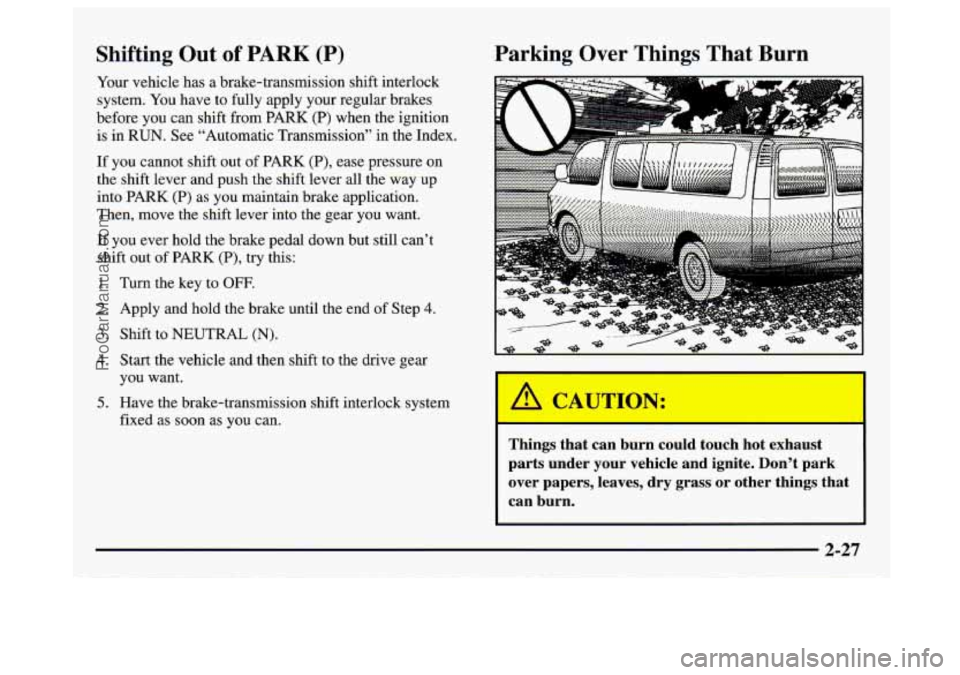
Parking Over Things That Burn
T1
I
Things that can burn could touch hot exhaust
parts under your vehicle and ignite. Don’t park
over papers, leaves, dry grass or other things that
can burn.
ProCarManuals.com
Page 108 of 388
NOTICE:
Holding a cigarette lighter in with your hand
while it is heating can make it overload,
damaging the lighter and the heating element.
Just push the lighter all the way in and let
go.
When it’s done, it will pop back by itself.
To remove the front ashtray, pull up on the tab with a
key or screwdriver inserted in the tab, and lift the
ashtray out.
Sun Visors
To block out glare, you can swing down the visors. You
can also swing them from side to side. Your visors have
elastic straps
you can use to hold items such as maps.
Visor Vanity Mirror (Option)
Some visors have illuminated mirrors on them. Pull the
visor down and lift the mirror cover
(if there is one), to
use the mirror.
2-46
ProCarManuals.com
Page 112 of 388
1
Warning Lights, Gages and Indicators
This part describes the warning lights and gages that
may be on your vehicle. The pictures will help you
locate them.
Warning lights and gages can signal that something is
wrong before it becomes serious enough to cause an
expensive repair or replacement. Paying attention to
your warning lights and gages could also save you or
others from injury.
Warning lights come on when there may be or is a
problem with one of your vehicle’s functions.
As you
will see in the details on the next few pages, some
warning lights come on briefly when you start the
engine just to let you know they’re working. If you are
familiar with this section, you should not be alarmed
when this happens.
Gages can indicate when there may be or
is a problem
with one
of your vehicle’s functions. Often gages and
warning lights work together to let you know when
there’s a problem with your vehicle. When
one
of the warning lights comes on and stays on
when you are driving, or when one
of the gages shows
there may be
a problem, check the section that tells you
what to
do about it. Please follow this manual’s advice.
Waiting to do repairs can be costly
-- and even
dangerous.
So please get to know your warning lights
and gages. They’re a big help.
Safety Belt Reminder Light
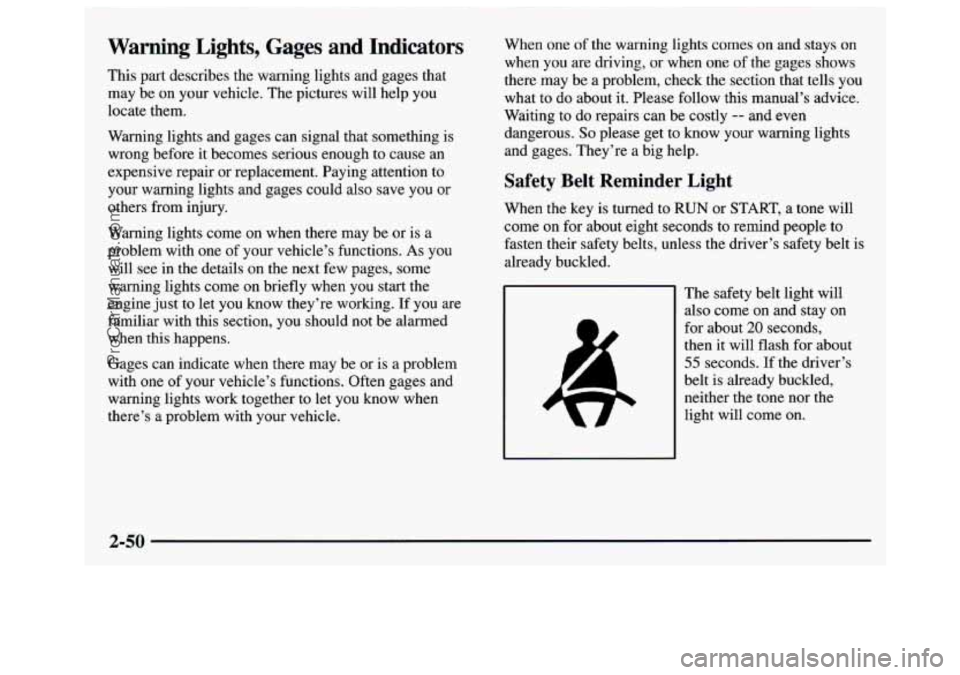
When the key is turned to RUN or START, a tone will
come on for about eight seconds to remind people to
fasten their safety belts, unless the driver’s safety belt is
already buckled.
The safety belt light will
also come on and stay on
for about
20 seconds,
then it will flash for about
55 seconds. If the driver’s
belt is already buckled,
neither the tone nor the
light will come on.
2-50
ProCarManuals.com
Page 113 of 388
Air Bag Readiness Light
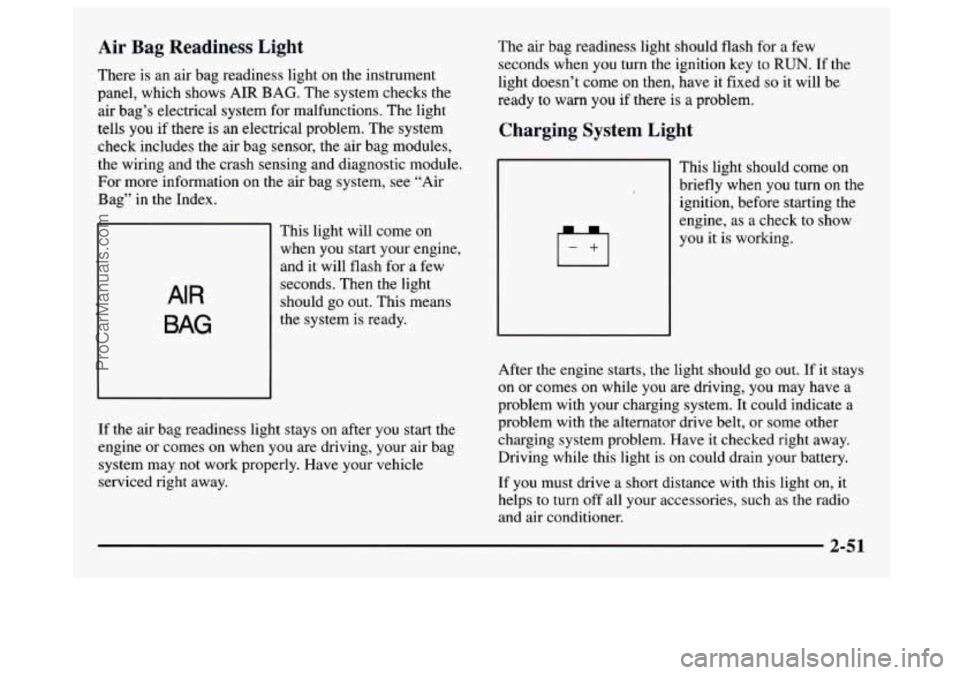
There is an air bag readiness light on the instrument
panel, which shows
AIR BAG. The system checks the
air bag’s electrical system
for malfunctions. The light
tells you if there
is an electrical problem. The system
check includes the air bag sensor, the
air bag modules,
the wiring and the crash sensing and diagnostic module.
For more information on the air bag system, see “Air
Bag” in the Index.
AIR
BAG
This light will come on
when you start your engine,
and it will flash for a few
seconds. Then the light
should go out. This means
the system is ready.
If the air bag readiness light stays on after you start the
engine or comes on when you are driving, your air bag
system may not work properly. Have your vehicle
serviced right away. The
air bag readiness light should
flash for a few
seconds when you turn the ignition key to
RUN. If the
light doesn’t come on then, have it fixed
so it will be
ready to warn
you if there is a problem.
Charging System Light
This light should come on
briefly when you turn
on the
ignition, before starting the
engine, as a check to show
you it is working.
After the engine starts, the light should go out. If
it stays
on or comes on while you are driving, you may have a
problem with your charging system. It could indicate a
problem with the alternator
drive belt, or some other
charging system problem. Have it checked right away.
Driving while this light is on could drain your battery.
If you must drive a short distance with this light on, it
helps to turn off all your accessories, such as the radio
and air conditioner.
2-51
ProCarManuals.com