key GMC SAVANA 1997 Owner's Manual
[x] Cancel search | Manufacturer: GMC, Model Year: 1997, Model line: SAVANA, Model: GMC SAVANA 1997Pages: 388, PDF Size: 20.17 MB
Page 114 of 388
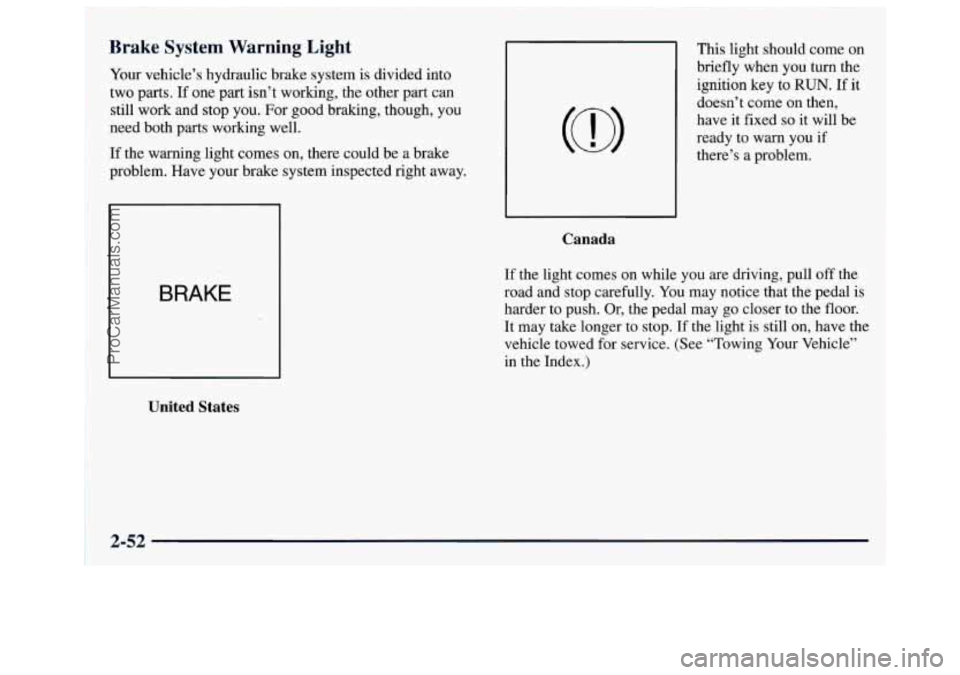
Brake System Warning Light
Your vehicle’s hydraulic brake system is divided into
two parts.
If one part isn’t working, the other part can
still work and stop you. For good braking, though, you
need both parts working well.
If the warning light comes on, there could be a brake
problem. Have your brake system inspected right away.
BRAKE
United States
This light should come on
briefly when you turn the
ignition key to RUN. If it
doesn’t come on then,
have it fixed
so it will be
ready to warn you if
there’s a problem.
Canada
If the light comes on while you are driving, pull off the
road and stop carefully. You may notice that the pedal is
harder to push. Or, the pedal may go closer to the floor.
It may take longer to stop. If the light is still on, have the
vehicle towed for service. (See “Towing Your Vehicle”
in the Index.)
2-52
ProCarManuals.com
Page 116 of 388
If the light stays on, or comes on when you’re driving,
your vehicle needs service. If the regular brake system
warning light isn’t on, you still have brakes, but you
don’t have anti-lock brakes. If the regular brake system
warning light is also on, you don’t have anti-lock brakes
and there’s a problem
with your regular brakes. See
“Brake System Warning Light” earlier in this section.
The anti-lock brake system warning light should come
on briefly when you turn the ignition key to RUN.
If the
light doesn’t come on then, have it fixed
so it will be
ready to warn you
if there is a problem.
Daytime Running Lamps Indicator Light
You may have this light on
the instrument panel. It will
light whenever the DRL are
on, It is also a reminder to
turn on your headlamps
when driving at night. For
more details about DRL, see
“Headlamps and Vehicle
Lighting” in this section.
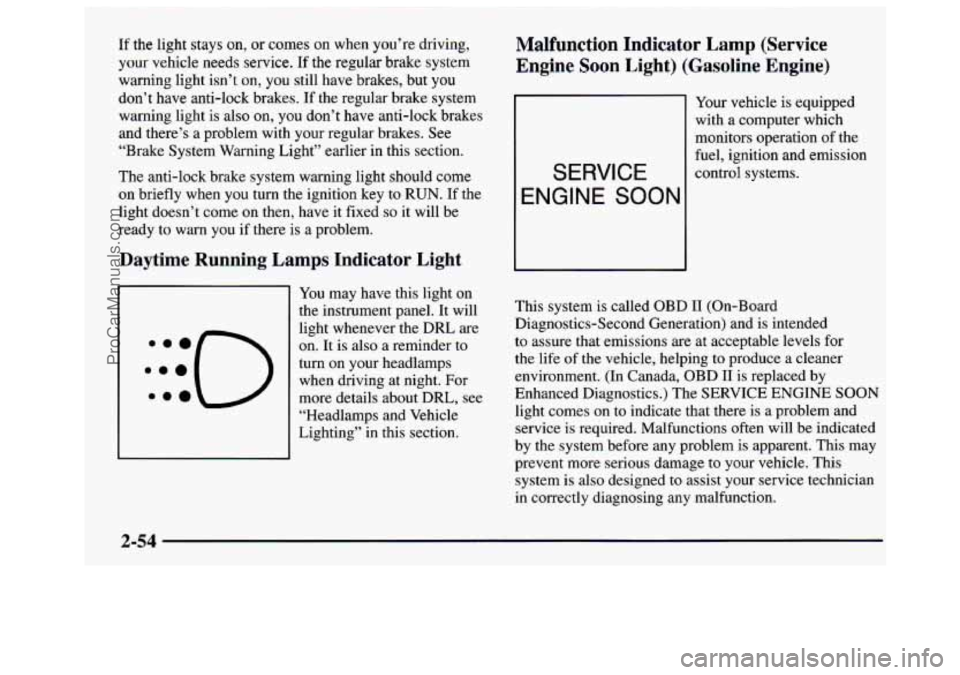
Malfunction Indicator Lamp (Service
Engine Soon Light) (Gasoline Engine)
Your vehicle is equipped
with a computer which
monitors operation of the
fuel, ignition and emission
SERVICE control systems.
ENGINE SOON
This system is called OBD I1 (On-Board
Diagnostics-Second Generation) and is intended
to assure that emissions are at acceptable levels for
the life
of the vehicle, helping to produce a cleaner
environment. (In Canada, OBD
I1 is replaced by
Enhanced Diagnostics.) The SERVICE ENGINE
SOON
light comes on to indicate that there is a problem and
service is required. Malfunctions often
will be indicated
by the system before any problem is apparent. This may
prevent more serious damage to your vehicle. This
system is also designed to assist your service technician
in correctly diagnosing any malfunction.
2-54
ProCarManuals.com
Page 117 of 388
If the Light Is Flashing
I NOTICE:
If you keep driving your vehicle with this light
on, after
a while, your emission controls may not
work as well, your fuel economy may not be as
good and your engine may not run as smoothly.
This could lead to costly repairs that may not be
covered
by your warranty.
This light should come on, as a check to show you it is
working, when the ignition is on and the engine is not
running. If the light doesn’t come on, have it repaired.
This light will also come
on during a malfunction in one
of two ways:
0 Light Flashing -- A misfire condition has been
detected. A misfire increases vehicle emissions and
may damage the emission control system on your
vehicle. Dealer or qualified service center diagnosis
and service is required.
Light On Steady -- An emission control system
malfunction has been detected on your vehicle.
Dealer or qualified service center diagnosis and
service may be required. The
following may prevent more serious damage to
your vehicle:
Reducing vehicle speed.
Avoiding hard accelerations.
0 Avoiding steep uphill grades.
If you are towing a trailer, reduce the amount of
cargo being hauled as soon as it is possible.
If the light stops flashing and remains on steady, see “If
the Light Is On Steady” following.
If the light continues to flash, when it is safe to do
so,
stop the vehicle. Find a safe place to park your vehicle.
Turn the key
off, wait at least 10 seconds and restart the
engine. If the light remains
on steady, see “If the Light
Is On Steady” following. If the light is still flashing,
follow the previous steps, and drive the vehicle to your
dealer or qualified service center for service.
ProCarManuals.com
Page 157 of 388
Drunken Driving
Death and injury associated with drinking and driving is
a national tragedy. It’s the number one contributor to
the highway death toll, claiming thousands of victims
every year.
Alcohol affects four things that anyone needs to drive
a vehicle:
Judgment
Muscular Coordination
0 Vision
Attentiveness.
Police records show that almost half of all motor
vehicle-related deaths involve alcohol. In most cases,
these deaths
are the result of someone who was drinking
and driving.
In recent years, some 17,000 annual motor
vehicle-related deaths have been associated with the use
of alcohol, with more than
300,000 people injured.
Many adults
-- by some estimates, nearly half the adult
population
-- choose never to drink alcohol, so they
never drive after drinking. For persons under 21,
it’s
against the law in every U.S. state to drink alcohol.
There
are good medical, psychological and
developmental reasons for these laws. The obvious
way to solve this highway safety problem
is for people never to drink alcohol and then drive. But
what
if people do? How much is “too much” if the
driver plans to drive? It’s a lot less than many might
think. Although it depends
on each person and situation,
here
is some general information on the problem.
The Blood Alcohol Concentration (BAC)
of someone
who is drinking depends upon four things:
0 The amount of alcohol consumed
The drinker’s body weight
0 The amount of food that is consumed before and
during drinking
consume the alcohol.
0 The length of time it has taken the drinker to
According to the American Medical Association, a
180-lb. (82 kg) person who drinks three 12-ounce
(355 ml) bottles of beer in an hour will end up with a
BAC of about
0.06 percent. The person would reach the
same BAC by drinking three 4-ounce (120 ml) glasses
of wine or three mixed drinks if each had 1 - 1/2 ounces
(45 ml) of a liquor like whiskey, gin or vodka.
4-3
ProCarManuals.com
Page 196 of 388
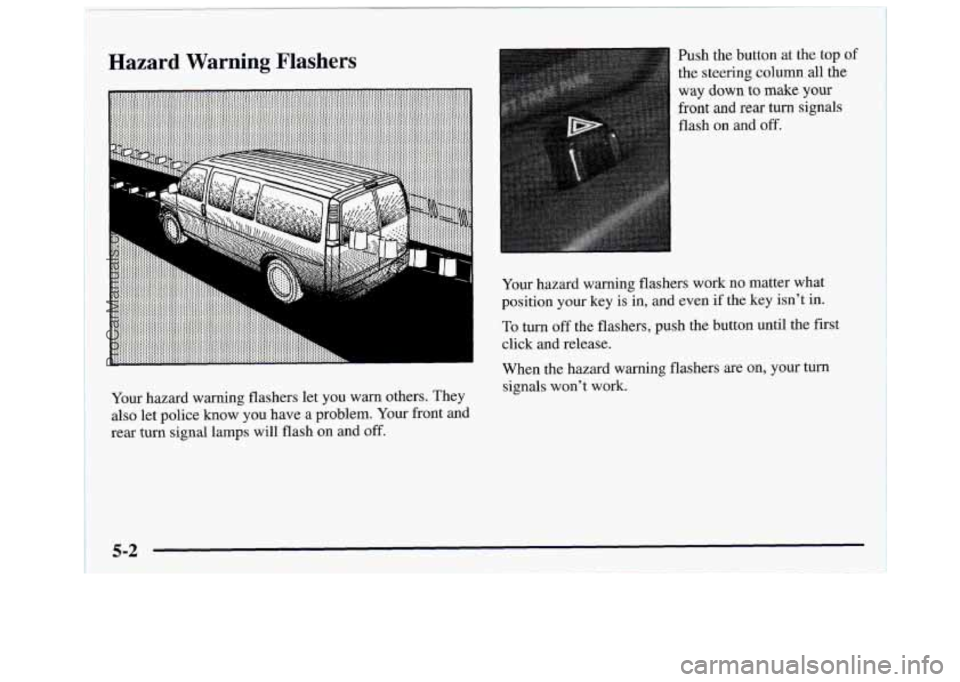
Hazard Warning Flashers
Your hazard warning flashers let you warn others. They
also let police know you have a problem. Your front and
rear turn signal lamps will flash on and off. Push the button at the
top of
the steering column all
the
way down to make your
front and rear turn signals
flash on and off.
Your hazard warning flashers work no matter what
position your key
is in, and even if the key isn't in.
To
turn off the flashers, push the button until the first
click and release.
When the hazard warning flashers are on, your turn
signals won't work.
ProCarManuals.com
Page 203 of 388
A CAUTION:
I
To help avoid injury to you or others:
0 Never let passengers ride in a vehicle that is
0 Never tow faster than safe or posted speeds.
0 Never tow with damaged parts not
0 Never get under your vehicle after .it has
0 Always use separate safety chains on each
being towed.
fully secured.
been lifted by the tow truck.
side when towing a vehicle.
When your vehicle is being towed, have the ignition
key
off. The steering wheel should be clamped in a
straight-ahead position, with a clamping device designed
for towing service.
Do not use the vehicle’s
steering column lock for this. The transmission should
be in
NEUTRAL (N) and the parking brake should
be released.
A CAUTION:
A vehicle can fall from a car carrier if it isn’t
adequately secured. This can cause
a collision,
serious personal injury and vehicle damage.
The vehicle should be tightly secured with
chains
or steel cables before it is transported.
Don’t use substitutes (ropes, leather straps,
canvas webbing, etc.) that can be cut by sharp
edges underneath the towed vehicle.
5-9
ProCarManuals.com
Page 295 of 388
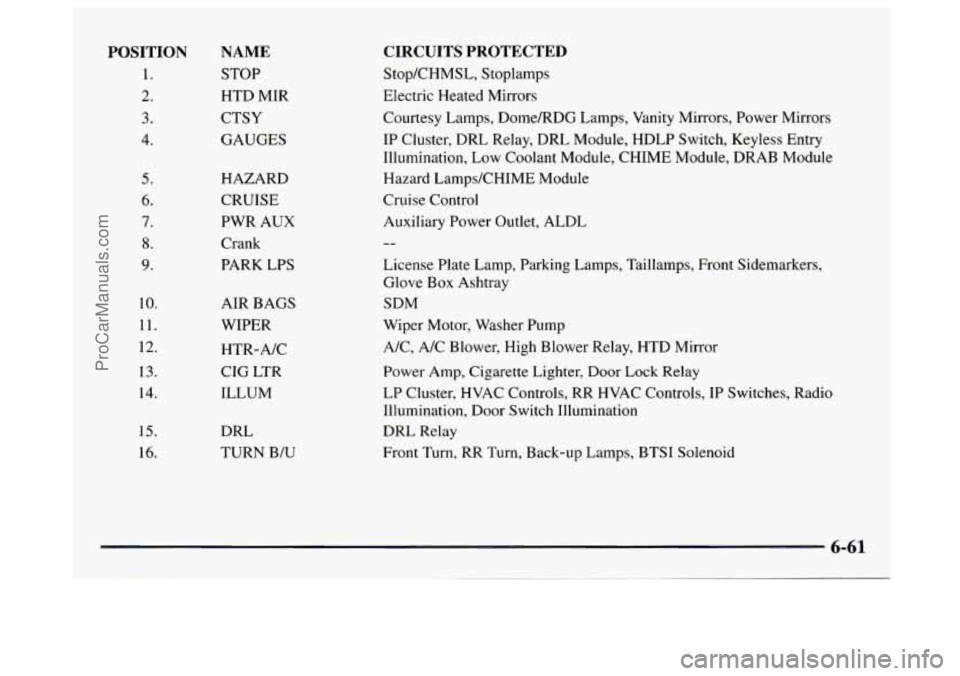
POSITION
1.
2.
3.
4.
5.
6.
7.
8.
9.
10.
11.
12.
13.
14.
15.
16.
NAME
STOP HTD
MIR
CTSY
GAUGES
HAZARD CRUISE
PWR AUX Crank
PARK LPS
AIR BAGS WIPER
HTR-A/C
CIG
LTR
ILLUM
DRL
TURN
B/U
CIRCUITS PROTECTED
Stop/CHMSL, Stoplamps
Electric Heated Mirrors
Courtesy Lamps, Dome/RDG Lamps, Vanity Mirrors, Power Mirrors
IP Cluster, DRL Relay, DRL Module, HDLP Switch, Keyless Entry
Illumination, Low Coolant Module, CHIME Module, DRAB Module
Hazard LampdCHIME Module
Cruise Control
Auxiliary Power Outlet, ALDL
License Plate Lamp, Parking Lamps, Taillamps, Front Sidemarkers,
Glove Box Ashtray
SDM
Wiper Motor, Washer Pump
A/C, A/C Blower, High Blower Relay, HTD Mirror
Power Amp, Cigarette Lighter, Door Lock Relay
LP Cluster, HVAC Controls,
RR HVAC Controls, IP Switches, Radio
Illumination, Door Switch Illumination
DRL Relay
Front Turn, RR Turn, Back-up Lamps,
BTSI Solenoid
6-61
ProCarManuals.com
Page 296 of 388
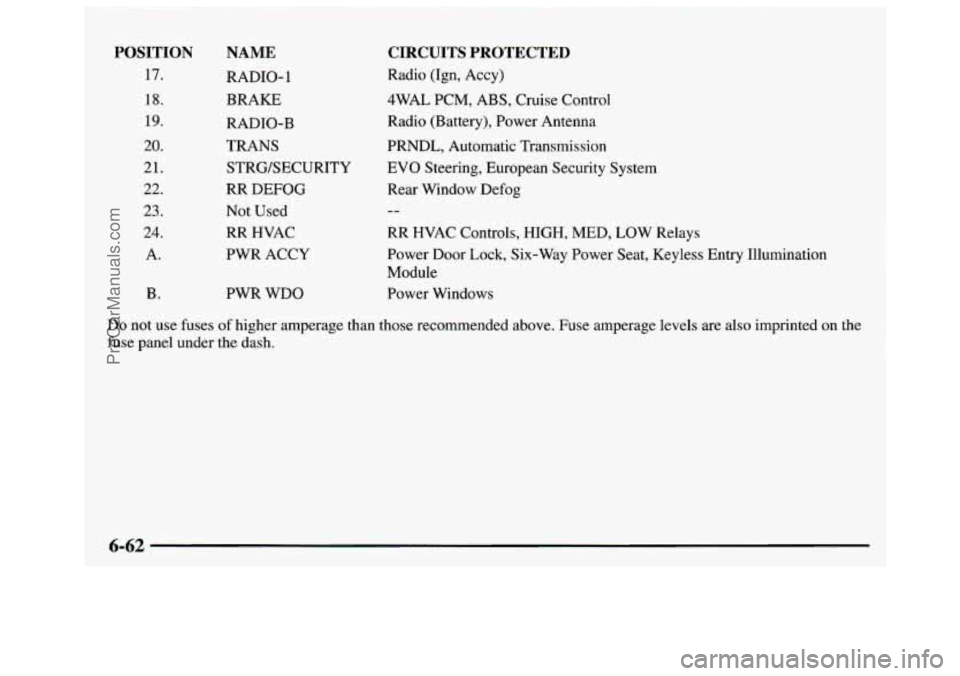
POSITION
17.
18.
19.
20.
21.
22.
23.
24.
A.
B.
NAME
RADIO- 1
BRAKE
RADIO-B TRANS STRGISECURITY
RR DEFOG
Not Used
RR HVAC
PWR ACCY
PWR WDO
CIRCUITS PROTECTED
Radio (Ign, Accy)
4WAL PCM, ABS, Cruise Control
Radio (Battery), Power Antenna
PRNDL, Automatic Transmission
EVO Steering, European Security System
Rear Window Defog
RR HVAC Controls, HIGH, MED, LOW Relays
Power Door Lock, Six-Way Power Seat, Keyless Entry Illumination
Module
Power Windows
Do not use fuses of higher amperage than those recommended above. Fuse amperage levels are also imprinted on the
fuse panel under the dash.
6-62
ProCarManuals.com
Page 350 of 388
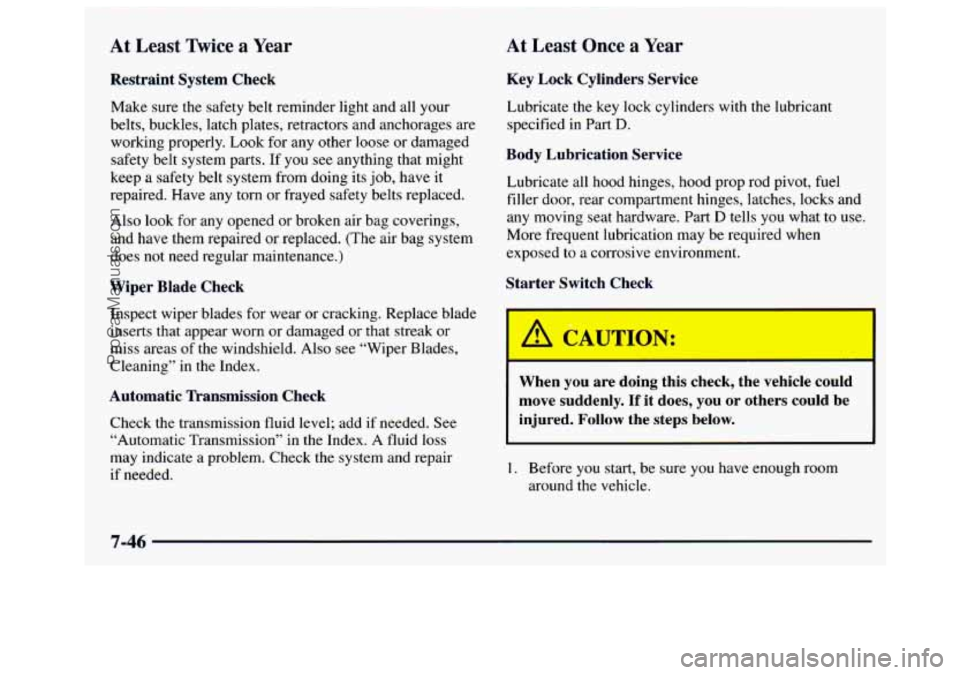
At Least Twice a Year At Least Once
a Year
Restraint System Check Key Lock Cylinders
Service
Make sure the safety belt reminder light and all your
belts, buckles, latch plates, retractors and anchorages are
working properly.
Look for any other loose or damaged
safety belt system parts. If you see anything that might
keep a safety belt system from doing its
job, have it
repaired. Have
any torn or frayed safety belts replaced.
Also look for any opened or broken air bag coverings,
and have them repaired or replaced. (The air bag system
does not need regular maintenance.) Lubricate the key lock
cylinders with the lubricant
specified in Part
D.
Body Lubrication Service
Lubricate all hood hinges, hood prop rod pivot, fuel
filler door, rear compartment hinges, latches, locks and
any moving seat hardware.
Part D tells you what to use.
More frequent lubrication may be required when
exposed
to a corrosive environment.
Wiper Blade Check Starter Switch Check
Inspect wiper blades
for wear or cracking. Replace blade
inserts that appear worn or damaged or that streak or
miss areas of the windshield. Also see “Wiper Blades,
Cleaning” in the Index.
Automatic Transmission Check
Check the transmission fluid level; add if needed. See
“Automatic Transmission” in the Index.
A fluid loss
may indicate a problem. Check the system and repair
if needed.
I
When you are doing this check, the vehicle could
move suddenly.
If it does, you or others could be
injured. Follow the steps below.
I. Before you start, be sure you have enough room
around the vehicle.
7-46
ProCarManuals.com
Page 351 of 388
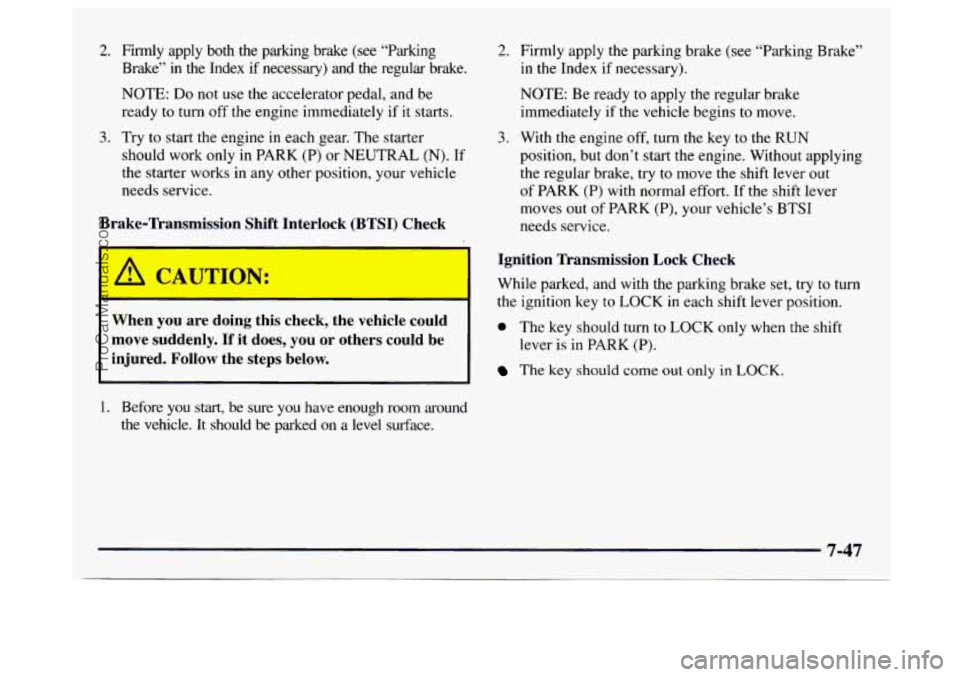
2.
3.
Firmly apply both the parking brake (see “Parking Brake” in the Index if necessary) and the regular brake.
NOTE:
Do not use the accelerator pedal, and be
ready to turn off the engine immediately if it starts.
Try to start the engine in each gear. The starter
should work only in PARK
(P) or NEUTRAL (N). If
the starter works in any other position, your vehicle
needs service.
Brake-Transmission Shift Interlock (BTSI) Check
When you are doing this check, the vehicle could
move suddenly.
If it does, you or others could be
injured. Follow the steps below.
1. Before you start, be sure you have enough around the vehicle. It should
be parked on a level surface.
2. Firmly apply the parking brake (see “Parking Brake”
in the Index
if necessary).
NOTE: Be ready to apply the regular brake
immediately if the vehicle begins
to move.
3. With the engine off, turn the key to the RUN
position, but don’t start the engine. Without applying
the regular brake, try
to move the shift lever out
of PARK (P) with normal effort. If the shift lever
moves out of PARK (P), your vehicle’s BTSI
needs service.
Ignition Transmission Lock Check
While parked, and with the parking brake set, try to turn
the ignition key to
LOCK in each shift lever position.
0 The key should turn to LOCK only when the shift
lever is in PARK (P).
The key should come out only in LOCK.
7-47
ProCarManuals.com