service GMC SAVANA 1997 User Guide
[x] Cancel search | Manufacturer: GMC, Model Year: 1997, Model line: SAVANA, Model: GMC SAVANA 1997Pages: 388, PDF Size: 20.17 MB
Page 116 of 388
If the light stays on, or comes on when you’re driving,
your vehicle needs service. If the regular brake system
warning light isn’t on, you still have brakes, but you
don’t have anti-lock brakes. If the regular brake system
warning light is also on, you don’t have anti-lock brakes
and there’s a problem
with your regular brakes. See
“Brake System Warning Light” earlier in this section.
The anti-lock brake system warning light should come
on briefly when you turn the ignition key to RUN.
If the
light doesn’t come on then, have it fixed
so it will be
ready to warn you
if there is a problem.
Daytime Running Lamps Indicator Light
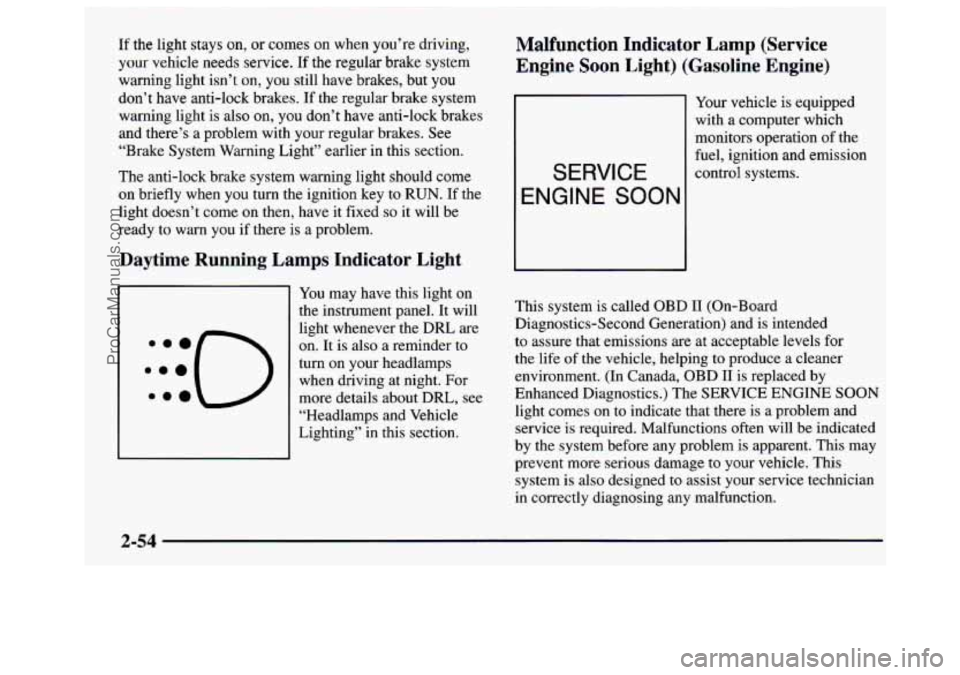
You may have this light on
the instrument panel. It will
light whenever the DRL are
on, It is also a reminder to
turn on your headlamps
when driving at night. For
more details about DRL, see
“Headlamps and Vehicle
Lighting” in this section.
Malfunction Indicator Lamp (Service
Engine Soon Light) (Gasoline Engine)
Your vehicle is equipped
with a computer which
monitors operation of the
fuel, ignition and emission
SERVICE control systems.
ENGINE SOON
This system is called OBD I1 (On-Board
Diagnostics-Second Generation) and is intended
to assure that emissions are at acceptable levels for
the life
of the vehicle, helping to produce a cleaner
environment. (In Canada, OBD
I1 is replaced by
Enhanced Diagnostics.) The SERVICE ENGINE
SOON
light comes on to indicate that there is a problem and
service is required. Malfunctions often
will be indicated
by the system before any problem is apparent. This may
prevent more serious damage to your vehicle. This
system is also designed to assist your service technician
in correctly diagnosing any malfunction.
2-54
ProCarManuals.com
Page 117 of 388
If the Light Is Flashing
I NOTICE:
If you keep driving your vehicle with this light
on, after
a while, your emission controls may not
work as well, your fuel economy may not be as
good and your engine may not run as smoothly.
This could lead to costly repairs that may not be
covered
by your warranty.
This light should come on, as a check to show you it is
working, when the ignition is on and the engine is not
running. If the light doesn’t come on, have it repaired.
This light will also come
on during a malfunction in one
of two ways:
0 Light Flashing -- A misfire condition has been
detected. A misfire increases vehicle emissions and
may damage the emission control system on your
vehicle. Dealer or qualified service center diagnosis
and service is required.
Light On Steady -- An emission control system
malfunction has been detected on your vehicle.
Dealer or qualified service center diagnosis and
service may be required. The
following may prevent more serious damage to
your vehicle:
Reducing vehicle speed.
Avoiding hard accelerations.
0 Avoiding steep uphill grades.
If you are towing a trailer, reduce the amount of
cargo being hauled as soon as it is possible.
If the light stops flashing and remains on steady, see “If
the Light Is On Steady” following.
If the light continues to flash, when it is safe to do
so,
stop the vehicle. Find a safe place to park your vehicle.
Turn the key
off, wait at least 10 seconds and restart the
engine. If the light remains
on steady, see “If the Light
Is On Steady” following. If the light is still flashing,
follow the previous steps, and drive the vehicle to your
dealer or qualified service center for service.
ProCarManuals.com
Page 118 of 388
If the Light Is On Steady
You may be able to correct the emission system
malfunction by considering the following:
Did you just drive through a deep puddle of water?
If
so, your electrical system may be wet. The condition
will usually be corrected when the electrical system
dries
out. A few driving trips should turn the light off.
Are you low on fuel?
As your engine starts to run out of fuel, your engine may
not run as efficiently as designed since small amounts of
air are sucked into
the fuel line causing a misfire. The
system can detect this. Adding fuel should correct this
condition.
Make sure to install the fuel cap properly. It
will take a few driving trips to turn the light off.
Have you recently changed brands
of fuel?
If so, be sure to fuel your vehicle with quality fuel (see
“Fuel” in the Index). Poor fuel quality will cause your
engine not to
run as efficiently as designed. You may
notice this as stalling after start-up, stalling when you
put the vehicle into gear, misfiring,’hesitation on
acceleration or stumbling
on acceleration. (These
conditions may go away once the engine is warmed up.)
This will be detected by the system and cause the light
to turn on.
If you experience one or more of these conditions,
change the fuel brand you use. It will require at least one
full tank of the proper fuel to turn the light off.
If none of the above steps have made the light
turn off,
have your dealer or qualified service center check the
vehicle. Your dealer has the proper test equipment and
diagnostic tools to fix any mechanical or electrical
problems
that may have developed.
2-56
ProCarManuals.com
Page 119 of 388
Oil Pressure Gage
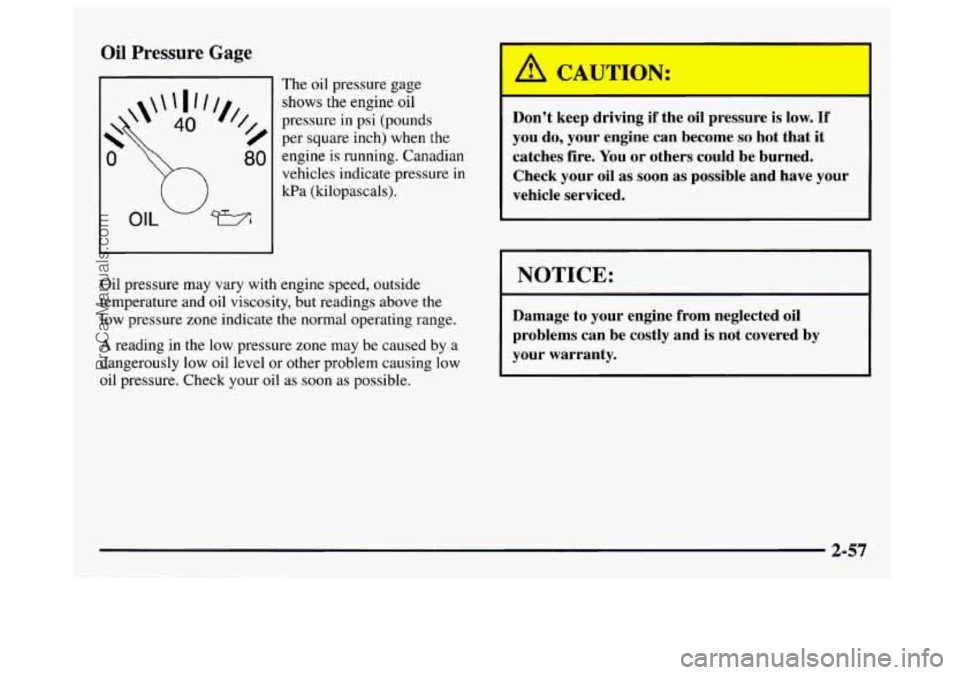
The oil pressure gage
shows the engine oil
pressure in psi (pounds
per square inch) when
the
engine is running. Canadian
vehicles indicate pressure
in
kPa (kilopascals).
Oil pressure may vary
with engine speed, outside
temperature and oil viscosity, but readings above the
low pressure zone indicate the normal operating range.
A reading in the low pressure zone may be caused by a
dangerously low oil level or other problem causing
low
oil pressure. Check your oil as soon as possible.
A CAUTION:
Don't keep driving if the oil pressure is low. If
you do, your engine can become so hot that it
catches fire. You or others could be burned.
Check your oil as
soon as possible and have your
vehicle serviced.
I NOTICE: I
Damage to your engine from neglected oil
problems can be costly and is not covered by
your warranty.
2-57
ProCarManuals.com
Page 122 of 388
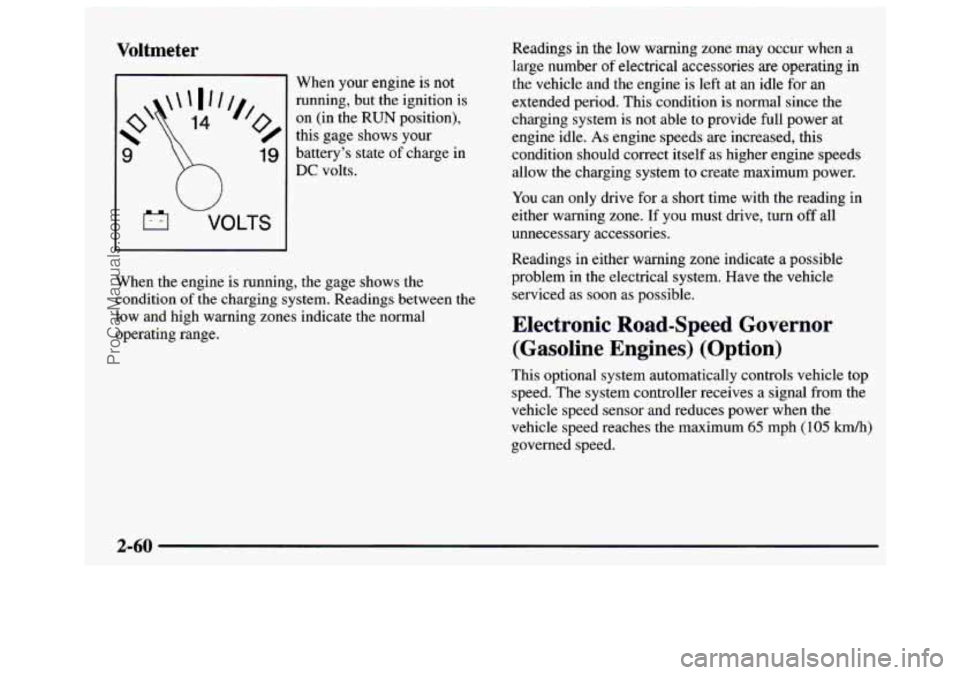
Voltmeter
When your engine is not
running, but the ignition is
on (in the RUN position),
this gage shows your
battery’s state of charge in
DC volts.
When the engine is running, the gage shows the
condition
of the charging system. Readings between the
low and high warning zones indicate the normal
operating range. Readings
in the
low warning zone may occur when a
large number of electrical accessories are operating in
the vehicle and the engine is left at an idle for an
extended period. This condition is normal since the
charging system
is not able to provide full power at
engine idle.
As engine speeds are increased, this
condition should correct itself as higher engine speeds
allow the charging system to create maximum power.
You can only drive for a short time with the reading in
either warning zone. If you must drive, turn
off all
unnecessary accessories.
Readings in either warning zone indicate a possible
problem in the electrical system. Have the vehicle
serviced as soon as possible.
Electronic Road-Speed Governor
(Gasoline Engines) (Option)
This optional system automatically controls vehicle top
speed. The system controller receives a signal from
the
vehicle speed sensor and reduces power when the
vehicle speed reaches the maximum
65 mph ( 105 km/h)
governed speed.
2-60
ProCarManuals.com
Page 123 of 388
Center High-Mounted Stoplamp
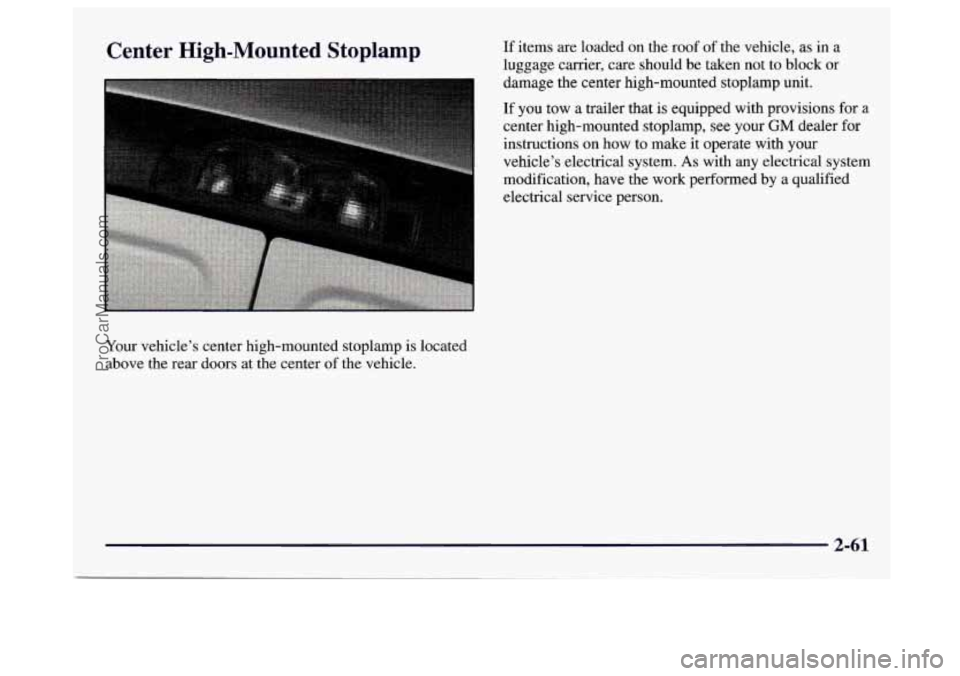
Your vehicle’s center high-mounted stoplamp is located
above the rear doors at the center
of the vehicle. If
items are loaded
on the roof of the vehicle, as in a
luggage carrier, care should be taken not to block or
damage the center high-mounted stoplamp unit.
If
you tow a trailer that is equipped with provisions for a
center high-mounted stoplamp, see your GM dealer for
instructions on how to make
it operate with your
vehicle’s electrical system.
As with any electrical system
modification, have the work performed
by a qualified
electrical service person.
2-61
ProCarManuals.com
Page 153 of 388
Care of Your Cassette Tape Player
A tape player that is not cleaned regularly can cause
reduced sound quality, ruined cassettes
or a damaged
mechanism. Cassette tapes should be stored in their
cases away from contaminants, direct sunlight and
extreme heat. If they aren’t, they may not operate
properly or may cause failure
of the tape player.
Your tape player should be cleaned regularly after every
50 hours of use. Your radio may display CLN to indicate
that you have used your tape player for
50 hours without
resetting the tape clean timer.
If this message appears
on the display, your cassette tape player needs to be
cleaned. It will still play tapes, but
you should clean it
as soon as possible
to prevent damage to your tapes and
player.
If you notice a reduction in sound quality, try a
known good cassette to see if it is the tape or the tape
player at fault.
If this other cassette has no improvement
in sound quality, clean the tape player.
Cleaning may be done with a scrubbing action,
non-abrasive cleaning cassette with pads which scrub
the tape head as the hubs of the cleaner cassette turn. It
is normal for the cassette to eject while cleaning. Insert
the cassette at least three times to ensure thorough
cleaning. A scrubbing action cleaning cassette is
available through your
GM dealership. You
may also choose
a non-scrubbing action, wet-type
cleaner which uses a cassette with
a fabric belt to clean
the tape head. This type of cleaning cassette will not
eject and, it may not clean as thoroughly
as the
scrubbing type cleaner.
After
you clean the player, press and hold EJECT for
five seconds to reset the
CLN indicator. The radio
will display
--- to show the indicator was reset.
Cassettes are subject to wear and the sound quality
may degrade over time. Always make sure the cassette
tape is in good condition before you have your tape
player serviced.
Care of Your Compact Discs
Handle discs carefully. Store them in their original cases
or other protective cases and away from direct sunlight
and dust. If the surface of
a disc is soiled, dampen a
clean, soft cloth in a mild, neutral detergent solution
and clean it, wiping from the center to the edge.
Be sure never to touch the signal surface when handling
discs. Pick up discs by grasping the outer edges or the
edge
of the hole and the outer edge.
3-27
ProCarManuals.com
Page 175 of 388
Once you are moving on the freeway, make certain you
allow
a reasonable following distance. Expect to move
slightly slower at night.
When you want to leave the freeway, move to the proper
lane well in advance. If you miss your exit, do not,
under any circumstances, stop and back up. Drive
on to
the next exit.
The exit ramp can be curved, sometimes quite sharply.
The exit speed is usually posted.
Reduce your speed according to your speedometer, not
to your sense
of motion. After driving for any distance
at higher speeds, you may tend to think you are going
slower than you actually are.
Before Leaving on a Long Trip
Make sure you’re ready. Try to be well rested. If you
must start when you’re not fresh
-- such as after a day’s
work
-- don’t plan to make too many miles that first part
of
the journey. Wear comfortable clothing and shoes you
can easily drive in.
Is your vehicle ready for
a long trip? If you keep it
serviced and maintained, it’s ready to go. If it needs
service, have it done before starting out. Of course,
you’ll find experienced and able service experts in GM
dealerships all across North America. They’ll be
ready and willing to help if you need it.
Here are some things you can check before a trip:
0
e
0
0
0
0
e
Windshield Washer Fluid: Is the reservoir full?
Are
all windows clean inside and outside?
Wiper Blades: Are they in good shape?
Fuel, Engine Oil, Other Fluids: Have you checked
all levels?
Lamps: Are they all working? Are the lenses clean?
Tires: They are vitally important to a safe,
trouble-free trip.
Is the tread good enough for
long-distance driving? Are the tires all inflated to the
recommended pressure?
Weather Forecasts: What’s the weather outlook
along your route? Should you delay your trip a short
time to avoid a major storm system?
Maps: Do you have up-to-date maps?
4-21
ProCarManuals.com
Page 176 of 388
Highway Hypnosis
Is there actually such a condition as “highway hypnosis”?
Or is it just plain falling asleep at the wheel?
Call it
highway hypnosis, lack of awareness,
or whatever.
There is something about an easy stretch of road with
the Same scenery, along with the hum of the tires on the
road, the drone of the engine, and the rush
of the wind
against the vehicle that can make you sleepy. Don’t let it
happen to you!
If it does, your vehicle can leave the
road in
less than a second, and you could crash and
be injured.
What can you do about highway hypnosis? First, be
aware that it can happen.
Then here are some tips:
0 Make sure your vehicle is well ventilated, with a
Keep your eyes moving. Scan the road ahead and
comfortably cool interior.
to the sides. Check your mirrors and your
instruments frequently.
If you get sleepy, pull off the road into a rest, service
or parking area and take a nap, get some exercise, or
both. For safety, treat drowsiness on the highway as
an emergency.
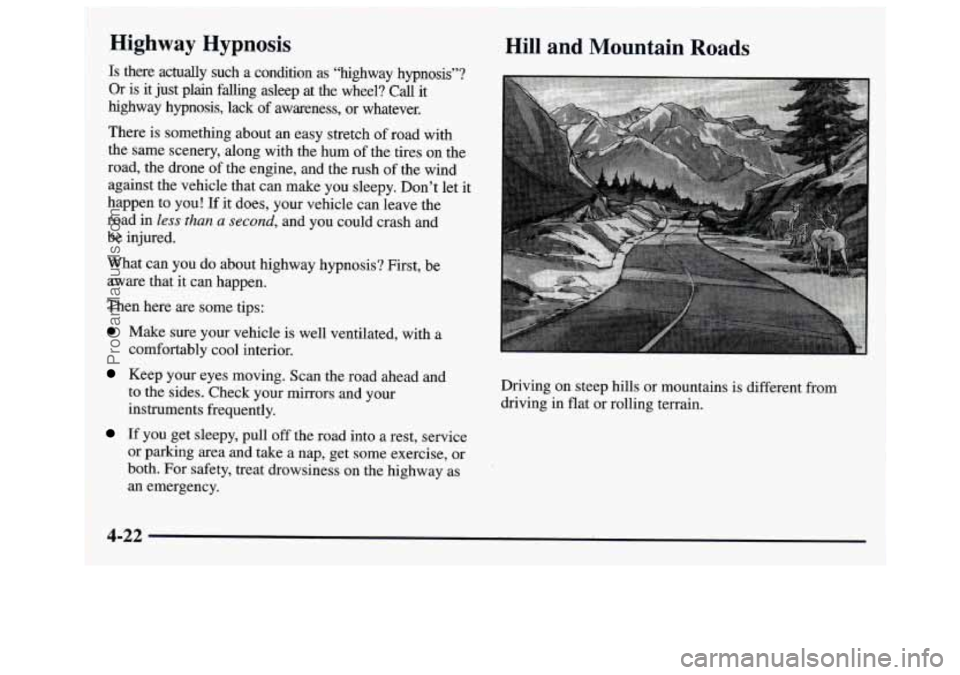
Hill and Mountain Roads
Driving on steep hills or mountains is different from
driving in flat or rolling terrain.
4-22
ProCarManuals.com
Page 191 of 388
Parking on Hills
You really should not park your vehicle, with a trailer
attached, on a hill. If something goes wrong, your rig
could
start to move. People can be injured, and both
your vehicle and the trailer can be damaged.
But
if you ever have to park your rig on a hill, here’s
how to do it:
1. Apply your regular brakes, but don’t shift into
PARK (P) yet. Then turn your wheels into the curb
if facing downhill or into ttaffic if facing uphill.
2. Have someone place chocks under the trailer wheels.
3. When the wheel chocks are in place, release the
regular brakes until
the chocks absorb the load.
4. Re-apply the regular brakes. Then apply your
parking brake and
then shift to PARK (P).
5. Release the regular brakes.
When You Are Ready to Leave After
Parking
on a Hill
1. Apply your regular brakes and hold the pedal down
while you:
Start your engine;
Shift into a gear; and
Release the parking brake.
2. Let up on the brake pedal.
3. Drive slowly until the trailer is clear of the chocks.
4. Stop and have someone pick up and store the chocks.
Maintenance When Trailer Towing
Your vehicle will need service more often when you’re
pulling a trailer. See the Maintenance Schedule for more
on this. Things
that are especially important in trailer
operation are automatic transmission fluid (don’t
overfill), engine oil, axle lubricant, belt, cooling system
and brake adjustment. Each of these is covered in this
manual, and the Index will help you find them quickly.
If you’re trailering, it’s a good idea to review these
sections before you start your trip.
Check periodically to see that all hitch
nuts and bolts
are tight.
4-37
ProCarManuals.com