fuel GMC SAVANA 1997 Owner's Manual
[x] Cancel search | Manufacturer: GMC, Model Year: 1997, Model line: SAVANA, Model: GMC SAVANA 1997Pages: 388, PDF Size: 20.17 MB
Page 246 of 388
Among those acts presumed to constitute tampering are
the acts listed below.
Insulation:
Removal of the noise shields or underhood insulation.
Engine:
Removal or rendering engine speed governor (if
equipped) inoperative
so as to allow engine speed to
exceed manufacturer specifications.
Fan and Drive:
Removal of fan clutch (if equipped) or rendering
clutch inoperative.
Removal of the fan snroud (if equipped).
Air Intake:
Removal of the air cleaner silencer.
Reversing the air cleaner cover.
Exhaust:
Removal of the muffler and/or resonator.
Removal of the exhaust pipes and exhaust pipe clamps.
Engine Oil (Gasoline Engine)
If your vehicle has a diesel engine, see “Engine Oil
(Diesel Engine)” in the Diesel Engine Supplement.
It’s a good idea to check your engine oil every time you
get fuel. In order to get an accurate reading, the oil must
be warm and the vehicle must be on level ground.
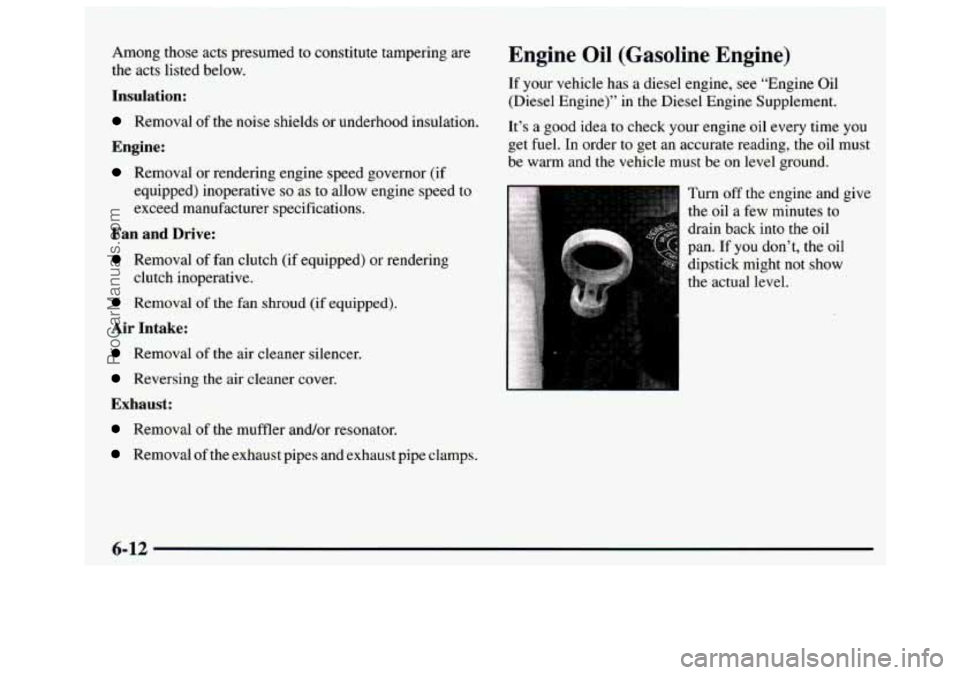
Turn
off the engine and give
the oil a few minutes to
drain back into the oil
pan. If you don’t, the oil
dipstick might not show
the actual level.
6-12
ProCarManuals.com
Page 249 of 388
I RECOMMENDED SAE VISCOSITY GRADE ENGINE OILS
FOR BEST FUEL ECONOMY AND COLD STARTING, SELECT THE LOWEST
I SAE VISCOSITY GRADE OIL FOR THE EXPECTED TEMPERATURE RANGE.
HOT
WEATHER
+loo- ~
+ 80- -
+60- -
+40- -
+20- -
0- -
-7
-18 --
SAE 5W PREFER ~
COLD
WEATHER
LOOK
FOR THIS
SYMBOL
DO NOT USE SAE 2OW-50 OR ANY OTHER
GRADE OIL NOT RECOMMENDED
L
1-30 REO
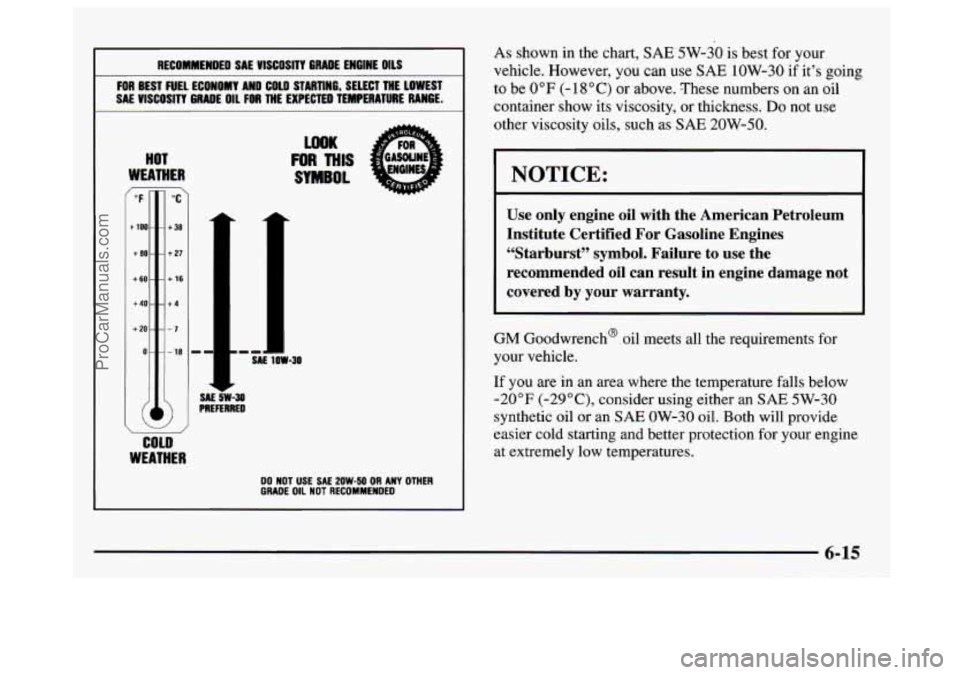
As shown in the chart, SAE 5W-30 is best for your
vehicle. However,
you can use SAE low-30 if it's going
to be
0°F (- 18 "C) or above. These numbers on an oil
container show its viscosity, or thickness.
Do not use
other viscosity oils, such as
SAE 20W-50.
NOTICE:
Use only engine oil with the American Petroleum
Institute Certified For Gasoline Engines
"Starburst" symbol. Failure to use the
recommended oil can result in engine damage not
covered by your warranty.
GM Goodwrench@, oil meets all the requirements for
your vehicle.
If you are in an area where the temperature falls below
-20°F (-29"C), consider using either an SAE 5W-30
synthetic oil or an SAE OW-30 oil. Both will provide
easier cold starting and better protection for your engine
at extremely low temperatures.
6-15
ProCarManuals.com
Page 276 of 388
Inflation -- Tire Pressure
The Certificationmire label, which is on the rear edge of
the driver’s door, shows the correct inflation pressures
for your tires when they’re cold.
“Cold” means your
vehicle has been sitting for at least three hours or driven
no more than
1 mile (1.6 km).
NOTICE:
Don’t let anyone tell you that underinflation or
overinflation is all right. It’s not.
If your tires
don’t have enough
air (underinflation), you can
get the following:
@ Too much flexing
Too much heat
Tire overloading
Bad wear
Bad handling
Bad fuel economy.
NOTICE: (Continued)
NOTICE: (Continued)
If your tires have too much air (overinflation),
you can get the following:
Unusual wear
Bad handling
Rough ride
Needless damage from road hazards.
I
When to Check
Check your tires once a month or more. Also, check the
tire pressure of the spare tire.
How to Check
Use a good quality pocket-type gage to check tire
pressure. You can’t tell if your tires are properly inflated
simply by looking at them. Radial tires may look
properly inflated even when they’re underinflated.
Be sure
to put the valve caps back on the valve stems.
They help prevent leaks by keeping out dirt and moisture.
6-42
ProCarManuals.com
Page 290 of 388
Finish Damage
Any stone chips, fractures or deep scratches in the finish
should be repaired right away. Bare metal will corrode
quickly and may develop into a major repair expense.
Minor chips and scratches can be repaired with touch-up
materials available from your dealer or other service
outlets. Larger areas of finish damage
can be corrected
in your dealer’s body and paint shop.
Underbody Maintenance
Chemicals used for ice and snow removal and dust control
can collect on the underbody.
If these are not removed,
accelerated corrosion (rust) can occur on the underbody
parts such
as fuel lines, frame, floor pan and exhaust
system even though they have corrosion protection.
At least every spring, flush these materials from the
underbody with plain water. Clean any areas where mud
and other debris can collect. Dirt packed in closed areas
of the frame should be loosened before being flushed.
Your dealer or an underbody car washing system can do
this for you.
Chemical Paint Spotting
Some weather and atmospheric conditions can create a
chemical fallout. Airborne pollutants can fall upon and
attack painted surfaces on your vehicle. This damage
can take two forms: blotchy, ringlet-shaped
discolorations, and small irregular dark spots etched
into the paint surface.
Although no defect in the paint job causes this,
GM will repair,
at no charge to the owner, the surfaces
of new vehicles damaged by this fallout condition
within
12 months or 12,000 miles (20 000 km) of
purchase, whichever occurs first.
This applies only to materials manufactured and sold by
General Motors. Bodies, body conversions or equipment
not made or sold by General Motors are not covered.
I
6-56
ProCarManuals.com
Page 297 of 388
![GMC SAVANA 1997 Owners Manual Engine Compartment Fuse Relay Center
The fuse block is on the drivers side of the engine
compartment at the rear.
[-I
[)
[T]
Name
BLOWER
ABS
Circuits Protected
Blower Motor
Electr](/img/44/57846/w960_57846-296.png "GMC SAVANA 1997 Owners Manual Engine Compartment Fuse Relay Center
The fuse block is on the drivers side of the engine
compartment at the rear.
[-I
[)
[T]
Name
BLOWER
ABS
Circuits Protected
Blower Motor
Electr")
Engine Compartment Fuse Relay Center
The fuse block is on the driver's side of the engine
compartment at the rear.
[-I
[)
[T]
Name
BLOWER
ABS
Circuits Protected
Blower Motor
Electronic Brake Control Module
Name
IGN-B
IGN-A
BATT
LIGHTING
RR BLOWER
ENG-
1
A/C SPARE
AUX A
AUX-B
RH-HDLP
Circuits Protected
Ignition Switch
Starter Relay, Ignition Switch
Instrument Panel Fuse Block
Instrument Panel Fuse Block,
Headlamp Switch
Rear Auxiliary Blower
Motor Relays
Heated
02 Sensors, Mass Air
Flow Sensor, EGR Valve
Solenoid, Evap Canister Purge
Valve, Crankshaft Position Sensor,
Secondary Air Injection Relay
(Diesel), Water in Fuel Sensor
(Diesel), Fuel Heater (Diesel),
Glowplug Relay (Diesel),
Wastegate Solenoid (Diesel)
Air Conditioning Clutch Relay
Spare Fuses
Upfitter Provisions
Upfitter Provisions
Right-hand Headlamp
(Export Only)
6-63
ProCarManuals.com
Page 298 of 388
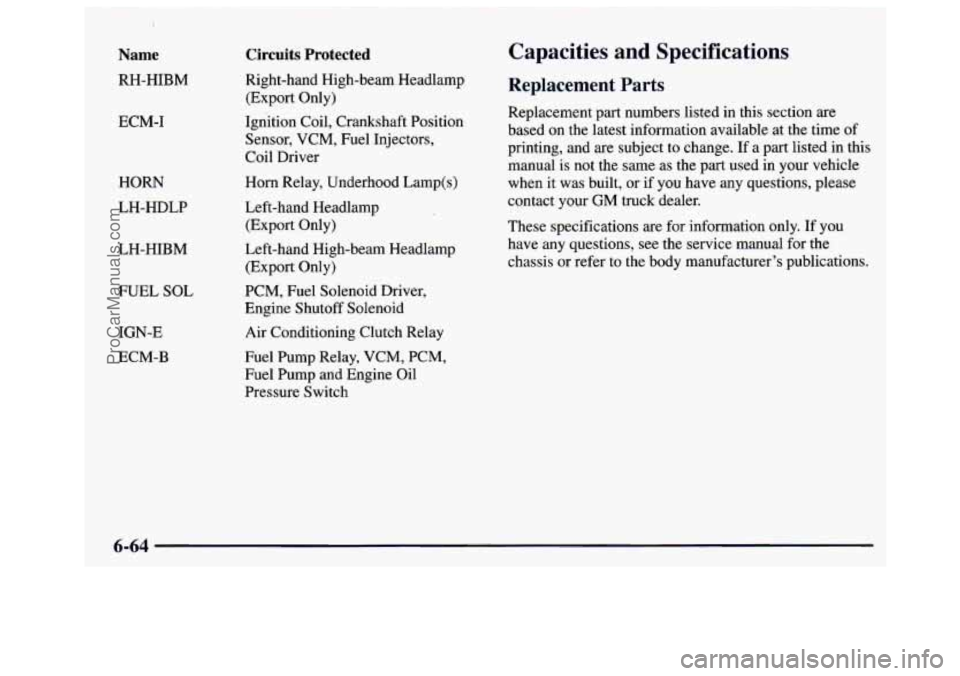
Name
RH-HIBM
ECM-I
HORN
LH-HDLP
LH-HIBM
FUEL SOL
IGN-E
ECM-B
Circuits Protected
Right-hand High-beam Headlamp
(Export Only)
Ignition Coil, Crankshaft Position Sensor, VCM, Fuel Injectors,
Coil Driver
Horn Relay, Underhood Lamp(
s)
Left-hand Headlamp
(Export Only)
Left-hand High-beam Headlamp
(Export Only)
PCM, Fuel Solenoid Driver,
Engine Shutoff Solenoid
Air Conditioning Clutch Relay
Fuel Pump Relay, VCM, PCM,
Fuel Pump and Engine Oil
Pressure Switch
Capacities and Specifications
Replacement Parts
Replacement part numbers listed in this section are
based on the latest information available at the time of
printing, and are subject to change. If a part listed in this
manual is not the same as the part used in your vehicle
when
it was built, or if you have any questions, please
contact your GM truck dealer.
These specifications
are for information only. If you
have
any questions, see the service manual for the
chassis or refer to the body manufacturer’s publications.
6-64
ProCarManuals.com
Page 299 of 388
![GMC SAVANA 1997 Owners Manual Engine Identification -- Gasoline Engines
Engine “VORTEC”4300 “VORTEC”5000
Type V6 V8
VIN Code
w M
Fuel System CSFI’ CSFI*
]Central
Sequential Fuel Injection
2Sequential Fuel I](/img/44/57846/w960_57846-298.png "GMC SAVANA 1997 Owners Manual Engine Identification -- Gasoline Engines
Engine “VORTEC”4300 “VORTEC”5000
Type V6 V8
VIN Code
w M
Fuel System CSFI’ CSFI*
]Central
Sequential Fuel Injection
2Sequential Fuel I")
Engine Identification -- Gasoline Engines
Engine “VORTEC”4300 “VORTEC”5000
Type V6 V8
VIN Code
w M
Fuel System CSFI’ CSFI*
]Central
Sequential Fuel Injection
2Sequential Fuel Injection
Wheel Nut Torque
MODEL TORQUE
All 140 ft-lb (190 N-m)
Cooling System Capacity
ENGINE VIN
“VORTEC”4300
“VORTEC”5000
“VORTEC”5700
“VORTEC”7400 W
M
R
J
QTJ “VORTEC”5700
V8
R
CSFI’
1 Without Rear Heater*
11
Quarts (10.4 L)
17 Quarts (16 L)
17 Quarts (16 L)
23 Quarts (2 1.8 L)
“VORTEC”7400
V8
J
SF12
rl With Rear Heater 8
14 Quarts (13.2 L)
20 Quarts (18.9 L)
20 Quarts (18.9 L)
26 Quarts (24.6 L)
After refill, the level MUST be checked as outlined under “Engine Cooling System” in Section 5.
*All quantities are approximate.
6-65
ProCarManuals.com
Page 300 of 388
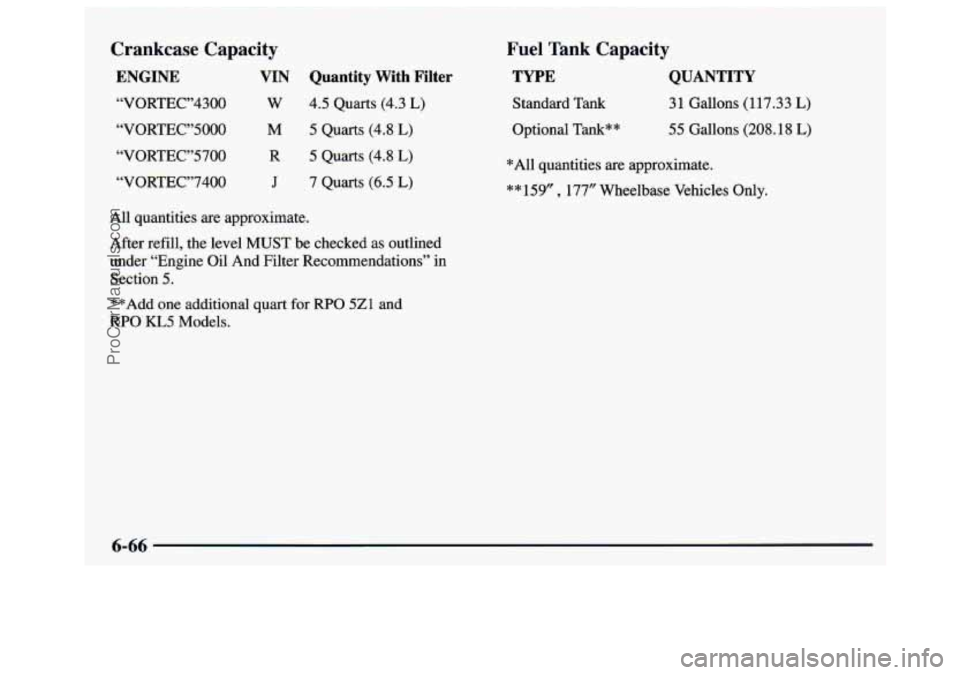
Crankcase Capacity
ENGINE VIN Quantity With Filter
“VORTEC”4300 W 4.5 Quarts (4.3 L)
“VORTEC”5000
“VORTEC”5700
“VORTEC”7400 M
R
J
5 Quarts (4.8 L)
5 Quarts (4.8 L)
7 Quarts (6.5 L)
Fuel Tank Capacity
TYPE QUANTITY
Standard Tank 3 1 Gallons (1 17.33 L)
Optional Tank* * 55 Gallons (208.18 L)
*All quantities are approximate.
** 159’’ , 177” Wheelbase Vehicles Only.
All quantities are approximate. After refill, the level MUST be checked as outlined
under “Engine Oil And Filter Recommendations’’ in
Section
5.
**Add one additional quart for RPO 5Z1 and
WO KL5 Models.
6-66
ProCarManuals.com
Page 301 of 388

Normal Replacement Parts
Engine “VORTEC”4300 “VORTEC”5000 “VORTEC”5700 “VORTEC”\
7400
VIN w M R J
Oil Filter PF52 PF1218 PF1218 PF1218
Air Cleaner Filter* A917C A917C A917C A917C
PCV Valve CV789C cv774c cv774c cv774c
Spark Plugs 41-932 4 1-932 41-932 4 1-932
Fuel Filter GF48
1 GF48 1 GF48 1 GF48 1
Radiator Cap RC36 RC36 RC36 RC36
*Replace with
AC Air Filter, Part No. A917C and for severe dusty conditions, use, AC Air Filter, Part No. 1236C.
Air Conditioning Refrigerant Capacity
I NOTICE:
~~
R-134A refrigerant is not compatible with R-12
refrigerant in an air conditioning system. R-12 in
an R-134A system
will cause compressor failure,
refrigerant oil sludge,
or poor air conditioning
system performance. TYPE
QTY Front Only QTY Front and Rear
Refrigerant 3.00 lbs. (1.36 kg) 4.875 lbs. (2.21 kg)
R- 134A
Air Conditioning Refrigerants
Not all air conditioning refrigerants are the same.
If the air conditioning system in your vehicle needs
refrigerant, be sure the proper refrigerant is used.
If you’re not sure, ask your GM dealer.
6-67
ProCarManuals.com
Page 308 of 388
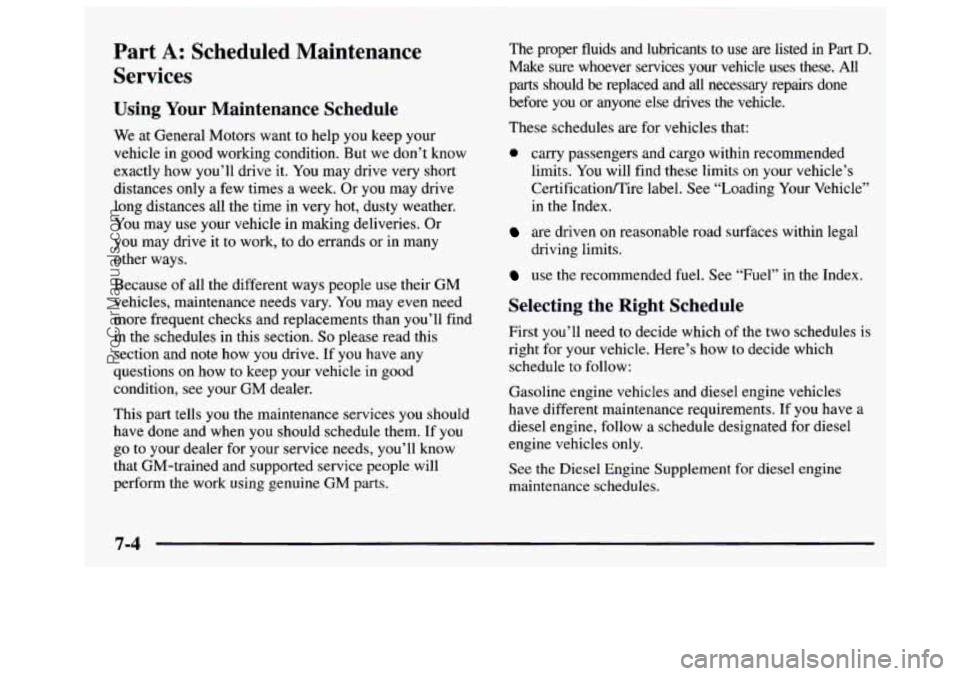
Part A: Scheduled Maintenance
Services
Using Your Maintenance Schedule
We at General Motors want to help you keep your
vehicle in good working condition. But we don’t know
exactly how you’ll drive it.
You may drive very short
distances only
a few times a week. Or you may drive
long distances all the time in very hot, dusty weather.
You may use your vehicle in making deliveries. Or
you may drive it to work, to do ---‘ands or in many
other ways.
Because
of all the different ways people use their GM
vehicles, maintenance needs vary. You may even need
more frequent checks and replacements than you’ll find
in the schedules in this section.
So please read this
section and note how you drive. If you have any
questions on how to keep your vehicle in good
condition, see your GM dealer.
This part tells
you the maintenance services you should
have done and when you should schedule them. If you
go
to your dealer for your service needs, you’ll know
that GM-trained and supported service people will
perform the work using genuine GM parts. The proper fluids and lubricants
to use are listed in Part D.
Make sure whoever services
you vehicle uses these. All
parts should be replaced and all necessary repairs done
before
you or anyone else drives the vehicle.
These schedules are for vehicles that:
0 carry passengers and cargo within recommended
limits. You will find these limits on your vehicle’s
CertificationEire label. See “Loading Your Vehicle’’
in the Index.
are driven on reasonable road surfaces within legal
driving limits.
use the recommended fuel. See “Fuel” in the Index.
Selecting the Right Schedule
First you’ll need to decide which of the two schedules is
right for your vehicle. Here’s how to decide which
schedule to follow:
Gasoline engine vehicles and diesel engine vehicles
have different maintenance requirements. If
you have a
diesel engine, follow a schedule designated for diesel
engine vehicles only.
See the Diesel Engine Supplement for diesel engine
maintenance schedules.
7-4
ProCarManuals.com