instrument panel GMC SAVANA 1997 Owner's Manual
[x] Cancel search | Manufacturer: GMC, Model Year: 1997, Model line: SAVANA, Model: GMC SAVANA 1997Pages: 388, PDF Size: 20.17 MB
Page 129 of 388
Mode Knob
The right knob changes the heater setting.
+.
/J VENT: This setting directs air through the
instrument panel vents.
’# BI-LEVEL: Use this setting to divide
airflow between the heater floor vents and instrument
panel vents.
+’ HEAT This setting directs air through the heater
floor vents. This setting
is useful for cold weather.
+H HEATmEFROST: Use this setting to divide
airflow between the heater floor vents and windshield.
+.
e
w.
DEFROST This setting directs air through the
windshield defroster vents. This setting is useful when
you have fog or ice on the windshield.
HeatedAir Conditioning Controls
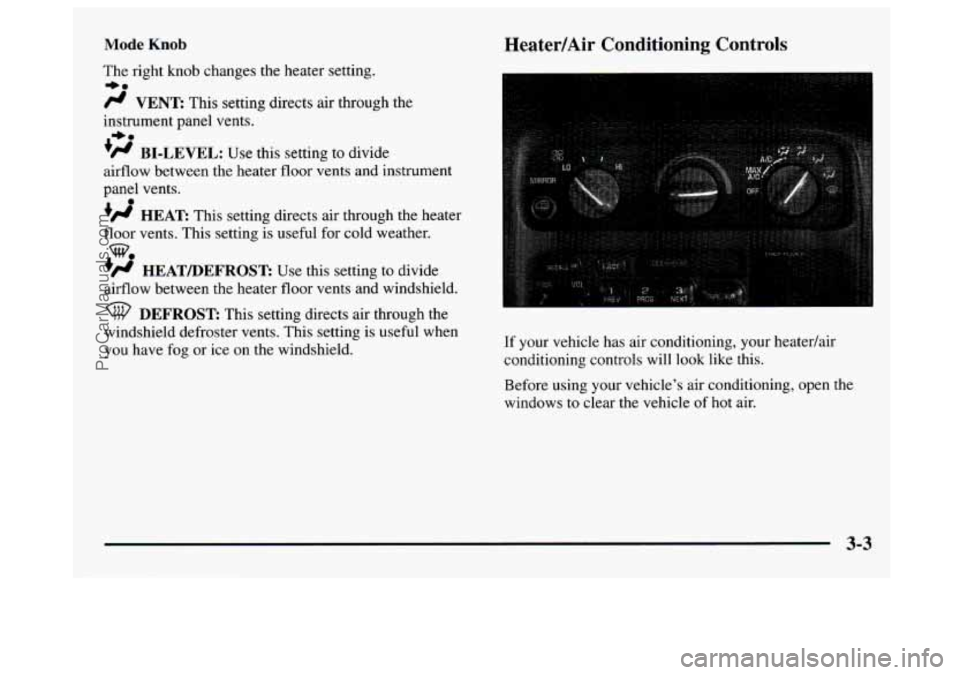
If your vehicle has air conditioning, your heatedair
conditioning controls will look like this.
Before using
your vehicle’s air conditioning, open the
windows
to clear the vehicle of hot air.
3-3
ProCarManuals.com
Page 130 of 388
Fan Knob
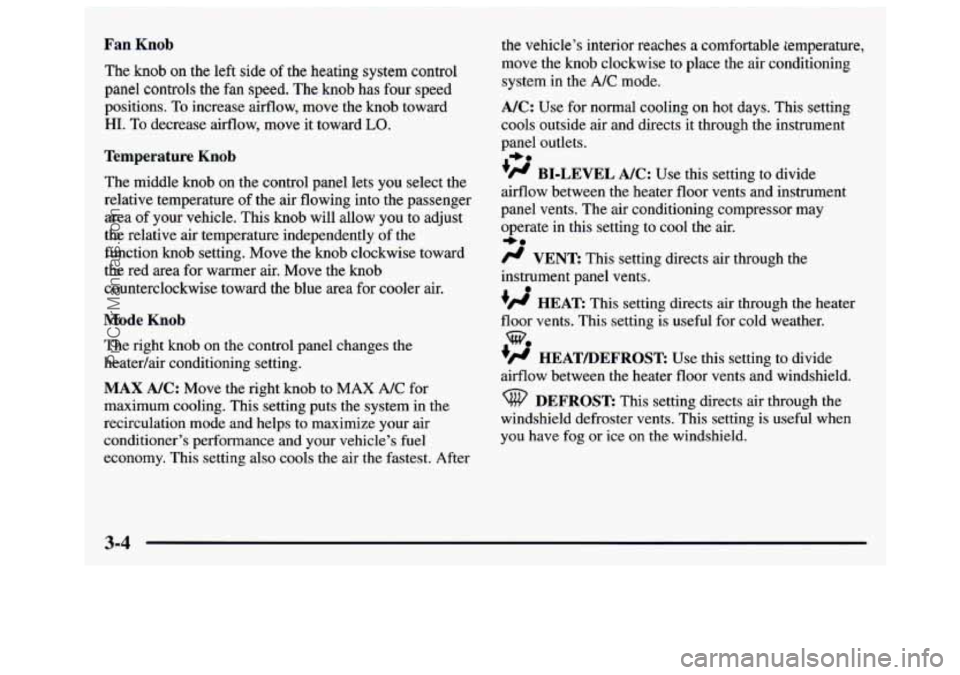
The knob on the left side of the heating system control
panel controls the
€an speed. The knob has four speed
positions.
To increase airflow, move the knob toward
HI. To decrease airflow, move it toward LO.
Temperature Knob
The middle knob on the control panel lets you select the
relative temperature of the air flowing into the passenger
area of your vehicle. This knob will allow you to adjust
the relative air temperature independently of the
function knob setting. Move the knob clockwise toward
the red area for warmer air. Move the knob
counterclockwise toward the blue area for cooler air.
Mode Knob
The right knob on the control panel changes the
heatedair conditioning setting.
MAX A/C: Move the right knob to MAX A/C for
maximum cooling. This setting puts the system in the
recirculation mode and helps to maximize your air
conditioner’s performance and your vehicle’s fuel
economy. This setting also cools the air the fastest. After
the vehicle’s interior reaches a comfortable temperature,
move the knob clockwise to place
the air conditioning
system in the
A/C mode.
A/C: Use for normal cooling on hot days. This setting
cools outside air and directs it through the instrument
panel outlets.
’# BI-LEVEL A/C: Use this setting to divide
airflow between the heater floor vents and instrument
panel vents. The air conditioning compressor
may
operate in this setting to cool the air.
/J VENT: This setting directs air through the
instrument panel vents.
+H HEAR This setting directs air through the heater
floor vents. This setting is useful for cold weather.
+H HEATLIEFROST: Use this setting to divide
airflow between the heater floor vents and windshield.
I,.
*e
0
DEFROST This setting directs air through the
windshield defroster vents. This setting is useful when
you have fog
or ice on the windshield.
3-4
ProCarManuals.com
Page 131 of 388
Rear Heater (Without Air Conditioning)
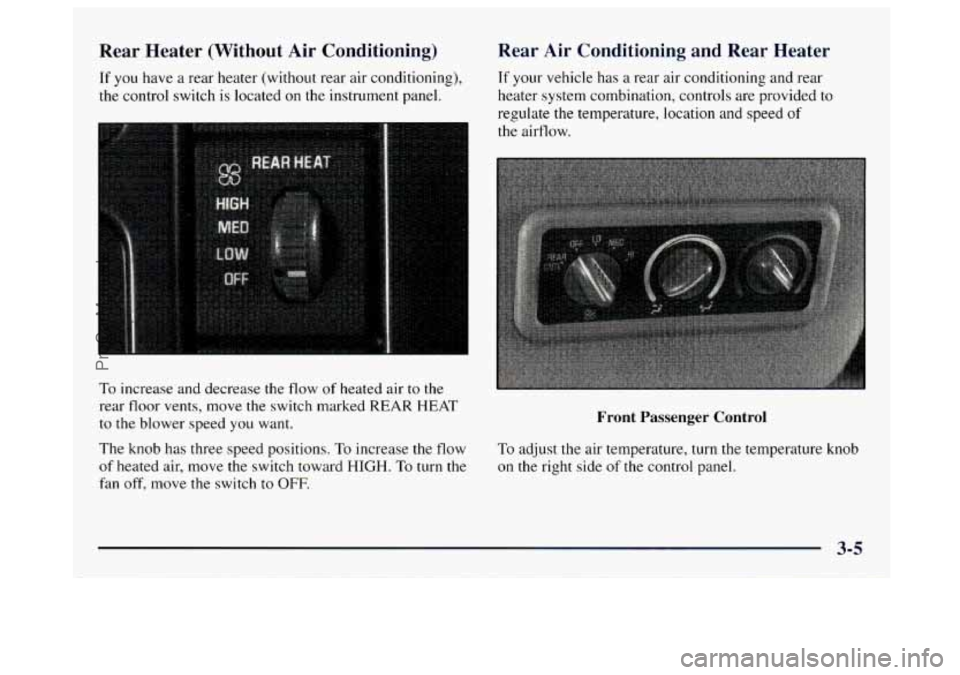
If you have a rear heater (without rear air conditioning),
the control switch is located on the instrument panel.
To increase and decrease the flow of heated air to the
rear floor vents, move the switch marked
REAR HEAT
to the blower speed you want.
The knob has three speed positions.
To increase the flow
of heated air, move the switch toward HIGH. To turn the
fan
off, move the switch to OFF.
Rear Air Conditioning and Rear Heater
If your vehicle has a rear air conditioning and rear
heater system combination, controls are provided to
regulate the temperature, location
and speed of
the airflow.
Front Passenger Control
To adjust the air temperature, turn the temperature knob
on
the right side of the control panel.
3-5
ProCarManuals.com
Page 134 of 388
Keep the air path under the front seats clear of
objects. This helps air to circulate throughout
your vehicle.
Your vehicle has air vents in the center and on the sides
of your instrument panel.
You can move the vents from side to side or up and
down to direct the flow
of air, or close the vents
altogether. When
you close a vent, it will increase the
flow
of air coming out of any vents that are open.
Audio Systems
Your Delco@ audio system has been designed to operate
easily and give years
of listening pleasure. You will get
the most enjoyment out of it if
you acquaint yourself
with it first. Find out what your Delco system can do
and how to operate all its controls,
to be sure you’re
getting the most out
of the advanced engineering that
went into it.
Setting the Clock for Systems without
Automatic
Tone Control
Press SET. Within five seconds, press and hold the
SEEK right arrow until the correct minute appears on
the display. Press and hold the
SEEK left arrow until
the correct hour appears on the display.
Setting the Clock for Systems with
Automatic
Tone Control
Press and hold HR until the correct hour appears on
the display. Press and hold MIN until the correct
minute appears
on the display. To display the clock
with the ignition off, press
RECALL or HFUMIN and
the time
will be displayed for a few seconds. There is
an initial two-second delay before the clock goes into
the time-set mode.
3-8
ProCarManuals.com
Page 190 of 388
Making Turns
I NOTICE:
Making very sharp turns while trailering could cause the trailer to come in contact with the
vehicle. Your vehicle could be damaged. Avoid
making very sharp turns while trailering.
When you’re turning with a trailer, make wider turns
than normal.
Do this so your trailer won’t strike soft
shoulders, curbs, road signs, trees or other objects.
Avoid jerky or sudden maneuvers. Signal well
in advance.
limn Signals When Towing a Trailer
When you tow a trailer, your vehicle has to have extra
wiring and a heavy-duty turn signal flasher (included in
the optional trailering package).
The arrows on your instrument panel will flash
whenever you signal a turn or lane change. Properly
hooked up, the trailer lamps will also flash, telling other
drivers you’re about
to turn, change lanes or stop. When towing
a trailer, the arrows on your instrument
panel will flash for turns even if the bulbs on
the trailer
are burned out. Thus,
you may think drivers behind you
are seeing your signal when they are not. It’s important
to check occasionally
to be sure the trailer bulbs are
still working.
Driving On Grades
Reduce speed and shift to a lower gear before you
start down a long or steep downgrade. If you don’t shift
down, you might have to use your brakes
so much that
they would get hot and no longer work well.
On
a long uphill grade, shift down and reduce your
speed to around
45 mph (70 kmh) to reduce the
possibility
of engine and transmission overheating.
When towing at high altitude
on steep uphill grades,
consider the following: Engine coolant will boil at a
lower temperature than at normal altitudes. If you turn
your engine off immediately after towing at high altitude
on steep uphill grades, your vehicle may show signs
similar to engine overheating.
To avoid this, let the
engine run while parked (preferably on
level ground)
with the automatic transmission in PARK
(P) for a
few minutes before turning the engine
off. If you do
get the overheat warning, see “Engine Overheating”
in the Index.
4-36
ProCarManuals.com
Page 206 of 388
Engine Overheating
(Gasoline Engine)
You will find a coolant temperature gage on your vehicle’s
instrument panel.
If you have a diesel engine, you will also
find a low coolant light on your instrument panel.
If your vehicle has a diesel engine, see “Engine
Overheating” in the Diesel Engine Supplement.
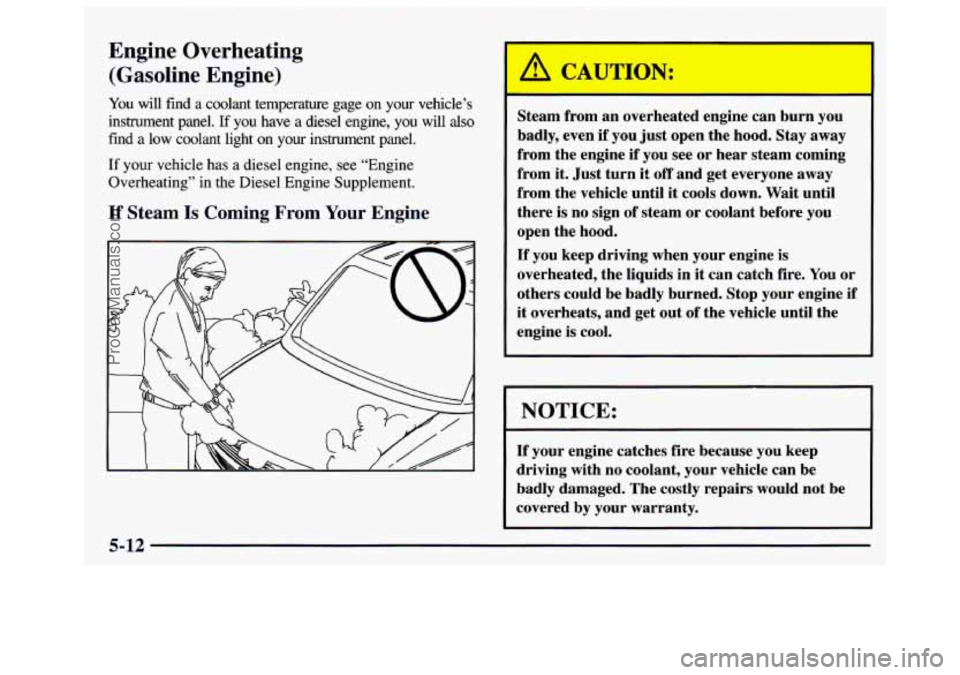
If Steam Is Coming From Your Engine
Steam from an overheated engine can burn you
badly, even if you just open the hood. Stay away
from the engine if you see or hear steam coming
from it. Just turn it
off and get everyone away
from the vehicle until it cools down. Wait until
there is no sign of steam or coolant before you
open the hood.
If you keep driving when your engine is
overheated, the liquids in it can catch fire. You or
others could be badly burned. Stop your engine if
it overheats, and get out of the vehicle until the
engine is cool.
I NOTICE:
If your engine catches fire because you keep
driving with no coolant, your vehicle can be
badly damaged. The costly repairs would not be
covered by your warranty.
5-12
ProCarManuals.com
Page 237 of 388
Adding Equipment to the Outside of
Your Vehicle
Things you might add to the outside of your vehicle can
affect the airflow around it. This may cause wind noise
and affect windshield washer performance. Check with
your GM dealer before adding equipment to the outside
of your vehicle.
Fuel (Gasoline Engine)
If your vehicle has a diesel engine, see “Diesel Fuel
Requirements and Fuel System” in the Diesel Engine
Supplement. For vehicles with gasoline engines, please
read this.
Use regular unleaded gasoline rated at 87 octane or
higher. At a minimum, it should meet specifications
ASTM D4814 in the United States and CGSB 3.5-M93
in Canada. Improved gasoline specifications have been
developed by the American Automobile Manufacturers
Association (AAMA) for better vehicle performance
and engine protection. Gasolines meeting
the AAMA
specification could provide improved driveability and
emission control system protection compared to
other gasolines. Be
sure the posted octane is
at least 87. If the octane is
less than 87, you may get a heavy knocking noise when
you drive. If it’s bad enough, it can damage your engine.
If you’re using fuel rated at 87 octane or higher and you
hear heavy knocking, your engine needs service. But
don’t worry if you hear a little pinging noise when
you’re accelerating or driving up a hill. That’s normal,
and you don’t have to buy a higher octane fuel to get rid
of pinging. It’s the heavy, constant knock that means
you have a problem.
If your vehicle is certified to meet California Emission
Standards (indicated on the underhood tune-up label),
it is designed to operate on fuels that meet California
specifications. If such fuels are not available in states
adopting California emissions standards, your vehicle
will operate satisfactorily on fuels meeting federal
specifications, but emission control system performance
may be affected. The malfunction indicator lamp on
your instrument panel may turn on and/or your vehicle
may fail a smog-check test. If this occurs, return to your
authorized GM dealer for diagnosis to determine the
cause
of failure. In the event it is determined that the
cause of the condition is the type of fuels used, repairs
may not be covered by your warranty.
6-3
ProCarManuals.com
Page 238 of 388
Some gasolines that are not reformulated for low
emissions contain an octane-enhancing additive called
methylcyclopentadienyl manganese tricarbonyl (MMT);
ask your service station operator whether or not
his fuel
contains MMT. General Motors does not recommend the
use
of such gasolines. If fuels containing MMT are used,
spark plug life may be reduced and your emission
control system performance may be affected. The
malfunction indicator lamp on your instrument panel
may turn
on. If this occurs, return to your authorized
GM dealer for service.
To provide cleaner air, all gasolines in the United States
are
now required to contain additives that will help
prevent deposits from forming
in your engine and fuel
system, allowing your emission control system
to
function properly. Therefore, you should not have to aad
anything to the fuel. In addition, gasolines containing
oxygenates, such
as ethers and ethanol, and reformulated gasolines may be
available in your area to
help clean the air. General Motors recommends that you
use these gasolines if they comply with the
specifications described earlier.
NOTICE:
Your vehicle was not designed for fuel that
contains methanol. Don’t use it. It can corrode
metal parts in your fuel system and also damage
plastic and rubber parts. That damage wouldn’t
be covered under your warranty.
6-4
ProCarManuals.com
Page 286 of 388
3. If an odor lingers after cleaning vomit or urine,
treat the area with a waterhaking soda solution:
1
teaspoon (5 ml) of baking soda to 1 cup (250 ml)
of lukewarm water.
4. If needed, clean lightly with solvent-type cleaner.
Combination Stains
Stains caused by candy, ice cream, mayonnaise, chili
sauce and unknown stains can be removed as follows:
1. Carefully scrape off excess stain.
2. Clean with cool water and allow to dry.
3. If a stain remains, clean it with solvent-type cleaner.
Cleaning Vinyl
Use warm water and a clean cloth.
0 Rub with a clean, damp cloth to remove dirt. You
may have to do it more than once.
Things like tar, asphalt and shoe polish will stain if you
don’t get them
off quickly. Use a clean cloth and a
vinyVleather cleaner.
See your dealer for this product.
Cleaning Leather I
Use a soft cloth with lukewarm water and a mild soap or I
saddle soap and wipe dry with a soft cloth. Then, let the
leather dry naturally.
Do not use heat to dry.
For stubborn stains, use a leather cleaner. See your
dealer for this product.
cleaners, furniture polish
or shoe polish on leather.
Never use oils, varnishes, solvent-based or abrasive
Soiled or stained leather should be cleaned
immediately. If dirt is allowed to work into the
finish,
it can harm the leather.
Cleaning the Top of the Instrument Panel
Use only mild soap and water to clean the top surfaces
of the instrument panel. Sprays containing silicones or
waxes may cause annoying reflections in the windshield
and even make it difficult to see through the windshield
under certain conditions.
6-52
ProCarManuals.com
Page 292 of 388
I
Vehicle Identification Number (VIN)
- -1 I1 11111.11 1.11 111 111111 II. 111111I1 111111111111 111111111 11- a
SAMPLE4UXVM072675
I I 111 1111II IIII 11111111111111 IIIIIIII 11111111 11111111 I IIIIIII I
ENGINE A97 7 ASSEMBLY
CODE
MODEL YEAR PLANT
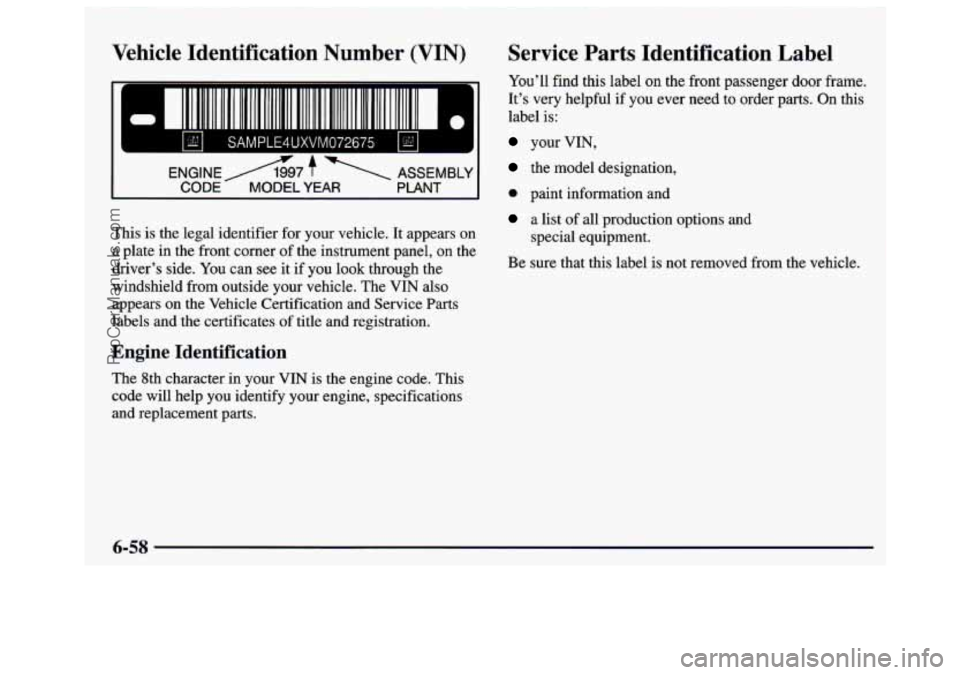
This is the legal identifier for your vehicle. It appears on
a plate in the front corner
of the instrument panel, on the
driver’s side. You can see it if
you look through the
windshield from outside your vehicle. The
VIN also
appears on the Vehicle Certification and Service Parts
labels and the certificates
of title and registration.
Engine Identification
The 8th character in your VIN is the engine code. This
code will help you identify your engine, specifications
and replacement
parts.
Service Parts Identification Label
You’ll find this label on the front passenger door frame.
It’s very helpful if you ever need to order parts. On this
label is:
your VIN,
the model designation,
0 paint information and
a list of all production options and
special equipment.
Be sure that this label
is not removed from the vehicle.
6-58
ProCarManuals.com