instrument panel GMC SAVANA 1997 User Guide
[x] Cancel search | Manufacturer: GMC, Model Year: 1997, Model line: SAVANA, Model: GMC SAVANA 1997Pages: 388, PDF Size: 20.17 MB
Page 95 of 388
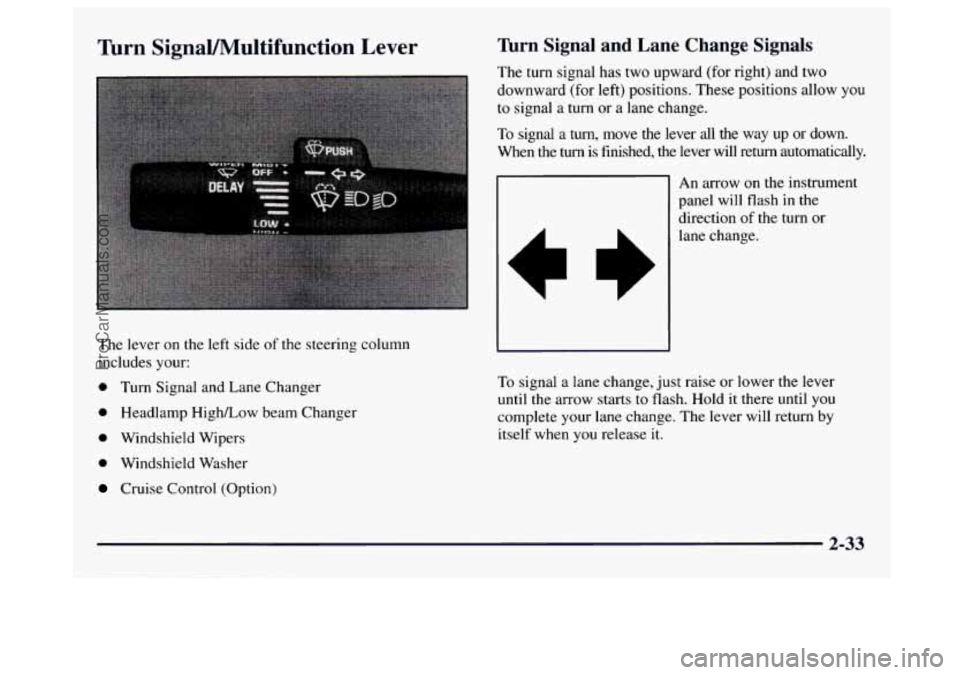
Turn SignaVMultifunction Lever
The lever on the left side of the steering column
includes your:
0 Turn Signal and Lane Changer
0 Headlamp High/Low beam Changer
0 Windshield Wipers
0 Windshield Washer
Cruise Control (Option)
Turn Signal and Lane Change Signals
The turn signal has two upward (for right) and two
downward (for left) positions. These positions allow
you
to signal a turn or a lane change.
To signal a turn, move the lever all the way up or down.
When the turn is finished, the lever will return automatically.\
7
An arrow on the instrument
panel will flash in the
direction of the turn or
lane change.
To signal a lane change,
just raise or lower the lever
until
the arrow starts to flash. Hold it there until you
complete your lane change. The lever will return by
itself when you release it.
2-33
ProCarManuals.com
Page 96 of 388
As you signal a turn or a lane change, if the arrows flash
at twice the normal rate, a signal bulb may be burned
out and other drivers
may not see your turn signal.
If a bulb is burned out, replace it to help avoid an
accident. If the arrows don’t
go on at all when you
signal a turn, check for burned-out bulbs and a blown
fuse (see “Fuses and Circuit Breakers” in the Index).
Headlamp High/Low Beam Changer
To change the headlamps from low beam to high or high
to low, pull the multifunction lever all the way toward
you. Then release it.
When the high beams
are
on, this light on the
instrument panel also will be on.
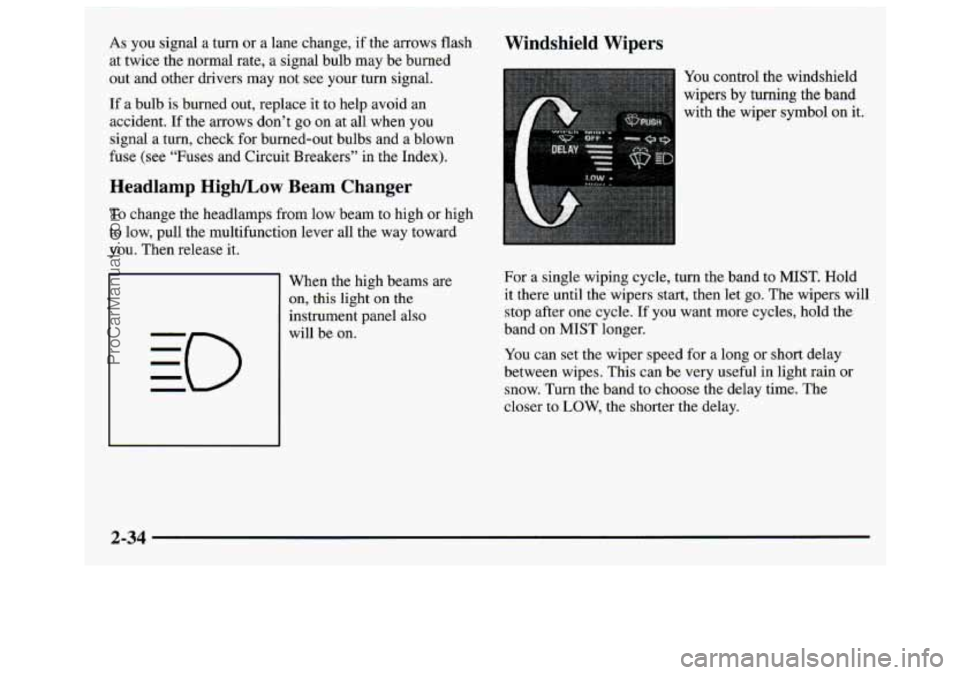
Windshield Wipers
You control the windshield
wipers by turning the band
with the wiper symbol on it.
For a single wiping cycle, turn the band to MIST. Hold
it there until the wipers start, then let go. The wipers will
stop after one cycle.
If you want more cycles, hold the
band
on MIST longer.
You can set the wiper speed for a long or short delay
between wipes. This can be very useful
in light rain or
snow.
Turn the band to choose the delay time. The
closer to LOW, the shorter the delay.
2-34
ProCarManuals.com
Page 100 of 388
Using Cruise Control on Hills
How well your cruise control will work on hills depends
upon your speed, load and the steepness
of the hills.
When going up steep hills, you may have
to step on
the accelerator pedal to maintain your speed. If the
steepness of the hill causes the vehicle speed to drop
more than
15 mph (9.4 km/h) below the set speed, your
cruise control will automatically disengage. When going
downhill,
you may have to brake or shift to a lower gear
to keep your speed down.
Of course, applying the brake
takes
you out of cruise control. Many drivers find this to
be too much trouble and don’t use cruise control on
steep hills.
Ending Cruise Control
There are two ways to turn off the cruise control:
Step lightly on the brake pedal; or
Move the cruise switch to OFF.
Erasing Speed Memory
When you turn off the cruise control or the ignition,
your cruise control set speed memory is erased.
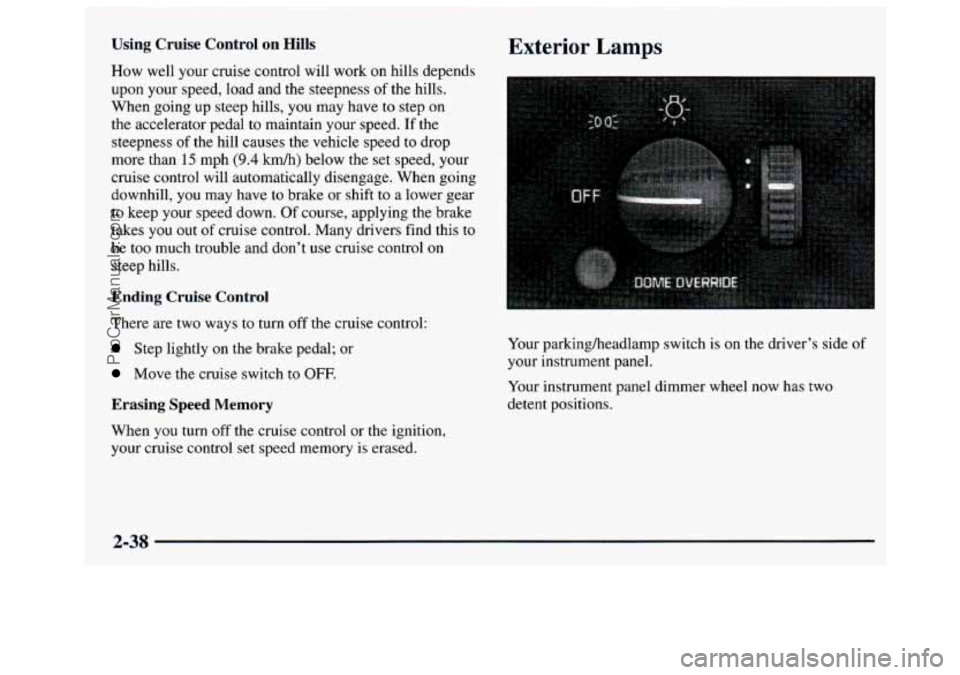
Exterior Lamps
Your parkingheadlamp switch is on the driver’s side of
your instrument panel.
Your instrument panel dimmer wheel now has two
detent positions.
2-38
ProCarManuals.com
Page 101 of 388
When the wheel is turned to full brilliance, and then into
the first detent position, the radio display and PRNDL
display will go to the day mode (full intensity). This is
known as “parade” mode. The rest
of the I/P
illumination will stay in the maximum dimming state
(full brilliance dimming). Turning the wheel up one
more detent will activate the interior dome light circuit
(with slightly higher effort).
The dome lights cannot be turned on by depressing the
dome light switch button, located below the parkhead
lamp switch knob. This switch is a dome lamp off
switch and will only interrupt inputs from the door jamb
switches, inhibiting interior light operation when
depressed. It will not inhibit the light function from the
I/P dimmer switch.
The delayed entry will allow
you to enter or exit your
vehicle with the lights staying
on for about 20 seconds
after the door
is closed or ignition is cycled.
Rotate the switch knob clockwise to the parking lamp
symbol to turn on:
0 Parking Lamps
0 Sidemarker Lamps
0 Taillamps
License Plate Lamps
Instrument Panel Lights
0 Ashtray Lamp
0 Glove Box Lamp
Rotate the switch
knob clockwise again to the master
lighting symbol to turn on all the lamps listed above as
well as the headlamps.
Rotate the switch counterclockwise to
OFF to turn off
your lamps and lights.
Rotate the thumb wheel next to the switch knob up to
adjust instrument panel lights. Rotate the thumb wheel
up to the first notch to return the radio display and
gearshift indicator Vacuum Fluorescence (VF) display
to full intensity when the headlamps or parking lamps
are on.
Rotate the thumb wheel up
to the second notch to
activate the interior dome lamps.
You can switch your headlamps from high to low beam
by pulling
on the turn signalhigh beam lever.
A circuit breaker protects your headlamps. If you have
an electrical overload, your headlamps will flicker on
and off. Have your headlamp wiring checked right away
if this happens.
ProCarManuals.com
Page 102 of 388
Headlamps On Reminder
A tone will sound when your headlamps are turned on
and your ignition is in OFF, LOCK or ACCESSORY.
If you need to use your headlamps when the ignition
switch is in
OFF, LOCK or ACCESSORY, the tone
can be turned off by turning the thumb wheel
next to
the parking lamp/headlamp switch all the way down.
Daytime Running Lamps (If Equipped)
Daytime Running Lamps (DRL) can make it easier for
others
to see the front of your vehicle during the day.
DRL can be helpful in many different driving conditions,
but they can be especially helpful in
the short periods
after dawn and before sunset.
The DRL system will make your headlamps come on at
a reduced brightness when:
0 The ignition is on,
0 The headlamp switch is off, and
0 The parking brake is released.
If your vehicle was first sold, when new,
in Canada,
your headlamps will come on at reduced brightness.
If your vehicle was first sold, when new,
in the United
States, your vehicle may be equipped with DRL. If your
vehicle has DRL,
you will see the the DRL indicator light
on your instrument panel and your low-beam
headlamps will
come on at reduced brightness.
When the DRL are on,
only your headlamps will be on.
The taillamps, sidemarker and other lamps won’t be on.
Your instrument panel won’t be lit up either.
When
it begins to get dark, your DRL indicator light is a
reminder
to turn your headlamp switch on. The other lamps
that come on with your headlamps will also come on.
When you turn off the headlamp switch, the regular
lamps will go off, and your headlamps will change to
the reduced brightness
of DRL.
To idle your vehicle with the engine on and the DRL off,
set the parking brake. The DRL will stay off until you
release the parking brake.
As with any vehicle, you should turn on the regular
headlamp system when you need
it.
Dome Lamps
The dome lamps will come on when you open the doors.
You can also turn the dome lamps on by rotating the
thumb wheel, located next
to the headlamp knob, all
the way up to the second notch. In this position, the
dome lamps will remain on whether the doors are
opened or closed.
2-40
ProCarManuals.com
Page 106 of 388
Convex Outside Mirror
Your passenger’s side mirror is convex. A convex
mirror’s surface
is curved so you can see more from the
driver’s
seat.
CAUTION:
-
A convex mirror can make things (like other
vehicles) look farther away than they really are.
If you cut too sharply into the right lane, you
could hit a vehicle on your right. Check your inside mirror
or glance over your shoulder before
changing lanes.
Storage Compartments
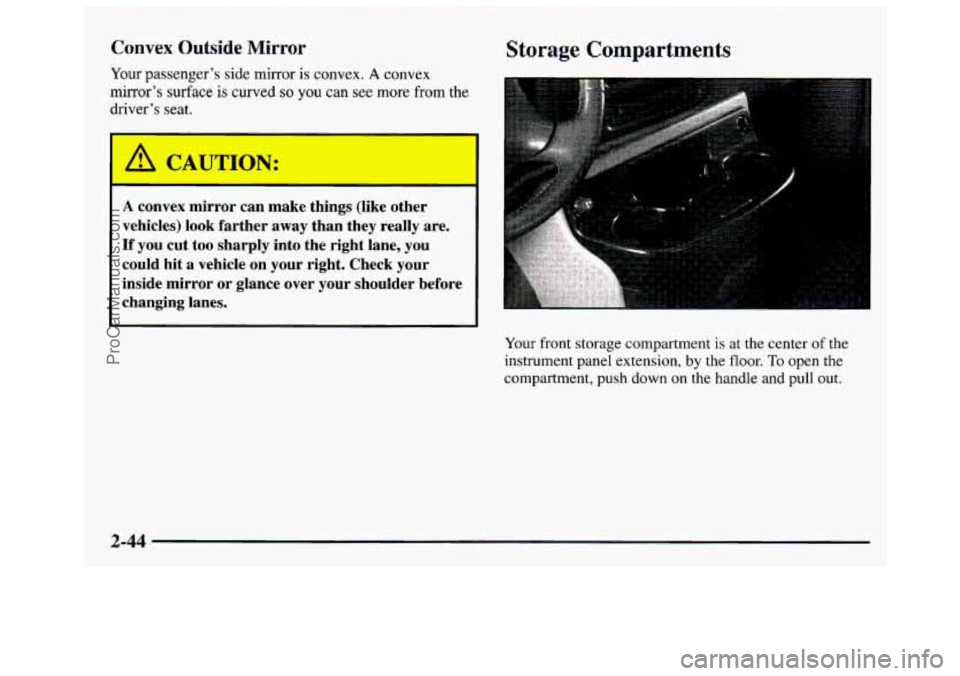
Your front storage compartment is at the center of the
instrument panel extension,
by the floor. To open the
compartment, push down
on the handle and pull out.
2-44
ProCarManuals.com
Page 107 of 388
k
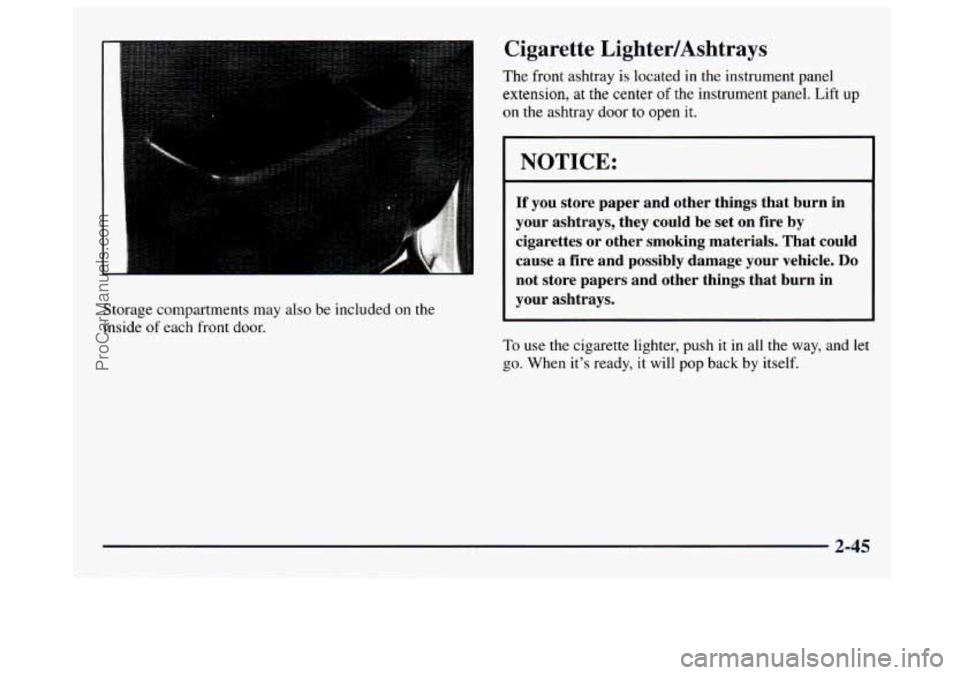
Storage compartments may also be included on the
inside of each front door.
Cigarette LightedAshtrays
The front ashtray is located in the instrument panel
extension, at the center of the instrument panel. Lift
up
on the ashtray door to open it.
NOTICE:
If you store paper and other things that burn in
your ashtrays, they could be set on fire by
cigarettes or other smoking materials. That could cause a fire and possibly damage your vehicle.
Do
not store papers and other things that burn in
your ashtrays.
To use the cigarette lighter, push it in all the way, and let
go. When it’s ready, it will pop back by itself.
2-45
ProCarManuals.com
Page 109 of 388
Instrument Panel
Y
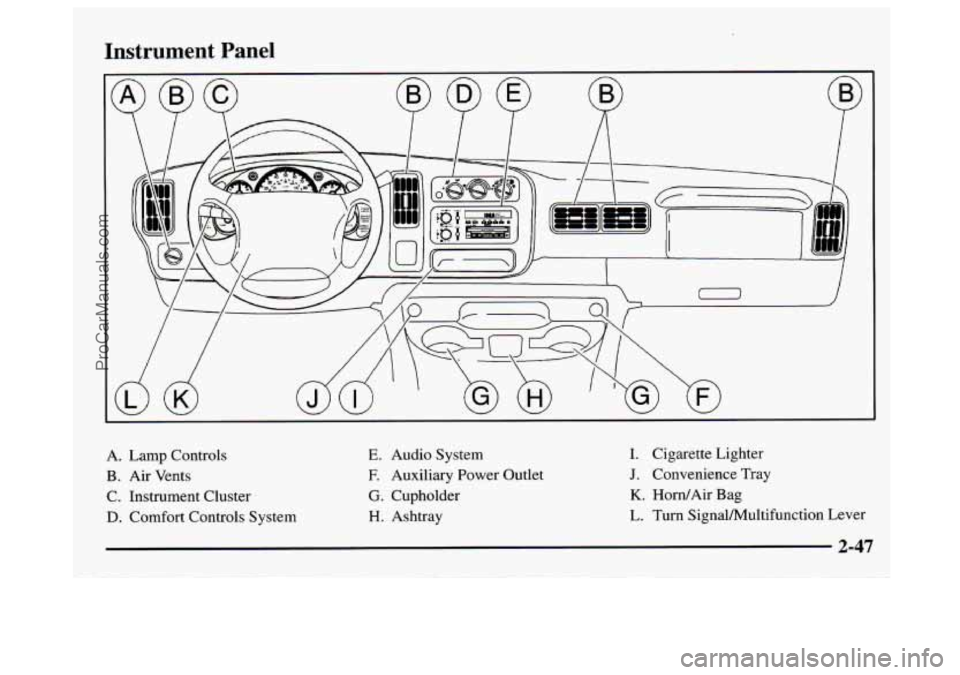
A.
B.
C.
D.
Lamp Controls Air Vents
Instrument Cluster
Comfort Controls System
E.
E
G.
H.
Audio System
Auxiliary Power Outlet
Cupholder
Ashtray
I.
J.
K.
L.
Cigarette Lighter Convenience Tray
Horn/Air Bag
Turn SignalMultifunction Lever
2-47
ProCarManuals.com
Page 113 of 388
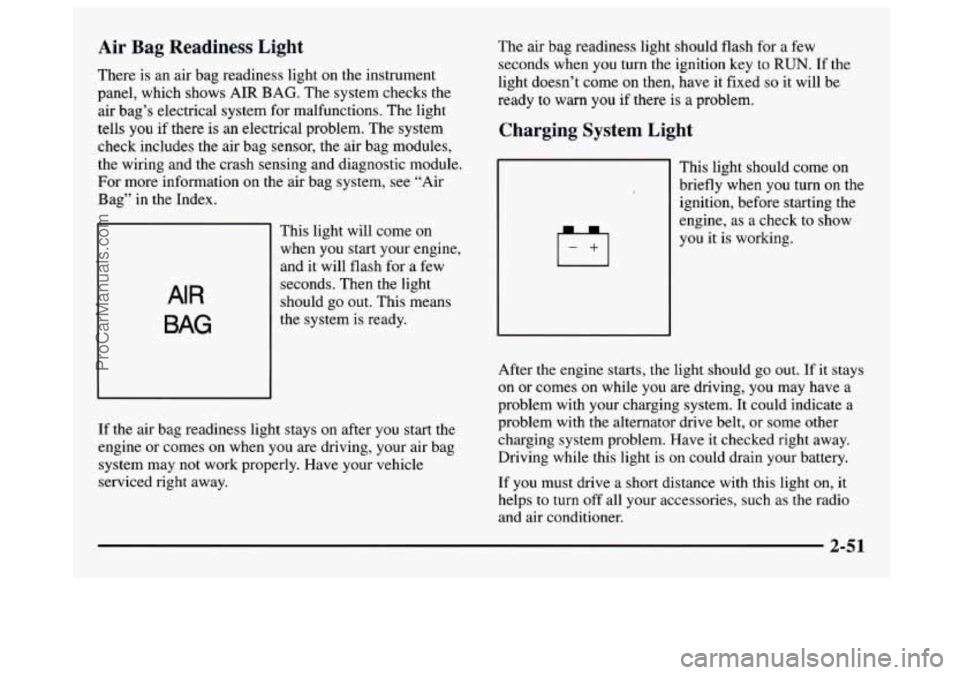
Air Bag Readiness Light
There is an air bag readiness light on the instrument
panel, which shows
AIR BAG. The system checks the
air bag’s electrical system
for malfunctions. The light
tells you if there
is an electrical problem. The system
check includes the air bag sensor, the
air bag modules,
the wiring and the crash sensing and diagnostic module.
For more information on the air bag system, see “Air
Bag” in the Index.
AIR
BAG
This light will come on
when you start your engine,
and it will flash for a few
seconds. Then the light
should go out. This means
the system is ready.
If the air bag readiness light stays on after you start the
engine or comes on when you are driving, your air bag
system may not work properly. Have your vehicle
serviced right away. The
air bag readiness light should
flash for a few
seconds when you turn the ignition key to
RUN. If the
light doesn’t come on then, have it fixed
so it will be
ready to warn
you if there is a problem.
Charging System Light
This light should come on
briefly when you turn
on the
ignition, before starting the
engine, as a check to show
you it is working.
After the engine starts, the light should go out. If
it stays
on or comes on while you are driving, you may have a
problem with your charging system. It could indicate a
problem with the alternator
drive belt, or some other
charging system problem. Have it checked right away.
Driving while this light is on could drain your battery.
If you must drive a short distance with this light on, it
helps to turn off all your accessories, such as the radio
and air conditioner.
2-51
ProCarManuals.com
Page 116 of 388
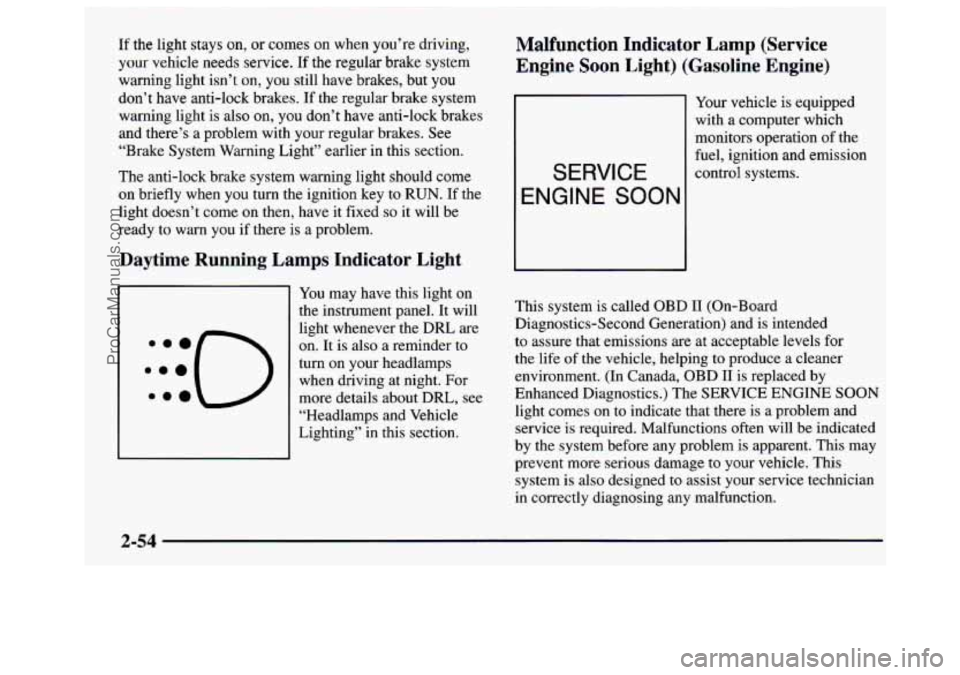
If the light stays on, or comes on when you’re driving,
your vehicle needs service. If the regular brake system
warning light isn’t on, you still have brakes, but you
don’t have anti-lock brakes. If the regular brake system
warning light is also on, you don’t have anti-lock brakes
and there’s a problem
with your regular brakes. See
“Brake System Warning Light” earlier in this section.
The anti-lock brake system warning light should come
on briefly when you turn the ignition key to RUN.
If the
light doesn’t come on then, have it fixed
so it will be
ready to warn you
if there is a problem.
Daytime Running Lamps Indicator Light
You may have this light on
the instrument panel. It will
light whenever the DRL are
on, It is also a reminder to
turn on your headlamps
when driving at night. For
more details about DRL, see
“Headlamps and Vehicle
Lighting” in this section.
Malfunction Indicator Lamp (Service
Engine Soon Light) (Gasoline Engine)
Your vehicle is equipped
with a computer which
monitors operation of the
fuel, ignition and emission
SERVICE control systems.
ENGINE SOON
This system is called OBD I1 (On-Board
Diagnostics-Second Generation) and is intended
to assure that emissions are at acceptable levels for
the life
of the vehicle, helping to produce a cleaner
environment. (In Canada, OBD
I1 is replaced by
Enhanced Diagnostics.) The SERVICE ENGINE
SOON
light comes on to indicate that there is a problem and
service is required. Malfunctions often
will be indicated
by the system before any problem is apparent. This may
prevent more serious damage to your vehicle. This
system is also designed to assist your service technician
in correctly diagnosing any malfunction.
2-54
ProCarManuals.com