parking brake GMC SAVANA 1997 Owners Manual
[x] Cancel search | Manufacturer: GMC, Model Year: 1997, Model line: SAVANA, Model: GMC SAVANA 1997Pages: 388, PDF Size: 20.17 MB
Page 63 of 388
Section 2 Features and Controls
Here you can learn about the many standard and optional features on your vehicle, and information on starting,
shifting and braking. Also explained are the instrument panel and the warning systems that tell you if everything is
working properly
-- and what to do if you have a problem.
2-2
2-4
2-6
2-9
2-15
2-16
2-16
2-17
2- 19
2-20
2-23
2-23
2-24 2-27
2-27
2-28
2-28 Keys
Door Locks
Keyless Entry System
Your Doors and
How They Work
Theft
New Vehicle “Break-In”
Ignition Switch Starting Your Gasoline Engine
Engine Coolant Heater (Option) Automatic Transmission Operation
Locking Rear Axle
Parking Brake
Shifting Into PARK (P)
Shifting Out of PARK (P)
Parking Over Things That Burn
Engine Exhaust
Running Your Engine While You’re Parked 2-29
2-32
2-32
2-33
2-3 8 2-43
2-44
2-45
2-46
2-47
2-48
2-49
2-50
2-60
2-6 1 Windows
Horn
Tilt
Wheel (Option)
Turn Signalhlultifunction Lever
Exterior Lamps
Mirrors
Storage Compartments
Cigarette LightedAshtrays Sun Visors
Instrument Panel Instrument Cluster
Speedometer
Warning Lights, Gages and Indicators
Electronic Road-Speed Governor
(Gasoline Engines) (Option)
Center High-Mounted Stoplamp
2-1
ProCarManuals.com
Page 64 of 388
1 Keys
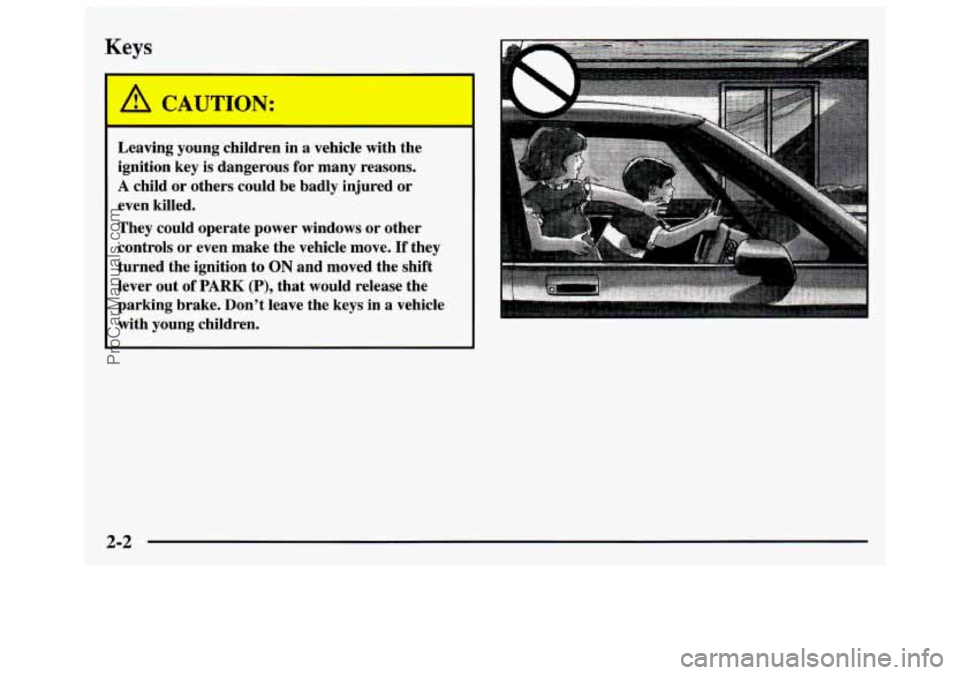
A CAUTION:
Leaving young children in a vehicle with the
ignition key is dangerous for many reasons.
A child or others could be badly injured or
even killed.
They could operate power windows
or other
controls or even make the vehicle move.
If they
turned the ignition to
ON and moved the shift
lever out
of PARK (P), that would release the
parking brake. Don’t leave the keys in a vehicle
with young children.
2-2
ProCarManuals.com
Page 82 of 388
Automatic Transmission Operation
There are several different positions for your shift lever.
If your vehicle is equipped with an automatic
transmission, it now features an electronic shift position
indicator within the instrument cluster. This display
must be powered anytime the shift lever
is capable of
being moved out of the PARK (P) position. This means
that
if your key is in the OFF position, but not locked,
there will be a small current drain on your battery which
could discharge your battery over
a period of time. If
you have a need to leave your key in the ignition in the
OFF position for an extended period for any reason, it is
recommended that you disconnect the battery cable from
the battery to prevent discharging your battery.
PARK (P): This locks your rear wheels. It’s the best
position to
use when you start your engine because your
vehicle can’t move easily.
It is dangerous to get out of your vehicle if the
shift lever
is not fully in PARK (P) with the
parking brake firmly set. Your vehicle can roll.
Don’t leave your vehicle when the engine
is
running unless you have to. If you have left the
engine running, the vehicle can move suddenly.
You or others could be injured. To be sure your
vehicle won’t move, even when you’re on fairly
level ground, always set your parking brake and
move the shift lever to
PARK (P).
See “Shifting Into PARK (P)” in the Index. If
you’re pulling
a trailer, see “Towing a Trailer” in
the Index.
2-20
ProCarManuals.com
Page 85 of 388
Locking Rear Axle
If you have this feature, your locking rear axle can
give you additional traction on snow, mud,
ice, sand or
gravel.
It works like a standard axle most of the time,
but when one
of the rear wheels has no traction and the
other does, the locking feature will allow the wheel with
traction
to move the vehicle.
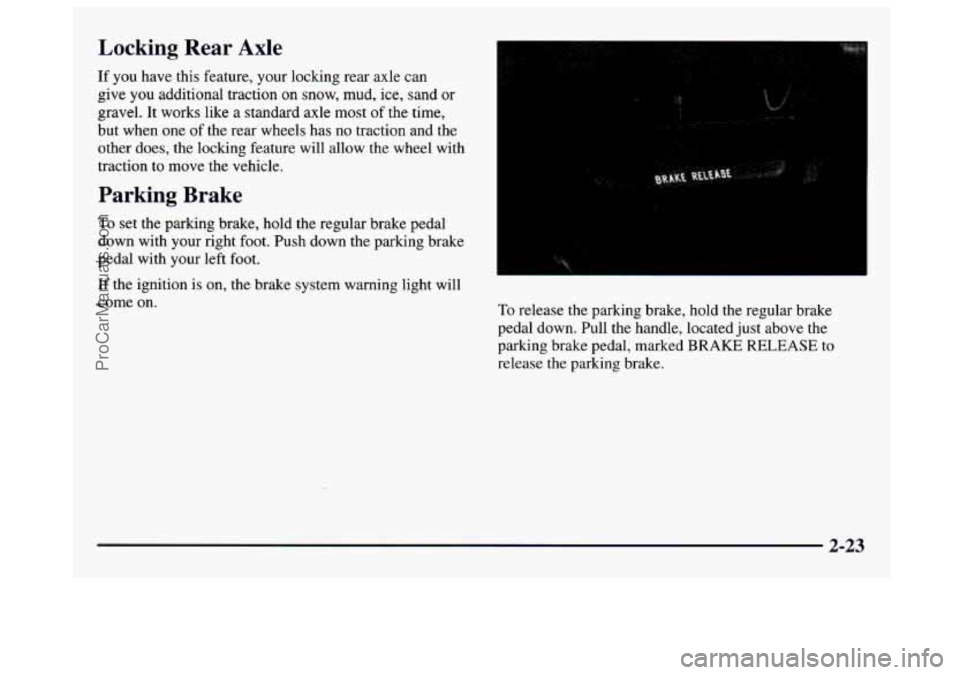
Parking Brake
To set the parking brake, hold the regular brake pedal
down with your right foot. Push down the parking brake
pedal with your left foot.
If the ignition is on, the brake system warning light will
come
on. To release the parking brake, hold the regular brake
pedal down. Pull the handle, located just above the
parking brake pedal, marked
BRAKE RELEASE to
release the parking brake.
2-23
ProCarManuals.com
Page 86 of 388
I
t
:f the ignition is on when the parking brake is released,
he
brake system warning light will go off.
NOTICE:
Driving with the parking brake on can
cause your rear brakes to overheat. You may
have to replace them, and you could also damage
other parts of your vehicle. Always check to be
sure your parking brake
is fully released before
you drive.
If you are towing a trailer and are parking on any hill,
see “Towing a Trailer” in the Index. That section shows
what to do first to keep the trailer from moving.
Shifting Into PARK (P)
It can be dangerous to get out of your vehicle if
the shift lever
is not fully in PARK (P) with the
parking brake firmly set. Your vehicle can roll.
If you have left the engine running, the vehicle
can move suddenly. You or others could be
injured.
To be sure your vehicle won’t move, even
when you’re on fairly level ground, use the steps
that follow.
If you’re pulling a trailer, see
“Towing a Trailer” in the Index.
1. Hold the brake pedal down with your right foot and
set the parking brake.
2-24
ProCarManuals.com
Page 88 of 388
Leaving Your Vehicle With the
Engine Running
It can be dangerous to leave your vehicle with
the engine running, Your vehicle could move
suddenly if the shift lever is not fully in
PARK (P)
with the parking brake firmly set. And, if you
leave the vehicle with the engine running, it could
overheat and even catch
fire. You or others could
be injured. Don’t leave your vehicle with the
engine running unless you have to.
Torque Lock
If you are parking on a hill and you don’t shift your
transmission into PARK (P) properly, the weight
of the
vehicle may put too much force on the parking pawl in
the transmission. You may find it difficult to pull the
shift lever out of PARK (P). This is called “torque lock.”
To prevent torque lock, set the parking brake and then
shift into PARK
(P) properly before you leave the
driver’s seat.
To find out how, see “Shifting Into
PARK (P)” in the Index.
When you are ready to drive, move the shift lever out of
PARK (P) before you release the parking brake.
If torque lock does occur, you may need to have another
vehicle push yours a little uphill to take some
of the
pressure from the parking pawl in the transmission,
so you can pull the shift lever out of PARK (P).
2-26
ProCarManuals.com
Page 89 of 388
Shifting Out of PARK (P)
Your vehicle has a brake-transmission shift interlock
system. You have to fully apply your regular brakes
before you can shift from PARK (P) when the ignition
is in RUN. See “Automatic Transmission” in the Index.
If you cannot shift out of PARK (P), ease pressure on
the shift lever and push the shift lever all the way up
into PARK
(P) as you maintain brake application.
Then, move the shift lever into the gear you want.
If you ever hold the brake pedal down but still can’t
shift out of
PARK (P), try this:
1. Turn the key to OFF.
2. Apply and hold the brake until the end of Step 4.
3. Shift to NEUTRAL (N).
4. Start the vehicle and then shift to the drive gear
you want.
5. Have the brake-transmission shift interlock system
fixed as soon
as you can.
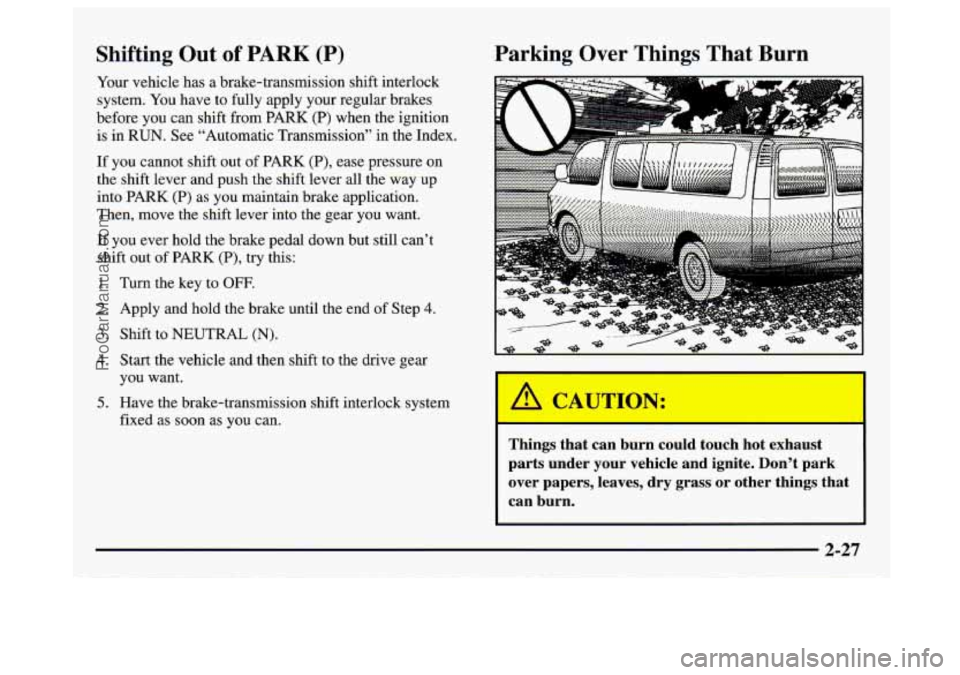
Parking Over Things That Burn
T1
I
Things that can burn could touch hot exhaust
parts under your vehicle and ignite. Don’t park
over papers, leaves, dry grass or other things that
can burn.
ProCarManuals.com
Page 91 of 388
Windows
It can be dangerous to get out of your vehicle if
the shift lever is not fully in PARK (P) with the
parking brake firmly set. Your vehicle can roll.
Don’t leave your vehicle when the engine is
running unless you have to.
If you’ve left the
engine running, the vehicle can move suddenly.
You or others could be injured.
To be sure your
vehicle won’t move, even when you’re
on fairly
level ground, always set your parking brake and
move the shift lever to PARK
(P).
Manual Windows
To operate your manual windows, turn the hand crank
on each door to raise or lower your side door windows.
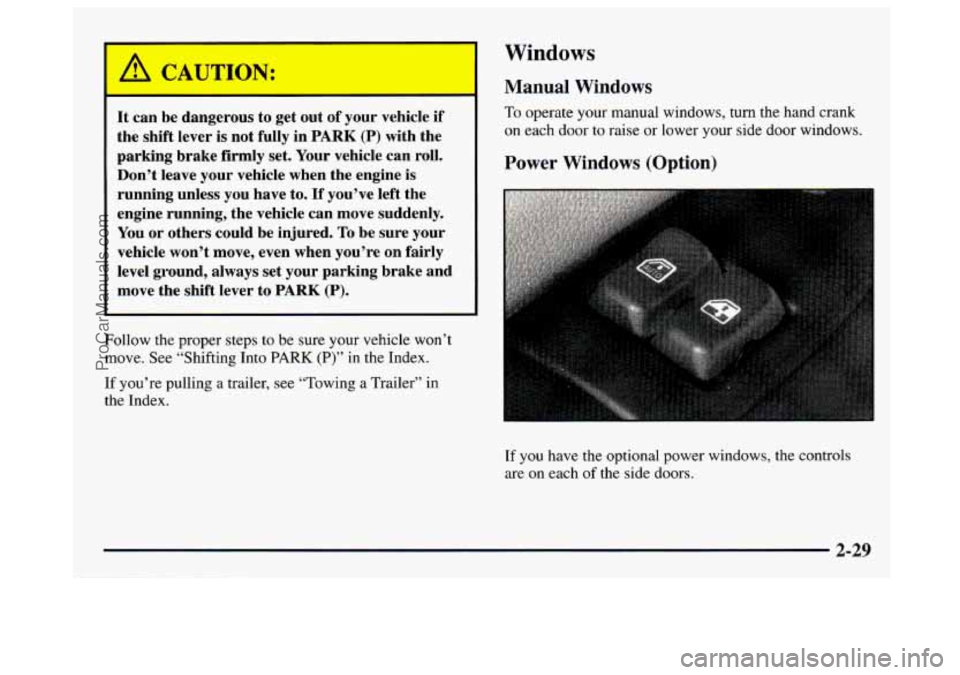
Power Windows (Option)
Follow the proper steps to be sure your vehicle won’t
move. See “Shifting
Into PARK (P)” in the Index.
If you’re pulling a trailer, see “Towing a Trailer”
in
the Index.
If you have the optional power windows, the controls
are on each of the side doors.
ProCarManuals.com
Page 100 of 388
Using Cruise Control on Hills
How well your cruise control will work on hills depends
upon your speed, load and the steepness
of the hills.
When going up steep hills, you may have
to step on
the accelerator pedal to maintain your speed. If the
steepness of the hill causes the vehicle speed to drop
more than
15 mph (9.4 km/h) below the set speed, your
cruise control will automatically disengage. When going
downhill,
you may have to brake or shift to a lower gear
to keep your speed down.
Of course, applying the brake
takes
you out of cruise control. Many drivers find this to
be too much trouble and don’t use cruise control on
steep hills.
Ending Cruise Control
There are two ways to turn off the cruise control:
Step lightly on the brake pedal; or
Move the cruise switch to OFF.
Erasing Speed Memory
When you turn off the cruise control or the ignition,
your cruise control set speed memory is erased.
Exterior Lamps
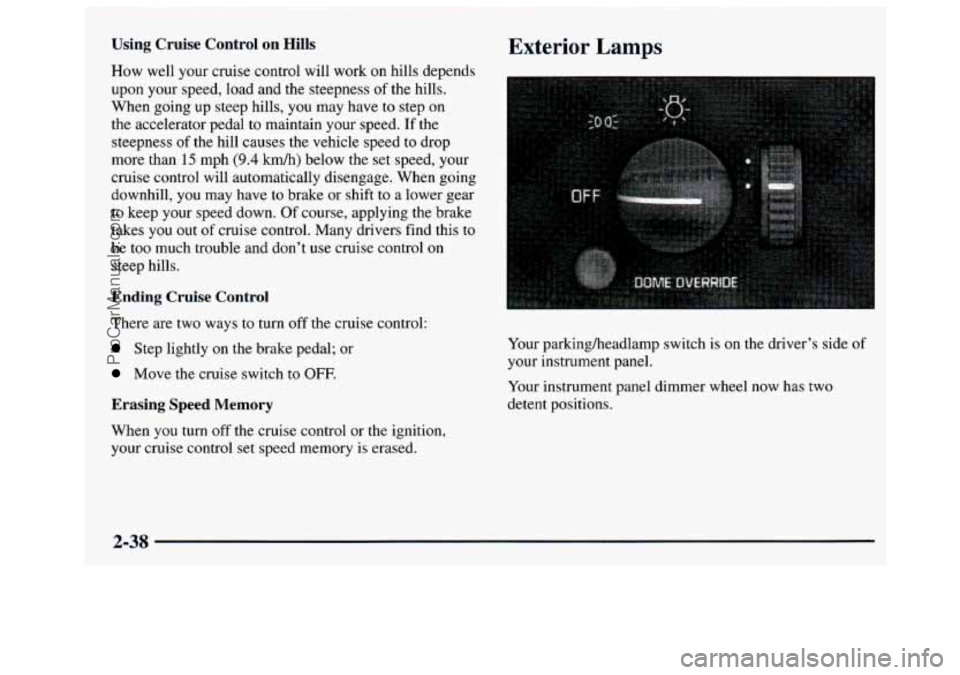
Your parkingheadlamp switch is on the driver’s side of
your instrument panel.
Your instrument panel dimmer wheel now has two
detent positions.
2-38
ProCarManuals.com
Page 102 of 388
Headlamps On Reminder
A tone will sound when your headlamps are turned on
and your ignition is in OFF, LOCK or ACCESSORY.
If you need to use your headlamps when the ignition
switch is in
OFF, LOCK or ACCESSORY, the tone
can be turned off by turning the thumb wheel
next to
the parking lamp/headlamp switch all the way down.
Daytime Running Lamps (If Equipped)
Daytime Running Lamps (DRL) can make it easier for
others
to see the front of your vehicle during the day.
DRL can be helpful in many different driving conditions,
but they can be especially helpful in
the short periods
after dawn and before sunset.
The DRL system will make your headlamps come on at
a reduced brightness when:
0 The ignition is on,
0 The headlamp switch is off, and
0 The parking brake is released.
If your vehicle was first sold, when new,
in Canada,
your headlamps will come on at reduced brightness.
If your vehicle was first sold, when new,
in the United
States, your vehicle may be equipped with DRL. If your
vehicle has DRL,
you will see the the DRL indicator light
on your instrument panel and your low-beam
headlamps will
come on at reduced brightness.
When the DRL are on,
only your headlamps will be on.
The taillamps, sidemarker and other lamps won’t be on.
Your instrument panel won’t be lit up either.
When
it begins to get dark, your DRL indicator light is a
reminder
to turn your headlamp switch on. The other lamps
that come on with your headlamps will also come on.
When you turn off the headlamp switch, the regular
lamps will go off, and your headlamps will change to
the reduced brightness
of DRL.
To idle your vehicle with the engine on and the DRL off,
set the parking brake. The DRL will stay off until you
release the parking brake.
As with any vehicle, you should turn on the regular
headlamp system when you need
it.
Dome Lamps
The dome lamps will come on when you open the doors.
You can also turn the dome lamps on by rotating the
thumb wheel, located next
to the headlamp knob, all
the way up to the second notch. In this position, the
dome lamps will remain on whether the doors are
opened or closed.
2-40
ProCarManuals.com